Prevalence,
Abuse & Exploitation of Street Children In the first decade of the 21st Century gvnet.com/streetchildren/Iran.htm
|
|||||||||||
|
CAUTION: The following links
and accompanying text have been culled from the web to illuminate the
situation in Iran. Some of these links
may lead to websites that present allegations that are unsubstantiated or
even false. No attempt has been made to validate their authenticity or
to verify their content. HOW TO USE THIS WEBPAGE Students If you are looking for
material to use in a term-paper, you are advised to scan the postings on this
page and others to see which aspect(s) of street life are of particular
interest to you. You might be
interested in exploring how children got there, how they survive, and how
some manage to leave the street.
Perhaps your paper could focus on how some street children abuse the
public and how they are abused by the public … and how they abuse each
other. Would you like to write about
market children? homeless children? Sexual and labor exploitation? begging? violence? addiction? hunger? neglect? etc. There is a lot to the subject of Street
Children. Scan other countries as well
as this one. Draw comparisons between
activity in adjacent countries and/or regions. Meanwhile, check out some of the Term-Paper resources
that are available on-line. Teachers Check out some of
the Resources
for Teachers attached to this website. ***
FEATURED ARTICLE *** Street children in
Iran Morteza Aminmansour,
Persian Journal, Oct 25, 2004 At one time this
article had been archived and may possibly still be accessible [here] [accessed 31 May
2011] Most of them make
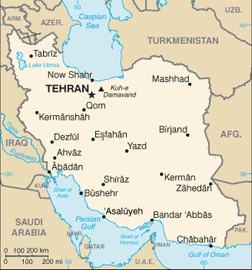
it only to big cities (Mashad, Tehran, Isfahan, Tabriz) to end up in situations as poor as those
that they left. Typically, this type
of migrant is a boy, 10 to 18 years old with many siblings and a mother who
earns a living by washing clothes or sending her children out to sell small
goods or other products. Often abused
by family members, increasing numbers of these children look elsewhere for
support. With no papers or any other
kind of documents and little money, they are easily transformed into street
children. ***
ARCHIVES *** Human Rights Reports
» 2005 Country Reports on Human Rights Practices U.S. Dept of State Bureau of Democracy, Human Rights, and
Labor, March 8, 2006 2009-2017.state.gov/j/drl/rls/hrrpt/2005/61688.htm [accessed 9 February
2020] CHILDREN
-
There are reportedly significant numbers of children, particularly Afghan but
also Iranian, working as street vendors in Tehran and other cities and not
attending school. In January government representatives told the UN Committee
on the Rights of the Child that there were less than 60 thousand street
children in the country. Tehran has reportedly opened several shelters for
street children. The government's January report on the rights of the child
claimed seven thousand street children had been resettled to date. Concluding
Observations of the Committee on the Rights of the Child (CRC) UN Convention on the
Rights of the Child, 28 January 2005 sim.law.uu.nl/SIM/CaseLaw/uncom.nsf/0/e7b8824bdd987268c1256fa8004a8753?OpenDocument [accessed 13
February 2011] [59] Although the
Committee notes the high level of literacy in Iran and the measures taken by
the State party to increase school enrolment and lower dropout rates, it
remains concerned that not all children are enrolled in or graduate from
primary school. Working children, children living on the streets and children
without complete personal documents, particularly refugee children with
bi-national parents, have reduced access to schools. It is also concerned
that refugee children are currently only being enrolled in schools if their
parents have registered with the authorities, and that the enrolment of
refugee children is not currently being offered free of charge. It is further
concerned about well-documented information that a large number of Baha'i
students were not admitted to university on the grounds of their religious
affiliation [64] The Committee
continues to be concerned about the large number of children living and/or
working in the streets, particularly in urban centers such as Tehran,
Isfahan, Mashhad, and Shiraz. It regrets that the State party could not
present studies on the extent and nature of the problem and is concerned that
the centers known as "Khaneh Sabz", "Khaneh Shoush" and "Khaneh Reyhane" homes, which were established to assist
these children, albeit in a limited capacity, have been closed down. It is
equally concerned at reports of the round-up and arrest of Afghan children in
the streets despite the fact that they were registered with the authorities,
and that as a "condition" for their release the authorities request
that their parents register for repatriation. Inside Iran: The
industry of child trafficking Al Arabiya News, 15
June 2015 [accessed 17 June
2015] Al Arabiya’s report
also sheds light on how street children lack the most fundamental children’s
rights. It is estimated
that the number of Iranian children living on streets is about 200,000. Reports
say half of them are thought to be Afghan child refugees. The parents of
street children in Iran are unknown, thus they are left without identity
cards or birth certificates. They also live in abandoned houses and public
parks. Grim life of
outcast children The Sydney Morning
Herald, November 17, 2008 www.smh.com.au/news/world/grim-life-of-outcast-children/2008/11/16/1226770257430.html [accessed 31 May
2011] When Mehr's sister, Sania, now 16,
asked why Iranian children wore identical clothes and carried a bag, she was
told that they were on their way to school. "Why can't I join
them?" she asked her mother. "My mum said to me, 'Because we are
Afghani and the Iranian Government doesn't allow Afghanis to learn, to go to
a school.' " The sense of
rejection the Mehr family experienced during their
years as refugees in Iran lingers. For these Afghan children, their only
memory of their homeland was of being caught in conflict. When they arrived
in Tehran they were deemed outcasts and deprived of financial, educational or
social support. Forced to work illegally, some of the children and
their father took to the polluted roads of the city, selling cigarettes and lollies. Many Iranians were resentful of refugees at a
time of high unemployment. Iran has 1 million registered refugees and the
United Nations refugee agency UNHCR estimates there are at least another
million unofficially living there. When Mehr's family arrived, unemployment was running at 12 per
cent, and more than 20 per cent for those aged 15 to 29, who make up 36 per
cent of the population. Even the UNHCR ended its education support to
refugees in 2004, preferring instead to focus its resources on voluntary
repatriation to Afghanistan. Mehr tells how people
on the streets would swear at her and her parents when they heard her
conversing with them in Dari, their Afghan dialect. "The Iranian
Government does not respect us, so the people look at the Government and
follow," she says. Iran street
children rights, human rights Morteza Aminmansour,
Oct 30, 2007 www.iranian.ws/cgi-bin/iran_news/exec/view.cgi/34/23028 streetchildrennews.wordpress.com/2007/10/30/iran-street-children-rights-human-rights/ [accessed 18 January
2017] Most of these
street children who were rounded up from the streets of Tehran by the
authorities, according to the head of Social Service in the Iranian capital?s town hall. The
majority of these children had run away from their homes to escape social
pressures (because the parents lost jobs, addicted to drugs or involved in
illegal activities). Lot of these
children make it only to big cities (Mashad,
Tehran, Isfahan, Tabriz) to end up in situations as
poor as those that they left their homes. Typically, this type of children
are in the age of 10 to 18 years old with many siblings and a mother who
earns a living by washing clothes, cleaning homes for very low paid jobs
(because they do not have any skills) sending heir
children out to sell small goods or other products. Often abused within the
family crises by family members or outside by strangers, increasing numbers
of these children look elsewhere for support without any chances. With no
papers or any other kind of documents and little money, they are easily
transformed into street children and criminal activities. Laws Are Not
Enough: An Interview with Mehrangiz Kar on Children's Rights Sasan Ghahreman,
Payvand News, Gozaar,
October 5, 2007 www.payvand.com/news/07/oct/1042.html [accessed 31 May
2011] In the current
academic year of 2007-2008, about three million children, according to
official sources, and five million children, according to unofficial sources,
have been prevented from attending primary and middle schools across the
country. Instead of finding a solution to this predicament and removing
obstacles, the Iranian officials have threatened parents, mandating that if
they refuse to send their children to primary and middle school, they would
be fined up to 1,200 dollars. These threats have no effect. Low-income
segments of society prefer to generate illegal income by forcing their
children to beg on streets rather than send them to school. A generation of
street kids hustling in Iran Kim Murphy, The Los
Angeles Times, Tehran, April 22, 2007 At one time this
article had been archived and may possibly still be accessible [here] [accessed 31 May 2011] Atefeh is one of the
younger members of Iran's merchant class. Her sales territory is the
notorious traffic jams of north Tehran. She moves in on potential clients
when the light turns red, pressing her face to car windows, cocking her head
to one side and putting on a plaintive face. At 12, she isn't as
good at plaintive as some of her younger competitors, two boys who are
hawking Koranic inscriptions and balloons just up the street. Sometimes her
face looks more furious than sad. But she still can clear 55 cents a day
selling her packages of pink-and-red strawberry chewing gum to bored and
surly drivers. A decade ago,
street children were rare in Iran, with its long traditions of charity for
the poor, government aid programs and strong family connections. No more. About 55% of the
city's street children are offspring of the estimated 1.5 million refugees
who have flooded into Iran from Afghanistan in waves over the last 20 years,
school officials say, and many of the rest are children of single parents, mixed-nationality
families or Gypsies. Many come from the growing number of families beset by
drug addiction as heroin shipments across the Afghan border have multiplied
since the fall of the Taliban in 2001. Most runaway girls
in www.wfafi.org/E-ZanVol14.htm [accessed 2
September 2014] [scroll down to Iran
Focus – July 12, 2005] In April, a number
of government officials and security officers were arrested during raids on at
least five houses used as brothels in and around the town of Neka, northern Iran.
Many runaway girls, some as young as 13, were being forced into
prostitution by organized child prostitution rings. A number of officers from
Needy
Youngsters Live On City Streets Azam Gorgin/Charles
Recknagel, Radio Free Europe/Radio Liberty RFE/RL,
Prague, 7 December 2000 www.womenfreedomforum.org/trafficking/needyoungsters.htm [accessed 31 May
2011] Iran's daily "Dowran Emrooz" reports
that Tehran has 25,000 to 30,000 children forced by adults to live and beg on
the street or to work as slave laborers in sweat shops. The paper said the death rate among street
children is high, from 100 to 150 a month. The cause of their deaths varies
from malnutrition to diseases brought on by unsanitary conditions. The adults who exploit the children often
train them for criminal activities, including selling illegal drugs and
alcohol. Record
Number Of Street Children In Iran Capital Iran Focus, Tehran,
Jun. 28, 2005 www.iranfocus.com/en/?option=com_content&task=view&id=2666 [accessed 31 May
2011] [accessed 17
December 2016] Some 1,949 street
children were rounded up from the streets of Tehran during the spring period,
according to the head of Social Service in the Iranian capital’s town
hall. The majority of these children
had run away from their homes to escape social pressures. Uprooting Child
Labor Panorama, Iran
Daily, Feb 08, 2005 At one time this
article had been archived and may possibly still be accessible [here] [accessed 31 May
2011] More than 8,200
vagabond kids were collected in Tehran alone during the first half of current
year (started March 20). It is estimated that the number of street children
handed over to the State Welfare Organization would hit 40,000 by the
yearend. Street Children,
Women Trafficking in Iran (part 2) Morteza Aminmansour,
Persian Journal, Dec 21, 2004 At one time this
article had been archived and may possibly still be accessible [here] [accessed 31 May
2011] Twenty–five
thousand child squatters, most of the girls, live on the streets of Tehran,
where growing drug use and prostitution are leading to a social crisis.
Iranian MP Amani warned of the consequence of social inequalities on the
young, calling "the unfair distribution of wealth" the main culprit
of Iran's social ills. IRAN:
Focus On Child Labor UN Integrated
Regional Information Networks IRIN, Tehran, 31 May 2004 http://www.irinnews.org/report/40428/iran-iran-focus-on-child-labour [accessed 10 March
2015] Every day, seven
days a week, Hamid stands in the middle of four lanes of unrelenting, heaving
Tehran traffic, waiting for the lights to go red. He then weaves his way
through the fumes and noise, tapping on the sides of cars. If he is lucky, a
driver will lean out of his window and pluck from his hand a small sheet of
paper - a poem written by the great Persian poet Hafez - in return for the
equivalent of 15 US cents. Appeal
- Help street children in Iran Susan Bahar, The Association for the Abolition of Child Labour in Iran, 20 November 2002 www.darvag.com/jamiat/kampain/appeal1.htm [accessed 31 May
2011] In the span of six
years the number of street children in Iran has soared from 20 000 to over
one million. This fifty-fold increase in the number of children who are
bereft of any kind of family protection and are treated as stray dogs by the
authorities is as striking as it is unbelievable. Without any protection and
pushed to their limits of endurance, these unprotected, hungry and
traumatized children have been victims to all sorts of social evils. Mashhad
Housing Second Largest Number Of Street Children In Iran Islamic Republic
News Agency IRNA, Mashhad, Khorassan Prov., July
23, 2001 www.payvand.com/news/01/jul/1124.html [accessed 31 May
2011] Mashhad is home to
the second largest group of street children after the capital Tehran. There are roughly 647 street children in
Mashhad, 320 of whom identified by the authorities. Those identified are being taken care of by
a center for street children. Iran: Street
Children Receive Limited Help (Part 2) Azam Gorgin/Charles
Recknagel, Radio Free Europe/Radio Liberty RFE/RL,
Prague, 7 December 2000 At one time this
article had been archived and may possibly still be accessible [here] [accessed 31 May
2011] Recent reports in
the Iranian press that 100 to 150 of the country's street children die each
month have shed new light on the plight of small children who are forced to
work on the streets. In the second of a two-part series on Iran's street
children, RFE/RL correspondent Azam Gorgin tells how one charitable group tries to aid the
children. All
material used herein reproduced under the fair use exception of 17 USC § 107
for noncommercial, nonprofit, and educational use. PLEASE RESPECT COPYRIGHTS OF COMPONENT
ARTICLES. Cite this webpage as: Patt,
Prof. Martin, "Street Children - Iran", http://gvnet.com/streetchildren/Iran.htm,
[accessed <date>] |