Prevalence,
Abuse & Exploitation of Street Children In the first
decade of the 21st Century gvnet.com/streetchildren/Gabon.htm
|
|||||||||||
|
CAUTION: The following links
and accompanying text have been culled from the web to illuminate the
situation in HOW TO USE THIS WEBPAGE Students If you are looking for
material to use in a term-paper, you are advised to scan the postings on this
page and others to see which aspect(s) of street life are of particular
interest to you. You might be
interested in exploring how children got there, how they survive, and how
some manage to leave the street.
Perhaps your paper could focus on how some street children abuse the
public and how they are abused by the public … and how they abuse each
other. Would you like to write about
market children? homeless children? Sexual and labor exploitation? begging? violence? addiction? hunger? neglect? etc. There is a lot to the subject of Street
Children. Scan other countries as well
as this one. Draw comparisons between
activity in adjacent countries and/or regions. Meanwhile, check out some of the Term-Paper resources
that are available on-line. Teachers Check out some of
the Resources
for Teachers attached to this website. ***
FEATURED ARTICLE *** Information about
Street Children - Gabon [DOC] www.streetchildren.org.uk/reports/Information%20about%20Street%20Children%20in%20Gabon.doc [Last access date
unavailable] www.streetchildrenresources.org/wp-content/uploads/2013/01/a-civil-society-forum-for-francophone-africa.pdf [accessed 29 November
2016] DEFINITIONS AND
STATISTICS
- In Gabon, we define street children quite simply as those who have chosen
to leave their family / household and make their own way in the street.
However, the distinction between children of the street and children on the
street is still used by many organisations. Most of
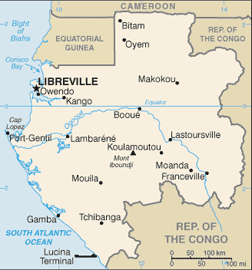
the street children are concentrated in Libreville and are boys between the
ages of 6 and 17 who have abandoned both family life and their schooling.
Numbers are small however – only 150 street children were recorded by Caritas
during 2002-03. TESTIMONY FROM A
STREET CHILD IN GABON
- I have been on the streets since 1997. My father was cruel to me – he would
hit me and never let me leave the house, and this lack of freedom is why I
left home… The older children in the street often bully the younger ones and
steal our money. The police also harass and beat us, particularly when
someone has reported a theft or when they catch us smoking marijuana. They
often put us in prison cells where we are kept for 2 days and sometimes
longer. Many children contract diseases such as scabies and sometimes malaria
inside the dirty cells, but when we are released, we face further verbal
abuse from the public. ***
ARCHIVES *** The Department of Labor’s 2004 Findings on
the Worst Forms of Child Labor www.dol.gov/ilab/media/reports/iclp/tda2004/gabon.htm [accessed 6 February
2011] INCIDENCE
AND NATURE OF CHILD LABOR - According to the government, over 40 percent of
students drop out before they complete the last year of primary school. CHILD
LABOR LAWS AND ENFORCEMENT - Minimum age laws were strictly enforced in urban
areas among citizen children, but rarely enforced in rural areas. While the Labor Code is intended to cover
all children, in practice it is enforced only in situations involving
Gabonese children, and not those who are foreign-born, many of whom work in
domestic service or in marketplaces. Human Rights
Reports » 2005 Country Reports on Human Rights Practices 2009-2017.state.gov/j/drl/rls/hrrpt/2005/61570.htm [accessed 9 February
2020] CHILDREN
- The
government publicly expressed its commitment to youth, provided 4 thousand
academic scholarships during the year, and used oil revenues to build
schools, pay teacher salaries, and promote education, even in rural areas.
Nonetheless, the upkeep of schools and payment of teachers continued to
decline. Education is compulsory until age 16 and generally was available
through sixth grade. Approximately 78 percent of primary school-age children
attended school, and less than half of secondary school‑age children
attended school. Secondary school attendance rates for immigrant children
were lower, although public schools accepted immigrant children, and the
government encouraged them to attend. Students were required to pay for
books, uniforms, and other school supplies, which precluded numerous children
from attending school. SECTION
6 WORKER RIGHTS
– [d] An unknown number of children‑‑primarily foreign‑‑worked
in marketplaces or performed domestic duties; many of these children were
reportedly the victims of child trafficking. Such children generally did not
attend school, received only limited medical attention, and often were
exploited by employers or foster families. Laws forbidding child labor
theoretically extended protection to these children, but abuses often were
not reported. A 2001 ILO study estimated that the number of economically active
children between the ages of 10 and 14 years was 19 thousand to 20 thousand,
but the actual number was probably considerably higher since most children
worked in the informal sector. Concluding
Observations of the Committee on the Rights of the Child (CRC) UN Convention on the
Rights of the Child, 1 February 2002 www1.umn.edu/humanrts/crc/gabon2002.html [accessed 6 February
2011] [62] The Committee expresses
its concerns at the increasing number of street children and at the lack of
specific mechanisms and measures to address this situation and to provide
those children with adequate assistance. War is Boring: David Axe, World
Politics Review, [partially accessed
6 February 2011 - access restricted] It's a crisis that
intersects with another. Across Africa, but especially in the central part of
the continent, boys are sold, coerced or kidnapped into military service in
both government and rebel armies. Many of these child soldiers also flee
their captors, especially during combat, and end up homeless on the streets
of major cities, where aid groups struggle to find and care for them. Children represent a major commodity in a
dark economy of violence and exploitation that is perhaps most prominent in
West and Central Africa. Escudero described Gabon as an importer of child slaves,
"either for cheap manual labor or to work in people's homes or
factories. Often these kids win up on streets, if they've been abused at home
or mistreated where they're working." Gabonese students
found NGO to cater for street children Xinhua News Agency,
May 22, 2007 english.people.com.cn/200705/22/eng20070522_376627.html [accessed 16 May
2011] en.people.cn/200705/22/eng20070522_376627.html [accessed 29
November 2016] Gabonese primary and
secondary school students have launched a non-governmental organization, the
Movement of the Young People for Social Welfare (MJBES) to primarily cater
for street children, their education but more so their reintegration into the
society, the local press reported Sunday. In Gabon, the
number of street children has reached worrying proportions. Very early in the
morning, one can meet street children milling around the large markets where
they generally spend the night. During the day, they beg in front of
department stores and at bus stops. Reports to Treaty
Bodies - Committee on the Rights of the Child UN Committee on the
Rights of the Child, January/February 2002 session At one time this
article had been archived and may possibly still be accessible [here] [accessed 16 May
2011] The Committee
recommended that the government ensure that street children are provided with
adequate nutrition, clothing, housing, health care and educational
opportunities in support of their full development; ensure that these
children are provided with recovery and reintegration services when victims
of physical, sexual and substance abuse; ensure their protection against
police brutality; provide services for reconciliation with their families and
community; establish a comprehensive strategy to address the high and
increasing number of street children with the aim of preventing and reducing
this phenomenon. Youth
Is More Afraid Of Unemployment Than AIDS UN Integrated
Regional Information Networks IRIN PlusNews www.irinnews.org/report/48625/gabon-youth-is-more-afraid-of-unemployment-than-aids [accessed 10 March
2015] A survey of 15 to
26 year-olds showed that unemployment was their main concern in life, with
catching AIDS in second place and poverty in third. Meanwhile the state is faced with the
challenge of looking after an estimated 9,000 orphans of people who have died
from AIDS. Government policy is to
encourage extended families to take these children under their wing. The Protection
Project - The www.protectionproject.org/human_rights_reports/report_documents/gabon.doc [accessed 2009] FORMS OF TRAFFICKING - Children are
trafficked primarily for domestic labor, as well
as for work as street and market vendors. The majority of children
trafficked from All
material used herein reproduced under the fair use exception of 17 USC § 107
for noncommercial, nonprofit, and educational use. PLEASE RESPECT COPYRIGHTS OF COMPONENT
ARTICLES. Cite this webpage as: Patt,
Prof. Martin, "Street Children - |