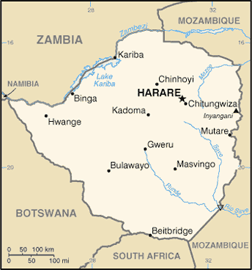
Human Trafficking & Modern-day Slavery Poverty drives the unsuspecting poor into the
hands of traffickers Published reports & articles
from 2000 to 2025 gvnet.com/humantrafficking/Zimbabwe.htm
Zimbabwe is a
source, transit, and destination country for men, women, and children
trafficked for the purposes of forced labor and sexual exploitation. Large
scale migration of Zimbabweans to surrounding countries has increased – as
they flee a progressively more desperate situation at home – and NGOs,
international organizations, and governments in neighboring countries report
that some of these Zimbabweans face human trafficking. Rural Zimbabwean men,
women, and children are trafficked within the country to farms for
agricultural labor and to cities for forced domestic labor and commercial
sexual exploitation. NGOs believe internal trafficking increased during the
year, largely due to the closure of schools, worsening political violence,
and a faltering economy. - U.S.
State Dept Trafficking in Persons Report, June,
2009 Check out a later country report here and possibly a full TIP Report here |
|
|||||||||||
|
CAUTION: The following
links have been culled from the web to illuminate the situation in HOW TO USE THIS WEB-PAGE Students If you are looking
for material to use in a term-paper, you are advised to scan the postings on
this page and others to see which aspects of Human Trafficking are of
particular interest to you. Would you
like to write about Forced-Labor? Debt
Bondage? Prostitution? Forced Begging? Child Soldiers? Sale of Organs? etc. On the other
hand, you might choose to include precursors of trafficking such as poverty and hunger. There is a lot to
the subject of Trafficking. Scan other
countries as well. Draw comparisons
between activity in adjacent countries and/or regions. Meanwhile, check out some of the Term-Paper resources
that are available on-line. Teachers Check out some of
the Resources
for Teachers attached to this website. HELP for Victims International Organization for
Migration ***
FEATURED ARTICLE *** Reports of Rape and
Torture Inside Zimbabwean Militia [Category – Rape] Michael Wines, The New
York Times, Bulawayo, Zimbabwe, December 28, 2003 www.nytimes.com/2003/12/28/world/reports-of-rape-and-torture-inside-zimbabwean-militia.html [accessed 17 January
2011] For Ms. Siyangapi's secret was not merely her own. Her appearance
was also testimony to one of the least documented — and most brutal —
practices of the military enforcers of Amnesty
International documented cases of rape within the Youth Service in a report
released in April. The Amani Trust, perhaps the most active human rights
group currently in Tanya: It’s Better
to Die of AIDS Than Hunger [Category – Poverty] Stanley Karombo, New Internationalist Magazine, Issue 377, April
1, 2005 www.newint.org/features/2005/04/01/harare-zimbabwe/ [accessed 17 January
2011] ‘Soon after the
death of my father I was evicted from the house where my parents lodged in Mbare. I went to stay with my grandmother who lives
in Mabvuku. There were 10 of us children
staying there and we had all been left by deceased relatives. Life was
difficult because, being an old woman, my grandmother had no means of
sustaining herself and all of us at the same time.’ ***
ARCHIVES *** Lied to and abused,
trafficked persons from Zimbabwe find some healing [Category – Rape]
[Category –Labor-adult] Doreen Ajiambo, Global Sisters Report, Harare, 24 August 2020 [accessed 24 August
2020] Jane's journey of
pain began in 2016, when she was enticed by a trafficking agent in Harare
with promises of a salary of $1,400 per month at a hotel in Kuwait, more than
3,000 miles away. Life had become unbearable in Zimbabwe after her husband
lost his job as a casual laborer in a local milk factory and they were
evicted from their house for nonpayment of rent. "Life was very
difficult and we barely had something to eat, and if we ate, it was one meal
per day," she said. It was at this difficult
time that she met her trafficker, who was well acquainted with her mother.
Everything was planned quickly, and within one week, all her travel documents
were ready, including her passport. She was given a new Islamic name: Amina
Ishmael. Upon reaching
Kuwait, she was picked up from the airport by a man who would be her boss. It
was at his house that Jane realized she had been lied to and trafficked. Her
host took away her travel documents and forcefully performed a medical
procedure to check her overall health. "I was raped
every day, and I was helpless to do anything about it," she said,
weeping throughout the interview with GSR but insisting she wanted to tell
her story. "I was forced to work day and night, beaten, restricted to go
anywhere, threatened of arrest and deportation and unlawful withholding of my
passport. I wasn't even paid for the five months I worked at the home." When things became
intolerable, she fled the home and took refuge in the Zimbabwe consulate. 2020 Country
Reports on Human Rights Practices: Zimbabwe U.S. Dept of State Bureau of Democracy, Human Rights, and
Labor, 30 March 2021 www.state.gov/reports/2020-country-reports-on-human-rights-practices/zimbabwe/
[accessed 29 June
2021] PROHIBITION OF
FORCED OR COMPULSORY LABOR The laws against
forced labor were neither effectively nor sufficiently enforced. Forced labor
occurred in agriculture, mining, street vending, and domestic servitude. The
full extent of the problem was unknown. PROHIBITION OF CHILD
LABOR AND MINIMUM AGE FOR EMPLOYMENT Working children
often faced hazards to their health and safety and lacked necessary equipment
and training. Working on farms exposed children to bad weather, dangerous
chemicals, and the use of heavy machinery. Most children involved in mining
worked for themselves, a family member, or someone in the community. Exposure
to hazardous materials, particularly mercury, took place in the informal
mining sector. Some employers did
not pay wages to child domestic workers, claiming they were assisting a child
from a rural home by providing room and board. Some employers paid with goods
instead of cash, while others paid the parents for a child’s work. Freedom House
Country Report 2020 Edition freedomhouse.org/country/zimbabwe/freedom-world/2020 [accessed 10 May
2020] G4. DO INDIVIDUALS
ENJOY EQUALITY OF OPPORTUNITY AND FREEDOM FROM ECONOMIC EXPLOITATION? Due to an ongoing
economic crisis, many workers are not adequately compensated, and some have
gone for months without pay. Inflation was estimated at about 300 percent as
of late 2019, when the government attempted to introduce a new currency to
ease a cash shortage, and it continued to rise through the end of the year. A
2019 assessment by the International Trade Union Confederation (ITUC) Global
Rights Index categorized Zimbabwe as one of the worst countries to work in. A
previous assessment said that just 15.5 percent of workers in 2017 had formal
contracts, leaving the majority of workers vulnerable to exploitation and
abuse. The government has
continued efforts to combat human trafficking, though it remains a serious
problem. Men, women, and children can be found engaged in forced labor in the
agricultural sector, forced begging, and forced domestic work. Women and
girls remain particularly vulnerable to sex trafficking. 2017 Findings on
the Worst Forms of Child Labor Office of Child
Labor, Forced Labor, and Human Trafficking, Bureau of International Labor
Affairs, US Dept of Labor, 2018 www.dol.gov/sites/default/files/documents/ilab/ChildLaborReport_Book.pdf [accessed 22 April
2019] www.dol.gov/sites/dolgov/files/ILAB/child_labor_reports/tda2017/ChildLaborReportBook.pdf [accessed 8 May
2020] Note:: Also check out this country’s report in the more recent edition DOL
Worst Forms of Child Labor [page 1055] Zimbabwean children
are trafficked to South Africa, Mozambique, and Zambia, where they become
victims of commercial sexual exploitation and forced labor in domestic work.
Zimbabwean children, especially orphans, are sometimes lured by relatives
with the promise of education or adoption, but instead are recruited to work
within the country as domestic workers or forced to work in mining, drug
smuggling, or other illegal activities. (5) The deterioration of Zimbabwe’s
economy also contributes to an increase in child labor. (26; 27; 28) An NGO
conducted research that revealed that girls under age 18 engaged in
commercial sex due to push factors such as the breakdown of the family unit,
poverty, and gender-based violence. (2; 29) In 2017, UNICEF reported that
Zimbabwe experienced flooding that damaged schools in Tsholotsho,
Hwange, Bubi, Masvingo,
and Gokwe North, resulting in the displacement of
hundreds of people, including children, from their homes. (30; 31) These push
factors increase children’s vulnerability to child labor, including its worst
forms. (9). Human trafficking:
A women’s issue [Category – Progress
needed] Veritas, The
Zimbabwean, Sept. 22, 2010 www.thezimbabwean.co.uk/index.php?option=com_content&view=article&id=34378:human-trafficking-a-womens-issue&catid=52&Itemid=32 [accessed 17 January
2011] archive.kubatana.net/html/archive/legisl/100920veritas.asp?sector=legisl&year=2010&range_start=61 [accessed 25 June
2017] Women comprise at
least 56 per cent of the world’s trafficking victims. The feminisation
of poverty and the feminisation of migration mean
that women from poorer and developing countries are particularly vulnerable
and the proportion of women trafficked is higher in these countries. Human
trafficking is modern day slavery. Its victims are men, women and children in
search of better prospects in life. Lured with promises of better jobs or
education, they often end up in prostitution or forced labour. Public awareness seems sparse. The media
does not seem to view it as a serious threat in Combat Human
Trafficking [Category – Sale of
Organs] The Herald, Harare,
10 April 2007 allafrica.com/stories/200704100256.html [accessed 18 June
2013] Markets for body
parts in the southern Africa region seem to be on the upsurge as reports
indicate that numbers of missing girl children and women are shooting up,
particularly in neighbouring countries. The
human parts found in the plastic bag in Bindura are suspected breasts and
private parts of a woman probably trafficked under the pretext of job
promises. Human body parts are believed to enhance profits in business
and the belief seems to be widespread in this region. Zimbabwe - A centre for Human Trafficking [Category – Progress
needed] Saul Chaminuka, The Zimbabwean, Harare, Nov 23, 2006 www.zimbabwesituation.com/nov23a_2006.html#Z7 [accessed 17 January
2011] www.thezimbabwean.co/2006/11/zimbabwe-a-centre-for-human-trafficking/ [accessed 3 March
2019] The Zimbabwean
government has rejected assertions by the International Organization for
Migration (IOM) that human trafficking is a growing phenomenon in the
southern African country, despite the existence of enormous evidence on the
ground. [Category – Progress
needed] Voice of America VOA
News, Washington DC, 28 September 2006 www.voazimbabwe.com/content/a-13-56-74-2006-09-28-voa59-68950037/1457688.html [accessed 4
September 2012] The The White House
said Hunger forces Zim girls into forced marriages [Category – Forced
Marriage] ZimOnline, Mutare, Zimbabwe, May 17 2006 www.mg.co.za/article/2006-05-17-hunger-forces-zim-girls-into-forced-marriages [accessed 17 January
2011] wunrn.com/2006/05/zimbabwe-girls-forced-marriages-hunger-rights/ [accessed 19 January
2020] Faced with
starvation after six years of poor harvests, Zimbabweans are resorting to
centuries-old traditions of "forced marriages", known in the local
Shona language as "kuzvarira", for
survival. Nip Human
Trafficking in the Bud [Category – Poverty] Hatred Zenenga, Editorial, The Herald (Harare), March 29, 2004 www.zimbabwesituation.com/mar30_2004.html#link16 [accessed 17 January
2011] Reports of organised human trafficking and smuggling gangs in But for the
majority of the victims of human trafficking, promises of wealth and better life
often turn out to be modern-day slavery.
Young men and women are lured by agents who cash in on the dreams of
the poor to make it big in developed countries or African countries with
opportunities like Section IV
Clinical and therapeutic responses [PDF] Linda Richter,
Andrew Dawes, Craig Higson-Smith, eds, "Sexual
Abuse of Young Children in Click [here]
to access the article. Its URL is not
displayed because of its length [accessed 3 March
2019] [Sect IV, Ch 19] CASE STUDIES OF CHILD SEXUAL ABUSE IN ZIMBABWE (BY
CLARE RUDD)
– INTRODUCTION
- In
this chapter, case studies concerning children who were seen at the clinics
are presented. Earning a Life:
Working Children in Zimbabwe [Category –
Exploitation of Children] Michael Bourdillon, 11/02/2003 www.crin.org/resources/infoDetail.asp?ID=1134&flag=report [accessed 17 January
2011] www.amazon.com/Earning-Life-Working-Children-Zimbabwe/dp/0797421629 [accessed 3 March
2019] The important question
we need to address is not the fact that children work, but rather the
conditions under which they work. Stopping children from working for their
livelihood is likely to do them more harm than good. We need to prevent not
the work of children, but the abuse of working children. Concluding
Observations of the Committee on the Rights of the Child (CRC) UN Convention on the
Rights of the Child, 7 June 1996 www1.umn.edu/humanrts/crc/crc-Zimbabwe96.htm [accessed 17 January
2011] [13] The Committee
notes with concern the persistence of behavioral attitudes in the society as
well as cultural and religious practices, which, as recognized by the State
party, hamper the implementation of children's rights. Mention can be made in
this regard of the difficulties in ensuring birth registration in remote
areas of abandoned and refugee children, as well as of the situation of
female victims of practices such as ngozi (girl
child pledging), lobola (bride price) and early
marriage, and of disabled children. Human Rights
Overview Human Rights Watch [accessed 17 January
2011] ***
EARLIER EDITIONS OF SOME OF THE ABOVE *** Freedom House
Country Report 2018 Edition freedomhouse.org/country/zimbabwe/freedom-world/2018 [accessed 8 May 2020] G4. DO INDIVIDUALS ENJOY
EQUALITY OF OPPORTUNITY AND FREEDOM FROM ECONOMIC EXPLOITATION? Due to the
prevailing economic crisis, many workers are not adequately compensated, and
some have gone for months without pay. A 2017 assessment by the International
Trade Union Confederation Global Rights Index found that Zimbabwe was among
the worst countries in the world to work in. The Zimbabwean
government has made significant progress in its efforts to combat human
trafficking, which women and girls are particularly vulnerable to. In
September 2017, Katswe Sisterhood, a reproductive
health and rights advocacy group, released an exposé about underage girls
engaged in commercial sex work, which prompted the Ministry of Public
Service, Labour, and Social Welfare to place 54
girls in statutory care. Human Rights
Reports » 2005 Country Reports on Human Rights Practices 2009-2017.state.gov/j/drl/rls/hrrpt/2005/61600.htm [accessed 11
February 2020] TRAFFICKING
IN PERSONS
– The traditional practice of offering a young girl in marriage as
compensatory payment in interfamily disputes continued during the year.
Arranged marriage of young girls also continued. The legal age for a civil
marriage is 16 for girls and 18 for boys. Customary marriage, recognized
under the Customary Marriages Act, does not provide for a minimum marriage
age for either boys or girls; however, the SOA prohibits sexual relations
with anyone younger than 16 years of age. Child welfare NGOs reported that
they occasionally saw evidence of underage marriages, particularly in
isolated religious communities or among HIV/AIDS orphans but lacked
meaningful statistics on its prevalence. Musasa
Project reported an increase in instances where families pledged girls in
marriage and even unborn babies in exchange for economic protection. Such
girls often "married" well before the age of 12. There was little
information on the extent of trafficking beyond anecdotal reports of girls
exchanging sex for passage across the South African border, women lured to
other countries with false job promises, immigration officials of neighboring
countries sexually abusing children during deportation, children working as
domestic or agricultural workers, and employers requiring sex from
undocumented Zimbabwean workers in South Africa under threat of deportation.
There also were anecdotal reports that victims were trafficked to border areas
and into Anecdotal
information suggested that citizens who emigrated to seek a better life were
exploited while employed illegally in a neighboring country, when being
deported, or after being lured to another country by false employment
schemes. The groups at highest risk were HIV/AIDS orphans and displaced
persons. The Department of Labor’s 2004 Findings on
the Worst Forms of Child Labor www.dol.gov/ilab/media/reports/iclp/tda2004/zimbabwe.htm [accessed 17 January
2011] Note:: Also check out this country’s report in the more recent edition DOL
Worst Forms of Child Labor INCIDENCE
AND NATURE OF CHILD LABOR - The traditional practice of offering a young girl as
payment to settle inter-family feuds continues to occur in Zimbabwe, as does early marriage of young girls. All
material used herein reproduced under the fair use exception of 17 USC § 107
for noncommercial, nonprofit, and educational use. PLEASE RESPECT COPYRIGHTS OF COMPONENT
ARTICLES. Cite this webpage as: Patt,
Prof. Martin, "Human Trafficking & Modern-day Slavery - |
||||||||||||