Human Trafficking & Modern-day Slavery Poverty drives the unsuspecting poor into the
hands of traffickers Published reports & articles from
2000 to 2025 gvnet.com/humantrafficking/Yemen.htm
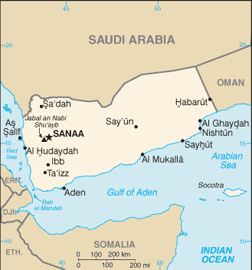
Yemen is a country
of origin and, to a much lesser extent, transit and
destination country for women and children trafficked for the purposes of
forced labor and sexual exploitation. Yemeni children, mostly boys, are
trafficked across the northern border with Saudi Arabia or to the Yemeni
cities of Aden and Sana’a for forced labor, primarily as beggars, but also
for domestic servitude or work in small shops. Some of these children are
subjected to commercial sexual exploitation in transit or once they arrive in
Saudi Arabia. - U.S. State Dept Trafficking in
Persons Report, June, 2009 Check out a later country report here
and possibly a full TIP Report here |
|||||||||||
|
CAUTION: The following links
have been culled from the web to illuminate the situation in HOW TO USE THIS WEB-PAGE Students If you are looking
for material to use in a term-paper, you are advised to scan the postings on
this page and others to see which aspects of Human Trafficking are of
particular interest to you. Would you like
to write about Forced-Labor? Debt
Bondage? Prostitution? Forced Begging? Child Soldiers? Sale of Organs? etc. On the other
hand, you might choose to include precursors of trafficking such as poverty and hunger. There is a lot to
the subject of Trafficking. Scan other
countries as well. Draw comparisons
between activity in adjacent countries and/or regions. Meanwhile, check out some of the Term-Paper resources
that are available on-line. Teachers Check out some of
the Resources
for Teachers attached to this website. ***
FEATURED ARTICLE *** Children in Poor
Countries Need Help Category - Forced Begging International Herald
Tribune, July 29, 2010 gulfnews.com/news/gulf/yemen/gangs-smuggling-yemeni-children-to-saudi-arabia-1.273504 [accessed 4 December
2011] gulfnews.com/world/gulf/yemen/gangs-smuggling-yemeni-children-to-saudi-arabia-1.273504 [accessed 19 January
2020] GANGS SMUGGLING
YEMENI CHILDREN TO SAUDI ARABIA - Saudi and Yemeni officials said gangs in
Yemen are kidnapping children and sending them to Saudi Arabia as beggars.
Some families "rent their children" to these gangs for want of
money. Children are mostly sent to Makkah and Madinah. The Plight Of Human
Trafficking In Yemen Stephen Blake Illes, The Borgen Project, 19
February 2021 borgenproject.org/human-trafficking-in-yemen/ [accessed 3 March
2021] Some migrants get
close to reaching the Saudi Arabian border in Houthi-controlled northern
Yemen but if Houthis catch them, they frequently have to remain in Yemen with
very few ways of leaving. Migrants that Houthis catch experience arrest and
must pay an “exit fee” for which they can then go back down south to the edge
of Houthi control. At this point, they do not have money or work and thus
become stuck in Yemen. Some migrants face
even worse fates if Houthis catch them. Upon arrival, many go to Yemeni detention
centers where they wait for their family back home to send a ransom while
they experience torture and abuse. ***
ARCHIVES *** Human Trafficking
is Booming in Yemen as the War Enters its Fifth Year Category – Sale of Organs Ahmed Abdulkareem, Mint Press News, MPN News, 13 Sept 2019 www.mintpressnews.com/human-trafficking-booming-yemen-war/261818/ [accessed 14
September 2019] Ismail, the owner
of a small electronics store in Taiz, told MintPress, as he pointed to the place where one of his
kidneys use to reside, “I needed money to feed my children.” Ismail hesitated
while he recounted his story, worried that the shame of what he had done
would reach his family. Yet thousands of Yemeni civilians who are living in
abject poverty as a result of the ongoing war are willing to allow a part of themselves to be cut out and sold in order to be able to
sustain their families. 2020 Country
Reports on Human Rights Practices: Yemen U.S. Dept of State Bureau of Democracy, Human Rights, and
Labor, 30 March 2021 www.state.gov/reports/2020-country-reports-on-human-rights-practices/yemen/
[accessed 29 June
2021] PROHIBITION OF
FORCED OR COMPULSORY LABOR Although
information was limited, in the past there were numerous reports of forced
labor in both urban and rural areas. The Asharq al–Awsat
newspaper reported in July 2019 that prominent Houthis held more than 1,800
Yemenis as slaves and servants who work in their residences and places of
work. Migrant workers and
refugees were vulnerable to forced labor. For example, some Ethiopians,
Eritreans, and Somalis were forced to work on khat
farms (khat is a flowering plant that contains
stimulants); some women and children among this population may also have been
exploited in domestic servitude. PROHIBITION OF CHILD
LABOR AND MINIMUM AGE FOR EMPLOYMENT Child labor was
common, including its worst forms. According to a 2013 International Labor
Organization study, which had the most recent available data, more than 1.3
million children participated in the workforce. In rural areas,
family poverty and traditional practice led many children to work in
subsistence farming. In urban areas, children worked in stores and workshops,
sold goods, and begged on the streets. Children also worked in some
industries and construction. Continued weak economic conditions forced
hundreds of children to seek work in the hazardous fishery, construction, and
mining sectors. Children also reportedly worked in dangerous conditions in
waste dumps. According to HRW, nearly one-third of all combatants in the
country were younger than 18 years of age (see section 1.g, Abuses in
Internal Conflict–Child Soldiers). Freedom House
Country Report 2020 Edition freedomhouse.org/country/yemen/freedom-world/2020 [accessed 10 May
2020] G4. DO INDIVIDUALS
ENJOY EQUALITY OF OPPORTUNITY AND FREEDOM FROM ECONOMIC EXPLOITATION? The war has
increased the risk of human trafficking, and after 2015 the government was no
longer able to pursue antitrafficking efforts it
had previously begun. Migrants, refugees, and the internally displaced are
especially vulnerable to exploitation. Border controls and naval blockades
imposed by the Saudi-led coalition have contributed to shortages of food,
medicine, fuel, and other essential imports, leaving the public more exposed
to famine and disease as well as coercion and deprivation by armed groups and
black-market traders. 2017 Findings on
the Worst Forms of Child Labor Office of Child
Labor, Forced Labor, and Human Trafficking, Bureau of International Labor
Affairs, US Dept of Labor, 2018 www.dol.gov/sites/default/files/documents/ilab/ChildLaborReport_Book.pdf [accessed 22 April
2019] www.dol.gov/sites/dolgov/files/ILAB/child_labor_reports/tda2017/ChildLaborReportBook.pdf [accessed 8 May
2020] Note:: Also check out this country’s report in the more recent edition DOL
Worst Forms of Child Labor [page 1041] Reports indicate
that, due to economic hardships, commercial sexual exploitation of children
has increased over the past several years. Girls are subjected to human
trafficking for commercial sexual exploitation within Yemen in hotels and
clubs located in Aden, Sana’a, Ta’iz, and other
cities. (5) Also, there is evidence that Yemeni children, mostly boys,
migrate to Sana’a, Aden, and Saudi Arabia, where they are engaged in forced
labor for domestic work, begging, or work in small shops. Limited evidence
points to the existence of chattel slavery, as children are sold and
inherited as property in the Al Hudaydah and Al Mahwit governorates. (5) In 2017, IOM stated that 25
percent of its services in Yemen were provided to unaccompanied child
migrants, mostly boys ages 14 to 17 from Ethiopia. Some of these children
were subjected to human trafficking. (21). Migrants Held at
‘Torture Camps’ Categories – Official
Complicity, Torture Human Rights Watch,
Sana'a, 25 May 2014 www.hrw.org/news/2014/05/25/yemen-migrants-held-torture-camps 82-page report
at hrw.org/node/125458 Video at www.youtube.com/watch?v=7SE4EqWhxrA#t=80 [accessed 25 May
2014] The human
traffickers have constructed the camps in recent years. The traffickers pick
up the migrants as they arrive by boat on the coast or “buy” them from
security and military officers at checkpoints, charging the migrants fees on
the promise of getting them to Saudi Arabia or other affluent Gulf Countries
to seek work. In these camps, the traffickers inflict severe pain and
suffering on the migrants to extort money from their relatives back home or
friends already working abroad. Except for some
Yemeni government raids in 2013, the authorities have done little to stop the
trafficking. Officials have more frequently warned traffickers of raids,
failed to prosecute, and then released those they arrested. In some cases,
they have actively helped the traffickers capture and detain migrants. The migrants
described horrific ill-treatment in the camps. Beatings were commonplace. One
man described watching another man’s eyes being gouged out with a water bottle.
Another said that traffickers hung him by wire wrapped around his thumbs, and
tied a string with a full water bottle around his penis. Witnesses said the
traffickers raped some of the women migrants they held. One migrant ended
up trapped for seven days in a traffickers’ camp. “They would tie my hands
behind my back and lay me down on the ground. Then they would beat me with
sticks,” Said told Human Rights Watch, showing scars across his back. “I saw
the guards kick the face of one man who was on the floor, breaking his
teeth.” State of children
in Yemen deteriorates, Children’s Parliament Category - Poverty Ashwaq Arrabyee,
The Yemen Observer, Culture & Society,
Feb 3, 2009 www.yobserver.com/culture-and-society/10015711.html [accessed 17 January
2011] CHILD TRAFFICKING - The report addresses the important issue of
child trafficking in New study shames
human traffickers Patrick Mathangani, The Standard, May 11, 2007 At one time this
article had been archived and may possibly still be accessible [here]
[accessed 13
September 2011] Countries in the A new report by an
international trade unions’ umbrella organisation
says Its report,
‘Trafficking in Persons — The Eastern Africa Situation’, notes that women and
children were favourite targets for well-organised trafficking rings, which operate freely for
lack of solid laws against the vice. Child Trafficking:
A Growing Problem In Yemen Category – Labor-Child Mira Baz, Special to
The Daily Star, January 11, 2005 Click [here]
to connect. The URL is not shown
because of its length [accessed 3 May
2012] The first workshop
on child trafficking in New Report
Addresses ... Yemen’s Suffering Kids Category –
Labor-Child Peter Willems, Yemen Times, Issue: (806), Volume 13 ,
From 10 January 2005 to 12 January 2005 At one time this
article had been archived and may possibly still be accessible [here]
[accessed 13
September 2011] The problems of
coming up with accurate numbers include the lack of facilities at borders
required to determine children being sent abroad to work, the vast border
region with Saudi Arabia which makes smuggling difficult to control, and few
reports coming from families. Another difficulty is trying to distinguish
between children traveling with their families or relatives and those being
trafficked. Parents, Children
Complicit In Human Trafficking Mohammed At one time this
article had been archived and may possibly still be accessible [here] [accessed 13
September 2011] Human trafficking
is an old problem in Rude awakening Category – Exploitation of
Children Peter Willems, Yemen
Times Issue: (738), Volume 13 , From 17 May 2004 to 19 May 2004 At one time this
article had been archived and may possibly still be accessible [here]
[accessed 13
September 2011] “Trafficking is the
worst form of child labor in UNICEF discovered
child trafficking in Concluding
Observations of the Committee on the Rights of the Child (CRC) UN Convention on the
Rights of the Child, 3 June 2005 www1.umn.edu/humanrts/crc/yemen2005.html [accessed 17 January
2011] [70] The Committee
is deeply concerned at the information that many children are trafficked to Human Rights
Overview Human Rights Watch www.hrw.org/middle-eastn-africa/yemen [accessed 17 January
2011] ***
EARLIER EDITIONS OF SOME OF THE ABOVE *** Human Rights
Reports » 2005 Country Reports on Human Rights Practices U.S. Dept of State Bureau of Democracy, Human Rights, and
Labor, March 8, 2006 2009-2017.state.gov/j/drl/rls/hrrpt/2005/61703.htm [accessed 11
February 2020] TRAFFICKING
IN PERSONS
– Trafficking was a relatively new phenomenon in the country, and there were
no reliable statistics available. During the year there were reports of
foreign Arab women, particularly Iraqis, who were possibly trafficked to the
country for the purpose of prostitution. They are located primarily in the
southern port city of According to a local human rights NGO, it was possible that citizen
women were trafficked from their homes to other regions within the country
for the purposes of prostitution, including those under the age of legal
consent. The same NGO also believed that such prostitution may have been
organized and speculated that low-level government and security officials
operated or were complicit in sex trafficking within the country. There were no
official statistics available on the number of children trafficked out of the
country. Press reports claimed that children mostly from northern
governorates were trafficked out of the country to work as street beggars,
vendors, or domestic help in Government
investigations revealed that extreme poverty was the primary motivation
behind child trafficking and that the victims' families were almost always
complicit. The traffickers were almost always well known by, if not related
to, the family; parents were either paid or promised money in exchange for
allowing their children to be trafficked. Many cases were also later
discovered to be instances of illegal immigration. The Department of Labor’s 2004 Findings on
the Worst Forms of Child Labor www.dol.gov/ilab/media/reports/iclp/tda2004/yemen.htm [accessed 17 January
2011] Note:: Also check out this country’s report in the more recent edition DOL
Worst Forms of Child Labor INCIDENCE
AND NATURE OF CHILD LABOR - Children are trafficked out of the country to work
as street beggars, domestic help, or as camel jockeys in oil rich Gulf
States. There are some reports that
children are involved in armed conflicts in the country. All
material used herein reproduced under the fair use exception of 17 USC § 107
for noncommercial, nonprofit, and educational use. PLEASE RESPECT COPYRIGHTS OF COMPONENT
ARTICLES. Cite this webpage as: Patt,
Prof. Martin, "Human Trafficking & Modern-day Slavery - |