Human Trafficking & Modern-day Slavery Poverty drives the unsuspecting poor into the
hands of traffickers Published reports & articles from 2000 to 2025 gvnet.com/humantrafficking/Uganda.htm
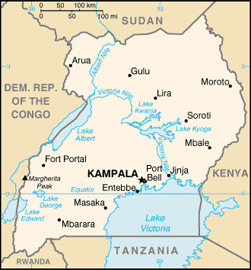
Uganda
is a source and destination country for men, women, and children trafficked
for the purposes of forced labor and sexual exploitation. Ugandan children
are trafficked within the country for forced labor in the fishing,
agricultural, and domestic service sectors, as well as for commercial sexual
exploitation; they are also trafficked to other East African and European
countries for the same purposes. Karamojong women and children are sold as
slaves in cattle markets or by intermediaries and are subsequently forced
into domestic servitude, sexual exploitation, cattle herding, and begging. Human trafficking of Ugandan children for the forcible
removal of body parts reportedly is widespread; so-called witchdoctors seek
various body parts of live victims for traditional medical concoctions
commonly purchased to heal illness, foster economic advancement, or hurt
enemies. - U.S. State Dept Trafficking in
Persons Report, June, 2009 Check out a later
country report here
and possibly a full TIP Report here CAUTION: The following
links have been culled from the web to illuminate the situation in Uganda.
Some of these links may lead to websites that present allegations that are
unsubstantiated or even false. No attempt has been made to validate
their authenticity or to verify their content. HOW TO USE THIS WEB-PAGE Students If you are looking
for material to use in a term-paper, you are advised to scan the postings on
this page and others to see which aspects of Human Trafficking are of
particular interest to you. Would you
like to write about Forced-Labor? Debt
Bondage? Prostitution? Forced Begging? Child Soldiers? Sale of Organs? etc. On the other
hand, you might choose to include precursors of trafficking such as poverty and hunger. There is a lot to
the subject of Trafficking. Scan other
countries as well. Draw comparisons
between activity in adjacent countries and/or regions. Meanwhile, check out some of the Term-Paper resources
that are available on-line. Teachers Check out some of
the Resources
for Teachers attached to this website. HELP for Victims International Organization for
Migration ***
FEATURED ARTICLE *** Uganda: Increased
Insecurity in Karamoja James Karuhanga, Senior Researcher, www.bloggernews.net/12015 [accessed 2 January
2011] The harsh weather
and climatic limitations make livestock maintenance difficult both to the
Karamojong and the neighboring tribes. They have to walk long distances,
disregarding national boundaries, with their animals in search of pasture for
grazing and water. This search for water and pasture has resulted in tribal
fights and a culture of cattle rustling coupled with the Karimojong's
natural belief that all livestock around them belongs to them, which
heightens the inter-tribal clashes. This is enforced by
the fact that cattle are used as a "bride price" and the raids are
a symbol of strength and manhood in the tradition of the community. In
addition, there are continual reports of Karimojong
children sold at weekly cattle markets in Kotido, Moroto and Nakapiripirit
districts. The alarming report
reveals that child abuse is on the increase in the sub-region as desperate Karimojong parents sell their children, especially girls,
to raise money to maintain the remaining members of their families. Police issues
measures to fight child sacrifice Josephine Maseruka, The New Vision, 6 January 2009 www.newvision.co.ug/D/8/12/667107 [accessed 2 January
2011] www.newvision.co.ug/new_vision/news/1252669/police-issues-measures-fight-child-sacrifice [accessed 20 June
2017] A
counter-trafficking unit has been created to curb child sacrifice and human
trafficking, he said. Kayihura's briefing came amid
reports of increasing cases of ritual murders, with children as the main
victims. Kayihura noted that of the
18 suspected ritual murder cases reported to the Police last year, 15 had
been conclusively investigated and the suspects committed to the High Court.
He observed that most ritual murders were committed by either parents or
relatives of the victims, adding that in the 15 cases, the suspects
confessed. The state minister
for internal affairs, Matia Kasaija,
regretted that there was a 600% increase in ritual murder, from the three
reported in 2007, up to 18 cases last year. Kasaija
noted that the problem was compounded by the increase in other crimes
affecting children like kidnapping, abduction and child stealing. ***
ARCHIVES *** Who is to blame for
human trafficking, government or agencies? Victoria Nyeko, Daily Monitor, 11 August 2019 [accessed 13 August
2019] Recently, The EastAfrican newspaper reported that human trafficking is
on the increase in the region. Since travel between the East African
countries is now easier with passports no longer required, the neighbouring countries of Uganda, Kenya and Tanzania are said to be the main transit
locations for trafficking. Although the most common form of human trafficking
is sexual exploitation and forced labour, there is
also a growing market for human organs ... 2020 Country
Reports on Human Rights Practices: Uganda U.S. Dept of State Bureau of Democracy, Human Rights, and
Labor, 30 March 2021 www.state.gov/reports/2020-country-reports-on-human-rights-practices/uganda/
[accessed 29 June
2021] PROHIBITION OF
FORCED OR COMPULSORY LABOR Local civil society
organizations and media reported that many citizens working overseas,
particularly in the Gulf States, became victims of forced labor. Civil
society organizations reported that traffickers and legitimate recruitment
companies continued to send mainly female jobseekers to Gulf countries where
many employers treated workers as indentured servants, withheld pay, and
subjected them to other harsh conditions. PROHIBITION OF CHILD
LABOR AND MINIMUM AGE FOR EMPLOYMENT Child labor was
common, especially in the informal sector. Local civil society organizations
and the UHRC reported that children worked in fishing, gold and sand mining,
cattle herding, grasshopper collecting, truck loading, street vending,
begging, scrap collecting, street hawking, stone quarrying, brick making,
road construction and repair, car washing, domestic services, service work (restaurants,
bars, shops), cross-border smuggling, and commercial farming (including the
production of tea, coffee, sugarcane, vanilla, tobacco, rice, cotton,
charcoal, and palm oil). Local civil society organizations and media reported
poverty led children to drop out of school to work on commercial farms, while
some parents took their children along to work in artisanal mines to
supplement family incomes. According to government statistics, children from
nearly half of all families living on less than $1 a day dropped out of
school to work. Local civil society organizations reported that orphaned
children sought work due to the absence of parental authority. Local civil
society organizations and local media also reported commercial sexual
exploitation of children (see section 6). Local NGOs reported
that children who worked as artisanal gold miners were exposed to mercury,
and many were unaware of the medium- to long-term effects of the exposure.
They felt compelled to continue working due to poverty and a lack of
employment alternatives. Children also suffered injuries in poorly dug mine
shafts that often collapsed. Freedom House
Country Report 2020 Edition freedomhouse.org/country/uganda/freedom-world/2020 [accessed 8 July
2020] G4. DO INDIVIDUALS
ENJOY EQUALITY OF OPPORTUNITY AND FREEDOM FROM ECONOMIC EXPLOITATION? Poor enforcement of
labor laws contributes to unsafe or exploitative conditions for some workers,
including extremely low pay. Child labor in agriculture, domestic service,
and a variety of other industries is a significant problem, and the issue is
most prevalent in rural areas. Sexual exploitation of minors is also an
ongoing problem. While Uganda has in
place a number of domestic laws to promote workers’ rights, the government
has failed to regulate the recruitment and transfer of Ugandan domestic
workers to Middle Eastern countries. Accounts that surfaced in the media in
2019 described Ugandan workers in the Middle East experiencing sexual abuse,
beatings, exploitation, and torture. A report issued by Parliament in late
2017 revealed the deaths of 48 Ugandans working in the Middle East in the
first 11 months of that year, out of which 34 died by committing suicide. The
government has promised legislation to regulate the employment of Ugandans
abroad, and a draft bill was under consideration in late 2019. 2017 Findings on
the Worst Forms of Child Labor Office of Child
Labor, Forced Labor, and Human Trafficking, Bureau of International Labor
Affairs, US Dept of Labor, 2018 www.dol.gov/sites/default/files/documents/ilab/ChildLaborReport_Book.pdf [accessed 22 April
2019] www.dol.gov/sites/dolgov/files/ILAB/child_labor_reports/tda2017/ChildLaborReportBook.pdf [accessed 8 May
2020] Note:: Also check out this country's report in the more recent edition DOL
Worst Forms of Child Labor [page 996] Children from the Karamoja region are trafficked and willingly migrate to
Kampala and other urban centers where they engage in begging, street vending,
domestic work, and commercial sexual exploitation. (2; 29; 30; 3) Children
from neighboring countries are exploited in forced agricultural labor and
commercial sexual exploitation in Uganda. (3) During the reporting period,
child trafficking victims from the Busoga sub-region in Uganda were used in
armed conflict in the Democratic Republic of the Congo. (36). Away From Home: An
Assessment Of The Effectiveness Of Uganda’s Anti-Trafficking Law Enforcementmechanisms (2009-2014) Tumwebaze Noah, Candidate for
degree of Master Of Arts In Human Rights, Department Of Philosophy, Makerere University, April 2016 [Long URL] [accessed 14
February 2022] ABSTRACT - The study
assessed the effectiveness of the enforcement mechanisms on human trafficking
in Uganda. Specifically, the study was guided by three objectives; to examine
the contribution of the Prevention of Trafficking in Persons Act 2009 in the
fight against human trafficking, to analyze Uganda’s enforcement mechanisms
on human trafficking and to assess the effectiveness of the anti-human
trafficking law enforcement mechanisms in promoting and protecting human
rights in Uganda. Diverse Human Trafficking
Trends in East African Region Highlights Urgent Need for Greater Protection International
Organization for Migration IOM, 12-10-2010 [accessed 18 January
2016] In Adult victims were
identified in the domestic sector, as well as the mining, agricultural and
hospitality industries. The IOM assessment
established that Ugandan children are trafficked to all the countries in the
region with Police must probe
human trafficking The New Vision, 11
April 2008 www.newvision.co.ug/D/8/14/621809 [accessed 2 January
2011] www.newvision.co.ug/new_vision/news/1192317/police-probe-human-trafficking [accessed 19
February 2018] The Uganda Human
Rights Commission and the Ministry of Labour are
handling cases involving allegations that some people smuggle Indians from
India and Pakistan into the country. They confiscate their passports and give
them jobs where a big percentage of their wages is taken to recover the costs
of bringing them here. After working for some time and accumulating salary
arrears, when they start demanding their wages, the employers get them
deported for illegal immigration. This is a modern version of slave trade,
which has been reported in many countries. Joyce Namutebi, The New Vision, www.afrika.no/Detailed/15014.html [accessed 2 January
2011] In its 145-page
report, the commission was concerned that child sacrifice, child trafficking,
child labour, abduction, child soldiering,
defilement, child prostitution and abuse were persisting in Uganda.
"Police reports reveal that there were 185 victims of combined cases of
child abduction, kidnap, disappearance, trafficking and sacrifice alone
during the period between January and September 2006," the report said.
Most of the children trafficked internally were from Katarzyna Heath, The New
Vision, This article has
been archived by World Street Children News and may possibly still be
accessible [here] [accessed 12
September 2011] www.newvision.co.ug/new_vision/news/1219950/forced-streets [accessed 27
February 2019] Most of them flee
their homes due to abuse and neglect, their heads filled with warped views of
urban existence. In reality, these dreams are not fulfilled and the end
result is there are children working and sleeping on the streets, fending for
themselves in unsafe conditions. The children are
exposed to many dangers. Many become part of child trafficking. They are
persuaded under false pretences by elders or family
'acquaintances' that they are moving to new places with better opportunities.
Instead, they are trapped in a world of exploitation, which exposes them to
anything from child prostitution to human sacrifices. Migration body to
monitor human trafficking impact [Original source
information not available] www.realrestoration.org/uganda.html [accessed 9 May
2020] "Many girls
are taken from Iringa and brought to major cities to work as housegirls but they end up being subjected to
prostitution and other works which they did not expect, this is internal
trafficking," she said. Many young boys,
she said, are taken to work in the mining companies, something which not only
denies their rights but also are psychosocially affected. A Hero in Hell.
Former Drug Dealer Frees Abducted Child Soldiers in Maria Sliwa, Assist News Service ANS, Nimule, ithinkimafundamentalist.blogspot.com/2005/10/this-guy-is-just-asking-to-have-movie.html [accessed 2 January
2011] In March of this
year, a band of these small predators attacked a group of women who were collecting
firewood near the border of The children of the
LRA perform these acts at the bidding of their adult counterparts and make up
about 80 percent of the rebel group, according to the United Nations. The LRA
has kidnapped more than 20,000 children since 1988 and today its captives
constitute the largest army of child soldiers in Uganda's forgotten
war Save the Children www.boernpaaflugt.dk/Library/Annual_Reports/2003/The_Children_of_the_World/Uganda.aspx [accessed 2 January
2011] Has the world forgotten
about us? That is the question raised by children in northern least 20,000
children have been kidnapped and forced into being child soldiers in one of
the most brutal rebel armies in the world. Jennifer Achoro was twelve years old and on her way to school when
she was kidnapped. "I had just put on my school uniform and was about to
eat breakfast, when some men from the rebel army came and asked my mother
whether we had a radio. When she said 'No,' they forced their way into our hut
and forced me along with them." Ex-child soldier's
path to hope Laura Smith-Spark,
BBC News Online, 25 May 2004 news.bbc.co.uk/2/hi/uk_news/3733349.stm [accessed 2 January
2011] Ms Keitetsi says she was enlisted into Yoweri
Museveni's National Resistance Army in Child, slave,
soldier Testimony provided
by the Coalition to Stop the Use of Child Soldiers, New Internationalist 337,
August 2001 www.newint.org/features/2001/08/05/soldier/ [accessed 2 January
2011] HERE IS THE
TESTIMONY OF ONE UGANDAN CHILD SOLDIER - I heard later that two boys from my home
were captured and beaten because I had escaped. One of the boys was stabbed
in the hand and asked to bring the rebels to my parents' home. They beat my
mother and brother with clubs and axes until they died. They threatened that
they'll kill more people if I don't come back. This was told me by a boy who
lived near my home. He told me it was my fault my mother and brother had been
killed.' ICC: Investigate
All Sides in Human Rights Watch,
February 4, 2004 www.hrw.org/en/news/2004/02/04/icc-investigate-all-sides-uganda [accessed 2 January
2011] The ICC prosecutor,
Luis Moreno Ocampo, announced in According to Human
Rights Watch research, the LRA has committed widespread abuses against
civilians in Uganda, including child abductions, summary executions, torture,
rape and sexual assault, forced labor, and mutilation. Recently, LRA
abductions have reached record levels, with an estimated 10,000 children
abducted since mid-2002 and forced to fight, kill civilians, and abduct other
children. Children who fail to comply with orders are murdered, often by
other children who are forced to kill them. HRW Report - Child
Soldier Use 2003 Human Rights Watch,
Briefing for the 4th UN Security Council Open Debate on Children and Armed
Conflict, 2004 www.hrw.org/reports/2004/childsoldiers0104/18.htm [accessed 2 January
2011] DEMOBILIZATION AND
CHILD PROTECTION PROGRAMS - Children "rescued" from the LRA by the
UPDF were kept in military confinement, sometimes for protracted periods, to
gather intelligence before being transferred to the Child Protection Unit,
and then to rehabilitation programs operated by NGOs including World Vision
and the Gulu Save Our Children Organization
(GUSCO).285
The 120 recruits identified at the Lugore training
camp were demobilized and were taking part in counselling and reintegration
programs. In response to the influx of "night commuters", child
protection agencies and church groups established programs to feed and
shelter these children. Ugandan child
soldier activist wins Anti-Slavery Award Anti-Slavery
International, 1 December 2000 At one time this
article had been archived and may possibly still be accessible [here]
[accessed 12
September 2011] George Omona, Project Co-ordinator of
the Gulu Support the Children Organisation
(GUSCO), will receive the 2000 Anti-Slavery Award from the Child Labour Persists Around The World: More Than 13 Percent Of
Children 10-14 Are Employed International Labour Organisation (ILO) News,
www.ilo.org/global/about-the-ilo/press-and-media-centre/news/WCMS_008058/lang--en/index.htm [accessed 9
September 2011] www.scribd.com/document/366840945/Child-Labour-Persists-Around-the-World [accessed 19
February 2018] "Today's child
worker will be tomorrow's uneducated and untrained adult, forever trapped in
grinding poverty. No effort should be spared to break that vicious
circle", says ILO Director-General Michel Hansenne. Among the countries
with a high percentage of their children from 10-14 years in the work force
are: Mali, 54.5 percent; Burkina Faso, 51; Niger and Uganda, both 45;
Kenya, 41.3; Senegal, 31.4; Bangladesh, 30.1; Nigeria, 25.8; Haiti, 25;
Turkey, 24; Côte d'Ivoire, 20.5; Pakistan, 17.7; Brazil, 16.1; India, 14.4;
China, 11.6; and Egypt, 11.2. ***
EARLIER EDITIONS OF SOME OF THE ABOVE *** Human Rights Reports
» 2005 Country Reports on Human Rights Practices U.S. Dept of State Bureau of Democracy, Human Rights, and
Labor, March 8, 2006 2009-2017.state.gov/j/drl/rls/hrrpt/2005/61598.htm [accessed 11
February 2020] CHILDREN
-
According to UNICEF estimates, the LRA has abducted approximately 12 thousand
children since 2002, and continued to abduct children during the year. The
LRA forced children into virtual slavery as laborers, soldiers, guards, and
sex slaves. In addition to being beaten, raped, and forced to march until
exhausted, abducted children were forced to participate in the killing of
other children who attempted to escape. More than 85 percent of LRA captives
were made up of children whom the LRA abducted and forced to fight as rebels;
most LRA rebels were between the ages of 11 and 16. TRAFFICKING
IN PERSONS
- In addition to trafficking related to LRA abductions, adults and children
were trafficked internally for labor, commercial sexual exploitation, and
criminal activities. Trafficking in persons primarily occurred internally:
the LRA abducted children to be soldiers, sex slaves, and porters. Freelance
operators, including taxi drivers and hotel/bar operators, conducted the
commercial sex trafficking. Victims of internal
trafficking were subjected to hazardous working conditions, and commercial
sex victims were subjected to physical abuse and the risk of contracting
sexually transmitted diseases. Victims of commercial sex trafficking in urban
centers often came from small rural villages. The Department of Labor's 2004 Findings on
the Worst Forms of Child Labor www.dol.gov/ilab/media/reports/iclp/tda2004/uganda.htm [accessed 2 January
2011] Note:: Also check out this country's report in the more recent edition DOL
Worst Forms of Child Labor INCIDENCE
AND NATURE OF CHILD LABOR - Uganda is considered to be a source country for
trafficking of persons. There is evidence of children being abducted
and trafficked across the border to All material
used herein reproduced under the fair use exception of 17 USC § 107 for
noncommercial, nonprofit, and educational use. PLEASE RESPECT COPYRIGHTS OF
COMPONENT ARTICLES. Cite this webpage as: Patt, Prof. Martin, "Human
Trafficking & Modern-day Slavery - |