Human Trafficking & Modern-day Slavery Poverty drives the unsuspecting poor into the
hands of traffickers Published reports & articles from 2000 to 2025 gvnet.com/humantrafficking/Tunisia.htm
Tunisia is a source,
destination, and possible transit country for small numbers of men, women,
and children trafficked for the purposes of forced labor and commercial
sexual exploitation. Several Tunisian trafficking victims were identified
during the reporting period in foreign locations; two women were rescued from
forced prostitution in Jordan and three men from forced labor in Italy. Some
Tunisian girls are trafficked within the country for domestic servitude. A
2008 survey of 130 domestic workers in the Greater Tunis region found that 52
percent were under the age of 16; twenty-three percent claimed to be victims
of physical violence, and 11 percent of sexual violence. Ninety-nine percent
indicated they had no work contracts and the majority received salaries below
the minimum wage. These conditions are indicators of possible forced labor. -
U.S. State Dept Trafficking in Persons Report,
June, 2009 Check out a later country report here and possibly a full TIP Report here |
|||||||||||
|
CAUTION: The following links
have been culled from the web to illuminate the situation in Tunisia. Some of these links may lead to websites that
present allegations that are unsubstantiated or even false. No attempt
has been made to validate their authenticity or to verify their content. HOW TO USE THIS WEB-PAGE Students If you are looking for
material to use in a term-paper, you are advised to scan the postings on this
page and others to see which aspects of Human Trafficking are of particular
interest to you. Would you like to
write about Forced-Labor? Debt
Bondage? Prostitution? Forced Begging? Child Soldiers? Sale of Organs? etc. On the other
hand, you might choose to include precursors of trafficking such as poverty and hunger. There is a lot to
the subject of Trafficking. Scan other
countries as well. Draw comparisons
between activity in adjacent countries and/or regions. Meanwhile, check out some of the Term-Paper resources
that are available on-line. Teachers Check out some of
the Resources
for Teachers attached to this website. ***
FEATURED ARTICLE *** Amnesty Web reality
check Internet
Correspondent Chris Nuttall, BBC News, 5 February 1999 news.bbc.co.uk/2/hi/science/nature/273218.stm [accessed 1 January
2011] Amnesty
International has hit back at a fake site lauding the human rights
achievements of Tunisia by creating a new Website to counter the claims. www.amnesty-tunisia.org has "nothing
to do with Amnesty International," the new site says. "It was
created by supporters of the Tunisian government in an attempt intentionally
to mislead the public. "It is yet
another example of the extent to which the Tunisian authorities are prepared
to go in order to hide the reality of their human rights record. ***
ARCHIVES *** 2020 Country
Reports on Human Rights Practices: Tunisia U.S. Dept of State Bureau of Democracy, Human Rights, and
Labor, 30 March 2021 www.state.gov/reports/2020-country-reports-on-human-rights-practices/tunisia/
[accessed 28 June
2021] PROHIBITION OF CHILD
LABOR AND MINIMUM AGE FOR EMPLOYMENT Children engage in
the worst forms of child labor, including in forced labor and domestic work
in third-party households. They work nearly 10 hours per day without written
contracts and have no social coverage. They are victims of health problems
related to the arduous nature and long hours of work and to the dangers to
which they may be exposed in the performance of various household tasks and
other types of work in employers’ home, begging, street vending, and seasonal
agricultural work. They were also subjected to commercial sexual exploitation
and used in illicit activities, including drug trafficking, sometimes as a
result of human trafficking The Ministries of
Employment and Vocational Training, Social Affairs, Education, and Women,
Family, Childhood, and Senior Citizens all have programs directed at both
children and parents to discourage children from entering the informal labor
market at an early age. These efforts include programs to provide vocational
training and to encourage youth to stay in school through secondary school. Freedom House
Country Report 2020 Edition freedomhouse.org/country/tunisia/freedom-world/2020 [accessed 7 May 2020] G4. DO INDIVIDUALS
ENJOY EQUALITY OF OPPORTUNITY AND FREEDOM FROM ECONOMIC EXPLOITATION? Tunisian women and
children are subject to sex trafficking and forced domestic work in both
Tunisia and abroad. Refugees and other migrants are also susceptible to
exploitation by traffickers. Cases of exploitation in the agriculture and
textile sectors are prevalent; women often work long hours with no contracts,
benefits, or legal recourse. Recent protests have called attention to the
lack of economic opportunity for average Tunisians due to high inflation,
high unemployment, and a lack of meaningful reform to address such issues.
Protests and a general strike in Sidi Bouzid in April 2019 highlighted the continued problem of
regional economic inequality, with marginalization, underdevelopment,
unemployment, and deteriorating conditions plaguing the country’s interior. 2017 Findings on
the Worst Forms of Child Labor Office of Child
Labor, Forced Labor, and Human Trafficking, Bureau of International Labor
Affairs, US Dept of Labor, 2018 www.dol.gov/sites/default/files/documents/ilab/ChildLaborReport_Book.pdf [accessed 22 April
2019] www.dol.gov/sites/dolgov/files/ILAB/child_labor_reports/tda2017/ChildLaborReportBook.pdf [accessed 7 May
2020] Note:: Also check out this country’s report in the more recent edition DOL
Worst Forms of Child Labor [page 974] Children are
engaged in child labor in the informal sector, predominantly in street work,
including vending and garbage scavenging. (20; 15) Child migrants from
sub-Saharan countries and those fleeing conflict in Libya and Syria, as well
as young girls from Tunisia’s northwest region, are particularly vulnerable
to human trafficking. (16; 19) Preliminary results from the National Child
Labor Survey conducted by the government indicated that 7.9 percent of all
children are engaged in child labor, with 63.2 percent of whom
involved in hazardous work. The northwest region—consisting of the
governorates of Béja, Jendouba,
Kef, and Siliana—noted the highest incidence of
child labor at 27.7 percent. (12) The government has not yet made the full
dataset from this survey publicly available, or allowed other government
agencies to access it, leaving the nature and causes of children’s
involvement in specific forms of child labor unknown. Commercial sexual
exploitation of children - The situation in the Middle East/North Africa
region Summary based on the
situation analysis written by Dr Najat M’jid for the
Arab-African Forum against Commercial Sexual Exploitation, Rabat, Morocco,
24-26 October 2001 -- Source document (in French): Rapport sur la situation
de l’exploitation sexuelle
des enfants dans la région MENA, 10 septembre 2001 www.unicef.org/events/yokohama/backgound8.html [accessed 1 January
2011] SOME RESPONSES AND
EXAMPLES OF ACTION AGAINST CSEC - In 1995, Tunisia introduced a Code for
the Protection of Children, including a rapid reaction task force to
intervene in emergencies, under the direction of the Family Judge, to ensure
that the provisions of the Code are used. The Protection
Project - Tunisia [DOC] The Paul H. Nitze School of Advanced International Studies (SAIS),
The Johns Hopkins University www.protectionproject.org/human_rights_reports/report_documents/tunisia.doc [accessed 2009] FACTORS THAT
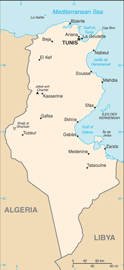
CONTRIBUTE TO THE TRAFFICKING INFRASTRUCTURE - Tunisia’s 800 miles (1,300
kilometers) of coastline facing Italy,
combined with its proximity to Sicily and the rest of Italy, make it
an ideal transit country for smuggling and trafficking in persons. Women and
children make the dangerous journey across the Mediterranean believing that
they will have better lives in Europe.
The corruption of public officials in Tunisia also contributes to the
trafficking infrastructure. United Nations and Tunisian police officers have
been found to be involved in trafficking for prostitution. FORMS OF TRAFFICKING - Victims are
trafficked to and through Tunisia for purposes of prostitution and domestic
labor. Commercial sex tourism exists in Tunisia, though little research has
been devoted to uncovering the extent of the problem. ***
EARLIER EDITIONS OF SOME OF THE ABOVE *** Freedom House
Country Report 2018 Edition freedomhouse.org/country/tunisia/freedom-world/2018 [accessed 7 May 2020] G4. DO INDIVIDUALS
ENJOY EQUALITY OF OPPORTUNITY AND FREEDOM FROM ECONOMIC EXPLOITATION? Tunisian women and
children are subject to sex trafficking and forced domestic work in both
Tunisia and abroad. Refugees and other migrants are also susceptible to
exploitation by traffickers. Cases of exploitation in the agriculture and
textile sectors are prevalent; women often work long hours with no contracts,
benefits, or legal recourse. Human Rights
Reports » 2005 Country Reports on Human Rights Practices U.S. Dept of State Bureau of Democracy, Human Rights, and
Labor, March 8, 2006 2009-2017.state.gov/j/drl/rls/hrrpt/2005/61700.htm [accessed 11
February 2020] TRAFFICKING
IN PERSONS
– The law prohibits trafficking in persons, and there were no reports that
persons were trafficked to, from, or within the country. In January 2004 the
legislature approved amendments to the 1975 law on passports and travel
documents. The law includes provisions for sentencing convicted traffickers
to prison terms of 3 to 20 years, and fines of $67 thousand to $83 thousand
(80 thousand to 100 thousand dinars). The amendments brought national law
into conformance with the international protocol agreement on trafficking of
persons. The government prepared to use provisions of the penal code to
combat trafficking should the need arise. For example, traffickers could be
prosecuted under laws prohibiting forced displacement of persons. The Ministry of
Interior and Local Development and the Ministry of Social Affairs, Solidarity
and Tunisians Abroad were the agencies responsible for anti-trafficking
efforts. Since trafficking was not deemed a problem, there were no specific
government campaigns to prevent trafficking. |