Human Trafficking & Modern-day Slavery Poverty drives the unsuspecting poor into the
hands of traffickers Published
reports & articles from 2000 to 2025 gvnet.com/humantrafficking/Togo.htm
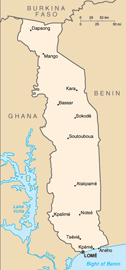
Togo is a source,
transit and, to a lesser extent, a destination country for women and children
trafficked for the purposes of forced labor and commercial sexual
exploitation. Trafficking within Togo is more prevalent than transnational
trafficking and the majority of victims are children. Togolese girls are
trafficked primarily within the country for domestic servitude, for forced
work as market vendors and produce porters, and for commercial sexual
exploitation. To a lesser extent, girls from Togo are also trafficked to
other African countries, primarily Benin, Nigeria, Ghana, and Niger, for the
same purposes listed above. Although some Togolese boys are trafficked within
the country, they are more commonly trafficked transnationally to work in
agricultural labor, including on cocoa farms, in other African countries,
primarily Nigeria, Cote d’Ivoire, Gabon and Benin. - U.S. State Dept
Trafficking in Persons Report, June, 2009 Check
out a later country report here and possibly a full TIP Report here |
|||||||||||
|
CAUTION: The following links have
been culled from the web to illuminate the situation in HOW TO USE THIS WEB-PAGE Students If you are looking
for material to use in a term-paper, you are advised to scan the postings on
this page and others to see which aspects of Human Trafficking are of
particular interest to you. Would you like
to write about Forced-Labor? Debt
Bondage? Prostitution? Forced Begging? Child Soldiers? Sale of Organs? etc. On the other
hand, you might choose to include precursors of trafficking such as poverty and hunger. There is a lot to
the subject of Trafficking. Scan other
countries as well. Draw comparisons
between activity in adjacent countries and/or regions. Meanwhile, check out some of the Term-Paper resources
that are available on-line. Teachers Check out some of
the Resources
for Teachers attached to this website. HELP for Victims Direction Générale
de la Protection de l’Enfant (DGPE) ***
FEATURED ARTICLE *** Children rescued
from trafficking wait with their nightmares to go home U.N. Integrated
Regional Information Networks IRIN, [accessed 1 March 2015] The wisp of a girl
sits silently to one side, staring at the scarred tips of her fingers.
Probably no more than five years old, Enyonam has
just arrived at a center for trafficked children in the Togolese capital, HRW Report: Human Rights Watch,
1 April 2003 www.hrw.org/en/node/76184/section/1 [accessed 30
December 2010] www.hrw.org/report/2003/04/01/borderline-slavery/child-trafficking-togo [accessed 13 August
2020] SUMMARY - SUMMARY - Boys worked from as
early as 5:00 a.m. until late at night, sometimes with hazardous equipment
such as saws or machetes. Some described conditions of bonded labor, whereby
their trafficker would pay for their journey to ***
ARCHIVES *** 2020 Country
Reports on Human Rights Practices: Togo U.S. Dept of State Bureau of Democracy, Human Rights, and
Labor, 30 March 2021 www.state.gov/reports/2020-country-reports-on-human-rights-practices/togo/
[accessed 28 June
2021] PROHIBITION OF
FORCED OR COMPULSORY LABOR Forced labor
occurred in sectors including mining, domestic work, roadside vending, and
agriculture. Children were subjected to forced labor (see section 7.c.). PROHIBITION OF CHILD
LABOR AND MINIMUM AGE FOR EMPLOYMENT Child labor was a
problem. Some children started work at age five and typically did not attend
school for most of the school year. Children worked in both rural and urban
areas, particularly in family-based farming and small-scale trading, and as
porters and domestic servants. In some cases children worked in factories. In
the agricultural sector, children assisted their parents with the harvesting
of cotton, cocoa, and coffee. Children were involved in crop production, such
as of beans and corn, for family consumption. The most dangerous
activity involving child labor was in quarries, where children assisted their
parents in crushing rock by hand and carrying buckets of gravel on their
heads. The government did not sanction such labor, and it occurred only in
small, privately owned quarries. Reputable local NGOs reported that, while
quarry work was a weekend and holiday activity for most children, some left
school to work full time in the quarries. In both urban and
rural areas, particularly in farming and small-scale trading, very young
children assisted their families. In rural areas parents sometimes placed
young children into domestic work in other households in exchange for
one-time fees as low as 12,500 to 17,500 CFA francs ($22 to $30). Children sometimes
were subjected to forced labor, primarily as domestic servants, porters, and
roadside sellers. Children were also forced to beg. Employers subjected
children to forced labor on coffee, cocoa, and cotton farms, as well as in
rock quarries, domestic service, street vending, and begging. Children were
trafficked into indentured servitude. Child sexual exploitation occurred (see
section 6, Children). Freedom House
Country Report 2020 Edition freedomhouse.org/country/togo/freedom-world/2020 [accessed 8 July
2020] G4. DO INDIVIDUALS
ENJOY EQUALITY OF OPPORTUNITY AND FREEDOM FROM ECONOMIC EXPLOITATION? Protections against
exploitative labor conditions, including rules on working hours, are poorly
enforced, and much of the workforce is informally employed. Child labor is
common in the agricultural sector and in certain urban trades; some children
are subjected to forced labor. According to the US State Department, the
government has made efforts to address human trafficking for forced labor and
sexual exploitation, including by identifying more trafficking victims,
prosecuting more perpetrators, and stepping up public-awareness programs,
though it still fell short on victim protection and other issues. 2017 Findings on
the Worst Forms of Child Labor Office of Child
Labor, Forced Labor, and Human Trafficking, Bureau of International Labor
Affairs, US Dept of Labor, 2018 www.dol.gov/sites/default/files/documents/ilab/ChildLaborReport_Book.pdf [accessed 22 April
2019] www.dol.gov/sites/dolgov/files/ILAB/child_labor_reports/tda2017/ChildLaborReportBook.pdf [accessed 7 May
2020] Note:: Also check out this country’s report in the more recent edition DOL
Worst Forms of Child Labor [page 959] Togo is a source
and transit country for victims of human trafficking to neighboring
countries, primarily for domestic work, work in agriculture, and commercial
sexual exploitation. (13; 4; 25; 29; 30) Parents may be complicit in child
trafficking as a result of confiage, which involves
sending a child to a relative or friend to attend school in a larger town or
city, a practice that may place children at risk of exploitation as a result
of internal human trafficking. (3; 5; 10; 30; 4). A Study on Human
Trafficking for Sexual Exploitation within th Gulf
of Guinea countries James Okolie-Osemene PhD, Department of International Relations
and the Director of Research and Linkage Programme,
Wellspring University, Nigeria [Long URL] [accessed 14
February 2022] The objectives of
this study are to situate and examine the context, nature and networks of
human trafficking for sexual exploitation around the Gulf of Guinea in order
to identify the intersection between the sources, transit and destinations of
the illicit trade, interrogate the human rights implications of human
trafficking for sexual exploitation around the countries of the Gulf of
Guinea on the one hand, and the strengths, weaknesses, opportunities and
threats to the anti-trafficking activities on the other hand. In Togo, a
10-Year-Old's Muted Cry: 'I Couldn't Take Any More' Kevin www.washingtonpost.com/wp-dyn/content/story/2008/12/26/ST2008122600004.html [accessed 30
December 2010] Adiza ran scared and
crying into the street. Ten years old and 4-foot-9, she fled the house where
she had worked for more than a year, cleaning and sweeping from before dawn
until late at night. She ran to a
woman selling food in the street and told her that since the day she had
arrived in this capital city from her village in the country, her employer
had beaten her almost daily and kept her in slavelike
conditions. "I couldn't take any
more," recalled Adiza, a slight girl with
close-cropped hair and almond-shaped eyes, who talked in a halting whisper as
she described how her employer beat her with her hands and with cooking pots
before the November day she ran away. Rarely making eye
contact, Adiza spoke in a shelter here surrounded
by other tiny girls who had suffered physical or sexual abuse in the growing
global trade in domestic servants.
The number of girls like Adiza, who leave
their communities or even their countries to clean other people's houses, has
surged in recent years, according to labor and human rights specialists. The
girls in the maid trade, some as young as 5, often go unpaid, and their work
in private homes means the abuses they suffer are out of public view. A FRAYING OF TRUST - Adiza was raised in Kpatchile,
a few mud huts scattered among fields of corn and yams 250 miles north of A closer look at
domestic child labour in Africa Konye Obaji
Ori, AFRIK News, 18 October 2008 www.afrik-news.com/article14712.html [accessed 30
December 2010] When my master
brought me from the village, he said that I will show that I deserved to go to
school by proving my hard work at home. I was bent on going to school so I
put my heart into everything I was commanded to do. I Swept, cleaned, washed,
mopped, ironed, and fetched water from a public tap, two streets away, to
fill the drums and basins in our house.
In-between these chores I had to go out and hawk sachets water in
traffic and in the streets of the ghetto. I slept last and woke up first. I
didn’t eat with my master, his wife and his children at table, I ate a small
portion of foodon the floor at the back yard, after
they had all eaten. Sometimes I could not work because I was always hungry,
but I had to work otherwise knocks and the Koboko
cane will descend on me.’ An 8 year old Togolese househelp
narrated. In most African
families, wealth entails owning a houseboy or a house girl as they are
called. This cultural practice that allows people to take deprived children
from the remote villages, offer them shelter, food and sometimes primary
education in return for their labor which is often child labor or even slave
labor, is an issue that needs to be addressed with regards to human rights,
child rights and international labor rights After 3 years, my
master registered me in a community school down the street. It was more like
a place where street children passed time, the teachers hardly came to class.
My chores and task were still a problem but I managed to deliver, so as to
avoid any problem with my master or his wife. I liked school, I wanted to
learn but I hardy had time to review my school work or do assignments and
when I did poorly, my master or his wife would beat me like a thief.
Sometimes I thought of running away, but to where? I wanted to go back to my
mother, but how do I tell my uncle that, when the last time I asked about my
mother, I was given the beating of my life, called an ingrate and denied food
for two days. I wasn’t doing well at school, I wasn’t happy at home, I missed
my mother, but I couldn’t do anything about it. All my mother knew was that
her son was in the city and was in school, and will be a big shot.’ In smuggling case,
'victims' defend the accused Brian Donohue, The
Star-Ledger, 10 May 2008 www.nj.com/news/index.ssf/2008/05/in_smuggling_case_victims_defe.html [accessed 30
December 2010] Last September,
U.S. Immigration and Customs Enforcement agents arrested two men and a woman
from They
say they long to return to the hair salons -- even if they weren't paid for
their long hours performing intricate hair weaves. And worse, they say, their
parents in Africa are blaming them for the downfall of the three jailed
suspects, who had been sending money to the workers' families before the
salons were shut. When she calls home,
says one 21-year old woman, her parents blame her for disappointing the
village, then they hang up on her. Trafficking
of African women is thriving Francois Tillinac,
International Labour Organisation (ILO)
News, May 10 2007 www.iol.co.za/news/africa/trafficking-of-african-women-is-thriving-1.352453 [accessed
14 November 2010] In January Italian
police smashed several human trafficking rings involving African and eastern
European females and netted some 800 suspects. Outside Combating Child
Trafficking in Togo through Education (COMBAT) Project Number:
TGO028 www.care.org/careswork/projects/TGO028.asp? [accessed 30
December 2010] [accessed 27
February 2019] [also see Page 23 –
Togo -- www.care.org/sites/default/files/documents/CARE_AR_2005.pdf PROJECT DESCRIPTION - CARE's COMBAT
project joins in the elimination of child trafficking in Togo, particularly
among girls in Central and Maritime regions, through improved and extended
programs of education and social support. COMBAT targets children 5-14 years
old and is implemented in collaboration with the two local organizations that
were CARE's partners in PEP (above) and the international group Terre des
Hommes. COMBAT contributes to a multidimensional effort against trafficking;
complements the government's efforts to create a policy and enforcement
environment; mobilizes communities as the key actors in the social-cultural
change required for effective prevention; revitalizes the education system as
a cornerstone of prevention and re-integration; deploys NGOs as effective
intermediaries and complementary service providers; facilitates coordination
and collaboration at all levels; and works with and under the auspices of
national and international efforts such as International Labor Organization
and International Program on the Elimination of Child Labor. Children
mobilization against Child Trafficking At one time this
article had been archived and may possibly still be accessible [here]
[accessed 12
September 2011] Child trafficking
takes alarming proportions in WHY DO THESE CHILDREN LEAVE THEIR FAMILY? - Poverty, ignorance,
children not attending school, the lack of a legal framing are the main
factors which make children vulnerable. These children are generally brought
to Aguegue (in Child prostitution
goes unchecked in Togo U.N. Integrated
Regional Information Networks IRIN, www.irinnews.org/report/49619/togo-child-prostitution-goes-unchecked-in-togo [accessed 9 March 9,
2015] www.irinnews.org/news/2004/04/23/child-prostitution-goes-unchecked-togo [accessed 27
February 2019] Adjo says she never
knew her real parents. But she and Amivi hand over
all the money they earn to a woman whom they call “Mama”. If the girls give this woman too little
cash at the end of a shift, they run the risk of a severe beating. “At the end of every day I have to give the
money to a woman called ‘Mama.’ If I don’t have enough money to give her, I
get beaten,” Adjo said. Besides Adjo and Amivi, there are
several hundred other young girls aged between nine and 15 who can openly be
bought for sex in the downtown area of Scale of African
slavery revealed BBC News, 23 April
2004 news.bbc.co.uk/2/hi/africa/3652021.stm [accessed 30
December 2010] COMPLICITY - Much of this
trade in children often has the tacit collaboration of the victims' own
families where it is seen not so much as criminal activity but as a way for a
large family to boost its poor income.
Joseph's back bears the scars of his beatings. The story of Joseph
in Child Trafficking
in Livina Nkiruka
Agwunobi, 14
September 2004 At one time this article
had been archived and may possibly still be accessible [here] [accessed 12
September 2011] In Child labor on
cocoa farms 'tip of the iceberg' Human Rights Watch, www.hrw.org/en/news/2003/04/01/west-africa-stop-trafficking-child-labor [accessed 14
December 2010] Young Togolese boys
told Human Rights Watch they could not afford to pay school fees and so
agreed to do agricultural work in Building a network
against child trafficking Reporter,
Anti-Slavery International, July 2002 At one time this
article had been archived and may possibly still be accessible [here]
[accessed 12
September 2011] Tens of thousands
of children are trafficked in In 1997,
Anti-Slavery International's partner in Ship Discovered
With Human Cargo Orando Yanquoi,
ExpoTimes ( www.diastode.org/Nouvelles/usnews190.html [accessed 30
December 2010] news.bbc.co.uk/2/hi/africa/1281391.stm [accessed 10
February 2016] 250 children have
been discovered aboard a ship in the Gabonese port. The children who were
allegedly sold to human traffickers by their parents or guardians were taken
to According to Zardzo, the children aboard the ship are between the ages
of 9,10,and 11, who are able to help government in the relocation of their
parents or guardians. These children
are said to have hailed from the two West African countries of Child Trafficking
in West and UN Economic and
Social Council, Commission on Human Rights, Sub-Commission on Prevention of
Discrimination and Protection of Minorities, Working Group on Contemporary
Forms of Slavery, 24th Session, Geneva, 23 June - 2 July 1999 At one time this
article had been archived and may possibly still be accessible [here]
[accessed 12
September 2011] The effect of
trafficking on children is devastating. Children are in danger of being cut
off from their roots, losing contact with their own family, sometimes
permanently, being subjected to harsh working conditions, as well as
physical, psychological and sexual abuse. Research by our partners in Bénin in 1998, found that even where children are
rescued, they are likely to encounter feelings of alienation from their own
family and culture and must undergo a long and difficult task of
reintegration. Concluding
Observations of the Committee on the Rights of the Child (CRC) UN Convention on the
Rights of the Child, 28 January 2005 www1.umn.edu/humanrts/crc/togo2005b.html [accessed 30
December 2010] [72] The Committee welcomes
the adoption of the National Plan of Action on the fight against child
trafficking for commercial exploitation and labor in 2001 as well as the
establishment of the Comités de vigilance
. However, the Committee is concerned that the Plan of Action did not
sufficiently involve the civil society and is not efficiently implemented. It
is further concerned that trafficking of children is not a separate offence
under the law, despite the wide scope prevalence of the phenomenon. The
Committee is further concerned by at the lack of measures taken to combat and
protect children from sale, trafficking and abduction. ***
EARLIER EDITIONS OF SOME OF THE ABOVE *** Human Rights
Reports » 2005 Country Reports on Human Rights Practices U.S. Dept of State Bureau of Democracy, Human Rights, and
Labor, March 8, 2006 2009-2017.state.gov/j/drl/rls/hrrpt/2005/61597.htm [accessed 11
February 2020] TRAFFICKING
IN PERSONS
– While official statistics for trafficked persons were not available,
trafficking occurred throughout the country. The majority of the country's
trafficking victims were children from the poorest rural areas, particularly
those of Kotocoli, Tchamba,
Ewe, Kabye, and Akposso
ethnicities and mainly from the Maritime, Plateau, and Central regions. Adult
victims usually were lured with phony job offers. Children were often trafficked abroad by parents misled by false information.
Sometimes parents sold their children to traffickers for bicycles, radios, or
clothing, and signed parental authorizations transferring their children into
the custody of the trafficker. Children were
trafficked into indentured and exploitative servitude, which amounted at
times to slavery. Most trafficking occurred internally, with children
trafficked from rural areas to cities, primarily The Department of Labor’s 2004 Findings on
the Worst Forms of Child Labor www.dol.gov/ilab/media/reports/iclp/tda2004/togo.htm [accessed 30
December 2010] Note:: Also check out this country’s report in the more recent edition DOL
Worst Forms of Child Labor INCIDENCE
AND NATURE OF CHILD LABOR - In rural areas, young children are sometimes placed
in domestic work in exchange for a one-time fee of 15,000 to 20,000 CFA
francs (USD 27.47 to 36.63) paid to their parents. In remote parts of the country, a form of
bonded labor occurs in the traditional practice known as trokosi,
where young girls become slaves to priests for offenses allegedly committed
by a member of their family. Abuse of
the cultural practice of Amegbonovei, through which
extended family relations help to place children (usually from rural areas)
with families who agree to pay for the children’s education or provide them
with a salary in exchange for domestic work, contributes to the incidence of
child trafficking. Often the intermediaries who arrange the placements
abuse the children and rape the girls. These children are also
sometimes mistreated by the families with whom they are placed. All
material used herein reproduced under the fair use exception of 17 USC § 107
for noncommercial, nonprofit, and educational use. PLEASE RESPECT COPYRIGHTS OF COMPONENT
ARTICLES. Cite this webpage as: Patt,
Prof. Martin, "Human Trafficking & Modern-day Slavery - |