Human Trafficking & Modern-day Slavery Poverty drives the unsuspecting poor into the
hands of traffickers Published reports & articles from 2000 to 2025 gvnet.com/humantrafficking/Tanzania.htm
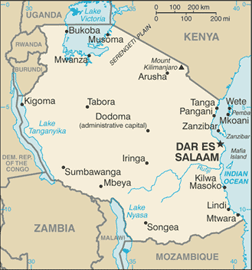
Tanzania is a source, transit, and destination country for
men, women, and children trafficked for the purposes of forced labor and
sexual exploitation. The incidence of internal trafficking is believed to be
higher than that of transnational trafficking. Tanzanian girls from rural
areas are trafficked to urban centers and the island of Zanzibar for domestic
servitude; some domestic workers fleeing abusive employers fall prey to
forced prostitution. Tourist hotels reportedly coerce some girls employed as
cleaning staff into prostitution. Boys are trafficked within the country for
forced labor on farms, in mines, in the informal business sector, and
possibly on small fishing boats. Smaller numbers of Tanzanian children and
adults reportedly are trafficked to surrounding African nations, South
Africa, Saudi Arabia, the United Kingdom, Sweden, and possibly other European
countries for domestic servitude and sexual exploitation. - U.S. State Dept
Trafficking in Persons Report, June, 2009 Check out a later
country report here
and possibly a full TIP Report here |
|
|||||||||||
|
CAUTION: The following links
have been culled from the web to illuminate the situation in HOW TO USE THIS WEB-PAGE Students If you are looking
for material to use in a term-paper, you are advised to scan the postings on
this page and others to see which aspects of Human Trafficking are of
particular interest to you. Would you
like to write about Forced-Labor? Debt
Bondage? Prostitution? Forced Begging? Child Soldiers? Sale of Organs? etc. On the other
hand, you might choose to include precursors of trafficking such as poverty and hunger. There is a lot to
the subject of Trafficking. Scan other
countries as well. Draw comparisons
between activity in adjacent countries and/or regions. Meanwhile, check out some of the Term-Paper resources
that are available on-line. Teachers Check out some of
the Resources
for Teachers attached to this website. ***
FEATURED ARTICLE *** Helping Children Reclaim
Their Lives
[PDF] 14 February 2006 www.tanzaniagateway.org/docs/reducing_childlabor_tanzania_through_Education.pdf [accessed 28
December 2010] In rural DETRIMENTAL WORKING
CONDITIONS
- Commercial agriculture in ***
ARCHIVES *** Who is to blame for
human trafficking, government or agencies? Victoria Nyeko, Daily Monitor, 11 August 2019 [accessed 13 August
2019] Recently, The EastAfrican newspaper reported that human trafficking is
on the increase in the region. Since travel between the East African
countries is now easier with passports no longer required, the neighbouring countries of Uganda, Kenya and Tanzania are said to be the main
transit locations for trafficking. Although the most common form of human
trafficking is sexual exploitation and forced labour,
there is also a growing market for human organs ... 2020 Country
Reports on Human Rights Practices: Tanzania U.S. Dept of State Bureau of Democracy, Human Rights, and
Labor, 30 March 2021 www.state.gov/reports/2020-country-reports-on-human-rights-practices/tanzania/
[accessed 28 June
2021] PROHIBITION OF
FORCED OR COMPULSORY LABOR The ILO reported
unspecified instances of forced labor, including those involving children
from the southern highlands forced into domestic service or labor on farms,
in mines, and in the informal business sector. PROHIBITION OF CHILD
LABOR AND MINIMUM AGE FOR EMPLOYMENT On the mainland
children worked as domestic workers, street vendors, and shopkeepers as well
as in agriculture, family-based businesses, fishing, construction, and
artisanal mining of gold and tanzanite. According to Human Rights Watch,
children as young as eight worked in mining. In Zanzibar children worked
primarily in fishing, clove picking, domestic labor, small businesses, and
gravel making. In Micheweni and Mwambe
villages, for example, children engaged in stone crushing, exposing them to
being hit by rock fragments. In fishing villages such as Matemwe,
children’s work at fish markets prevents them from attending school. Freedom House
Country Report 2020 Edition freedomhouse.org/country/tanzania/freedom-world/2020 [accessed 7 May 2020] G4. DO INDIVIDUALS
ENJOY EQUALITY OF OPPORTUNITY AND FREEDOM FROM ECONOMIC EXPLOITATION? Sexual and labor
exploitation remain problems, especially for children living in poor rural areas
who are drawn into domestic service, agricultural labor, mining, and other
activities. Child labor in gold mines, where working conditions are often
dangerous, is common. 2017 Findings on
the Worst Forms of Child Labor Office of Child
Labor, Forced Labor, and Human Trafficking, Bureau of International Labor
Affairs, US Dept of Labor, 2018 www.dol.gov/sites/default/files/documents/ilab/ChildLaborReport_Book.pdf [accessed 22 April
2019] www.dol.gov/sites/dolgov/files/ILAB/child_labor_reports/tda2017/ChildLaborReportBook.pdf [accessed 7 May
2020] Note:: Also check out this country’s report in the more recent edition DOL
Worst Forms of Child Labor [page 934] Tanzania is a
source, transit, and destination country for child trafficking for forced
labor and commercial sexual exploitation. Child trafficking is often
facilitated by victims’ family members, friends, or intermediaries promising
assistance or employment. (29; 31; 32; 6; 12) Girls are often trafficked for
domestic servitude or commercial sexual exploitation, including along the
Kenya border and in tourist areas. (29; 30; 6) Although most children are
trafficked internally, children from Burundi and Rwanda are also trafficked
to Tanzania for involuntary servitude. (33) Impoverished rural children and
those orphaned by HIV/AIDS are particularly vulnerable. (32; 34; 6; 12) Children working in
mining are exposed to many hazards such as mercury poisoning and entrapment when
tunnels collapse, especially in smaller unlicensed operations. (35; 22; 21). Diverse Human
Trafficking Trends in East African Region Highlights Urgent Need for Greater
Protection International
Organization for Migration IOM, 12 October 2010 [accessed 10
February 2016] In Adult victims were
identified in the domestic sector, as well as the mining, agricultural and
hospitality industries. The IOM assessment
established that Ugandan children are trafficked to all the countries in the
region with Uganda also a destination for trafficked victims from Kenya, Tanzania and Rwanda. Trafficking in
humans: Another threat calling for public intervention Bilham Kimati,
Guardian, 17 December 2007 At one time this
article had been archived and may possibly still be accessible [here]
[accessed 12
September 2011] Habiba Shegere, 14, (not her real name also an orphan) from The man said he
would take care of the girl and enroll her with a tailoring vocational
training college to help her become a competent tailor, earn a living to
support the grand parents back in the village. She was taken to a
strange family instead of a tailoring school where she worked as a house maid
for eight months without being paid anything.
She worked for 18 hours a day no payment in return for explanation
that she took meals, shelter and better looking second-hand cloths from the host family. After sometime someone advised her to be
bold enough to register complaints to the police. Unfortunately she
ended up in more misery than ever as the policeman found on duty was
spiteful. He kept her waiting for hours and finally advised her to accompany
him to his house for the night. After two weeks a
concerned neighbour reported the matter to the
police and local leaders as she always heard someone weeping in the house of
the policeman. The local leaders
forced open the door to rescue Habiba who was found
terribly depressed. She complained of
serious abdominal pains. She was taken to hospital only to be discovered that
she had already been infected with syphilis. IOM Launches
Campaign to Stop Human Trafficking in Lisa Schlein, Voice of www.voanews.com/content/a-13-2007-12-16-voa39/336689.html [accessed 23 June
2013] www.voanews.com/archive/iom-launches-campaign-stop-human-trafficking-tanzania [accessed 16 January
2020] Spokesman
Jean-Philippe Chauzy tells VOA most of the victims
are young boys and girls that are trafficked from rural to urban areas. "They are routinely abused and
exploited either as domestic workers or working in commercial agriculture, in
some cases, in fishing and mining industries," said Jean-Philippe Chauzy. Migration body to
monitor human trafficking impact [access information
unavailable] "Many girls
are taken from Iringa and brought to major cities to work as housegirls but they end up being subjected to prostitution
and other works which they did not expect, this is internal
trafficking," she said. Many young boys,
she said, are taken to work in the mining companies, something which not only
denies their rights but also are psychosocially affected. Tanzania
blacklisted over human trafficking The Guardian, 25
June 2004 At one time this
article had been archived and may possibly still be accessible [here]
[accessed 12
September 2011] Geoffrey Ijumba from UNICEF in Wanyenda: A New Life for a
Child Victim of Prostitution Rose www.dol.gov/ilab/grants/sga0106/Tanzania-FeatureStory-Wanyenda.htm [accessed 28
December 2010] www.jamiiforums.com/threads/tanzania-kuwa-thailand-siyo-kuhusu-mvua-ya-el.8155/ [accessed 19
February 2018] [scroll down] Wanyenda’s* ordeal dates back
to 1997 when she was in her third year at the Igawilo
primary school in the Mbeya region of the southern highlands of Tanzania.
Only 13 at that time, she decided to drop out of school and leave home, like
many of her friends before her, to escape difficult living conditions. It happened one day
when she was going to school and met a boy from a nearby village who
persuaded her to escort him to the town where he lived. This boy, who was
jobless, took her to a slum area called Mabatini
and she never came back. The boy would bring
home two or three of his friends and force Wanyenda
to sleep with all of them for cash payment. She was tortured, sexually abused
and sometimes beaten by the boy if she refused to provide the services.
Whenever the boy was away, she received customers on her own in order to earn
some money for food. TANZANIA: Focus on
child labour U.N. Integrated
Regional Information Networks IRIN, www.irinnews.org/report/45464/tanzania-focus-on-child-labour [accessed 9 March
2015] Kena, 13, left her home
in the northeastern Tanzanian port
town of At first, life in Despite being
frequently abused and beaten, Kena endured this
treatment for 15 months, earning 2,500 shillings ($2.50) a month until she
fled, eventually coming across a shelter run by an organisation
that cares for children who escape labour. MODERN-DAY SLAVERY - Mwaituka added that there was also an increase in the
number of girls being trafficked from various parts of the country to Dar es Salaam, where they are sold to work as domestic
workers, sometimes for as little as 20,000 shillings ($20). U.N. Integrated
Regional Information Networks IRIN, www.irinnews.org/report/32259/tanzania-child-labour-common-in-zanzibar [accessed 9 March
2015] A recent rapid
assessment by the International Labour Organisation (ILO), an associate organisation
of the United Nations, has found that child labour
is "common" in Concluding
Observations of the Committee on the Rights of the Child (CRC) UN Convention on the
Rights of the Child, 8 June 2001 www1.umn.edu/humanrts/crc/tanzania2001.html [accessed 28
December 2010] [64] The Committee
notes with concern that there have been reported incidents of the sale,
trafficking and abduction of children, especially girls, primarily for
domestic labor. The Protection
Project – Tanzania The Paul H. Nitze School of Advanced International Studies (SAIS),
The Johns Hopkins University www.protectionproject.org/country-reports/ [accessed 13
February 2019] A Human Rights
Report on Trafficking in Persons, Especially Women and Children ***
EARLIER EDITIONS OF SOME OF THE ABOVE *** Freedom House
Country Report 2018 Edition freedomhouse.org/country/tanzania/freedom-world/2018 [accessed 7 May 2020] G4. DO INDIVIDUALS
ENJOY EQUALITY OF OPPORTUNITY AND FREEDOM FROM ECONOMIC EXPLOITATION? Sexual and labor
exploitation remain problems, especially for children living in poor rural
areas who are drawn into domestic service, agricultural labor, mining, and other
activities. Tanzanians are also vulnerable to trafficking for work under
exploitative conditions abroad. Human Rights
Reports » 2005 Country Reports on Human Rights Practices U.S. Dept of State Bureau of Democracy, Human Rights, and
Labor, March 8, 2006 2009-2017.state.gov/j/drl/rls/hrrpt/2005/61596.htm [accessed 11
February 2020] TRAFFICKING
IN PERSONS
– Most victims were trafficked internally; boys were trafficked for exploitative
work on farms, in mines, and in the large informal sector, while girls from
rural areas were trafficked to the towns for involuntary domestic labor. Many
of these domestic workers have fled abusive employers and turned to
prostitution for survival. Most victims came from the regions of Iringa,
Mwanza, Dodoma Kigoma, Children in
low-income families were at significant risk of being trafficked, and girls
were more vulnerable than boys since girls were considered more of an
economic burden on their families. Girls who completed primary school but did
not enter secondary school were at particularly high risk. The country was
also experiencing a boom in the number of child-headed households as more
adults succumbed to HIV/AIDS-related disease and death, leaving their
dependents at very high risk for child labor and trafficking. Trafficking methods
varied. Some trafficking victims left their homes with assistance from their
family; some left on their own to escape life in rural areas; and some were
transported by someone who had offered to help them find city work,
legitimate or otherwise. There were reports that men recruited village girls
who had completed primary school but were not entering secondary school. The
men offered the girls money and employment and promised the girls a better
life if they accompanied them to urban areas; however, these girls reportedly
ended up in prostitution or domestic labor. Another method of trafficking
involved low-income parents entrusting a child to a wealthier relative o r respected member
of the community, who was charged with caring for the child as one of his or
her own. Some persons took advantage of this traditional practice and placed
the child in a situation where he or she was at risk of being exploited or
abused. Sometimes placement and transport to households was organized by
small-scale freelance agents who recruited children from rural villages. The Department of Labor’s 2004 Findings on
the Worst Forms of Child Labor www.dol.gov/ilab/media/reports/iclp/tda2004/tanzania.htm [accessed 28
December 2010] Note:: Also check out this country’s report in the more recent edition DOL
Worst Forms of Child Labor INCIDENCE
AND NATURE OF CHILD LABOR - Children are reportedly trafficked internally to
work in the fishing industry, mines, commercial agriculture, and domestic
service. Children are trafficked from
rural areas for exploitation in the commercial sex sector. It is reported that girls are trafficked
from All
material used herein reproduced under the fair use exception of 17 USC § 107
for noncommercial, nonprofit, and educational use. PLEASE RESPECT COPYRIGHTS OF COMPONENT
ARTICLES. Cite this webpage as: Patt,
Prof. Martin, "Human Trafficking & Modern-day Slavery - |
||||||||||||