Human Trafficking & Modern-day Slavery Poverty drives the unsuspecting poor into the
hands of traffickers Published reports & articles from 2000 to 2025 gvnet.com/humantrafficking/Somalia.htm
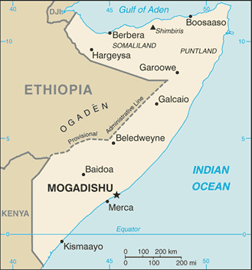
Scope and Magnitude. Information
regarding trafficking in Somalia remains extremely difficult to obtain or
verify; however, the Somali territory is believed to be a source, transit,
and perhaps destination country for trafficked men, women, and children. In
Somali society, certain groups are traditionally viewed as inferior and are
marginalized; Somali Bantus and Midgaan are sometimes
kept in servitude to other more powerful Somali clan members as domestics,
farm laborers, and herders. During the year, the widespread use of children
in fighting forces in the country was noted;
- U.S. State Dept Trafficking in Persons
Report, June, 2009
Check out a later
country report here and possibly a full TIP Report here |
|
|||||||||||
|
CAUTION: The following links
have been culled from the web to illuminate the situation in HOW TO USE THIS WEB-PAGE Students If you are looking
for material to use in a term-paper, you are advised to scan the postings on
this page and others to see which aspects of Human Trafficking are of
particular interest to you. Would you
like to write about Forced-Labor? Debt
Bondage? Prostitution? Forced Begging? Child Soldiers? Sale of Organs? etc. On the other
hand, you might choose to include precursors of trafficking such as poverty and hunger. There is a lot to
the subject of Trafficking. Scan other
countries as well. Draw comparisons
between activity in adjacent countries and/or regions. Meanwhile, check out some of the Term-Paper resources
that are available on-line. Teachers Check out some of
the Resources
for Teachers attached to this website. ***
FEATURED ARTICLE *** Human Trafficking:
Greed and the Trail of Death The Independent,
5/25/2006 www.crin.org/violence/search/closeup.asp?infoID=8393 [accessed 23
December 2010] anthony.sogang.ac.kr/Somalia.htm [accessed 15 January
2020] The human
trafficking trade out of Somalia is now one of the busiest, most lucrative
and the most lethal in the world. The ferocious violence and anarchy in the
region has kept the scale of profits and misery the most hidden from outside
eyes. Dozens corpses are
found floating in the Arabian Sea every month, often with gunshot wounds,
often with hands tied behind their back - victims of traffickers who have
jettisoned their cargo in the most final way. ***
ARCHIVES *** Outrage as Somali
parliament drafts law permitting child, forced marriages Nita Bhalla & Mohammed Omer, Thomson Reuters Foundation,
Nairobi/Garowe, 11 Aguust
2020 [accessed 12 August
2020] [Progress Needed] Somalia’s
parliament has sparked outrage by replacing long-awaited legislation to
protect women and girls from violence with a new bill permitting child and
forced marriage. The east African
nation has high rates of child marriage and violence against women, including
rape and female genital mutilation (FGM). The United Nations says 45% of
women are married before 18, while 98% have undergone FGM. “This amended bill
is harmful in nature to all Somalis but especially to women, girls and
children as it does not protect from child marriage, forced marriage, rape
and other forms of sexual abuse.” 2020 Country
Reports on Human Rights Practices: Somalia U.S. Dept of State Bureau of Democracy, Human Rights, and
Labor, 30 March 2021 www.state.gov/reports/2020-country-reports-on-human-rights-practices/somalia/
[accessed 24 June
2021] PROHIBITION OF FORCED
OR COMPULSORY LABOR Forced labor
occurred. Al-Shabaab continued forcibly to recruit children as young as eight
years old for combat. Children and minority clan members were reportedly used
as porters to transport the mild narcotic khat (or miraa), in farming and animal herding, crushing stones,
and construction. Al-Shabaab forced persons in their camps to move to the
countryside, reportedly to raise cash crops for the organization. PROHIBITION OF CHILD
LABOR AND MINIMUM AGE FOR EMPLOYMENT Child labor was
widespread, and the recruitment and use of child soldiers remained a problem
(see section 1.g.). A majority of children did not attend school, rendering
them vulnerable to child labor. Youth commonly worked in herding,
agriculture, household labor, and street work from an early age. Children
broke rocks into gravel and worked as vendors and transporters of cigarettes
and khat on the streets. Freedom House
Country Report 2020 Edition freedomhouse.org/country/somalia/freedom-world/2020 [accessed 7 July
2020] G4. DO INDIVIDUALS
ENJOY EQUALITY OF OPPORTUNITY AND FREEDOM FROM ECONOMIC EXPLOITATION? Child labor and trafficking
in persons for the purposes of sexual exploitation or forced labor are
common. Refugees and displaced persons are particularly vulnerable. Children
are abducted or recruited to serve as fighters by the Shabaab
and to a lesser extent by government and militia forces. 2017 Findings on
the Worst Forms of Child Labor Office of Child
Labor, Forced Labor, and Human Trafficking, Bureau of International Labor
Affairs, US Dept of Labor, 2018 www.dol.gov/sites/default/files/documents/ilab/ChildLaborReport_Book.pdf [accessed 22 April
2019] www.dol.gov/sites/dolgov/files/ILAB/child_labor_reports/tda2017/ChildLaborReportBook.pdf [accessed 5 May
2020] Note:: Also check out this country’s report in the more recent edition DOL
Worst Forms of Child Labor [page 897] As of September
2017, there were an estimated 2 million internally displaced persons in
Somalia. (10) Internally displaced persons, including children, are
vulnerable to human trafficking for sexual and labor exploitation. Trucks
transporting goods to Somalia return to Kenya with girls who are trafficked
for commercial sexual exploitation in brothels in Kenya and destinations
outside of Kenya. (1) Some Somali children seeking refuge in Kenya to avoid
recruitment by the terrorist organization al-Shabaab are subsequently
trafficked for labor and commercial sexual exploitation. Research also found
that children in Somalia are trafficked to Saudi Arabia and forced to beg on
the streets. (1) In 2017, the terrorist
group al-Shabaab increased its campaign of forcibly recruiting children as
young as age 8 for use in armed conflict. (1; 11) These children planted
explosive devices, acted as human shields, conducted assassinations and
suicide attacks, gathered intelligence, and provided domestic service; some
girls were also forced into sexual servitude. (1) Research found that the Ahlu Sunnah Wal Jama’a militia, which to date has not yet integrated into
the Somali National Army (SNA), recruited children. Somalia’s numerous clan
militias also used child soldiers. (1) During the reporting period, the SNA
recruited children for use in armed conflict, even though General Order No. 1
prohibits military personnel from recruiting and employing child soldiers.
(12; 1). Somalia: Journalist
Arrested in Bossasso National Union of
Somali Journalists ( article.wn.com/view/WNAT806b929f67b27f433f5a070ef2f87df5/ [accessed 11
September 2014] The National Union
of Somali Journalists (NUSOJ) is strongly condemning the arrest of Journalist
Idle Moallim in Bossasso on 5 January 2008 by the police force of Idle Moallim, a
freelance journalist, was arrested when the Puntland asked him several times
where he came from and what reports he prepared about Human Trafficking of
people travelling from Bossasso to the Gulf by boat. The authorities
detain him in the central detention centre in Bossasso. Human smuggling and
human trafficking in Somalia: Fact sheet - Nov 2007 UN Office for the
Coordination of Humanitarian Affairs, Report reliefweb.int/report/somalia/human-smuggling-and-human-trafficking-somalia-fact-sheet-nov-2007 [accessed 30 April
2019] The main reason of
these deaths is smugglers forcing Somalis and Ethiopians into stormy seas off
the coast of Yemen. Survivors reported that those who resisted were stabbed
and beaten with wooden and steel clubs, then thrown overboard. Some were then
attacked by sharks. Recovered bodies showed signs of severe mutilation. Upon
arrival to the Yemeni shore, some passengers reportedly had their money
confiscated by security forces. Such casualty rates
are not uncommon. Passengers also frequently report that some travellers are being tied up and/or thrown overboard by
the smugglers in an attempt to lighten their load and avoid capsizing. Others
drift for days at a time with little food or fresh water on board. Both
during the journey and en route to Bossaso, women report having been sexually abused,
exploited and/or raped by the smugglers, police and the multitude of militias
operating illegal checkpoints on the roads to Bossaso.
When the boats reach Yemen's coast, passengers - including children - are
routinely forced to swim the last kilometres so
that the boats are not detected by the Yemen authorities. Some never make it
to the coast. Fatality figures are difficult to verify as the trade is secret
and many bodies are never found. SUMMARY - Extreme
underdevelopment UN Office for the
Coordination of Humanitarian Affairs, Somalia 2004 Appeal www.un.org/depts/ocha/cap/somalia.html [accessed 23 December
2010] Somalis still face
extreme poverty and underdevelopment. They consistently rank among the lowest
in the world on key indicators of human development, life expectancy, per
capita income, malnutrition and infant mortality. Somalis also suffer
widespread human rights violations, including: murder, rape, looting and
destruction of property, child soldiering, kidnapping, discrimination against
minorities, torture, female genital mutilation, unlawful arrest and
detention, and denial of due process. Human Rights
Overview Human Rights Watch [accessed 23
December 2010] ***
EARLIER EDITIONS OF SOME OF THE ABOVE *** Human Rights
Reports » 2005 Country Reports on Human Rights Practices U.S. Dept of State Bureau of Democracy, Human Rights, and
Labor, March 8, 2006 2009-2017.state.gov/j/drl/rls/hrrpt/2005/61592.htm [accessed 11
February 2020] TRAFFICKING
IN PERSONS
– The pre-1991 law prohibits trafficking; however, there were reports of
trafficking during the year. The unimplemented TFC does not specifically
prohibit trafficking. Puntland was noted by human rights organizations as an
entry point for trafficking. The UNIE reported that trafficking in persons
remained rampant in The Department of Labor’s 2004 Findings on
the Worst Forms of Child Labor www.dol.gov/ilab/media/reports/iclp/tda2004/somalia.htm [accessed 23
December 2010] Note:: Also check out this country’s report in the more recent edition DOL
Worst Forms of Child Labor INCIDENCE
AND NATURE OF CHILD LABOR - Children are also conscripted by armed Somali
militias and used for forced labor or sexual exploitation. Boys as young as 14 or 15 have participated
in combat and many belong to gangs who raid indiscriminately. Trafficking networks exist that transport
children to All
material used herein reproduced under the fair use exception of 17 USC § 107
for noncommercial, nonprofit, and educational use. PLEASE RESPECT COPYRIGHTS OF COMPONENT
ARTICLES. Cite this webpage as: Patt,
Prof. Martin, "Human Trafficking & Modern-day Slavery - |
||||||||||||