Human Trafficking & Modern-day Slavery Poverty drives the unsuspecting poor into the
hands of traffickers Published reports & articles
from 2000 to 2025 gvnet.com/humantrafficking/SierraLeone.htm
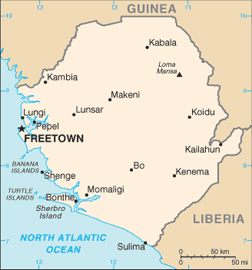
Sierra Leone is a
source, transit, and destination country for children and women trafficked
for the purposes of forced labor and commercial sexual exploitation. The
majority of victims are children trafficked internally within the country,
largely from rural provinces, and sometimes from refugee communities, to
urban and mining centers. Within the country, women and children are
trafficked for: domestic servitude; commercial sexual exploitation; forced
labor in agriculture, diamond mining, and the fishing industry; forced petty
trading; forced street crime; and forced begging. - U.S. State Dept
Trafficking in Persons Report, June, 2009 Check
out a later country report here and possibly a full TIP Report here |
|
|||||||||||
|
CAUTION: The following
links have been culled from the web to illuminate the situation in HOW TO USE THIS WEB-PAGE Students If you are looking for
material to use in a term-paper, you are advised to scan the postings on this
page and others to see which aspects of Human Trafficking are of particular
interest to you. Would you like to
write about Forced-Labor? Debt
Bondage? Prostitution? Forced Begging? Child Soldiers? Sale of Organs? etc. On the other
hand, you might choose to include precursors of trafficking such as poverty and hunger. There is a lot to
the subject of Trafficking. Scan other
countries as well. Draw comparisons
between activity in adjacent countries and/or regions. Meanwhile, check out some of the Term-Paper resources
that are available on-line. Teachers Check out some of
the Resources
for Teachers attached to this website. ***
FEATURED ARTICLES *** Children working in
Lansana Fofana, BBC
News, news.bbc.co.uk/2/hi/africa/3189299.stm [accessed 22
December 2010] BLESSINGS - Undoubtedly, the
children number several thousands, and many of them get the blessing of their
parents, who have come to see them as breadwinners of the impoverished
families. Over the past few days, I
have been visiting the mine sites here and what I see is incredible. The children aged between seven and 16 go
to the mines as early as 0800 and work through to 1800. They do hard labour, like digging in soil
and gravel, before sifting with a pan for gemstones and shifting heavy mud
believed to contain diamonds. Boy soldier
'recruited' at the age of 6 The Times, March 30,
2004 www.essex.ac.uk/armedcon/story_id/000179.html [accessed 25 April
2012] Kabba
Williams is thought to have been One day in
particular is etched on his memory. At the age of 12 he was given a group of
captives to kill. “I had the nickname ‘Hungry Lion’. I was given a bayonet.
They were tied up, six of them. I stabbed them repeatedly with the knife.” ***
ARCHIVES *** 2020 Country
Reports on Human Rights Practices: Sierra Leone U.S. Dept of State Bureau of Democracy, Human Rights, and
Labor, 30 March 2021 www.state.gov/reports/2020-country-reports-on-human-rights-practices/sierra-leone/
[accessed 23 June
2021] PROHIBITION OF
FORCED OR COMPULSORY LABOR Men, women, and
child victims of forced labor originated largely from rural provinces within
the country and were recruited to urban areas for artisanal and granite
mining, petty trading, rock breaking, fishing and agriculture, domestic
servitude, and begging (see also section 7.c. and section 6, Sexual
Exploitation of Children). The Ministry of Social Welfare reported it was
aware of trafficking, domestic service, mining, or other activities, but it
had no specific data on these forms of forced or compulsory labor. PROHIBITION OF CHILD
LABOR AND MINIMUM AGE FOR EMPLOYMENT In remote villages
children were forced to carry heavy loads as porters, which contributed to
stunted growth and development. There were reports that children whose
parents sent them to friends or relatives in urban areas for education were
forced to work on the street, where they were involved in street vending,
stealing, and begging. According to the
NGO GOAL Ireland, more than 45 percent of children aged 5-17 were engaged in
child labor, with more than 20 percent involved in dangerous work. Children
were on the streets selling water, groundnuts, cucumbers, and other items.
Children engaged in petty trading, carrying heavy loads, breaking rocks,
harvesting sand, begging, diamond mining, deep-sea fishing, agriculture
(production of coffee, cocoa, and palm oil), domestic work, commercial sex,
scavenging for scrap metal and other recyclables, and other hazardous work.
Larger mining companies enforced strict rules against child labor, but it
remained a pressing problem in small-scale informal artisanal diamond and
gold mining. As in previous
years, many children worked alongside parents or relatives and abandoned
educational or vocational training. In rural areas children worked seasonally
on family subsistence farms. Children also routinely assisted in family
businesses and worked as petty vendors. There were reports that adults asked
orphanages for children to work as household help. Because the adult
unemployment rate remained high, few children were involved in the industrial
sector or elsewhere in the formal economy. Freedom House
Country Report 2018 Edition freedomhouse.org/country/sierra-leone/freedom-world/2018 [accessed 6 May 2020] G4. DO INDIVIDUALS
ENJOY EQUALITY OF OPPORTUNITY AND FREEDOM FROM ECONOMIC EXPLOITATION? Reports of economic
exploitation of workers in the natural resource sector are common. Barriers to
access remain for individuals who wish to seek redress for economic
exploitation. While it is not common
for individuals to take such cases to the formal legal system, there is
little data on how such issues are handled. Child trafficking
remained a problem in 2017. Through August 2017, 698 cases of sexual
exploitation of children were reported, and only 142 were referred for
prosecution. Child labor is prevalent, despite laws limiting it. 2017 Findings on
the Worst Forms of Child Labor Office of Child
Labor, Forced Labor, and Human Trafficking, Bureau of International Labor
Affairs, US Dept of Labor, 2018 www.dol.gov/sites/default/files/documents/ilab/ChildLaborReport_Book.pdf [accessed 22 April
2019] www.dol.gov/sites/dolgov/files/ILAB/child_labor_reports/tda2017/ChildLaborReportBook.pdf [accessed 6 May
2020] Note:: Also check out this country’s report in the more recent edition DOL
Worst Forms of Child Labor [page 883] Sierra Leone is a
source, transit, and destination country for children trafficked for forced
labor in domestic work, granite and diamond mining, and begging; trafficking
for commercial sexual exploitation also occurs. (3; 8; 20; 22). Trafficking
of African women is thriving Francois Tillinac, International Labour Organisation (ILO) News, May 10 2007 www.iol.co.za/news/africa/trafficking-of-african-women-is-thriving-1.352453 [accessed 14
November 2010] In January Italian
police smashed several human trafficking rings involving African and eastern
European females and netted some 800 suspects. Outside Four Nations Move
Against Trafficking in Response to U.S. Report Bureau of
International Information Programs, iipdigital.usembassy.gov/st/english/texttrans/2004/09/20040910174056cmretrop0.6162226.html#axzz3CMfHlohT [accessed 4
September 2014] "These four
countries made notable progress in many key areas including prosecution of
trafficking related cases; creating police anti-trafficking units; increasing
efforts to identify and rescue trafficking victims; drafting new
anti-trafficking legislation and procedures; and conducting high-profile
public awareness campaigns," said spokesman Scott McClellan. "These
tremendous accomplishments will punish perpetrators and help innocent victims
of this heinous crime around the world." afrol News (African
News Agency), June 3, 2004 www1.essex.ac.uk/armedcon/story_id/000203.html [accessed 22
December 2010] The International law
history has been written in Sierra Leone -
Human Rights Aisling www.bellaonline.com/articles/art24082.asp [accessed 22
December 2010] Sierra Leone is
probably is the poorest country of the world due to the ravaging civil war
and the terrorist activities of the Revolutionary United Front, or RUF. For both
men and women, living under these conditions is producing hundreds of
thousands refugees and internal displacement. Generally speaking, it is
difficult to differentiate between women's rights and human rights. Women and
children are known to be the principal war victims. women and Children are
often submitted to rape, sexual slavery, forced labour, torture, mutilation
and forced recrutiation by the RUF. The RUF is notoriously known to use
terror against the civil population, especially Women and Children.
Violations such as these are one of their principal war tactics. The biggest
UN peacekeeping force in history is present, so now exists some hope of peace
in the country. USAID/Sierra Leone
Transition Strategy Phase 2 - Fy 2004 – Fy 2006 USAID At one time this
article had been archived and may possibly still be accessible [here] [accessed 11
September 2011] BACKGROUND - The emergence of
the Revolutionary United Front (RUF), a loose grouping of former Sierra
Leonean soldiers and mercenaries backed by Liberian president, Charles
Taylor, in early 1991 led Open letter to
Permanent Representatives at the African Union (AU) regarding the case of
Charles Taylor, former President of Amnesty
International, Index Number: IOR 63/007/2004, Date Published: 3 August 2004 www.amnesty.org/en/library/info/IOR63/007/2004/en [accessed 22
December 2010] This decision is a
betrayal of the tens of thousands of African victims of the worst possible
crimes imaginable committed during the conflict in 2004 UN Commission
on the Status of Women. Violence against Women: universal but not inevitable! Amnesty
International, Index Number: IOR 41/004/2004, Date Published: 1 March 2004 www2.amnesty.se/svaw.nsf/0/924AB7A1E3C85228C1256E82002F3951?opendocument [accessed 22
December 2010] www.amnesty.org/en/documents/ior41/004/2004/en/ [accessed 22
December 2010] VIOLENCE IN
POST-CONFLICT SITUATIONS - Peace processes have routinely failed to include
women and to deal with gender issues, which can result in gender-based
persecution and violence being rendered invisible in peace agreements and not
taken into account in their interpretation and implementation. For example,
an AI delegation which visited UNICEF: War fuels Jonathan Fowler,
Associated Press AP, www.highbeam.com/doc/1P1-93762330.html [partially accessed
28 August 2011 - access restricted] apnews.com/b27f9b0b3192888782d9c3e4cb15c893 [accessed 24
February 2019] Some 80 percent of
African nations reported "internal trafficking," where individuals
do not cross borders but are shifted around the country to meet demand for
cheap household and farm labor and prostitution. Flawed or
nonexistent birth registration makes it easier for traffickers to move
youngsters between countries, because unregistered children never formally
acquire a nationality, said Rossi.
"It becomes impossible to prove whether a young girl working as a
housemaid in In sub-Saharan Victoria Brittain,
The Guardian, 16 January 2003 www.guardian.co.uk/world/2003/jan/16/sierraleone.westafrica [accessed 22
December 2010] Unknown numbers of
the thousands of women and girls abducted by the rebels still remain with
their "husbands" in conditions of sexual slavery, although the war
was declared over a year ago, HRW reports.
There has been no accountability for the thousands of crimes of sexual
violence, and a climate of impunity persists, the report says, allowing the
perpetrators of sexual violence (as well as other crimes) to escape justice. Survivors of rape and other sexual crimes -
some boys as well as the thousands of women and girls - need
"drastically increased funding for trauma counselling, health, education
and skills training", according to HRW. Sierra rebels free
child soldiers BBC News, 26 May
2001 news.bbc.co.uk/2/hi/africa/1352801.stm [accessed 22
December 2010] Rebels in Children have
carried out some of the worst atrocities of the war, including hacking off
the limbs of enemies and civilians. Forced labour,
human trafficking, slavery haunt us still International Labour
Organisation (ILO) News, World Of Work, No. 39, June 2001 www2.ilo.org/public/english/bureau/inf/magazine/39/human.htm [accessed 22
December 2010] www.ilo.org/global/about-the-ilo/newsroom/news/WCMS_007842/lang--en/index.htm [accessed 15
February 2018] The report notes
that outright slavery, though increasingly rare in the modern world, is still
found in a handful of countries, and the wholesale abduction of individuals
and communities in such conflict-torn societies as Liberia, Mauritania, Sierra Leone and Sudan is not
uncommon. The forced recruitment of children for armed conflict, deemed one
of the worst forms of child labour, is also on the rise. Amnesty
International www.amnesty.org/en/library/info/AFR51/069/2000/en [accessed 3
September 2012] MAY 2000 - CHILDREN
AGAIN FORCED INTO CONFLICT - In his Fourth Report on UNAMSIL to the UN Security
Council on 19 May 2000, the UN Secretary-General cited preliminary reports
which suggested that child combatants were being used extensively as
hostilities resumed. UNAMSIL human rights officers who visited Masiaka on 15
May 2000 observed several child combatants, mostly boys, with the CDF, the
AFRC and former Sierra Leone Army and the reconstituted Sierra Leone Army.
Some 25 per cent of the combatants observed were under 18 and some freely
admitted that they were between 7 and 14. Almost all of them were armed. Concluding
Observations Of The Committee On The Rights Of The Child (CRC) UN Convention on the
Rights of the Child, 28 January 2000 www1.umn.edu/humanrts/crc/sierraleone2000.html [accessed 22
December 2010] [52] The Committee
notes the introduction by the State party of the 1989 Adoption Act, but is
nevertheless concerned that child nationals of the State party may remain
vulnerable to problems of illegal adoption, including inter-country adoption. ***
EARLIER EDITIONS OF SOME OF THE ABOVE *** Human Rights
Reports » 2005 Country Reports on Human Rights Practices 2009-2017.state.gov/j/drl/rls/hrrpt/2005/61591.htm [accessed 11
February 2020] TRAFFICKING
IN PERSONS
– The country continued to be a source, transit point, and destination for
internationally trafficked persons. The majority of victims were women and
the majority of traffickers were thought to be family members or friends who
lured victims from their home villages with promises of education,
caretaking, or employment. There were no
specific figures on the number of persons trafficked. However, anecdotal
reports indicated the following: children were trafficked from the provinces to
work in the capital as laborers and commercial sex workers and to diamond
areas for labor and sex work; persons were trafficked from neighboring
countries for domestic and street labor and for commercial sex work; persons
were trafficked out of the country to destinations in west Africa, including
Nigeria, Cote d'Ivoire, Guinea, and Guinea-Bissau for labor and sex work;
persons were also trafficked to Lebanon, Europe, and North America; and the
country served as a transit point for persons trafficked from elsewhere in
west Africa and possibly the Middle East. The Department of Labor’s 2004 Findings on
the Worst Forms of Child Labor www.dol.gov/ilab/media/reports/iclp/tda2004/sierra-leone.htm [accessed 22
December 2010] Note:: Also check out this country’s report in the more recent edition DOL
Worst Forms of Child Labor INCIDENCE
AND NATURE OF CHILD LABOR - Trafficking in persons declined with the
demobilization of child soldiers following the end of the civil
conflict. Children have been
trafficked to All
material used herein reproduced under the fair use exception of 17 USC § 107 for
noncommercial, nonprofit, and educational use. PLEASE RESPECT COPYRIGHTS OF COMPONENT
ARTICLES. Cite this webpage as: Patt,
Prof. Martin, "Human Trafficking & Modern-day Slavery – |
||||||||||||