Human Trafficking & Modern-day Slavery Poverty drives the unsuspecting poor into the
hands of traffickers Serbia,
Montenegro & Kosovo Published reports & articles from
2000 to 2025 gvnet.com/humantrafficking/Serbia-Montenegro.htm
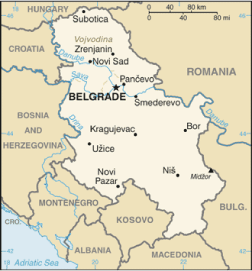
Serbia is a source, transit, and destination
country for men, women, and girls trafficked internationally and within the
country for the purposes of commercial sexual exploitation and forced labor …
Children, mostly Roma, continued to be trafficked for the purpose of sexual
exploitation, forced marriage, or forced street begging. The majority of
identified victims in 2008 were Serbian women and girls trafficked for the
purpose of sexual exploitation; over half were children. There was an
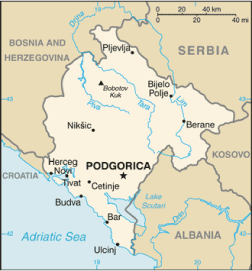
increase in cases of trafficking for forced labor in 2008. - U.S. State Dept Trafficking in Persons Report, June, 2009 Check out a later country report here and possibly a full TIP Report here Montenegro is primarily a transit country for the
trafficking of women and girls from Ukraine, Moldova, Serbia, Albania, and
Kosovo to Western Europe for the purpose of commercial sexual exploitation.
There have been reported cases of forced labor in the construction industry.
There is anecdotal evidence that foreign children, mainly Roma, are also
trafficked through Montenegro for the purpose of forced begging. - U.S. State
Dept Trafficking in Persons Report, June, 2009 Check
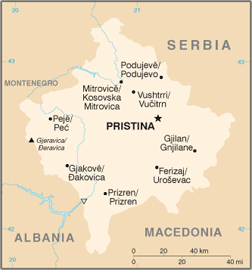
out a later country report here and possibly a full TIP Report here Kosovo is a source, transit, and destination
country for women and children trafficked across national borders for the
purpose of commercial sexual exploitation. Kosovo women and children are also
trafficked within Kosovo for the same purpose. NGOs reported that child
trafficking, particularly from Roma communities, for the purpose of forced
begging, was an increasing problem. Most foreign victims are young women from
Eastern Europe subjected to forced prostitution. Kosovo victims are also
trafficked to countries throughout Europe including Macedonia, Italy, and
Albania. Kosovo residents, including three children, made up the majority of
identified trafficking victims in 2008. Police report that internal
trafficking involving Kosovo Serbs may also occur in north Kosovo, a Serb-majority
region that presents particular security challenges. - U.S. State Dept Trafficking in Persons Report, June, 2009 Check
out a later country report here and possibly a full TIP Report here |
|||||||||||||||
|
CAUTION: The following links
have been culled from the web to illuminate the situation in Serbia,
Montenegro and Kosovo. Some of these
links may lead to websites that present allegations that are unsubstantiated
or even false. No attempt has been made to validate their authenticity
or to verify their content. HOW TO USE THIS WEB-PAGE Students If you are looking for
material to use in a term-paper, you are advised to scan the postings on this
page and others to see which aspects of Human Trafficking are of particular
interest to you. Would you like to
write about Forced-Labor? Debt
Bondage? Prostitution? Forced Begging? Child Soldiers? Sale of Organs? etc. On the other
hand, you might choose to include precursors of trafficking such as poverty and hunger. There is a lot to
the subject of Trafficking. Scan other
countries as well. Draw comparisons
between activity in adjacent countries and/or regions. Meanwhile, check out some of the Term-Paper resources
that are available on-line. Teachers Check out some of
the Resources
for Teachers attached to this website. HELP for Victims ASTRA (NGO) ***
FEATURED ARTICLE *** Shameful Investigation
Into Sex-Trafficking Case Amnesty
International, Index Number: EUR 70/001/2005, Date Published: 1 February 2005 www.amnesty.nl/nieuwsportaal/pers/shameful-investigation-sex-trafficking-case [accessed 26
February 2015] www.amnesty.org/en/documents/eur70/001/2005/en/ [accessed 16 June
2017] The government of
Montenegro must re-open as a matter of priority a high-profile
sex-trafficking case in which Montenegrin politicians, judges, police and
civil servants are implicated, Amnesty International said in a letter to the
Minister of the Interior of Montenegro. The Moldovan woman in the centre of
the case alleges that Montenegrin politicians, judges, police and civil
servants had tortured and raped her and other East European women who like
her had been trafficked and held as sex-slaves. A Legal Analysis of
Trafficking in Persons Cases in Kosovo [PDF] Organization for
Security and Co-operation in Europe, The Department Of Human Rights,
Decentralization, And Communities, Legal System Monitoring Section, October
2007 [accessed 28 August
2011] [page 3] EXECUTIVE SUMMARY - The problem of
trafficking in human beings (“trafficking”) continues to be a major human
rights concern in Kosovo. In cases monitored
by the OSCE, victims did not receive the basic guarantees provided by law,
and frequently faced prosecution or the threat of prosecution. Witness
protection measures were rarely used, despite the regular intimidation of
victims. Moreover, judges and prosecutors often failed to understand the
legal definition of the crime of trafficking, or permit perpetrators to go
unpunished. In summary, the OSCE
observed that authorities involved in the investigation and prosecution of
alleged traffickers fail to adopt a victim-centred approach, or to ensure
that perpetrators face justice. ***
ARCHIVES *** Montenegrin Police Cut
Human Trafficking, Slavery Chain Zdravko Ljubas,
Organized Crime and Corruption Reporting Project OCCRP, 10 January 2020 www.occrp.org/en/daily/11403-montenegrin-police-cuts-human-trafficiking-slavery-chain [accessed 11 January
2020] Montenegrin police
say they found during a raid on Thursday nearly 100 people from Taiwan
confined in three villas, where they were forced to commit unspecified cyber
fraud that was targeting China and Taiwan. “During the search
of those premises, we found 93 people, citizens of Taiwan, whose passports
were taken away and whose movement was limited,” read the statement. Police provided no details
about the operation, but confirmed that a number of suspects “with huge
amounts of money,” and a strong hierarchical structure, kept and controlled
the victims. They also confirmed that some “electronic devices” were seized
and will be the subject of a forensic expertise. 2020 Country
Reports on Human Rights Practices U.S. Dept of State Bureau of Democracy, Human Rights, and
Labor, 30 March 2021 www.state.gov/reports/2020-country-reports-on-human-rights-practices/serbia/ www.state.gov/reports/2020-country-reports-on-human-rights-practices/
montenegro/ www.state.gov/reports/2020-country-reports-on-human-rights-practices/kosovo/
[accessed 22 June
2021] PROHIBITION OF FORCED OR COMPULSORY LABOR SERBIA -- Citizens of the country, particularly
men, were reportedly subjected to labor trafficking in labor-intensive
sectors, such as the construction industry in Russia, other European
countries, and the United Arab Emirates. Penalties for violations within the
country were commensurate with those for other analogous serious crimes, such
as kidnapping. A number of
children, primarily from the Roma community, were forced to engage in
begging, theft, domestic work, commercial sexual exploitation, and other
forms of labor (see section 7.c.). MONTENEGRO – In January police operated the “Call
Center” action and reported that 93 Taiwanese persons were found and arrested
in three locations in Podgorica. The investigation showed that 37 persons, of
whom 25 were men and 12 were women, were victims of
forced labor and received the status of trafficking in persons victims. The
status of an additional 40 persons involved in the case was still unknown.
The traffickers restricted the movement of their victims and used force and
threats to commit fraud through the internet against persons from
Asian-language areas. Montenegrin police in cooperation with Taiwanese police
returned the victims and perpetrators to their country of origin, where
prosecutions were ongoing. There were reports
of Romani girls forced into domestic servitude and of children forced to beg,
mostly by their families (see section 7.c.). Migrants from neighboring
countries were vulnerable to forced labor during the summer tourist season,
although to a lesser extent during the year due to the COVID-19 pandemic.
There were no reports of prosecutions or convictions. KOSOVO -- The labor inspectorate reported
conducting only limited investigations for forced labor offenses. Penalties,
although commensurate with those for other serious crimes, were seldom
applied. PROHIBITION OF CHILD LABOR AND MINIMUM AGE FOR
EMPLOYMENT SERBIA -- In villages and farming communities,
underage children commonly worked in family businesses. In urban areas
children, primarily Roma, worked in the informal
sector as street vendors, car washers, and garbage sorters. With regard to the
worst forms of child labor, traffickers subjected children to commercial
sexual exploitation, used children in the production of pornography and
drugs, and sometimes forced children to beg and commit crimes. Some Romani
children were forced into manual labor or begging. MONTENEGRO – Many parents and relatives forced
Romani, Ashkali, and Balkan-Egyptian children to
work at an early age to contribute to their family’s income. They engaged in
begging at busy intersections, on street corners, door to door, and in
restaurants and cafes or in sifting through trashcans. While many working
children were from the country, a large percentage of those between the ages
of seven and 16 were from nearby countries, mainly Kosovo and Serbia. Police
generally returned the children they apprehended to their families. In villages,
children usually worked in family businesses and agriculture. Romani, Ashkali, and Balkan-Egyptian children worked chiefly
during the summer, typically washing car windows, loading trucks, collecting
items such as scrap metal, selling old newspapers or car accessories, or
working alongside their parents as day laborers. Many internally displaced
Romani, Ashkali, and Balkan-Egyptian children were
forced to engage in begging or manual labor. Police asserted that begging was
a family practice rather than an organized, large-scale activity, but this
claim was disputed by several NGOs. Begging was readily observable,
particularly in Podgorica and the coastal areas during the summer. During a
March operation dubbed “Beggar,” police identified children forced to beg and
prosecuted their parents, who faced misdemeanor charges. The children were
returned to their families. KOSOVO -- Child labor occurred primarily in the
informal sector. As of May, NGO Terres Des Hommes
reported 116 cases of minors (105 Kosovo citizens and 11 minors from Albania)
working in hazardous conditions. Of these, 73 were children engaged in
begging, 13 in street work, and 14 in coal extraction. The Coalition of
NGOs for the Protection of Children reported that children working in
agriculture encountered hazards from operating farm equipment. The coalition
reported that child labor in farming persisted as a traditional activity.
Government-run social-work centers reported children engaged in farming were
primarily in the informal sector and were not prevented from attending
school. While children were rarely their families’ main wage earners, child
labor contributed substantially to some families’ income. Urban children
often worked in a variety of unofficial construction and retail jobs, such as
selling newspapers, cigarettes, food, or telephone cards on the street. Some
children, especially those from ethnic minorities or from families receiving
social assistance, engaged in physical labor such as transportation of goods
or in picking through trash piles for items to sell. Freedom House
Country Report 2020 Editions, if
ready. Earlier editions are posted
below. Serbia - freedomhouse.org/country/serbia/freedom-world/2020 [accessed 6 May 2020] Montenegro - freedomhouse.org/country/montenegro/freedom-world/2020 [accessed 6 May 2020] Kosovo - freedomhouse.org/country/kosovo/freedom-world/2020 [accessed 6 May 2020] Findings on the
Worst Forms of Child Labor Office of Child
Labor, Forced Labor, and Human Trafficking, Bureau of International Labor
Affairs, US Dept of Labor www.dol.gov/agencies/ilab/resources/reports/child-labor/findings [accessed 20 January
2020] Note:: Also check out the country reports in the more recent edition DOL
Worst Forms of Child Labor [Select Serbia, Montenegro, & Kosovo] The Department of
Labor's annual Findings on the Worst Forms of Child Labor focuses on the
efforts of certain U.S. trade beneficiary countries and territories to
eliminate the worst forms of child labor through legislation, enforcement
mechanisms, policies and social programs. KPS rescues 2 human
trafficking victims BETA News Agency,
PRIŠTINA, 26 January 2008 www.b92.net/eng/news/crimes-article.php?yyyy=2008&mm=01&dd=26&nav_id=47248 [accessed 21
December 2010] www.b92.net/eng/comments.php?nav_id=47248 [accessed 24
February 2019] “Thanks to
cooperation from citizens, members of the anti-human trafficking unit
discovered two females from Kosovo in a hotel basement on Friday,
that had been locked up there against their will,” announced the
Peć Regional Police. A preliminary
investigation has revealed that the two girls, who are of Albanian ethnicity,
were locked up there for over two months. Amnesty
International on human rights in Serbia and Kosovo Amnesty
International, 15 February 2007 [accessed 6 May
2020] WHAT ACTION WOULD YOU LIKE TO SEE FROM THE EU’S SIDE TO TACKLE
HUMAN-RIGHTS ISSUES THAT ALSO CONCERN THE UNION ITSELF, SUCH AS HUMAN
TRAFFICKING? With respect to
trafficking, we urge the EU to assist the Kosovo authorities in implementing
the Kosovo Action Plan on Trafficking, to ensure the protection of the rights
of trafficked persons, including to assistance and other forms of support, in
compliance with the Council of Europe Convention on Action against
Trafficking in Human Beings. Over 120.000 human
trafficking victims pass via Balkan a year MakFaxOnline,
Belgrade 22 December 2006 At one time this
article had been archived and may possibly still be accessible [here]
[accessed 11
September 2011] More than 120.000
women and children, victims of human trafficking, pass through the Balkan
region per year before heading to the EU member-countries, Serbian government
said. "The number of trafficked
children rose from 10 to 56 percent, and lately up to 60 percent of identified
victims of human trafficking are Serbian citizens," said Serbian
Minister of Labor, Employment & Social Welfare Slobodan Lalovic. Human trafficking
recovery center opens in Belgrade B92 News, 16
September 2006 www.b92.net/eng/news/society.php?yyyy=2006&mm=09&dd=16&nav_id=36789 [accessed 24 June
2013] The
center's program was developed according to the demands and experiences
of victims, in order to offer help to abused women and enable them to return
to their normal lives and reintegrate into society. The route to hell Louisa Waugh, The
Scotsman, 22 August 2006 At one time this
article had been archived and may possibly still be accessible [here] [accessed 11
September 2011] Reports of women
and girls being trafficked into Kosovo began to emerge within months of the
United Nations mission in Kosovo and the NATO peacekeepers arriving in July
1999. While writing this book I travelled to Kosovo, and found it an
intimidating place to research the subject of trafficking. People were
guarded with information, and it is the only place I have ever been
threatened by a police officer for asking questions about human trafficking -
he said that he could have me detained if he wanted to. Human trafficking
in Vojvodina BETA News Agency, 7
August 2006 www.b92.net/eng/news/society.php?yyyy=2006&mm=08&dd=07&nav_id=36024 [accessed 8 February
2016] The victims are
most commonly women from poor families who were subjected to violence within
their families. Their documents are taken away and many times they are
threatened to be killed or thrown into the Danube River where no one will
find them. Protecting the
human rights of women and girls trafficked for forced prostitution in Kosovo
- Summary Amnesty
International, 06/05/2004 www.amnesty.eu/static/documents/Kosovo_summary.doc [accessed 21
December 2010] www.amnesty.org/en/documents/eur70/010/2004/en/ [accessed 24
February 2019] In this report,
Amnesty International attempts to add to the growing understanding of
trafficking as an abuse of human rights, not least the right to physical and
mental integrity, and of the right to life, liberty and security of the
person. The report
documents abuses perpetrated against women and girls in Kosovo, including
abduction, deprivation of liberty and denial of freedom of movement, often
combined with other restrictions, including the withdrawal of travel or
identity documents. The organization also finds that women and girls have
been subjected to torture and ill-treatment, including psychological threats,
beatings and rape. Co-operation to
Stop Sex Traffic Radio Sweden, 31
August 2005 sverigesradio.se/sida/artikel.aspx?ProgramID=2054&format=1&artikel=683238 [accessed 21
December 2010] The Swedish police have
begun working with their counterparts in Kosovo to stop a gang responsible
for sex trafficking. The co-operation
follows the case of a 17-year-old girl kidnapped from Kosovo and brought to
Sweden and forced into prostitution. Albanians Given 10
To 12 Years In Jail For Human Trafficking ONASA News Agency
& Agence France-Presse AFP, PRISTINA, 22 July 2005 kosovonewsandviews.blogspot.com/2005/07/albanians-given-10-to-12-years-in-jail.html [accessed 21
December 2010] Singh said the
investigation found out that two female victims from Albania, one of them 16
years old, "had been lured to Kosovo with false promises of legitimate
work, only to find that their supposed employers were in fact intending to
force them into prostitution". 13 Arrests in 10
Days on Human Trafficking Charges OneWorldSee,
03/03/2005 www.oneworldsee.org/sq/node/7214 [accessed 21
December 2010] UNMIK Police Trafficking
of Human Beings Section (THBS) has arrested 13 persons on Human Trafficking
charges in the past ten days. Based on checks, surveillance and
intelligence-led operations, the investigative teams were able to rescue four
female victims, one in Prishtinë/Pristina, two in Gjilan/Gnjilane and one in
Prizren Region and take into custody these 13 persons involved in the
trafficking. In one case, after
being forced into prostitution, the rescued victim had also been sold for
marriage: 4 suspects involved in the case were arrested. In another case, the
victim had been forced into prostitution by her boyfriend who brutally abused
her. Human Trafficking
Trial in Bijelo Polje OneWorldSee,
30/03/2005 oneworldsee.org/node/7650 [accessed 21
December 2010] The prosecution,
represented by the Deputy State Prosecutor Lepa Medenica, accused Licina of
holding forcibly Milica Novakovic from Pozega at his “Montenegro” Bar in
Rozaje, and forced her into prostitution. Milica Novakovic was brought to
Licina by Petrovic and Cubrakovic, under the false pretext that she would be
employed as a waitress. Balkans Urged To
Curb Trafficking Imogen Foulkes, BBC
News, Geneva, 31 March 2005 news.bbc.co.uk/2/hi/europe/4397497.stm [accessed 21
December 2010] Countries in South-East Europe are failing to take effective measures against people trafficking, the United Nations Children's Fund (UNICEF) says. A UNICEF report says that while countries in the region have strict anti-trafficking laws they do not tackle the root causes of the problem. Initiative to Help
Fight Human Trafficking in Three SEE Countries Robert Herschbach
for Southeast European Times – 05/04/05 www.setimes.com/cocoon/setimes/xhtml/en_GB/features/setimes/features/2005/04/05/feature-03?print=yes [accessed 21
December 2010] Bulgaria, Croatia
and Serbia-Montenegro are located in a pivotal zone between poorer countries
to the east and the affluent nations of the EU, and function as transit
points. Anti-trafficking efforts in
Serbia have run into continuing problems with inadequate witness protection
and police corruption, and penalties remain light, the State Department
found. Montenegro, meanwhile, was the
site of a major scandal in 2004 involving allegations of high-level
complicity in the sex trade. For Sale Age 3 Graham Johnson, 25
January 2004 www.rense.com/general68/whatthen.htm [accessed 21
December 2010] [scroll down] The children, some as
young as three, are snatched from their parents and sold for as little as
£300. Some are feared to have been taken as child sex slaves. Others are put
up for illegal adoptions by couples, including Britons, desperate to start a
family. These three youngsters all
live at a former United Nations refugee camp in Montenegro, part of the old
Yugoslavia. Government
officials in sex trafficking ring arrested Vesna Peric
Zimonjic, London Independent, 12/06/2002 www.prisonplanet.com/government_officials_in_sex_trafficking_ring_arrested.html [accessed 21
December 2010] [accessed 24
February 2019] The arrests are
only a small part of the scandal, according to sources in the Montenegrin
capital, Podgorica. It is an open secret in the Balkans that
people-trafficking rings run through Montenegro to Bosnia and Kosovo, with
profits from the dirty trade reaching millions of euros. The sex-slave
routes lead to Italy and Britain, where at least 1,400 women, mainly from
eastern Europe, are tricked into prostitution each year. The trade is highly
lucrative for the men who "own" them; in London, women can bring in
about £100,000 a year for their pimps. Trafficking in
Human Beings in Southeastern Europe [PDF] Barbara Limanowska,
Stability Pact Task Force on Trafficking in Human Beings, UNICEF, June 2002 www.iom.md/materials/1_traff_human_beings_se.pdf [accessed 29 August
2014] www.refworld.org/docid/49997af71a.html [accessed 16 June
2017] [page 78] 1.2.
TRAFFICKING OF CHILDREN
- Practically no
information exists on the trafficking and commercial sexual exploitation of
children. There are some reports that
Roma girls and children from FRY are sold to Italy for the sex industry and
for begging. About 30 Cases of
People Traffkicking Reported in Serbia since April 2003 Tanjug News Agency,
BELGRADE, August 3, 2004 www.msp.rs/Bilteni/Engleski/b040804_e.html#N2 [accessed 21
December 2010] The campaign against
the trafficking of children was initiated six month ago by non-governmental
organization Beosupport (Belgrade support to exploited children and young
people), and the inter-governmental International Organization for
Migrations. According to research carried out in Serbia by Beosupport among
young people between the ages 16 and 26, the problem of people trafficking is
generally defined as voluntary prostitution, while illegal labor and begging
are rarely mentioned. "So does it
mean that we have the rights?" Protecting the human rights of women and
girls trafficked for forced prostitution in Kosovo Amnesty
International, 6 May 2004 www.amnesty.eu/static/documents/Kosovo_summary.doc [accessed 25 April
2012] www.amnesty.org/download/Documents/96000/eur700102004en.pdf [accessed 24
February 2019] Since the
deployment in July 1999 of an international peacekeeping force (KFOR) and the
establishment of the United Nations Interim Administration Mission in Kosovo
(UNMIK) civilian administration, Kosovo(6) has become a major destination
country for women and girls trafficked into forced prostitution. Women are
trafficked into Kosovo predominantly from Moldova, Bulgaria and Ukraine, the
majority of them via Serbia. At the same time, increasing numbers of local
women and girls are being internally trafficked, and trafficked out of
Kosovo. Facts and figures
on trafficking of women and girls for forced prostitution in Kosovo Amnesty
International, Media Briefing, 6 May 2004 archive.wn.com/2004/05/08/1400/p/80/17f1bb9e9e65f5.html [accessed 8 February
2016] In 2002, it was
reported that 36 percent of the trafficked women and girls in Kosovo were
denied any medical care, while only ten percent were provided with regular
health care; the majority of trafficked women were forced to have unprotected
sex. To date, no trafficked women or
girls have obtained reparations for the physical, emotional and psychological
damage they have suffered as a result of these abuses of their human rights. UN Kosovo police
arrested for sex trafficking Ekrem Krasniqi in
Brussels, ISN Security Watch, 01/09/05 At one time this
article had been archived and may possibly still be accessible [here] [accessed 11
September 2011] In the meantime,
Amnesty International (AI) says the presence of international peacekeepers in
Kosovo has been fuelling the sexual exploitation of women and encouraging
trafficking. The human rights group
claims that UN and NATO troops in the region are using the trafficked women
and girls for sex, and that some have been involved in trafficking
itself. Girls as young as 11 from
Eastern European countries are being sold into sex slavery, according to
Amnesty International. The group’s 2004
yearly report - based on interviews with women and girls who have been
trafficked from countries such as Moldova, Bulgaria, and Ukraine to service
Kosovo’s sex industry - says that sex victims are moved illegally across
borders and sold in “trading houses” where they are sometimes drugged and
“broken in” before being sold from one trafficker to another for prices
ranging from €50 to €3,500. Montenegro: Little
political will to curb trafficking and corruption Civilitas Research,
09 January 2003 www.civilitasresearch.org/publications/view_article.cfm?article_id=26 [access date
unavailable] However, the main
difficulty in dealing with the issue is the involvement of many senior
officials who are supposed to curtail illegal activities in the first place.
This high level involvement often serves to deter those officials who would
otherwise be willing to take a stronger stand. Sex Slavery Scandal
Rattles Montenegro Associated Press
AP, Podgorica, July 8 2003 www.prisonplanet.com/070803sexrings.html [accessed 21
December 2010] www.theintelligencer.com/news/article/Sex-Slavery-Scandal-Rattles-Montenegro-10584718.php [accessed 24
February 2019] Svetlana has a
secret -- one so dark and lurid, it has scandalized this usually unflappable
corner of the Balkans. It's not the
story of how she ended up in sexual slavery after being lured to Montenegro
with the promise of a decent job. Nor
is it the agonizing tale of how she was locked up in a brothel for three
years and toyed with by clients who abused her so savagely they broke bones
and scarred her genitals with cigarette burns. Svetlana's unsettling secret is the
identities of those clients -- a damning account she gave police that
implicated prominent Montenegrin officials in the sex trade. ***
EARLIER EDITIONS OF SOME OF THE ABOVE *** Human Rights
Reports » 2005 Country Reports on Human Rights Practices U.S. Dept of State Bureau of Democracy, Human Rights, and
Labor, March 8, 2006 2009-2017.state.gov/j/drl/rls/hrrpt/2005/61673.htm [accessed 11
February 2020] TRAFFICKING
IN PERSONS
– Underage girls were among those trafficked for sexual exploitation. In
November authorities rescued a 14-year-old girl at the Slovenian border from
an international trafficking ring attempting to take her to the Netherlands
for work and sexual exploitation. Her family in Prokuplje
had sold her for $3,600 (3 thousand euros); the parents stated they thought
their daughter would be staying with an aunt and attending school in the
Netherlands. Two Croatians and two citizens of the Netherlands were arrested
for trafficking the girl. While Serbia was
not traditionally a major source for trafficked women, poor economic
conditions have increased women's vulnerability to traffickers, particularly
in the Romani community. Trafficking of children by Roma for use in begging
or theft rings was a problem. Traffickers
recruited victims through enticements including advertisements for escorts,
marriage offers, and offers of employment. Women often went to work as
prostitutes knowingly and only later became trafficking victims. In many
cases international organized crime networks recruited, transported, sold,
and controlled victims. The main points in Serbia for holding and
transferring trafficked women were the Belgrade suburbs and Pancevo. Freedom House
Country Report - Serbia 2018 Edition freedomhouse.org/country/serbia/freedom-world/2018 [accessed 6 May
2020] G4. DO INDIVIDUALS
ENJOY EQUALITY OF OPPORTUNITY AND FREEDOM FROM ECONOMIC EXPLOITATION? Residents generally
have access to economic opportunity, but factors such as weak macroeconomic
growth and a relatively high rate of unemployment contribute to labor
exploitation in some industries. Several reports in recent years have
described poor conditions in factories, including low wages, unpaid overtime,
and a hazardous working environment. Legal protections designed to prevent
such abuses are not well enforced. Freedom House
Country Report - Montenegro 2018 Edition freedomhouse.org/country/montenegro/freedom-world/2018 [accessed 6 May
2020] G4. DO INDIVIDUALS
ENJOY EQUALITY OF OPPORTUNITY AND FREEDOM FROM ECONOMIC EXPLOITATION? Most workers
employed in the private sector remain unprotected from exploitation and
arbitrary decisions of their employers. Trafficking in
persons for the purposes of prostitution and forced labor remains a problem,
and the government has reduced efforts to prosecute traffickers and aid
victims, according to the U.S. State Department’s 2017 Trafficking in Persons
Report. Freedom House
Country Report - Kosovo 2019 Edition freedomhouse.org/country/kosovo/freedom-world/2019 [accessed 6 May
2020] Equal opportunity
is inhibited by persistently high levels of unemployment. Kosovo is a source,
transit point, and destination for human trafficking, and corruption within
the government enables perpetrators. Children are at particular risk of
exploitation by traffickers, who can force them to beg or engage in sex work. All
material used herein reproduced under the fair use exception of 17 USC § 107
for noncommercial, nonprofit, and educational use. PLEASE RESPECT COPYRIGHTS OF COMPONENT
ARTICLES. Cite this webpage as: Patt,
Prof. Martin, "Human Trafficking & Modern-day Slavery –
Serbia-Montenegro", http://gvnet.com/humantrafficking/Serbia-Montenegro.htm,
[accessed <date>] |