Human Trafficking & Modern-day Slavery Poverty drives the unsuspecting poor into the
hands of traffickers Published reports & articles from 2000 to 2025 gvnet.com/humantrafficking/Senegal.htm
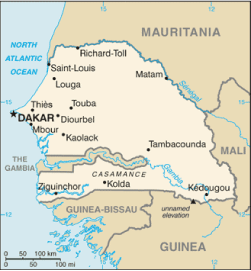
Senegal is a source,
transit, and destination country for children and women trafficked for the
purposes of forced labor and commercial sexual exploitation. Trafficking
within the country is more prevalent than trans-border trafficking and the
majority of victims are children. Within Senegal, religious teachers traffic
boys, called talibe, by promising to educate them,
but subjecting them instead to forced begging and physical abuse. A 2007
study done by UNICEF, the ILO and the World Bank found that 6,480 talibe were forced to beg in Dakar alone. Women and girls
are trafficked for domestic servitude and commercial sexual exploitation --
including exploitation by foreign sex tourists -- within Senegal. Children
are also trafficked for forced labor in gold mines within Senegal. - U.S.
State Dept Trafficking in Persons Report, June, 2009 Check out a later country report here and possibly a full TIP Report here |
|||||||||||
|
CAUTION: The following links
have been culled from the web to illuminate the situation in Senegal. Some of these links may lead to websites that
present allegations that are unsubstantiated or even false. No attempt
has been made to validate their authenticity or to verify their content. HOW TO USE THIS WEB-PAGE Students If you are looking for
material to use in a term-paper, you are advised to scan the postings on this
page and others to see which aspects of Human Trafficking are of particular
interest to you. Would you like to
write about Forced-Labor? Debt
Bondage? Prostitution? Forced Begging? Child Soldiers? Sale of Organs? etc. On the other
hand, you might choose to include precursors of trafficking such as poverty and hunger. There is a lot to
the subject of Trafficking. Scan other
countries as well. Draw comparisons
between activity in adjacent countries and/or regions. Meanwhile, check out some of the Term-Paper resources
that are available on-line. Teachers Check out some of
the Resources
for Teachers attached to this website. ***
FEATURED ARTICLE *** Lives of Street
Children in Senegal to Improve through New Campaign The World Bank News,
February 13, 2007 web.worldbank.org/WBSITE/EXTERNAL/NEWS/0,,contentMDK:21218879~pagePK:34370~piPK:34424~theSitePK:4607,00.html [accessed 21
December 2010] CHILD TRAFFICKERS
TARGETED
- Poor parents who cannot afford to care for their children often entrust them
to religious leaders known as marabous to educate them and teach them the
Koran. Child traffickers
posing as marabous will often kidnap the children from villages and take them
to Dakar where they are forced to beg for handouts in the streets. Under threat
of beatings, the children must give the money to their “masters.” ***
ARCHIVES *** First Human
Trafficking Case Law Database launched in Senegal Distributed by APO
Group on behalf of International Organization for Migration (IOM) www.africanews.com/2019/10/25/first-human-trafficking-case-law-database-launched-in-senegal/ [accessed 27 October 2019] Despite Senegal’s significant
efforts to identify and assist trafficking survivors, the country’s taskforce
against trafficking in persons (TiP) faces a lack
of data on survivors, crimes, and traffickers. What’s more, weak networking
and information sharing among local authorities and others means coordination
of actions across Senegal is impaired. In this context,
the International Organization for Migration (IOM) in Senegal and the
Ministry of Justice, through its National Unit for Combatting Trafficking in
Persons (CNLTP) and the Directorate of Criminal Affairs and Amnesty (DACG),
has endeavoured to promote the country’s first
human trafficking case law database, the Système de
suivi de la traite, known
as Systraite. The online system
will collect data on trafficking survivors – such as the country or region of
origin, age, gender – the types of abuse they faced, and other data including
methods of referral procedure before courts and traffickers’ profiles. 2020 Country
Reports on Human Rights Practices: Senegal U.S. Dept of State Bureau of Democracy, Human Rights, and
Labor, 30 March 2021 www.state.gov/reports/2020-country-reports-on-human-rights-practices/senegal/
[accessed 22 June
2021] PROHIBITION OF
FORCED OR COMPULSORY LABOR Forced child labor
occurred, including forced begging by children in some Quranic schools (see
section 6). Some children in these schools were kept in conditions of
servitude; were forced to work daily, generally in the street begging; and
had to meet a daily quota for money (or sometimes sugar or rice) set by their
teachers. The National Antitrafficking Task Force
and Child Protection Special Unit continued to address these matters throughout
the country. When officials identified a potential forced begging case,
however, they often did not prosecute according to previously mandated
minimum sentencing guidelines. PROHIBITION OF CHILD
LABOR AND MINIMUM AGE FOR EMPLOYMENT Most instances of
child labor occurred in the informal economy where labor regulations were not
enforced. Economic pressures and inadequate educational opportunities often
pushed rural families to emphasize work over education for their children.
Child labor was especially common in the regions of Tambacounda,
Louga, and Fatick, where
up to 90 percent of children worked. Child labor was prevalent in many
informal and family-based sectors, such as agriculture (millet, corn, and
peanuts), fishing, artisanal gold mining, garages, dumpsites,
slaughterhouses, salt production, rock quarrying, and metal and woodworking
shops. In the large, informal, unregulated artisanal mining sector, entire
families, including children, were engaged in artisanal mining work. Child
gold washers, most ages 10 to 14, worked approximately eight hours a day
using toxic agents such as mercury without training or protective equipment.
There were also reports of children working on family farms or herding
cattle. Children also worked as domestics, in tailoring shops, at fruit and
vegetable stands, and in other areas of the informal economy. Freedom House
Country Report 2020 Edition freedomhouse.org/country/senegal/freedom-world/2020 [accessed 5 May 2020] G4. DO INDIVIDUALS
ENJOY EQUALITY OF OPPORTUNITY AND FREEDOM FROM ECONOMIC EXPLOITATION? Child labor remains
a problem, particularly in the informal economy, and laws restricting the
practice are inadequately enforced. Forced begging by students at religious
schools is common, and teachers suspected of abuse are rarely prosecuted. Sex trafficking
remains a concern, although according to the US State Department, the
government has increased its efforts to eliminate trafficking and prosecute
perpetrators. However, it is difficult to discern the robustness of the law
enforcement response, since the government does not publicize records on sex
trafficking arrests and prosecutions. 2017 Findings on
the Worst Forms of Child Labor Office of Child
Labor, Forced Labor, and Human Trafficking, Bureau of International Labor
Affairs, US Dept of Labor, 2018 www.dol.gov/sites/default/files/documents/ilab/ChildLaborReport_Book.pdf [accessed 22 April
2019] www.dol.gov/sites/dolgov/files/ILAB/child_labor_reports/tda2017/ChildLaborReportBook.pdf [accessed 5 May
2020] Note:: Also check out this country’s report in the more recent edition DOL
Worst Forms of Child Labor [page 863] Children in Senegal
are exploited in domestic servitude, forced labor in gold mines, and
trafficking for commercial sexual exploitation, particularly internal
trafficking. (25; 26; 27) In Senegal, it is a traditional practice to send
boys to Koranic schools, called daaras. However,
instead of receiving an education, many students, known as talibés, are forced to beg by their teachers, known as
marabouts. (5; 9; 26; 35; 36; 37) The marabouts take the talibés’
earnings and often beat those who fail to meet the daily quota. (5; 6; 10;
36; 37) This system enriches marabouts, bringing in over $10 million annually
in Dakar alone, according to a recent study by UNODC. (38; 39) The talibés often live in overcrowded, unsanitary conditions,
receive inadequate food and medical care, and are vulnerable to physical and
sexual abuse. (5; 6; 9; 34; 37; 40) They typically come from rural areas in
Senegal and from neighboring countries, sometimes as a result of human
trafficking. (5; 6; 35; 37; 41) A 2014 daara-mapping
study estimated that 30,000 of the estimated 54,800 talibés
in Dakar are forced to beg, and a 2016 study found that 9,000 of the
estimated 14,000 talibés in the St. Louis
department are also forced to beg. (14; 42; 43; 44; 45; 46; 47; 48; 49; 50). Child Labour Persists Around The World: More Than 13 Percent Of
Children 10-14 Are Employed International Labour
Organisation (ILO) News, Geneva, 10 June 1996 www.ilo.org/global/about-the-ilo/press-and-media-centre/news/WCMS_008058/lang--en/index.htm [accessed 4
September 2011] www.scribd.com/document/366840945/Child-Labour-Persists-Around-the-World [accessed 15
February 2018] "Today's child
worker will be tomorrow's uneducated and untrained adult, forever trapped in
grinding poverty. No effort should be spared to break that vicious
circle", says ILO Director-General Michel Hansenne. Among the countries
with a high percentage of their children from 10-14 years in the work force
are: Mali, 54.5 percent; Burkina Faso, 51; Niger and Uganda, both 45; Kenya,
41.3; Senegal, 31.4; Bangladesh, 30.1; Nigeria,
25.8; Haiti, 25; Turkey, 24; Côte d'Ivoire, 20.5; Pakistan, 17.7; Brazil,
16.1; India, 14.4; China, 11.6; and Egypt, 11.2. Concluding Observations
of the Committee on the Rights of the Child (CRC) - 2006 [DOC] UN Convention on the
Rights of the Child, 29 September 2006 www.unhchr.ch/tbs/doc.nsf/898586b1dc7b4043c1256a450044f331/b10f8e9681275570c125722d002cef25/$FILE/G0644838.doc [accessed 21
December 2010] www.refworld.org/publisher,CRC,CONCOBSERVATIONS,SEN,45c30bca0,0.html [accessed 15
February 2018] [60] The Committee
notes with appreciation the establishment of projects with a view to
improving the curriculum of education of talibés. However, the Committee is concerned by the
large number of working children and in particular by the current practice of
the Koranic schools run by marabouts who use the talibés on a large scale for
economic gain, by sending them to agricultural fields or to the streets for
begging and other illicit work that provides money, thus preventing them from
having access to health, education and good living conditions. [62] The Committee notes
the measures taken by the State party to prevent girls from being used as
domestic servants (petites bonnes) and subjected to economic exploitation and
sexual abuse. However, the Committee
is concerned by the growing extent of this reality which threatens the
health, physical integrity and education of the girl child. Concluding
Observations of the Committee on the Rights of the Child (CRC) - 1995 UN Convention on the
Rights of the Child, 27 November 1995 www1.umn.edu/humanrts/crc/crc-senegal95.htm [accessed 21
December 2010] [15] The Committee
is seriously worried at the difficult living conditions faced by a great
number of talibés, who are deprived of the enjoyment of their fundamental
rights under the law. ***
EARLIER EDITIONS OF SOME OF THE ABOVE *** Freedom House
Country Report 2018 Edition freedomhouse.org/country/senegal/freedom-world/2018 [accessed 5 May 2020] G4. DO INDIVIDUALS
ENJOY EQUALITY OF OPPORTUNITY AND FREEDOM FROM ECONOMIC EXPLOITATION? Child labor remains
a problem, particularly in the informal economy, and laws restricting the
practice are inadequately enforced. Forced begging by students at religious
schools is common. A July 2017 report published by Human Rights Watch and
Senegalese human rights groups assessed the first year of the government’s
program to reduce forced begging; it found that several hundred children
taken from such schools had been returned to their families, but that over
1,000 were returned to the same schools they were taken from and that
teachers suspected of abuse were not investigated. Human Rights Reports
» 2005 Country Reports on Human Rights Practices U.S. Dept of State Bureau of Democracy, Human Rights, and
Labor, March 8, 2006 2009-2017.state.gov/j/drl/rls/hrrpt/2005/61589.htm [accessed 11
February 2020] TRAFFICKING
IN PERSONS
– Reliable statistics on the extent of the trafficking problem were
unavailable. However, studies have shown the extent of trafficking in and
through the country to be significant, particularly with regards to child
begging. Talibés were trafficked from surrounding
nations, such as The Gambia, Mali, Guinea, and Guinea-Bissau, and internally
to participate in exploitive begging by some Koranic schools. According to
the UN International Children's Emergency Fund (UNICEF), the country had 100
thousand talibe boys and 10 thousand street
children. "Marabouts," the Koranic teachers who take charge of
these boys, were the principal traffickers in the country. Young girls were
trafficked from villages in the Diourbel, Fatick, Kaolack, Thies, and Ziguinchor regions
to urban centers for work as underage domestics. The Department of Labor’s 2004 Findings on
the Worst Forms of Child Labor U.S. Dept of Labor Bureau of International Labor Affairs, 2005 www.dol.gov/ilab/media/reports/iclp/tda2004/senegal.htm [accessed 21
December 2010] Note:: Also check out this country’s report in the more recent edition DOL
Worst Forms of Child Labor INCIDENCE
AND NATURE OF CHILD LABOR - Senegal is a source and transit country for child
trafficking to Europe for sexual exploitation. Senegal is also a destination country for
children trafficked from surrounding countries. Most trafficking victims are young males
forced into exploitive begging for Koranic teachers. These boys, known as talibés,
spend the majority of the day begging for their Koranic teachers and are
vulnerable to sexual and other exploitation.
Domestically, some Koranic teachers bring children from rural areas to
Senegal’s major cities, holding them under conditions of involuntary
servitude. Children from Guinea and
Guinea-Bissau can also be found begging in Senegal’s streets as part of this
exploitive practice. CURRENT
GOVERNMENT POLICIES AND PROGRAMS TO ELIMINATE THE WORST FORMS OF CHILD LABOR - In March 2004,
the government participated in a workshop in Mali to discuss regional
strategies for addressing child trafficking in West Africa. In July 2004, Senegal signed a bilateral
agreement with Mali to combat child trafficking between the two
countries. Since 2003, Senegal’s
Family Ministry has operated the “Ginddi Center” in
Dakar to receive and care for street children, including trafficking
victims. Pursuant to Senegal’s 2004 anti-trafficking accord with Mali,
trafficked Malian children are kept at the Ginddi
Center prior to repatriation. All
material used herein reproduced under the fair use exception of 17 USC § 107
for noncommercial, nonprofit, and educational use. PLEASE RESPECT COPYRIGHTS OF COMPONENT
ARTICLES. Cite this webpage as: Patt,
Prof. Martin, "Human Trafficking & Modern-day Slavery -
Senegal", http://gvnet.com/humantrafficking/Senegal.htm, [accessed
<date>] |