Human Trafficking & Modern-day Slavery Poverty drives the unsuspecting poor into the
hands of traffickers Published reports & articles from 2000 to 2025 gvnet.com/humantrafficking/Paraguay.htm
Paraguay is
principally a source and transit country for women and children trafficked
for the purpose of commercial sexual exploitation, as well as a source and
transit country for men, women, and children trafficked into forced labor.
Most Paraguayan victims are trafficked to Argentina and Spain; smaller
numbers of victims are trafficked to Brazil, Chile, Italy, and Bolivia. The involuntary
domestic servitude of adults and children within the country is a serious
problem. Indigenous persons are vulnerable to forced labor exploitation,
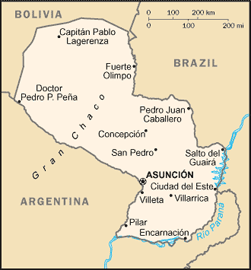
particularly in the Chaco region. Poor children are trafficked from rural areas
to urban centers such as Asuncion, Ciudad del Este, and Encarnacion
for commercial sexual exploitation and domestic servitude. Street children
and working children are common targets for trafficking recruiters. According
to the ILO, some traffickers coerce underage males, known as “taxi boys,”
into transgendered prostitution. Some of these boys are trafficked abroad,
particularly to Italy. Trafficking of Paraguayan and Brazilian women, girls,
and boys for commercial sexual exploitation commonly occurs in the Tri-Border
Area of Paraguay, Argentina, and Brazil. - U.S. State Dept
Trafficking in Persons Report, June, 2009 Check
out a later country report here and possibly a full TIP Report here |
|||||||||||
|
CAUTION: The following
links have been culled from the web to illuminate the situation in
Paraguay. Some of these links may lead
to websites that present allegations that are unsubstantiated or even
false. No attempt has been made to
validate their authenticity or to verify their content. HOW TO USE THIS WEB-PAGE Students If you are looking
for material to use in a term-paper, you are advised to scan the postings on
this page and others to see which aspects of Human Trafficking are of
particular interest to you. Would you
like to write about Forced-Labor? Debt
Bondage? Prostitution? Forced Begging? Child Soldiers? Sale of Organs? etc. On the other
hand, you might choose to include precursors of trafficking such as poverty and hunger. There is a lot to
the subject of Trafficking. Scan other
countries as well. Draw comparisons
between activity in adjacent countries and/or regions. Meanwhile, check out some of the Term-Paper resources
that are available on-line. Teachers Check out some of
the Resources
for Teachers attached to this website. ***
FEATURED ARTICLE *** International
Federation of Journalists - The 2002 Jury Report International Federation
of Journalists, 14 October 2002 www.ifj.org/nc/news-single-view/browse/148/backpid/191/category/asia-pacific-1/article/ifj-names-16-world-class-journalists-in-line-up-for-50000-euro-natali-prize-awards/ [accessed 9
September 2014] www.ifj.org/media-centre/news/detail/article/the-2002-jury-report.html [accessed 21
February 2019] IN THE REGIONAL
CATEGORY OF LATIN AMERICA AND THE CARIBBEAN THE 2002 NATALI PRIZE GOES TO: -- [scroll down] The series of five
articles by Julio César Benegas concerning human violations within the
Military Service of Paraguay is remarkable journalism, which highlights the corruption
which is at the core of the recruitment of child soldiers as well as the
cultural aspects involved. These articles also exposed the exploitation of
child soldiers and other human rights violations, which resulted in the death
of 10 soldiers a year on average. For military personnel Paraguay is one of
the most dangerous countries worldwide in peaceful times, Benegas concluded
in his report. ***
ARCHIVES *** 2020 Country
Reports on Human Rights Practices: Paraguay U.S. Dept of State Bureau of Democracy, Human Rights, and
Labor, 30 March 2021 www.state.gov/reports/2020-country-reports-on-human-rights-practices/paraguay/
[accessed 21 June
2021] PROHIBITION OF
FORCED OR COMPULSORY LABOR The Labor Ministry
did not confirm instances of debt bondage in the Chaco region but did not
dismiss the possibility that it continued to exist. In that region there were
reports children worked alongside their parents in debt bondage on cattle
ranches, on dairy farms, and in charcoal factories. PROHIBITION OF CHILD
LABOR AND MINIMUM AGE FOR EMPLOYMENT Despite the
government’s significant advancement in efforts to eliminate the worst forms
of child labor, child labor continued to occur in sugar, brick, and limestone
production; domestic service; and small-scale agriculture. Children also
worked in manufacturing, restaurants, and other service industries. Boys were
often victims of forced labor in domestic service, crime, and in some cases
as horse jockeys. In exchange for
work, employers promised room, board, and financial support for school to
child domestic servants. Some of these children were victims of human
trafficking for the purposes of forced child labor, did not receive pay or
the promised benefits in exchange for work, suffered from sexual
exploitation, and often lacked access to education. The worst forms of
child labor occurred where malnourished, abused, and neglected children
worked in unhealthy and hazardous conditions selling goods or services on the
street, working in factories, or harvesting crops. Children were used,
procured, and offered to third parties for illicit activities including
commercial sexual exploitation (see also section 6, Children), sometimes with
the knowledge of parents and guardians who received remuneration. Some minors
were involved in forced criminality, such as acting as drug smugglers for
criminal syndicates along the border with Brazil. Children reportedly worked
in debt bondage alongside their parents in the Chaco region. Freedom House
Country Report 2020 Edition freedomhouse.org/country/paraguay/freedom-world/2020 [accessed 8 July
2020] G4. DO INDIVIDUALS
ENJOY EQUALITY OF OPPORTUNITY AND FREEDOM FROM ECONOMIC EXPLOITATION? Some 24 percent of
the population lived in poverty in 2018, with 4.8 percent living in extreme
poverty. Both figures have fallen slightly in recent years. Indigenous populations
are particularly affected. Inequality in land ownership and income is
extremely high and social mobility very limited. Reports of forced labor and
slavery periodically surface. The ongoing illegal
practice of criadazgo, the temporary adoption in
which children, generally from poor families, work without pay for wealthier
ones, severely limits the freedom of roughly 47,000 children across the
country. 2017 Findings on
the Worst Forms of Child Labor Office of Child
Labor, Forced Labor, and Human Trafficking, Bureau of International Labor
Affairs, US Dept of Labor, 2018 www.dol.gov/sites/default/files/documents/ilab/ChildLaborReport_Book.pdf [accessed 22 April
2019] www.dol.gov/sites/dolgov/files/ILAB/child_labor_reports/tda2017/ChildLaborReportBook.pdf [accessed 5 May
2020] Note:: Also check out this country’s report in the more recent edition DOL
Worst Forms of Child Labor [page 802] Criadazgo, a practice in
which middle-class and wealthy families informally employ and house child
domestic workers from impoverished families, is pervasive in Paraguay; the
2011 National Survey of Child and Adolescent Activities estimated that more
than 46,000 children were engaged in criadazgo.
Many of these children are in situations of domestic servitude, subjected to
violence and abuse, and highly vulnerable to sex trafficking. (2; 12; 8; 15;
29; 5; 24; 9) Children are subjected to commercial sexual exploitation in
Ciudad del Este; in the Tri-Border area between Paraguay, Argentina and
Brazil; and along commercial shipping routes on the Paraguay River. (24; 5)
Children work alongside their parents in debt bondage on cattle ranches,
dairy farms, and charcoal factories in the remote Chaco region. (12; 5; 23;
24) Children shine shoes on the street and in the Palace of Justice, the
Supreme Court building. (12). Save the Children Save the Children www.scslat.org/web/trabajo_temas_sociedad.php?id=I [accessed 16
December 2010] www.linguee.com/spanish-english/translation/alianza+por+la+infancia.html [accessed 5 May
2020] CIVIL SOCIETY - In particular,
Save the Children Sweden operates through a partnership with Global Infancia
in Paraguay and CECODAP in Venezuela; the Latin American and Caribbean
Network for the Defense of Boys, Girls and Adolescents’ Rights (REDLAMYC), a
network gathering over 2300 organizations; national children’s organization
networks in El Salvador (RENAES), Paraguay (PLATAFORMA) and Peru (REDNNA)
that together represent over 2500 children, and the Latin American Network of
Boys, Girls and Adolescents (REDNNYA), with active members in Brazil, Chile,
Ecuador, El Salvador, Paraguay,
Peru and Venezuela. Triple Border
Project, International Labour
Organisation ILO Office for At one time this
article had been archived and may possibly still be accessible [here] [accessed 10
September 2011] PERSONAL STORY MABELIA - Mabelia is 10 years old. On November 30, 2002, she was found by a merchant from Ciudad del Este on Adraina Jara y Pampliega street. It was approximately 9:00 p.m. when she was found in, what is perhaps, one of the most frequented corners of the centre of Ciudad del Este, Paraguay. She was very dirty.
Dressed in pants and a pullover, and wearing Japanese-style slippers, when
she was found she had about 12 USD (80.000 Gs, Guaraníes) in her pockets, a
product of her 'sexual activity'. It had been 48 hours since she had returned
to her mother's home, but she feared going back, since she had not met the
goal that had been established by her mother, Doña Maria. At the Courthouse,
the young girl told the judge that the money found in her pockets was the
fruit of her 'sexual work'. She explained that, encouraged by her mother, she
would leave her house in the morning and sometimes would cross the Puente de
la Amistad (Friendship Bridge)to the border city of Foz de Iguazu in Brazil
on the pretext of buying candies to sell later. She admitted to having an
'established clientele'. - htcp ILO to mark World
Day Against Child Labour (12 June 2003) International Labour
Organisation (ILO) News, www.hrea.org/lists/child-rights/markup/msg00200.html [accessed 16
December 2010] www.ilo.org/global/about-the-ilo/newsroom/news/WCMS_005279/lang--en/index.htm [accessed 11
February 2018] FROM LATIN AMERICA - The Triple
Border region - where Argentina, Paraguay
and Brazil intersect - is a vast area with porous borders, major regional
commercial and tourism centres and a population of almost 500,000. The lack
of vigorous border checks and law enforcement in the region facilitates
illegal commerce, including weapons, drugs and the commercial sexual
exploitation of minors. Marcelino Gomes
Paredes and Cristian Ariel Nuñez - 14 years of age OAS Inter-American
Commission on Human Rights - Report Nº 82/03, Petition 12.330, October 22,
2003 www.cidh.org/annualrep/2003eng/Paraguay.12330.htm [accessed 16
December 2010] III. POSITION OF THE
PARTIES … A. POSITION OF THE PETITIONERS 7. The petitioners
argue that, despite the clear legal provisions prohibiting the recruitment of
children under the age of 18, and repeated complaints on this score, “the
military and police forces have made it a systematic, constant and frequent
practice to recruit minors between the ages of 12 and 17, and to date no
steps have been taken to curb this practice.” Concluding
Observations of the Committee on the Rights of the Child (CRC) UN Convention on the
Rights of the Child, 12 October 2001 www1.umn.edu/humanrts/crc/paraguay2001.html [accessed 16
December 2010] [4] In light of its
previous recommendation (CRC/C/15/Add.75, para. 41), the Committee notes with
satisfaction the promulgation in 1997 of the Adoption Act to combat
trafficking in children and establish strict control over all matters
connected with adoption, especially inter-country adoption. [49] The Committee
expresses its deep concern that, with regard to the increasing phenomenon of
commercial sexual exploitation of children, there are no data available,
legislation is inadequate, cases involving sexually exploited children are
often not investigated and prosecuted, victims are criminalized, and rehabilitation
programs are not available. It further notes that a national plan against
commercial sexual exploitation of children has not been developed. ***
EARLIER EDITIONS OF SOME OF THE ABOVE *** Human Rights
Reports » 2005 Country Reports on Human Rights Practices 2009-2017.state.gov/j/drl/rls/hrrpt/2005/61737.htm [accessed 10
February 2020] TRAFFICKING
IN PERSONS
– Trafficking victims within the country worked in the sex industry. Underage
girls reportedly also were forced to work as criadas,
both domestically and in neighboring countries. According to the Secretariat
for Children and Adolescents, many of these children were sexually abused.
Government and NGO studies showed that most of the girls trafficked were
working as street vendors when traffickers targeted them and that 70 percent
of victims had drug addictions. The local NGO Grupo
Luna Nueva and the International Organization for Migration reported that
trafficking of women and children increased by 27 percent in the past five
years. The trafficking of
women and children for sexual exploitation was a high-profit, low-risk
activity for traffickers who moved easily across the borders with On several
occasions, Argentine police rescued Paraguayan women from The government's
primary focus in protecting victims was the repatriation of its own citizens. The Department of Labor’s 2004 Findings on
the Worst Forms of Child Labor www.dol.gov/ilab/media/reports/iclp/tda2004/paraguay.htm [accessed 16
December 2010] Note:: Also check out this country’s report in the more recent edition DOL
Worst Forms of Child Labor INCIDENCE
AND NATURE OF CHILD LABOR - Paraguay is a source country for women and children trafficked
to Argentina and Spain for sexual exploitation and forced labor as well as a
destination country for girls trafficked from neighboring countries for
sexual exploitation. There are reports
of children working as prostitutes in the border regions of Ciudad del Este, Hernandarias and Encarnación,
where trafficking is a particular problem.
Children from poor families are trafficked internally from rural to
urban areas. Forcible recruitment of
adolescents into the armed forces has decreased in recent years due to public
pressure All
material used herein reproduced under the fair use exception of 17 USC § 107
for noncommercial, nonprofit, and educational use. PLEASE RESPECT COPYRIGHTS OF COMPONENT
ARTICLES. Cite this webpage as: Patt,
Prof. Martin, "Human Trafficking & Modern-day Slavery - |