Human Trafficking & Modern-day Slavery Poverty drives the unsuspecting poor into the
hands of traffickers Published
reports & articles from 2000 to 2025 gvnet.com/humantrafficking/Niger.htm
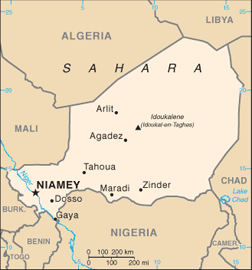
Niger is a source,
transit, and destination country for children and women trafficked for forced
labor and commercial sexual exploitation. Caste-based slavery practices,
rooted in ancestral master-slave relationships, continue primarily in the
northern part of the country. An estimated 8,800 to 43,000 Nigeriens live
under conditions of traditional hereditary slavery. Children within |
||||||||||||
|
CAUTION: The following links
have been culled from the web to illuminate the situation in HOW TO USE THIS WEB-PAGE Students If you are looking
for material to use in a term-paper, you are advised to scan the postings on
this page and others to see which aspects of Human Trafficking are of
particular interest to you. Would you
like to write about Forced-Labor? Debt
Bondage? Prostitution? Forced Begging? Child Soldiers? Sale of Organs? etc. On the other
hand, you might choose to include precursors of trafficking such as poverty and hunger. There is a lot to
the subject of Trafficking. Scan other
countries as well. Draw comparisons
between activity in adjacent countries and/or regions. Meanwhile, check out some of the Term-Paper resources
that are available on-line. Teachers Check out some of
the Resources
for Teachers attached to this website. HELP for Victims Ministry of Labor and Civil Service ***
FEATURED ARTICLE *** Africa: Slavery
lives on Liesl Louw,
News24, 2 September 2004 www.jihadwatch.org/2004/09/africa-slavery-lives-on [accessed 12 March
2011] www.news24.com/World/News/Slavery-lives-on-20040902 [accessed 13 June
2017] Last year, the ***
ARCHIVES *** Timidria’s Fight Against
Human Trafficking In Niger Ayesha Swaray, The Borgen Project, 19
February 2021 borgenproject.org/human-trafficking-in-niger/ [accessed 23
February 2021] OVERVIEW -- Ilguilas Weila, a Niger native,
founded Timidria in 1991. Together with
Anti-Slavery International, Timidria has been
standing at the forefront seeking to protect more than 40,000 lost,
unidentified and identified victims of inherited slavery and trafficking.
This is its printed testimony: “It clearly emerged
from this review that the failure of slavery prosecutions had less to do with
litigation itself than to external elements, particularly the influence of
traditional chiefs and social hierarchies on judges’ decisions and
disputations between customary and statutory law.” This is a credible
statement depicting the Nigerien government’s failure to identify, prosecute
and convict traffickers, as it has failed to identify the ones among them. Combating Child
Marriage In Niger Montana Moore, The Borgen Project, 17 October 2020 borgenproject.org/combatting-child-marriage-in-niger/ [accessed 23
February 2021] According to
UNICEF, married women become dependent on their husbands because their sense
of independence is taken away. However, women are, more often than not,
engaging in marriage during their teenage years before they are even fully
mature, which would explain why their sense of independence is stricken away
so early on. Education plays an
important role in child marriages in the country of Niger because the lack of
knowledge makes a woman more vulnerable to risky decisions. According to
UNICEF, “The link between education and the prevalence of child marriage is
particularly evident in Niger: 81% of women aged 20-24 with no education and
63% with only primary education were married or in union at age 18.” The lack
of children attending school is a primary reason for combatting child
marriage in Niger. 2020 Country
Reports on Human Rights Practices: Niger U.S. Dept of State Bureau of Democracy, Human Rights, and
Labor, 30 March 2021 www.state.gov/reports/2020-country-reports-on-human-rights-practices/niger/
[accessed 20 June
2021] PROHIBITION OF
FORCED OR COMPULSORY LABOR Forced labor
remained a problem, especially in domestic work and agriculture. A 2016 study
conducted by the National Institute of Statistics, in collaboration with the
Ministry of Justice, concluded that victims of forced labor were
characteristically young (age 17 on average) and predominantly male (62.5
percent), although adult victims were also identified. The study found
poverty and associated misery and unacceptable living conditions to explain
why victims accepted offers that put them into forced labor situations. The Tuareg, Zarma, Fulani, Toubou,
and Arab ethnic minorities throughout the country, particularly in remote
northern and western regions and along the border with Nigeria, practiced a
traditional form of caste-based servitude or bonded labor. Persons born into
a traditionally subordinate caste or descent-based slavery sometimes worked
without pay for those above them in the social order. Such persons were
forced to work without pay for their masters throughout their lives,
primarily herding cattle, working on farmland, or working as domestic
servants. Estimates of the numbers of persons involved in traditional slavery
varied widely. PROHIBITION OF CHILD
LABOR AND MINIMUM AGE FOR EMPLOYMENT Child labor was
prevalent, with children as young as five engaged in labor. Most rural
children regularly worked with their families from an early age, helping in
the fields, pounding grain, tending animals, gathering firewood and water,
and doing similar tasks. Some families kept children out of school to work or
beg. Children were also forced into prostitution and domestic servitude,
artisanal mining, and forced criminality. There were reports
that loosely organized clandestine international networks forced young boys
from neighboring countries into manual labor or begging and young girls to
work as domestic servants, usually with some degree of consent or complicity
of their families. The practice of
forced begging by talibes–Quranic
schoolchildren–where some Quranic schoolteachers forced their young male
pupils to work as beggars remained widespread, with a degree of complicity
from parents. Child labor
occurred in hereditary slavery and largely unregulated artisanal gold-mining
operations as well as in trona (a source of sodium
carbonate compounds), salt, and gypsum mines. The artisanal gold mines at Komabangou, Tillabery Region,
continued to use many children, particularly adolescent boys and some girls,
under hazardous health and safety conditions. The use of cyanide in these
mines further complicated the health hazards. Komabangou
miners, other residents, and human rights groups expressed deep concern
regarding poisoning, but the practice remained widespread. Children also
performed dangerous tasks in cattle herding. Children, especially boys and
girls in the Arab, Zarma, Fulani, Tuareg, and Toubou ethnic minorities, continued to be exploited as
slaves and endure conditions of bonded labor, particularly in distant western
and northern regions and along the border with Nigeria. Children born into
a traditionally subordinate caste or descent-based slavery became the
property of their masters and could be passed from one owner to another as
gifts or part of a dowry. Freedom House
Country Report 2020 Edition freedomhouse.org/country/niger/freedom-world/2020 [accessed 8 July 2020] G4. DO INDIVIDUALS
ENJOY EQUALITY OF OPPORTUNITY AND FREEDOM FROM ECONOMIC EXPLOITATION? Although slavery
was criminalized in 2003 and banned in the 2010 constitution, it remains a
problem in Niger. Estimates of the number of enslaved people
vary widely, but is generally counted in the tens of thousands. Niger
remains a source, transit point, and destination for human trafficking. 2017 Findings on
the Worst Forms of Child Labor Office of Child
Labor, Forced Labor, and Human Trafficking, Bureau of International Labor
Affairs, US Dept of Labor, 2018 www.dol.gov/sites/default/files/documents/ilab/ChildLaborReport_Book.pdf [accessed 22 April
2019] www.dol.gov/sites/dolgov/files/ILAB/child_labor_reports/tda2017/ChildLaborReportBook.pdf [accessed 4 May
2020] Note:: Also check out this country’s report in the more recent edition DOL
Worst Forms of Child Labor [page 749] Children in Niger,
especially boys and girls from the Arab, Djerma, Peulh, Tuareg, and Toubou ethnic minorities, continue to be exploited as
slaves and endure slave-like practices, particularly in distant western and
northern regions and along the border with Nigeria. Some children are born
into slavery, while others are born free, but remain in a dependent status
and are forced to work with their parents for their former masters in
exchange for food, money, and lodging. (23; 4; 3) A particular form of
slavery in Niger is the wahaya practice, in which
men buy girls born into slavery, typically between ages 9 and 11, as “fifth
wives.” Child slaves, including those involved in the practice of wahaya, are forced to work long hours as cattle herders,
agricultural workers, or domestic workers, and are often sexually exploited.
(3; 10; 24; 20; 7; 4; 17; 18) As with those involved in hereditary slavery,
the children of wahaya wives are considered slaves
as well and are passed from one owner to another as gifts or as part of
dowries. (13; 25; 4; 17) In Niger, it is also
a traditional practice to send boys (talibés) to
Koranic teachers (marabouts) to receive religious education. Some of these
boys, however, are forced by their teachers to perform manual labor or to beg
on the streets and surrender the money they earn. (2; 3; 4; 17; 21) During the year,
Boko Haram attacked numerous villages in the Diffa
region along Niger’s border with Nigeria, which caused an influx of Nigerian
refugees and Nigerien internally displaced persons and strained the
government’s resources for addressing child labor. Evidence suggests that
Boko Haram forcibly recruited Nigerien children for use in armed conflict in
the Diffa region. (26; 19; 7) In addition, refugee
and internally displaced children may have difficulty accessing education,
which makes them particularly vulnerable to engaging in the worst forms of
child labor, including recruitment by non-state armed groups. (23; 10; 25;
19). African Slavery and
Trafficking Sarah Williams,
Voice of www.wwenglish.com/t/d/voastan/2005/5/13865.htm [accessed 29 August
2011] [scroll down, for
English] Early in March, the
government of Still with us - A botched release of slaves in The Economist, Mar 9th 2005 www.economist.com/node/3737154 [accessed 2
September 2014] Anti-Slavery
International, a London-based human rights group, estimates that 43,000 slaves
are held in Niger, which the United Nations reckons to be the
second-least-developed country in the world. Slaves in the landlocked west
African country form a stigmatised, closed class.
Even freed slaves carry the taint of their hereditary status, and their
former masters or parents’ masters may claim some or all of their income,
property and dowries. Niger Begins
Enforcement Of Ban On Slavery Sarah Left, The
Guardian, 5 March 2005 www.guardian.co.uk/world/2005/mar/05/sarahleft [accessed 12 March
2011] Around 7,000 people
living as slaves in The chief of the In
Ates region will free all slaves in the area under
his control, where entrenched slavery means 95 % of the population are owned
and controlled by the other 5%. Slaves in Slavery in Niger October 26, 2004 At one time this
article had been archived and may possibly still be accessible [here] [accessed 9
September 2011] [scroll down] Almost 50,000
people still live as slaves in Niger. Slavery has always
been practised by the rulling
classes in Slaves are owned
and controlled by their masters, receiving a meagre amount of food and a
place to sleep in return for their labour, the study found. "The master
decides who a slave marries and whether their children go to school. Many of
those interviewed in the survey had also been subjected to violence, rape,
degrading treatment and threats." Testimony: Former BBC News, 3 November
2004 news.bbc.co.uk/2/hi/africa/3972669.stm [accessed 12
December 2010] Assibit, 50, describes
life as a slave in Assibit would begin work
at 0530 - pounding millet and milking the camels. She would then prepare breakfast for her
master and his family - she and her family ate the leftovers. While her husband and sons tended the
cattle and camels, she and her daughter did all the household chores. These included moving the heavy tent four
times a day to ensure her mistress could sit in the shade. Assibit prepared
lunch and spent the rest of the day collecting water and firewood. Slavery in Niger:
Historical, legal and contemporary perspectives [PDF] Anti-Slavery
International & Association Timidira, Edited by Galy kadir Abdelkader, March 2004 www.antislavery.org/includes/documents/cm_docs/2009/f/full_english_slavery_in_niger.pdf [accessed 2
September 2014] [page 13] INTRODUCTION - This study is aimed at
contributing to the setting up of the necessary mechanisms to eradicate
slavery in The Anti-Slavery
Award Anti-Slavery
International At one time this
article had been archived and may possibly still be accessible [here]
[accessed 9
September 2011] PREVIOUS
ANTI-SLAVERY AWARD WINNERS – Timidria received the 2004
Anti-Slavery Award for its pioneering work against slavery in Niger. It spearheaded the
anti-slavery movement in Drama as BBC News, 19
December, 2003 news.bbc.co.uk/2/hi/africa/3334099.stm [accessed 12
December 2010] In May this year,
acting under pressure According to a
local anti-slavery organisation, Timidria, the victims are usually aged between 14 and
25. Males
slaves are forced to work in farms and tender cattle, while women are
confined to domestic duties. The organisation says many female slaves are raped and
subjected to other forms of sexual abuse by their masters. Men who disobey orders are flogged or in
serious instances castrated. Slavery in United Nations
Commission on Human Rights, Sub-Commission on the Promotion and Protection of
Human Rights, Working Group on Contemporary Forms of Slavery, 28th Session, At one time this article
had been archived and may possibly still be accessible [here]
[accessed 9
September 2011] Signs, such as the
wearing of particular ankle bracelets, are used to identify those of a slave
caste as being distinct from the general population. In this way those born
into the slave caste are constantly subjected to social discrimination and it
is extremely difficult for them to move beyond their given status, for
example in terms of work or marriage. Overt violence or coercion are not always required in order to ensure that slaves
continue to function within the traditional social structures, which
prescribe them a subordinate status. Social conditioning, societal pressure,
lack of education or a perceived lack of alternatives may be sufficient to
retain control over the individual. Integrated Regional
Information Networks IRIN, www.irinnews.org/report/43737/niger-survey-finds-over-870-000-are-still-slaves [accessed 9 March
2015] Although In Africa, Idy Baraou,
BBC News, news.bbc.co.uk/2/hi/africa/2236499.stm [accessed 12
December 2010] DISOBEDIENCE - Talking about
his ordeal, Mr Mohamet
explained that he was being whipped everyday because he was suspected of
wanting to rebel against his master.
He said he had recently been sold to a new owner, known for his
cruelty towards his slaves. His new master accused him of rebellion and
disobedience. Mr
Mohamet said if he had not escaped, he would have
been castrated this week. His master
tried to control his slaves by castrating them or using amputation. ICFTU Releases Report
On Labour Standards Australian Council
of Trade Uniions ACTU, 24 September 2003 www.actu.org.au/Tools/print.aspx?ArticleId=931 [accessed 2
September 2014] The situation
concerning child labour is alarming. The vast majority of children in Rescued Niger
slaves 'tortured' Idy Baraou,
BBC News, news.bbc.co.uk/2/hi/africa/1697133.stm [accessed 12
December 2010] Aid workers have been
giving details of the physical and psychological trauma suffered by 10 slaves
rescued on Monday in the Tahoua region of northern Integrated Regional
Information Networks IRIN News www.irinnews.org/report/29224/niger-irin-focus-on-slavery [accessed 9 March
2015] One of them, Oumou Raicha, told Timidria that for many years, she was repeatedly raped by
Waglassane. "Since I was a small child, my
master used to force me to sleep with him," she was quoted as saying.
"I had many suitors, but the master opposed my marriage on many
occasions. What I want now is to have a family and live freely." She had three daughters by her master, two
of whom died. The third, eight-year-old Aggada, was taken from her by Waglassane
and given to his "legitimate" daughter as a "marriage
gift". Child labor and
child slaves Dr. Dipak Basu, Professor in Economics at www.wsws.org/articles/2000/jan2000/chld-j07.shtml [accessed 12 December
2010] Liptako is a major gold
mining area in The child laborers
manually carry sacks that weigh 5-10 kg. In addition to the danger of falling
rocks, the children can also fall down mine shafts. They are exposed to risks
such as explosions, asphyxiation, dust, dermatoid,
flooding and drowning in the mines. They also face very high or very low
temperatures, dangerous air and space, bilharziosis
due to polluted water where they wash gold ores and dangerous materials used
in mining and processing. The nearest medical facilities are 60 km away. Child Labour
Persists Around The World: More Than 13 Percent Of Children 10-14 Are
Employed International Labour
Organisation (ILO) News, www.ilo.org/global/about-the-ilo/press-and-media-centre/news/WCMS_008058/lang--en/index.htm [accessed 4
September 2011] www.scribd.com/document/366840945/Child-Labour-Persists-Around-the-World [accessed 8 February
2018] "Today's child
worker will be tomorrow's uneducated and untrained adult, forever trapped in
grinding poverty. No effort should be spared to break that vicious
circle", says ILO Director-General Michel Hansenne. Among the countries
with a high percentage of their children from 10-14 years in the work force
are: Mali, 54.5 percent; Burkina Faso, 51; Niger and Uganda, both 45;
Kenya, 41.3; Senegal, 31.4; Bangladesh, 30.1; Nigeria, 25.8; Haiti, 25;
Turkey, 24; Côte d'Ivoire, 20.5; Pakistan, 17.7; Brazil, 16.1; India, 14.4;
China, 11.6; and Egypt, 11.2. ***
EARLIER EDITIONS OF SOME OF THE ABOVE *** Human Rights
Reports » 2005 Country Reports on Human Rights Practices U.S. Dept of State Bureau of Democracy, Human Rights, and
Labor, March 8, 2006 2009-2017.state.gov/j/drl/rls/hrrpt/2005/61585.htm [accessed 10
February 2020] TRAFFICKING
IN PERSONS
– Trafficking in persons generally was conducted by small operators who
promised well‑paid employment in the country. Victims, primarily from neighboring
countries, were escorted through the formalities of entering the country and
found that their employment options were restricted to poorly paid domestic work or prostitution. Victims had to use a
substantial portion of their income to reimburse the persons who brought them
to the country for the cost of the trip. Compliance was enforced by
"contracts," which were signed by illiterate victims before they
departed their countries of origin; alternatively, traffickers seized
victim's travel documents. A local NGO also reported that some rural children
were victims of domestic trafficking in which the victim (or his/her family)
was promised a relatively decent job only to be placed in a home to work as a
servant. 2004 Findings on
the Worst Forms of Child Labor - Niger U.S. Dept of State Bureau of International Labor Affairs, 22
September 2005 www.refworld.org/docid/48c8ca69c.html [accessed 19
February 2019] Note:: Also check out this country’s report in the more recent edition DOL
Worst Forms of Child Labor INCIDENCE
AND NATURE OF CHILD LABOR - UNICEF estimated that 70.1 percent of children ages 5 to 14
years were working in Niger in 2000.
Children work primarily in the informal and agricultural sectors. Children in rural areas mainly work on family
farms gathering water or firewood, pounding grain, tending animals, or working
in the fields. Children as young as 6
years old are reported to work on grain farms in the southwest. Children also shine shoes; guard cars; work
as apprentices for artisans, tailors, and mechanics; perform domestic work;
and work as porters and street beggars.
Children work under hazardous conditions in small trona,
salt, gypsum, and gold mines and quarries; prostitution; and drug trafficking;[2969] as well as in slaughterhouses. Niger serves as a
source and transit country for children trafficked into for domestic service
and commercial labor, including commercial sexual exploitation. Some Koranic teachers indenture young boys
and send them to beg in the streets.
Forced domestic service and commercial sexual exploitation of girls is
a problem in Niger. All
material used herein reproduced under the fair use exception of 17 USC § 107
for noncommercial, nonprofit, and educational use. PLEASE RESPECT COPYRIGHTS OF COMPONENT
ARTICLES. Cite this webpage as: Patt,
Prof. Martin, "Human Trafficking & Modern-day Slavery - |
|
|||||||||||