Human Trafficking & Modern-day Slavery Poverty drives the unsuspecting poor into the
hands of traffickers Published reports & articles from 2000 to 2025 gvnet.com/humantrafficking/Nicaragua.htm
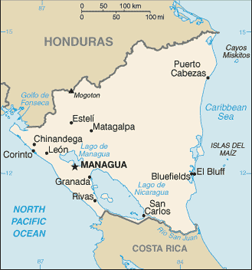
Nicaragua is
principally a source and transit country for women and children trafficked
for the purposes of commercial sexual exploitation and forced labor. Women
and children are trafficked within the country and to neighboring countries,
most often to El Salvador, Costa Rica, Guatemala, Honduras, Mexico, and the
United States, for commercial sexual exploitation. The most prevalent form of
internal trafficking is the exploitation of children, both boys and girls, in
prostitution. NGOs identify Managua, Granada, Esteli,
and San Juan del Sur as destinations for foreign child sex tourists. NGOs
report instances of forced child marriages between young girls and older
foreign men, particularly in San Juan del Sur. Children are trafficked within
the country for forced labor in construction, agriculture, the fishing
industry, and for domestic servitude. - U.S. State Dept
Trafficking in Persons Report, June, 2009 [Check
out a later country report here and possibly a full TIP Report here |
||||||||||||
|
CAUTION: The following links
have been culled from the web to illuminate the situation in HOW TO USE THIS WEB-PAGE Students If you are looking for
material to use in a term-paper, you are advised to scan the postings on this
page and others to see which aspects of Human Trafficking are of particular
interest to you. Would you like to
write about Forced-Labor? Debt
Bondage? Prostitution? Forced Begging? Child Soldiers? Sale of Organs? etc. On the other
hand, you might choose to include precursors of trafficking such as poverty and hunger. There is a lot to
the subject of Trafficking. Scan other
countries as well. Draw comparisons
between activity in adjacent countries and/or regions. Meanwhile, check out some of the Term-Paper resources
that are available on-line. Teachers Check out some of
the Resources
for Teachers attached to this website. HELP for Victims Foreign Affairs Ministry ***
FEATURED ARTICLE *** Child Gold Miners
in Ivan Castro,
Reuters, La Source of
photographs is "The Legacy of Greenstone Resources in www.minesandcommunities.org/article.php?a=1082 [accessed 11 March
2011] In a dim and
dangerous tunnel lit only by the flicker of candles, Juan Laguna and four
other children toil with rusty pick-axes to loosen chunks of rock they hope
will yield at least a little bit of gold.
Laguna then undertakes the arduous process of milling and washing the
ore. If it is a good day, it will give him enough gold to sell for about $3
(1.60 pounds). But he is not always lucky.
"Not every day goes well," says Laguna, who is 12 but has
the slight build of a child half his age.
Working with hundreds of other youngsters, Laguna has spent five years
scratching the walls of tunnels in the La India mining district, more than
100 miles (160 km) west of PHOTOS: Child gold
miners in AlertNet, Reuters
foundation, 09 Dec 2004 At one time this
article had been archived and may possibly still be accessible [here]
[accessed 9
September 2011] Featured here are
images by Reuters photographer Oswaldo Rivas of child gold miners working in
Nicaraguan mines. While more than 300,000 children between five and 17 work
at underpaid jobs instead of going to school, the Nicaraguan government is
working to pass a law to eradicate the ten most dangerous jobs that exploit
children. ***
ARCHIVES *** 2020 Country
Reports on Human Rights Practices: Nicaragua U.S. Dept of State Bureau of Democracy, Human Rights, and
Labor, 30 March 2021 www.state.gov/reports/2020-country-reports-on-human-rights-practices/nicaragua/
[accessed 18 June
2021] PROHIBITION OF
FORCED OR COMPULSORY LABOR Observers noted
reports of forced labor, including of men, women, and children in
agriculture, construction, mining, street begging, and domestic servitude.
Victim identification, prosecution, and conviction remained inadequate, and
victims’ family members were often complicit in their exploitation.
Traffickers lured residents of rural or border regions with the promise of
high-paying jobs in urban and tourist areas but then subjected them to sexual
exploitation and forced labor. PROHIBITION OF CHILD
LABOR AND MINIMUM AGE FOR EMPLOYMENT Child labor remained
widespread. According to organizations that worked on children’s rights, this
likely increased to almost 320,000 children working in some form of child
labor. A common feature of child labor was the prevalence of unpaid family
work, and the National Institute of Development Information stated 80 percent
of children and adolescents were unpaid workers. Children engaged in
the worst forms of child labor, including in commercial sexual exploitation
(see section 6). Most child labor occurred in forestry, fishing, and the
informal sector, including on coffee plantations and subsistence farms. Child
labor also occurred in the production of dairy products, oranges, bananas,
tobacco, palm products, coffee, rice, and sugarcane; cattle raising; street
sales; garbage-dump scavenging; stone crushing; gold mining and quarrying of
pumice and limestone; construction; drug production and trafficking; street
performing; domestic work; and transport. Persons with disabilities and
children were subjected to forced begging,
particularly in Managua and near tourist centers. Children working in
agriculture suffered from sun exposure, extreme temperatures, and dangerous
pesticides and other chemicals. Children working in the fishing industry were
at risk from polluted water and dangerous ocean conditions. Freedom House
Country Report 2020 Edition freedomhouse.org/country/nicaragua/freedom-world/2020 [accessed 4 May 2020] G4. DO INDIVIDUALS
ENJOY EQUALITY OF OPPORTUNITY AND FREEDOM FROM ECONOMIC EXPLOITATION? Nicaragua is a
source country for women and children forced into prostitution; adults and
children are also vulnerable to forced labor, notably in the agriculture and mining
sectors, and as domestic servants. While recognizing the government’s
“significant efforts” to tackle human trafficking, the 2019 US State
Department’s Trafficking in Persons Report said the country did not
demonstrate increasing efforts over the previous year, and that the Caribbean
coastal regions continued to be disproportionately affected due to weaker
institutions there. 2017 Findings on
the Worst Forms of Child Labor Office of Child
Labor, Forced Labor, and Human Trafficking, Bureau of International Labor
Affairs, US Dept of Labor, 2018 www.dol.gov/sites/default/files/documents/ilab/ChildLaborReport_Book.pdf [accessed 22 April
2019] www.dol.gov/sites/dolgov/files/ILAB/child_labor_reports/tda2017/ChildLaborReportBook.pdf [accessed 4 May
2020] Note:: Also check out this country’s report in the more recent edition DOL
Worst Forms of Child Labor [page 740] In Nicaragua,
children are subjected to commercial sexual exploitation, particularly in
Granada, Managua, the Caribbean autonomous regions, and San Juan del Sur.
(23; 26) Children in Nicaragua who lack identification documents, sometimes
due to a lack of birth registration, may not have access to social services
and are at an increased risk of human trafficking and commercial sexual
exploitation. (11) An estimated 15 percent of children born in Nicaragua lack
birth certificates. (27) Although the government’s birth registration
campaign is advancing, it does not reach all children, especially in remote
areas. (28; 29; 30). Trafficking in
Children in Latin America and the Caribbean [PDF] Casa Alianza,
Covenant House – www.childtrafficking.com/Docs/casa_alianza__trafficking_i.pdf [accessed 11 March
2011] poundpuplegacy.org/files/casa_alianza__trafficking_i.pdf [accessed 13 June
2017] [page 4] FINAL DESTINATIONS - Child Labour News
Service, March 15 2002 – Source: La
Prensa www.hrea.org/lists/child-rights/markup/msg00022.html [accessed 11 March
2011] [scroll down] CENTRAL AMERICA
BASTION OF CHILD SEXUAL EXPLOITATION - According to the
report, Nicaragua is the "principal supplier of sexual victims for the
whole region." Harris said,
"Many Nicaraguans, adults, adolescents and even minors, end up in
centres in Honduras, El Salvador, and principally Guatemala, and in the south
their destination is Costa Rica, where there is the most intense sexual
tourism." Advancing
the Campaign Against Child Labor: Efforts at the Country Level – digitalcommons.ilr.cornell.edu/cgi/viewcontent.cgi?article=1138&context=key_workplace [accessed 8
September 2014] [page 183] CHILD LABOR IN
NICARAGUA
- There are reports of children forced to work in the streets of Managua as
vendors and beggars by their parents; in some cases, these children are
“rented” by their parents to organized networks of beggars. Between 4,000 and
5,000 children are estimated to work on the streets of the capital city,
selling merchandise, cleaning automobile windows, or working in other
activities. House Armed
Services Committee Member Criticizes US Army & Air Force Relationship
with Burmese Sweatshop The National Labor
Committee, December 19, 2000 At one time this
article had been archived and may possibly still be accessible [here]
[accessed 9
September 2011] On December 5th, at a press conference on
Capitol Hill, Concluding
Observations of the Committee on the Rights of the Child (CRC) UN Convention on the
Rights of the Child, 3 June 2005 www1.umn.edu/humanrts/crc/nicaragua2005.html [accessed 12
December 2010] [62] The Committee further
notes that the domestic legislation does not seem to contain provisions
punishing sale and trafficking of children for the purpose of economic
exploitation. The
Protection Project - The www.protectionproject.org/human_rights_reports/report_documents/nicaragua.doc [accessed 2009] FACTORS THAT
CONTRIBUTE TO THE TRAFFICKING INFRASTRUCTURE - Throughout the Central American
region, “machismo” attitudes are prevalent, and women are often viewed as
sexual objects. Interfamily violence, the breakdown of families, and poverty
push young people to leave their homes and communities to search for better
lives. The pull factor of the United States also causes many young people to
migrate northward. To a lesser extent, pull factors entice young people
toward more prosperous neighboring countries, for example, from Nicaragua
south to Costa Rica. At border crossings, children are especially vulnerable
to the whims of corrupt immigration officials or traffickers who help them
cross the border. FORMS OF TRAFFICKING
-
Young women leave Nicaragua for neighboring countries or other places for
promised jobs in hotels or factories or as domestics. One report recounts the story of a girl who
was kidnapped at the age of 12 as she was walking to school in Managua in
1998. She had set out for school alone, as she did every morning. A taxi
stopped her to ask directions. She remembers nothing more after that. She
woke up in an unfamiliar place among other young girls, guarded by three
women. Less than a week later, she was sold to some men, who sold her to
others, who brought her to the United States to work in a brothel. For the
next 6 years, until she was 18, she was “dragged from place to place and
passed from hand to hand.” At the age of 18, she managed to go to the
authorities, who deported her. She is now back in
Nicaragua after “losing the best years of [her] life and [her] adolescence.” ***
EARLIER EDITIONS OF SOME OF THE ABOVE *** Freedom House
Country Report 2018 Edition freedomhouse.org/country/nicaragua/freedom-world/2018 [accessed 4 May 2020] G4. DO INDIVIDUALS
ENJOY EQUALITY OF OPPORTUNITY AND FREEDOM FROM ECONOMIC EXPLOITATION? Human trafficking
is a significant issue in Nicaragua, which serves as a source country for
women and children forced into prostitution; adults and children
are also vulnerable to forced labor in the agriculture, mining, and other
sectors, and as domestic servants. While recognizing the government’s
“significant efforts” to tackle human trafficking, the 2017 U.S. State
Department’s Trafficking in Persons Report stated that promised funds to be
put aside for antitrafficking initiatives had
failed to materialize, and that the Atlantic coast continued to be
disproportionately affected due to weaker institutions there. Human Rights
Reports » 2005 Country Reports on Human Rights Practices U.S. Dept of State Bureau of Democracy, Human Rights, and
Labor, March 8, 2006 2009-2017.state.gov/j/drl/rls/hrrpt/2005/61734.htm [accessed 10
February 2020] TRAFFICKING
IN PERSONS
– Government officials, NGOs, and other organizations characterized
trafficking as a growing problem throughout the region. The government, NGOs,
and media periodically reported cases of individual women trafficked to
brothels in The Department of
Labor’s 2004 Findings on the Worst Forms of Child Labor www.dol.gov/ilab/media/reports/iclp/tda2004/nicaragua.htm [accessed 12
December 2010] Note:: Also check out this country’s report in the more recent edition DOL
Worst Forms of Child Labor INCIDENCE
AND NATURE OF CHILD LABOR - Some children are forced by their parents to beg,
and some are “rented” out by their parents to organized groups of
beggars. All
material used herein reproduced under the fair use exception of 17 USC § 107
for noncommercial, nonprofit, and educational use. PLEASE RESPECT COPYRIGHTS OF COMPONENT
ARTICLES. Cite this webpage as: Patt,
Prof. Martin, "Human Trafficking & Modern-day Slavery - |
|
|||||||||||