Human Trafficking & Modern-day Slavery Poverty drives the unsuspecting poor into the
hands of traffickers Published reports & articles
from 2000 to 2025 gvnet.com/humantrafficking/Nepal.htm
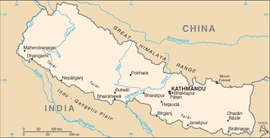
Nepal is a source
country for men, women, and children trafficked for the purposes of
commercial sexual exploitation and involuntary servitude. Children are
trafficked within the country and to India and the Middle East for commercial
sexual exploitation or forced marriage, as well as to India and within the
country for involuntary servitude as domestic servants, circus entertainers,
factory workers, or beggars. NGOs working on trafficking issues report an
increase in both transnational and domestic trafficking during the reporting
period, although a lack of reliable statistics makes the problem difficult to
quantify. NGOs estimate that 10,000 to 15,000 Nepali women and girls are
trafficked to India annually, while 7,500 children are trafficked
domestically for commercial sexual exploitation. In many cases, relatives or
acquaintances facilitated the trafficking of women and young girls into
sexual exploitation. - U.S. State Dept
Trafficking in Persons Report, June, 2009 Check
out a later country report here and possibly a full TIP Report here |
|||||||||||
|
CAUTION: The following links
have been culled from the web to illuminate the situation in HOW TO USE THIS WEB-PAGE Students If you are looking
for material to use in a term-paper, you are advised to scan the postings on
this page and others to see which aspects of Human Trafficking are of
particular interest to you. Would you
like to write about Forced-Labor? Debt
Bondage? Prostitution? Forced Begging? Child Soldiers? Sale of Organs? etc. On the other
hand, you might choose to include precursors of trafficking such as poverty and hunger. There is a lot to
the subject of Trafficking. Scan other
countries as well. Draw comparisons
between activity in adjacent countries and/or regions. Meanwhile, check out some of the Term-Paper resources
that are available on-line. Teachers Check out some of
the Resources
for Teachers attached to this website. ***
FEATURED ARTICLES *** Why Sanjaya Dhakal,
Kathmandu, OneWorld South us.oneworld.net/places/nepal/-/article/why-nepals-freed-laborers-want-return-slavery [accessed 9 December
2010] sajha.com/archives/openthread.cfm?threadid=13840 [accessed 4 May
2020] "Between 15
and 20 percent of the families declared free have returned to the same old
practice of slavery," says Dilli Chaudhary, president of an NGO called
Backward Society Education. Bonded labourers in
Nepal are called "kamaiyas" and belong to the country's backward
Tharu community. It is sheer poverty that forces the poor to borrow rice and
food from their employers - generally big landlords - and get trapped in
slavery. Under the practice,
once indebted, the labourer and his heirs are 'bonded' to the landlord. They
had to actually reside on the landlord's property until the debt was
completely repaid, which seldom happened. Women, Bought and
Sold in Nepal Katie Orlinsky, The
New York Times Sunday Review, 31 Aug 2013 www.nytimes.com/2013/09/01/opinion/sunday/women-bought-and-sold-in-nepal.html?smid=fb-share&_r=0 [accessed 1 Sept
2013] One of the women I
talked with was Charimaya Tamang, who 19 years ago went out to the fields to
cut grass in her village in Nepal. Typically she would have gone with other
women from her village, but that day she was alone. A group of men grabbed
her from behind, tied her hands and made her swallow “a powder.” When she
woke up she was in a city in northern India. “I had never seen tall buildings
before,” she recalled. It was a lot hotter than her village and the men
offered her a soda. “I didn’t want to drink it but I was so thirsty,” she
said. The heat and soda were her last memories before finding herself in a
Mumbai brothel under the care of a woman she called “Auntie,” where she
remained in forced prostitution for 22 months. A brothel pimp or
madam pays close to $2,000 for one trafficked Nepalese girl, according to
Rupa Rai, head of Caritas Nepal’s gender department. The girl is then
obligated to repay this fee over time. Charimaya Tamang was the first woman
in Nepal to file charges against her trafficker and win. The very same men
that made her drink that soda were caught and put in jail, she said. Nirakar Poudel,
Media for Freedom, Nepal, August 5, 2007 -- Source:
www.mediaforfreedom.com/ReadArticle.asp?ArticleID=3055 www.iccle.org/050807.php [accessed 23
February 2011] child-sts-nepal.org/abuse-and-exploitation-of-street-children/ [accessed 4 May
2020] An orphan from an
early age, Madan Karki (name changed),14, used to work at his uncle's small
farm in Jeevanpur of Dhading District, 50 kilometer west of capital. Madan's
job was to take the cattle for grazing the whole day. One day, a family
friend approached him with offer for work at his home in Kathmandu with a
promise that he will be admitted in a school. However, the man
instead engaged him at a carpet factory in After working in
harsh conditions for about eight months in the factory, Madan –who was not
paid - fled the factory to work as a helper in a gas tempo. Now, he earns
about Rs 1000 (approximately $15) a month. Madan's case is not a unique one
as this is the reality of many child workers in Nepal. Because Nepal's
dependency on child labor is so deeply entrenched, only half of the children
are allowed to complete the fifth grade of school. The ILO reports showed
that. Children are employed in eighteen different sectors like in brick kiln,
coal mines, child prostitution, mug house, leather processing industry, coal
mine, stone quarrying, match factory, house-hold helper, bonded labor, street
children, mine and carpet factory, drug trafficking, transport sector etc.
About 1.4 million children are not provided the salary for their work and
1.27 million children are working in worst forms of labor. Call for Global
Action to halt Nepalese women and girls trafficking Surya B. Prasai, The
American Chronicle, February 10, 2008 womenfreedomforum.com/index.php?option=com_content&task=view&id=456&Itemid=80 [accessed 22 August
2014] www.oijj.org/en/news/general-news/call-for-global-action-to-halt-nepalese-women-and-girls-trafficking [accessed 13 June
2017] The other alarming
fact of course is that Nepal has a unique cultural system known as
"Deukis," whereby by rich zamindars (feudalistic agricultural
families) having no children through a legally married wife, procure these
young girls from poor rural Nepalese families and after initiating them into
the household through the temple rites are taken as mistresses cum slave
bonded laborers to produce offspring. Later on, as the girl gets to be over
30 years and grows older, she is forced into prostitution. There is no
respite to what the poor Nepalese girl has to suffer on in life once
initiated into this system. In 2007 according to a UN report, there werel
nearly 30,000 deukis in Nepal compared to 1992, when there were 17,000 deuki
girls according to Radhika Coomaraswamy in the UN Special Report on Violence
against Women. ***
ARCHIVES *** Poverty’s
Contribution To Child Marriage In Nepal Daryn Lenahan,
The Borgen Project, 12 October 2020 borgenproject.org/povertys-contribution-to-child-marriage-in-nepal/ [accessed 23
February 2021] Several factors
contribute to child marriage in developing countries. Nepal has a patriarchal
society that values girls significantly less than boys. Limited access to
education and a negative outlook towards a sexual expression motivates
adolescents to marry early. The most massive motivator, however, is poverty.
Countries with a higher percentage of the population living on under $1.90
per day, including Nepal, frequently experience higher rates of child
marriage. Poverty correlates to the high rates of child marriage in Nepal, including
dowries and financial benefits, economic hardship of schooling and “love
marriages” to escape poverty. 12 trafficking
victims, including three minors, rescued in past three months [Categories -
Deception of Victims, Poverty] Shuvam Dhungana,
the Kathmandu Post, 24 June 2020 [accessed 24 June
2020] “The traffickers,
like in most cases, had lured their victims by offering them false hope of
well-paying jobs and better lifestyle. However, they were arrested before
they could reach far from the authorities due to the nationwide lockdown and
travel restrictions. Many of them were arrested near the India-Nepal border,”
said SSP Deb Bahadur Bohara, chief of the bureau. “The two men
reportedly lured the young girl to go with them to India by promising her a
job,” said SP Gobinda Thapaliya. “The girl, who was
sold to a dance company, was rescued with the help of Indian police and
reunited with her family,” Thapaliya said. Investigation
revealed that the teenager had been kept captive for months before she was
rescued. 2020 Country
Reports on Human Rights Practices: Nepal U.S. Dept of State Bureau of Democracy, Human Rights, and
Labor, 30 March 2021 www.state.gov/reports/2020-country-reports-on-human-rights-practices/nepal/
[accessed 18 June
2021] PROHIBITION OF
FORCED OR COMPULSORY LABOR Forced labor,
including through debt-based bondage, of adults and children existed in
agriculture, brick kilns, the stone-breaking industry, and domestic work. A
government study documented more than 61,000 individuals–including
approximately 10,000 children–in forced labor over
the past five years, especially in agriculture, forestry, and construction.
NGOs continued to report some children worked in brick kilns, including
carrying loads, preparing bricks, and performing other tasks at kilns for
extended periods. PROHIBITION OF CHILD
LABOR AND MINIMUM AGE FOR EMPLOYMENT Child labor,
including forced child labor, occurred in agriculture, domestic service, portering, recycling, and transportation; the worst
abuses were reported in brick kilns, the stone-breaking industry, the carpet
sector, embroidery factories, and the entertainment sector. In the informal
sector, children worked long hours in unhealthy environments, carried heavy
loads, were at risk of sexual exploitation, and at times suffered from numerous
health problems (see section 6, Children). Freedom House
Country Report 2020 Edition freedomhouse.org/country/nepal/freedom-world/2020 [accessed 8 July
2020] G4. DO INDIVIDUALS
ENJOY EQUALITY OF OPPORTUNITY AND FREEDOM FROM ECONOMIC EXPLOITATION? Trafficking of
children and women from Nepal for prostitution in India is common, and police
rarely intervene. Bonded labor is illegal but remains a serious problem. Child
labor also remains a problem; children can be found working in the
brickmaking, service, and other industries, as well as in forced begging and
sex work. The 2015 earthquake
left millions of people homeless. Many of those affected lack opportunities for
social mobility, as they struggle to recover from the disaster. 2017 Findings on
the Worst Forms of Child Labor Office of Child
Labor, Forced Labor, and Human Trafficking, Bureau of International Labor
Affairs, US Dept of Labor, 2018 www.dol.gov/sites/default/files/documents/ilab/ChildLaborReport_Book.pdf [accessed 22 April
2019] www.dol.gov/sites/dolgov/files/ILAB/child_labor_reports/tda2017/ChildLaborReportBook.pdf [accessed 4 May
2020] Note:: Also check out this country’s report in the more recent edition DOL
Worst Forms of Child Labor [page 731] Children are
trafficked for commercial sexual exploitation both within and outside Nepal,
including to India, the Middle East, Asia, and Sub-Saharan Africa. (6; 30;
31; 32; 2; 19) Many children in Nepal are engaged in the production of
bricks, which exposes them to hazardous working conditions, including
carrying heaving loads, using dangerous machinery, and working in extreme
heat. (1). Child marriages,
trafficking will soar after Nepal quake: charity Emma Batha, Thomson
Reuters Foundation, CASABLANCA, Morocco, 19 May 2015 www.reuters.com/article/2015/05/19/us-quake-nepal-childmarriage-idUSKBN0O426M20150519 [accessed 19 May
2015] The massive
earthquakes in Nepal will lead to a dramatic rise in child marriage and the
trafficking of children as criminals prey on orphans and parents act to
protect young daughters, the head of a social welfare organization predicted
on Tuesday. "Rape is
taking place. Almost every week we have a case of a young girl being raped by
a group of boys (in tents)," he said. "Parents who have young girls
will have fear in their minds and they will think the best way to ensure her
safety will be to marry her." Other girls may be
married off because their parents have been killed, their families can no
longer afford to keep them in school or because their schools were destroyed. Nepalese man sues
KBR on human trafficking charges Agence France-Presse
AFP, August 28, 2008 news.smh.com.au/world/nepalese-man-sues-kbr-on-human-trafficking-charges-20080828-44j7.html [accessed 23
February 2011] edition.cnn.com/2008/WORLD/asiapcf/08/28/kbr.nepal.workers/index.html [accessed 4 May
2020] A Nepalese man and
relatives of 12 of his slain comrades filed a lawsuit in federal court
against the construction and services giant KBR on charges of human trafficking,
for allegedly tricking the men into working in Iraq. The men, between the ages of 18 and 27,
"were recruited in Nepal to work as kitchen staff in hotels and
restaurants in Amman, Jordan," read a statement from Cohen, Milstein,
Hausfeld & Toll, one of the law firms handling the case. However once they arrived in Jordan
"they were not provided the expected employment." Their passports
were seized, and they were told they were being sent to Iraq "to provide
menial labor" at the Al-Asad Air Base, the statement read. Rescuing girls from
sex slavery Ebonne Ruffins,
Cable News Network CNN, www.cnn.com/2010/LIVING/04/29/cnnheroes.koirala.nepal/ [accessed 23
February 2011] The daughter of
Nepalese peasant farmers, Geeta -- now 26 -- had been sold to a brothel in Trafficking Of
Women And Girls: A Study Of Causes And Coping Strategies SSweta Thapa,
Graduate Student, Asian Institute of Technology (AIT), September 2008 [Long URL] [accessed 15
February 2022] The problem of
trafficking of women and girls is particularly acute in the rural areas of
Nepal. With an ever increasing number of Nepalese girls going abroad as
migrant women workers, itis even more difficult to estimate the exact figure.
Often, a figure of 5,000 to 15,000 women and young girls being trafficked to
Indian brothels each year is cited, and 30 districts were identified as the
most trafficking prone (UNICEF, 2007).
Most of the women are raped and sexually abused even before they reach to
brothels in various urban centers in India. One study shows that every year,
12,000 girls under the age of 18 are trafficked to India where they are sold
at prices varying from Indian rupees 25,000 to 100,000 (UNIFEM and IIDS,
22004). This has become a large profit making business and the International
Organization on Migration (IOM) states that the global trafficking industry
generates about US$ 8 billion in revenue each year (Widgren,
1994). About 44% of the trafficked women belong to the Dalit caste groups
(Save the Children Norway, 2005). The largest
proportion of victims are trafficked across the border from Nepal to India,
but the trafficking business has diversified nowadays to include new
destinations like Hong Kong, Singapore, Thailand and the Gulf states. Seven Nepalese held
for human trafficking to India Press Trust of www.indolink.com/displayArticleS.php?id=060608091956 [accessed 23
February 2011] The women, who had
been sold to a brothel in Kolkota last year, managed to escape from
Dharamtala area where they were locked up for three days, the police
said. Stop AIDS, halt
trafficking in Nepalese women Surya B. Prasai, The
American Chronicle, February 22, 2008 amchron.soundenterprises.net/articles/view/53039 [accessed 5 July
2013] trafficking-monitor.blogspot.com/2011/02/american-chronicle-human-trafficking.html [accessed 19
February 2019] The first known
case of AIDS in Nepal was in 1986 and in the period 1996-2006, the 10 year
period of the Nepalese civil conflict, a total of 200,000 to 250,000 Nepalese
young girls aged 12-29 were either sold or illegally exchanged for cash in
various Indian cities by women traffickers. Govt to set up 3
rehabs for trafficking victims Nov 24, 2007 www.kantipuronline.com/kolnews.php?&nid=129247 [access date
unavailable] "We have cases
in which children are trafficked to Human trafficking
helps spread HIV/AIDS in Asia: UN Ranga Sirilal,
Reuters, www.reuters.com/article/idUSL22325220070822 [accessed 23
February 2011] "Trafficking
... contributes to the spread of HIV by significantly increasing the
vulnerability of trafficked persons to infection," said Caitlin
Wiesen-Antin, HIV/AIDS regional coordinator, Major human
trafficking routes run between Nepal
and India and between Thailand and neighbors like Laos, Cambodia and Myanmar.
Many of the victims are young teenage girls who end up in prostitution. "The link between human trafficking
and HIV/AIDS has only been identified fairly recently," Wiesen-Antin
told the International Congress on AIDS in Asia and the Pacific. NGOs Work To
Eradicate Human Trafficking, Help Victims Press release
submitted by usinfo.state.gov, presszoom.com/story_134115.html [accessed 23
February 2011] U.S.-funded
nongovernmental organizations around the world are working to prevent human
trafficking, provide resources to victims and arrest and prosecute child-sex
offenders. From Africa to Europe to Asia, initiatives are raising worldwide
awareness of the illegal practice of human trafficking. PREVENTING HUMAN
TRAFFICKING
- Shakti Samuaha in Nepal is the first NGO in the world formed by trafficking
survivors, and more than 120 survivors attended its conference in March to
commemorate International Women’s Day. Conference participants focused on
preventing human trafficking of vulnerable populations, particularly
adolescent girls, and providing rehabilitative services for other trafficking
survivors. Of Serious Concern Editorial,
Gorkhapatra Sansthan - Dharmapath, Kathmandu, Nepal, 2007-1-13 At one time this
article had been archived and may possibly still be accessible [here]
[accessed 9
September 2011] [scroll down] Incidents of human
trafficking are on the rise in the country despite the presence of a number
of organisations, both in the private and government sectors, and the
powerful media that makes each incident of human trafficking public. The
latest case of human trafficking was revealed in Nepalgunj the other day when
a suspected trafficker was arrested while trying to traffic four boys and
five girls across the border. Thanks to Maiti Nepal, an NGO working for the
well-being of helpless girls, the police arrested the suspected trafficker.
Though there is no official record regarding the number of Nepalese girls
trafficked to Indian brothels, thousands of Nepalese girls are said to live
lives of untold misery in the Indian brothels. Action Plan Against
Trafficking www.gorkhapatra.org.np/content.php?nid=9149 [access date
unavailable] Although the
government, law enforcement agencies and social orgnisations have been active
in checking human trafficking, the unscrupulous brokers continue to do the business
taking advantage of legal and other loopholes. It is also believed that there
is a strong nexus between the brothel owners, brokers, politicians and
criminal gangs who aid in human trafficking. As a result, checking and
eliminating human trafficking have become a challenge. Update mechanism to
check human trafficking 12/25/2006 www.gorkhapatra.org.np/content.php?nid=9055 [access date
unavailable] Timely changes need
to be made in the existing national plan of action to combat human
trafficking and trade of human kind, participants at a national policy
consultation workshop said Sunday.
Speaking at the workshop jointly organised by the Ministry for Women,
Children and Social Welfare, Ministry for Local Development, WOREC Nepal and
Alliance working against the trafficking of women and children, participants
underscored the need to sign a extradition treaty to rescue the victims of
trafficking from the next country. Peace Won't Stop
Human Trafficking Marty www.ipsnews.net/news.asp?idnews=34720 [accessed 23
February 2011] www.ipsnews.net/2006/09/nepal-peace-wont-stop-human-trafficking-official/ [accessed 24
September 2016] Men also are
trafficked -- lured to a centre by the prospect of a certain job and then
kept in exploitative work situations. The report
estimates that 60 percent of trafficking from and within this South Asian
nation is for sexual purposes and 40 percent is to supply workers for labour,
such as toiling in garment factories. "Trafficking
for various purposes other than sexual ones still needs to be addressed
strategically...the lack of a definition has created confusion in formulating
acts, plans and policies" Human trafficking
from Mohan Budhair,
Kathmandu Post, Paliya www.ipcs.org/pdf_file/news_archive/sep_06_sanepal.pdf [accessed 29 May
2011] www.unodc.org/pdf/india/Nat_Rep2006-07.pdf [accessed 4 May
2020] [page 22] Trafficking of
Nepalese women and children into India, especially from the western
districts, has increased significantly in recent days due to lax security at
border checkpoints. A large number of
women and children are being trafficked into India from checkpoints west of Butwal,
representatives of several Indian and Nepalese non-governmental organizations
(NGOs) and security officials stated during an interaction on 'controlling
cross-border human trafficking'. Prostitution of
Nepalese girls rampant in Indian brothel webindia123.com,
Kolkata, Nov 20, 2005 www.stopdemand.org/afawcs0112878/ID=146/newsdetails.html [accessed 23
February 2011] zeenews.india.com/news/nation/prostitution-of-nepalese-girls-rampant-in-indian-brothels_257336.html [accessed 7 February
2018] ''Young girls are
trafficked from Nepal to brothels in Mumbai and Kolkata at an average age of
twelve. They are trapped into the vicious cycle of prostitution, debt and
slavery. By the time they are in their mid-twenties, they are at the dead end
or 'cul-de-sac','' the study noted. Women Trafficking
And Conflict Kamala Sarup,
Telegraph, 14 March 2005 www.scoop.co.nz/stories/HL0503/S00100.htm [accessed 23
February 2011] "I got
acquainted with a boy who was 30 who said he loved me and promised to marry
me. He convinced me to go to Around 30 Percent
Child Recruits in Maoist Army UNICEF Child Trafficking
Research HUB -- Source:
newkerala.com/news-daily/news/features.php?action=fullnews&id=65638, 27
January 2005 [accessed 23
February 2011] Around
30 percent of the "people's army" of 17,000 Xinhua News Agency,
March 26, 2005 english.people.com.cn/200503/26/eng20050326_178321.html [accessed 23
February 2011] According
to the study, the investigators talked personally to the Nepali women in the
brothels of The Saving of
Innocents - The Satya Interview with Ruchira Gupta Satya Magazine,
January 2005 At one time this
article had been archived and may possibly still be accessible [here]
[accessed 9
September 2011] An uncle or a
family friend pays the parent something like $30. There is the middleman in a
packed city, the border guard who takes a payoff, and the agent who takes the
girls across the border to the people who then transport them to Nepal's children
devastated by raging armed conflict Press Release, CARE,
26 Jan 2005 www.essex.ac.uk/armedcon/story_id/000248.html [accessed 29 August
2011] Watchlist calls for
immediate action to stop the spectrum of violations against children in the
context of armed conflict, including killing, maiming, torture, rape and
other forms of sexual violence, attacks on schools, abduction, trafficking,
forced labor, underage recruitment into fighting forces, forced displacement,
death and injury from landmines, and others. Fighting to stop
trade in sex slaves Kate Kirton, news.scotsman.com/nepal/Fighting-to-stop-trade-in.2532778.jp [accessed 23
February 2011] Girls as young as
13 are taken from villages and slum areas by traffickers - men, and sometimes
women - who lure them away with the promise of well-paid jobs in the
country’s capital, Kathmandu, or in the big cities of India and the Gulf
states. But what actually
awaits the girls is a life of forced prostitution in these cities’ brothels.
The girls don’t know how to escape - they are mainly uneducated and extremely
poor and too ashamed to tell their families what they are doing. Even if they manage to escape or get
rescued from the brothels, their families and communities often refuse to
take them back because of the social stigma the girls now carry. Nepal rebels plan
to train 50,000 Child Soldiers Asian Human Rights
Commission, acr.hrschool.org/mainfile.php/0169/284/ [accessed 23
February 2011] original.antiwar.com/sdhakal/2004/02/28/nepal-communists-plan-to-train-50000-child-soldiers/ [accessed 7 February
2018] This week, Nepal's
Maoist rebels announced plans to raise a militia of 50,000 children by April,
amid reports of mass abduction, even sexual abuse of kids, who they allegedly
use as cannon fodder. The lost childhood Anita Pandey, Feb
18, 2004 -- Source: nation.ittefaq.com/artman/publish/article_7429.shtml At one time this
article had been archived and may possibly still be accessible [here] [accessed 9
September 2011] In the past six
months, CWIN recorded 2,866 cases of child labour exploitation, child deaths
and murder, missing children, violence, sexual abuse, trafficking, forced
prostitution, children affected by armed conflict and children in conflict
with the law. Strengthening
Women's Rights OXFAM in action - At one time this
article had been archived and may possibly still be accessible [here]
[accessed 9
September 2011] [scroll down] STRENGTHENING
WOMEN'S RIGHTS
- Life is hard for most women in Between 5,000 and
12,000 Nepalese girls are trafficked by organised gangs to work in brothels
each year. Only 27 per cent of women
are literate compared with 67 per cent of men. A Nepalese woman
cannot apply for a job, passport, or bank account without permission from her
father or husband. And with low female literacy rates, it is difficult for
Nepali women to use public courts to challenge abuse and discrimination. Trafficking from Devesh K. Pandey,
The Hindu, The contents of this
article had appeared under a different title and may possibly still be
accessible [here] [accessed 9
September 2011] www.thehindu.com/2004/12/13/stories/2004121313190300.htm [accessed 7 February
2018] The survey found
that apart from Delhi and Uttar Pradesh, Nepalese women and children are also
trafficked to Maharashtra, West Bengal and Bihar. Most of the victims,
belonging to poor families, are brought here on the pretext of providing them
better jobs. It is being suspected that the three girls, who have gone
missing from Chitwan, were brought here on the pretext of getting them roles
in Indian movies. Lured by such offers, the victims accompany trafficking
agents, who sell them off to brothel owners.
From those rescued in the recent past, the authorities concerned have
come to know that several Nepalese girls were also sold off to brothels
located on G.B. Road in Central Delhi. Combating
Trafficking In USAID from the
American People, May 29, 2009 transition.usaid.gov/stories/nepal/fp_nepal_trafficking.html [accessed 2
September 2012] [accessed 19
February 2019] Fourteen-year-old
Urmila Tamang (name changed to protect her privacy) is from a small village
in Chitwan, Nepal. A woman from a neighboring district approached Urmila’s
unsuspecting parents in 2002 with promises of a lucrative circus job for
their daughter in Varanasi, a city in northern India. Ignorant about human
trafficking, they sent Urmila without enquiring further about the nature of
the job. There, Urmila endured a year of labor exploitation and sexual
harassment as an acrobat and tight rope walker. Sanjaya Dhakal,
OneWorld.net, January 08, 2004 web.archive.org/web/20050830222523/http:/www.kurakani.tk/Article84.phtml [Last access date
unavailable] www.peacewomen.org/sites/default/files/VAW_NepalShyJustice_Dhakal_2004_0.pdf [accessed 7 February
2018] Even though Nepal
has a strict legal system that can punish traffickers with life imprisonment,
a combination of factors keeps the victims away from the doors of justice -
social stigma, lengthy judicial process, re-victimisation and lack of easy
access to the law. Take the example of
Tirtha Rai (name changed), a girl in her mid-20s from the district of
Sindhupalchowk, east of Kathmandu valley. She had been sold to a brothel in
India by her aunt. Similarly, Bhawana
Sharma (name changed), a teen-aged girl from Nuwakot, a district west of
Kathmandu, was lured by a promise of marriage and taken to Pune in India,
where she was sold to a brothel. Labour migration
and human trafficking in Nepal OneWorld At one time this
article had been archived and may possibly still be accessible [here] [accessed 9
September 2011] US blames turmoil
for prostitution in Nepal Indo-Asian News
Service IANS, At one time this
article had been archived and may possibly still be accessible [here] [accessed 9
September 2011] The report holds
the eight-year-old Maoist insurgency responsible in many ways. The rebels
themselves are perpetrators, it says, abducting and forcibly conscripting
children. Since September 2003, the
insurgents have abducted about 950 children, the report says. In rural areas,
insurgency activities have led to the withdrawal of police, resulting in a
remarkable decrease in trafficking related investigations. The government, grappling with the rebels
on one hand and political parties on the other, has been unable to combat
trafficking. Since the
dissolution of parliament in 2002, no elections have been held. As a result,
legislation that would have cracked down on trafficking-related offences
remains in limbo, the report says. Bhagirath Yogi, BBC
correspondent in news.bbc.co.uk/2/hi/south_asia/2648525.stm [accessed 23
February 2011] Police in Combating
Trafficking of Women and Children in Regional Synthesis
Paper for www.adb.org/Documents/Books/Combating_Trafficking/Regional_Synthesis_Paper.pdf [accessed 23
February 2011] www.adb.org/sites/default/files/publication/30364/combating-trafficking-south-asia-paper.pdf [accessed 7 February
2018] [page 110] With regard to trafficking for sexual
exploitation, the Government of Nepal has become increasingly concerned,
particularly about the trafficking of adolescent and young girls to India,
where many of them end up in brothels. In 1998 the Government therefore began
work on a National Policy, Action Plan and Institutional Mechanism to Combat
Against Trafficking in Women and Children for Commercial Sexual Exploitation.
The National Action Plan is broad-based, and includes proposed activities in
the areas of (i) policy, research, and institutional development; (ii)
legislation and enforcement; (iii) awareness raising, advocacy, networking,
and social mobilization; (iv) health and education; (v) income and employment
generation; and (vi) rescue and reintegration. The UN Special Rapporteur on Violence
Against Women commended the Action Plan as both comprehensive and well
thought out, although she noted that more attention could be paid to the
prosecution and punishment of traffickers. The Enslavement of
Dalit and Indigenous Communities [PDF] Discrimination on
the Basis of Work and Descent, UN Sub-Commission on the Promotion and
Protection of Human Rights, February 2001 At one time this
article had been archived and may possibly still be accessible [here]
[accessed 9
September 2011] www.antislavery.org/wp-content/uploads/2017/01/goonesekere.pdf [accessed 7 February
2018] SUMMARY: - This paper
describes the gross and continuing violation of the rights of millions of
people in India, Pakistan and Nepal1, who are trapped in debt bondage and
forced to work to repay loans. Their designation as persons belonging outside
the Hindu caste system is a major determining factor of their enslavement.
Evidence from all three countries shows that the vast majority (80%-98%) of
bonded labourers are from communities designated as “untouchable”, to whom
certain occupations are assigned, or from indigenous communities. In the same
way that caste status is inherited, so debts are passed on to the succeeding
generations. Slaves To Lust Lesley Downer, The Sunday
Times, Weekend Magazine, July 18, 1999 At one time this
article had been archived and may possibly still be accessible [here]
[accessed 9
September 2011] She confides that,
in reality, she was sold by her friends, who tricked her into going to
Mumbai. The madam paid 35,000 rupees ($750) for her, a sum that took her four
and a half years to repay. In India, prostitution is not illegal, so long as
it is voluntary and the girls are not underage. None the less, the police
have been cracking down on Nepalese underage girls. So the girls lie about
everything – their age, their nationality, their names. By the time Kanchi
had repaid her debt she had forgotten the traffickers. Falkland Road had
become her life and her home. She began to make money. She charges, she says,
35 to 50 rupees (75c-$1.10) a customer, out of which she pays rent for the
bed and the regular requisite bribes to the police. Not long ago, she went
back to Kathmandu in Nepal. She told her sisters she was working in a hotel,
washing dishes. “I’m the only one in my family who’s gone to the bad,” she
says. “I don’t like this life, but what can I do? If I don’t do this, I die.
What else is there to do?” Because she is beautiful, many men have offered to
marry her. But she is too canny for that. “So many men try to seduce me. But
I know they’ll just sell me back to the brothel.” RAPE FOR PROFIT -
Trafficking of Nepali Girls and Women to Human Rights
Watch/Asia Report, Vol. 12, No. 5 (A), October 1995 www.hrw.org/legacy/reports/1995/India.htm [accessed 23
February 2011] INTRODUCTION - Trafficking
victims in Tulasa and the
Horrors of Child Prostitution - Sold And Resold Body And Soul Rajedar Menen
reports from Kathmandu and At one time this article
had been archived and may possibly still be accessible [here] [accessed 9
September 2011] Tulasa was abducted
from Thankut village in Bagmati district near Kathmandu and then smuggled to Concluding Observations
of the Committee on the Rights of the Child (CRC) UN Convention on the
Rights of the Child, 3 June 2005 www1.umn.edu/humanrts/crc/nepal2005.html [accessed 23
February 2011] [53] Given the
significant number of Nepalese children who are adopted by foreigners and in
the context of the current armed conflict in the State party, the Committee
is concerned at the lack of a clear policy and appropriate legislation on
inter-country adoption, which result in various practices, such as
trafficking and smuggling of babies. The Committee is particularly concerned
about the absence of due judicial process, including technical assessment of
capacity of the parents or guardians, in cases involving termination of the
parental responsibility. The Committee also expresses concern regarding the
practice of the so-called informal adoption, which may entail exploitation of
children as domestic servants. [95] The Committee
takes note of the various efforts undertaken by the State party to combat
child trafficking and welcomes the information that police officers are Human
Rights Overview – 2005 Human Rights Watch
World Report 2005 -- 13 january 2005 www.hrw.org/legacy/english/docs/2005/01/13/nepal9821.htm [accessed 23
February 2011] VIOLENCE AND
DISCRIMINATION BASED ON GENDER AND SEXUAL ORIENTATION - Gender-based
violence—including domestic violence, sexual assault, and trafficking into
forced labor and forced prostitution—remains pervasive and deeply entrenched
in ***
EARLIER EDITIONS OF SOME OF THE ABOVE *** Human Rights
Reports » 2005 Country Reports on Human Rights Practices 2009-2017.state.gov/j/drl/rls/hrrpt/2005/61709.htm [accessed 10
February 2020] CHILDREN
-
Maoists abducted teenagers and some younger children to serve as porters,
runners, cooks, and armed cadre. Most children abducted from their schools
for political education sessions were returned home within a few days, but
some remained with the Maoists, either voluntarily or under compulsion. The
Maoists denied recruiting children. In September the RNA estimated that 30
percent of Maoist guerillas were under the age of 18, and some were as young
as 10. TRAFFICKING IN PERSONS
– Local NGOs
combating trafficking estimated that 25 thousand to 200 thousand women and
girls were lured or abducted annually into Hundreds of women
and girls returned voluntarily or were rescued and repatriated to the country
annually after having worked as commercial sex workers in Traffickers were
usually from the country or The Department of Labor’s 2004 Findings on
the Worst Forms of Child Labor www.dol.gov/ilab/media/reports/iclp/tda2004/nepal.htm [accessed 23
February 2011] Note:: Also check out this country’s report in the more recent edition DOL
Worst Forms of Child Labor INCIDENCE
AND NATURE OF CHILD LABOR - The government has reported a range of estimates for
the number of child trafficking victims. Some 5,000 to 12,000 girls may
be trafficked for commercial sexual exploitation annually, and as many as
200,000 trafficked Nepalese girls are estimated to reside in Indian
brothels. Girls as young as 9 years
old have been trafficked. In 2001, a local NGO recorded 265 cases of
girl trafficking victims, of which 34 percent were below 16 years of
age. While trafficking of children
often leads to their sexual exploitation, there is also demand for trafficked
boys and girls to work in the informal labor sector All
material used herein reproduced under the fair use exception of 17 USC § 107
for noncommercial, nonprofit, and educational use. PLEASE RESPECT COPYRIGHTS OF COMPONENT
ARTICLES. Cite this webpage as: Patt,
Prof. Martin, "Human Trafficking & Modern-day Slavery - |