Human Trafficking & Modern-day Slavery Poverty drives the unsuspecting poor into the
hands of traffickers Published reports & articles
from 2000 to 2025 gvnet.com/humantrafficking/Mozambique.htm
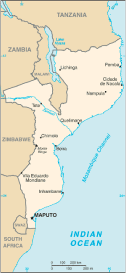
Mozambique is a
source and, to a much lesser extent, a destination country for men, women,
and children trafficked for the purposes of forced labor and sexual
exploitation. The use of forced and bonded child laborers is a common
practice in Mozambique's rural areas, often with the complicity of family
members. Women and girls, often with promises of employment or education, are
trafficked from rural to urban areas of Mozambique, as well as to South
Africa, for domestic servitude and commercial sexual exploitation; young men
and boys are trafficked to South Africa for farm work and mining. Trafficked
Mozambicans often labor for months in South Africa without pay and under
coercive conditions before their exploiters have them arrested and deported
as illegal migrants. A recent NGO report
found that human trafficking of Mozambican children and adults for the forcible
removal of body parts is significant; so-called witchdoctors in Mozambique
and South Africa seek various body parts of live victims for traditional
medical concoctions commonly purchased to heal illness, foster economic
advancement, or hurt enemies. - U.S. State Dept
Trafficking in Persons Report, June, 2009
Check out a later country
report here and possibly a full TIP Report here |
||||||||||||
|
CAUTION: The following links
have been culled from the web to illuminate the situation in Mozambique. Some of these links may lead to websites
that present allegations that are unsubstantiated or even false. No
attempt has been made to validate their authenticity or to verify their content. HOW TO USE THIS WEB-PAGE Students If you are looking
for material to use in a term-paper, you are advised to scan the postings on
this page and others to see which aspects of Human Trafficking are of
particular interest to you. Would you
like to write about Forced-Labor? Debt
Bondage? Prostitution? Forced Begging? Child Soldiers? Sale of Organs? etc. On the other
hand, you might choose to include precursors of trafficking such as poverty and hunger. There is a lot to
the subject of Trafficking. Scan other
countries as well. Draw comparisons
between activity in adjacent countries and/or regions. Meanwhile, check out some of the Term-Paper resources
that are available on-line. Teachers Check out some of
the Resources
for Teachers attached to this website. HELP for Victims Ministry of Interior 21 303510 Ministry of Justice 21 494264 Country code: 258- ***
FEATURED ARTICLE *** Mozambique tries to
curb human trafficking Reuters, Maputo,
July 25, 2007 edition.cnn.com/2007/WORLD/africa/07/25/mozambique.trafficking.reut/ [accessed 22
February 2011] Mozambique has not
prosecuted anyone for human trafficking. Efforts to do so have been
handicapped by the former Portuguese colony's general tolerance of child
labor, which is common in its rural areas, as well as its weak border
controls. Smugglers have seized on the
country's complacent attitude, arranging for young men and boys to be sent to
work on farms and mines, and young girls to be sold into domestic servitude
and to brothels in neighboring southern African nations. Authorities said
the smuggling networks were usually small operations run by Mozambicans and
South Africans. South Africa is one of the major destinations for those who
fall prey to the human traffickers. An
estimated 1,000 Mozambican women and children are trafficked to South Africa
each year, according to a recent study by the International Organization on
Migration (IOM). Human trafficking
rife in SA Lebogang Seale,
Independent Online (IOL) News, December 7 2006 www.iol.co.za/news/south-africa/human-trafficking-rife-in-sa-1.306483 [accessed 22
February 2011] They are promised a
better life in South Africa, but instead they are kidnapped, branded and sold
into sexual slavery for as little as R380.
Women and children, some as young as 13, are falling prey to
syndicates operating in Mozambique
and Swaziland, trafficking and smuggling them to South Africa on an
unprecedented scale. Six held over nun's
murder in Mozambique The Australian, 2 March 2004 cathnews.acu.edu.au/403/12.php [accessed 22
February 2011] www.iol.co.za/news/africa/brazilian-missionary-found-dead-in-mozambique-206721 [accessed 13 January
2020] Four missionary
nuns living in the same town told Portuguese radio TSF last week that they
had recently had a narrow escape from an armed ambush after presenting what
they said was evidence that local children were being killed so that their
organs could be sold. The four nuns
told a Spanish newspaper earlier this month that they had gathered testimony
from would-be victims of the network who had managed to escape and had
photographs of dead children with missing organs. ***
ARCHIVES *** Human Trafficking
In Mozambique Katherine Lucht, The Borgen Project, 17
February 2021 borgenproject.org/human-trafficking-in-mozambique/ [accessed 23
February 2021] CHILD LABOR -- In 2019, the
U.S. Department of Labor stated that 22.5% of Mozambique’s population
between the ages of 5 to 14 are working, while only 69.5% of children
within this age group attend school. Of this 69.5%, only 52% complete their
education. While the government has enacted policies such as the Prohibition
of Child Trafficking in the most recent Penal Code that Mozambique enacted in
June 2020 to push back against the predatory nature of human trafficking, the
country has consistently struggled to adapt the infrastructure necessary to
enforce these policies. The lack of manpower in the justice system limits its
effectiveness and leaves a gap in Mozambique’s ability to prevent further
trafficking. Religious sisters
fight human trafficking in Mozambique Crux Staff, Yaounde', Cameroon, 1 April 2020 cruxnow.com/interviews/2020/04/religious-sisters-fight-human-trafficking-in-mozambique/ [accessed 1 April
2020] WHO ARE USUALLY THE
VICTIMS? -- The
majority of trafficked people are women, globally
they represent 72 percent of the total. The percentage is more if we consider
only human trafficking for sexual exploitation. The main region of
recruitment of young girl for sexual exploitation in Mozambique in in the
south of the country, close to the capital Maputo. Men and boys are also
trafficked to South Africa for forced labor in mines and farms. In Mozambique there
is also a high number of boys who are victims of
human trafficking for the purpose of organs removal or body parts. This is
believed to be a practice connected with witchcraft. Also in Mozambique,
undocumented migrants are at high risk of being trafficked. Many undocumented
migrants smuggled from South Asian and other African countries to South
Africa are transported through the country. In the Mozambican ports were also
identified South Asian men exploited in slavery-like conditions on vessels
for the fishing industry. 2020 Country
Reports on Human Rights Practices: Mozambique U.S. Dept of State Bureau of Democracy, Human Rights, and
Labor, 30 March 2021 www.state.gov/reports/2020-country-reports-on-human-rights-practices/mozambique/
[accessed 17 June
2021] PROHIBITION OF
FORCED OR COMPULSORY LABOR There was limited
evidence of forced labor and forced child labor in the mining, domestic
service, and agricultural sectors. Girls and women from rural areas, as well
as migrant workers from bordering countries, were lured to cities with false
promises of employment or education and exploited in domestic servitude and
sex trafficking. PROHIBITION OF CHILD
LABOR AND MINIMUM AGE FOR EMPLOYMENT Child labor
remained a problem. NGOs reported some girls who migrated from rural areas to
urban centers to work as domestic help for extended family or acquaintances
to settle debts were vulnerable to commercial sexual exploitation (see
section 6, Children). Mothers who did not complete secondary school were more
likely to have children involved in child labor. Due to economic necessity,
especially in rural areas, children worked in agriculture, as domestic
employees, or in prostitution. Freedom House
Country Report 2020 Edition freedomhouse.org/country/mozambique/freedom-world/2020 [accessed 3 May 2020] G4. DO INDIVIDUALS
ENJOY EQUALITY OF OPPORTUNITY AND FREEDOM FROM ECONOMIC EXPLOITATION? Many women and
girls from rural areas are at risk of becoming drawn into sex trafficking and
domestic servitude. Government efforts to confront trafficking are improving
but remain inadequate, according to the US State Department’s most recent Trafficking
in Persons Report, but authorities have made increased efforts to
investigate trafficking claims and prosecute traffickers. Child labor is
permitted for children between 15 and 17 years old with a government permit.
However, children under 15 frequently labor in the agriculture, mining, and
fishing sectors, where they often work long hours and do not attend school.
According to an August 2017 report released by the Ministry of Labor,
Employment, and Social Security, more than one million children between the
ages of 7 and 17 are actively employed. 2017 Findings on
the Worst Forms of Child Labor Office of Child
Labor, Forced Labor, and Human Trafficking, Bureau of International Labor
Affairs, US Dept of Labor, 2018 www.dol.gov/sites/default/files/documents/ilab/ChildLaborReport_Book.pdf [accessed 19 April
2019] www.dol.gov/sites/dolgov/files/ILAB/child_labor_reports/tda2017/ChildLaborReportBook.pdf [accessed 3 May
2020] Note:: Also check out this country’s report in the more recent edition DOL
Worst Forms of Child Labor [page 717] Mozambican
children, lured from rural areas with promises of work and educational
opportunities, are subjected to forced domestic work and commercial sexual
exploitation in urban areas in Mozambique and South Africa. (10; 14; 2)
Research indicates that Mozambican children are also trafficked to South
Africa for forced labor in agriculture, street vending, and commercial sexual
exploitation. (10; 2). UN urges action on
'scary' levels of trafficking in southern Africa Agence France-Presse
AFP, Pretoria, Sept 3, 2007 captivedaughters.blogspot.com/2007/09/un-urges-action-on-levels-of.html [accessed 7 July
2013] ‘None of the
countries in southern Africa has specific anti-human trafficking legislation
in place,' Thomas Zindl-Cronin of the UN Office on Drugs and Crime (UNODC)
told reporters in Johannesburg.
Specific legislation to tackle the issue was needed to help the law
enforcement agencies get to grips with the situation. 'South Africa and Mozambique are more advanced than the rest of the region, but the
capacity of the police and the judiciary to deal with the problem is low.’ Human traffickers
thrive in Mozambique Fred Katerere, The
Citizen, South African Press Association SAPA, Maputo, 27 March 2007 [accessed 22
February 2011] Daring human
traffickers are taking advantage of Mozambique’s weak adoption laws in order
to traffic children out of the country for the purposes of prostitution or
cheap labour, Vista News reported on Tuesday. A 2003 study on
trafficking in the region by the International Organization on Migration
(IOM) estimated that 1000 Mozambican women and children were being trafficked
to South Africa every year for sexual exploitation. Mabunda maintained that although cases of
cross-border human trafficking received most attention in the media,
trafficking by local crime syndicates was by far the most prominent form of
the crime. The main reason for the
practice was the extreme poverty besetting most people, and a culture that
allowed girls to be married off at an extremely young age. Human, drug
trafficking at border on the rise South African Press
Association SAPA Maputo, March 6 2007 www.iol.co.za/news/africa/human-drug-trafficking-at-border-on-the-rise-1.317866 [accessed 22
February 2011] "We are
currently not pre-occupied with people who enter illegally into South Africa
or Swaziland to buy two or three kilograms of rice, but those who use the
illegal points for criminal activities," she said. Apart from facilitating human trafficking,
she said these points also assisted criminals to traffic drugs and illegal
arms between the countries. Organisations
working with trafficked women say more than 1000 Mozambican women are
trafficked each year, mostly to South Africa. Seduction,
Sale & Slavery: Trafficking In Women & Children For Sexual
Exploitation In Southern Africa [PDF] Jonathan Martens,
Maciej ‘Mac’ Pieczkowski, & Bernadette van Vuuren-Smyth, International
Organization for Migration IOM Pretoria SA, May 2003 www.unicef.org.mz/cpd/references/40-TraffickingReport3rdEd.pdf [accessed 23 April
2012] [accessed 3 May
2020] EXECUTIVE SUMMARY - The major
findings may be summarized as follows: Mozambican victims
include both girls and young women between the ages of 14 and 24. They are
offered jobs as waitresses or sex workers in Johannesburg, and pay their
traffickers ZAR 500 to smuggle them across the border in minibus taxis either
at Komatipoort or Ponta do Ouro. They stay in transit houses along South
Africa’s border with Mozambique and Swaziland for one night where they are
sexually assaulted as an initiation for the sex work that awaits them. Once
in Johannesburg, some are sold to brothels in the Central Business District
(CBD) for ZAR 1000. Others are sold as slaves on private order for ZAR 550,
or shopped around to mineworkers on the West Rand as ‘wives’ for ZAR 650. An
estimated 1000 Mozambican victims are recruited, transported, and exploited
in this way every year, earning traffickers approximately ZAR 1 million
annually. Organ traffickers
'threaten' nuns BBC News, 13
February, 2004 news.bbc.co.uk/2/hi/africa/3483581.stm [accessed 22
February 2011] Four Catholic nuns
say they have received death threats after exposing an organ trafficking
network allegedly operating in northern Mozambique. The traffickers are said to target the sex
organs of children, which are sold to make magic charms. The nuns from the Sisters Servants of Mary
Immaculate order say they have gathered evidence of the trade. Human Trafficking
in Mozambique:- Root Causes and Recommendations [PDF] UN Educational,
Scientific and Cultural Organization UNESCO Policy Paper Poverty Series, n°
14.1 (E), Paris 2006 unesdoc.unesco.org/images/0014/001478/147846E.pdf [accessed 22
February 2011] [page 21] Sixteen year-old Tobi wipes a tear from her
eye as she recalls the night she was plucked from her home, forced to trek
through the bush and then sold to a recruitment agent in South Africa.
She recoils from memories of being handed to a buyer in search of cheap farm
labour, a nanny and sex slave, who abused her for months before she escaped
to safety. Tobi is one of the hundreds of young Mozambican girls
kidnapped or lured by cash who end up mainly in South Africa every year or
are shipped to Europe in an industry that is growing at breakneck speed. Lack of legislation
fuels child trafficking December 12, 2004 At one time this
article had been archived and may possibly still be accessible [here]
[accessed 8
September 2011] Recent findings
revealed that children are increasingly being trafficked to be used as cheap
labourers, sexual exploitation and even for criminal activities. To curb the
trend, the Mozambique, Limpopo and Mpumalanga Task Team against child
trafficking launched the child trafficking campaign at the Lebombo border
gate between South Africa and Mozambique. Child Trafficking
Projects in southern Africa 01. 06. 2005 At one time this
article had been archived and may possibly still be accessible [here]
[accessed 8
September 2011] OFFERING REFUGE - In Mozambique,
girls are sometimes not even ten years old when they are sold off, mainly to
be forced into prostitution. Exploitation of domestic servants is also nothing
unusual. The destination for girls from Mozambique as well as neighboring
countries like Zambia, Angola or Tanzania is usually the more affluent South
Africa. SOUTHERN AFRICA:
Major destination for traffickers in women and children UN Integrated Regional
Information Networks IRIN, Johannesburg, 23 April 2004 [accessed 9 March
2015] Mozambican women
have been smuggled in by taxis because corruption in law enforcement or
judicial systems helps traffickers across borders. Child Slave Rings
Rife in Southern Africa James Hall, Inter
Press Service News Agency IPS, Maputo, August 15, 2003 www.ipsnews.net/2003/08/rights-child-slave-rings-rife-in-southern-africa/ [accessed 7 July
2013] But Leia
Boaventura, an activist who is alarmed at what she sees as a growing trend in
child trafficking in Southern Africa, feels that child slave rings are
already operating out of Mozambique. Her organisation, Terre des Hommes, has
found that foreign nationals, mostly from Russia and China, are currently
involved in child slave operations. Child slavery
usually does not involve kidnapping, but a financial arrangement with the
family or guardian of children who are from an impoverished background. "Sometimes, desperate parents who
cannot feed, clothe or give medical aid to their children will seek out
someone to take them off their hands, to give them the necessities of life.
In poor areas with underdeveloped social welfare institutions, this can mean
selling a child into servitude," says Lawrence Ngwane of the refugee
agency, CARITAS. "All such
deals are heartbreaking for everyone involved - the parents, the children who
are torn from the womb of their families - though not for the child traffickers
who can profit handsomely," he says.
An investigation by Child Network, a Mozambique non-governmental
organisation, found that child trafficking currently occurs in Mahubo, in the
Boane district of the Maputo province. Mozambique: children
sold for organs Timothy
Bancroft-Hinchey, Pravda.Ru, Lisbon Portugal, 15.10.2001 english.pravda.ru/news/russia/15-10-2001/34487-0/ [accessed 22
February 2011] Children are being
kidnapped or sold in Mozambique and are being used in prostitution rings and
forced labour rackets in Zimbabwe and South Africa. Others are less fortunate
– they are killed before their vital organs are removed and sold for
transplantation. Concluding Observations
of the Committee on the Rights of the Child (CRC) - 2002 UN Convention on the
Rights of the Child, 1 February 2002 www1.umn.edu/humanrts/crc/mozambique2002.html [accessed 22 February
2011] [66] The Committee
is concerned that (b) Some children
are victims of trafficking for the purposes of prostitution; ***
EARLIER EDITIONS OF SOME OF THE ABOVE *** Freedom House
Country Report 2018 Edition freedomhouse.org/country/mozambique/freedom-world/2018 [accessed 3 May 2020] G4. DO INDIVIDUALS
ENJOY EQUALITY OF OPPORTUNITY AND FREEDOM FROM ECONOMIC EXPLOITATION? Since 2012, human
trafficking has been on the rise. Women and girls from rural areas are drawn
into sex trafficking and domestic servitude. The number of investigations for
trafficking decreased in 2017, but the number of prosecutions increased. Human Rights
Reports » 2004 Country Reports on Human Rights Practices U.S. Dept of State Bureau of Democracy, Human Rights, and
Labor, February 28, 2005 2009-2017.state.gov/j/drl/rls/hrrpt/2004/41617.htm [accessed 10
February 2020] TRAFFICKING
IN PERSONS
– Poverty, a history of child migration, and weak border controls all
contributed to trafficking. In a widely cited 2003 study, the International
Office on Migration (IOM) reported that approximately one thousand Mozambican
women and children were trafficked to South Africa every year. Reportedly,
most traffickers brought their victims to South Africa through Swaziland,
where border controls were particularly weak. Trafficking victims came from
both urban and rural backgrounds. The majority of victims were women and
children, and they were trafficked for both sexual exploitation and forced
labor. Many of the women trafficked were sold to brothels in Johannesburg or
sold as concubines or "wives" to mineworkers in South Africa. Boys
were trafficked as laborers on South African farms. IOM conducted an
inquiry in April that indicated women continued to be trafficked from the
country and sold to mine workers at a mining district west of Johannesburg, known
as the West Rand. Taxi drivers commuting between the two countries recruited
young women from rural areas such as Macia and Chokwe in Gaza Province, as well as Maputo. The highway
running through Maputo was another major recruiting ground for traffickers.
In September South African police rescued three teenage Mozambican girls from
traffickers and returned them to Mozambique. In March police in Quelimane, Zambezia Province, arrested 2 men for attempting to sell an
11-year-old boy. The men were arrested, but it was not known whether charges
were filed at year's end. In November police detained a minibus driver in the
Manica Province for selling 35 children to farms
and domiciles in the area. The man reportedly offered the children employment
at his own residence, but instead sold them for the equivalent of $4 (100
thousand meticais). By year's end the man remained in detention pending
formal charges by police. The Department of Labor’s 2004 Findings on
the Worst Forms of Child Labor U.S. Dept of Labor Bureau of International Labor Affairs, 2005 www.dol.gov/ilab/media/reports/iclp/tda2004/mozambique.htm [accessed 22
February 2011] Note:: Also check out this country’s report in the more recent edition DOL
Worst Forms of Child Labor INCIDENCE
AND NATURE OF CHILD LABOR - An increasing number of children, mostly girls, also
work as domestic servants. In some cases,
children are forced to work in order to settle family debts. Mozambique is a source country for child
trafficking. All
material used herein reproduced under the fair use exception of 17 USC § 107
for noncommercial, nonprofit, and educational use. PLEASE RESPECT COPYRIGHTS OF COMPONENT
ARTICLES. Cite this webpage as: Patt,
Prof. Martin, "Human Trafficking & Modern-day Slavery -
Mozambique", http://gvnet.com/humantrafficking/ Mozambique.htm, [accessed
<date>] |
|
|||||||||||