Human Trafficking & Modern-day Slavery Poverty drives the unsuspecting poor into the
hands of traffickers Published reports & articles from 2000 to 2025 gvnet.com/humantrafficking/Mongolia.htm
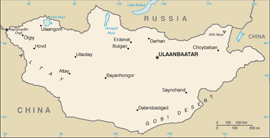
Mongolia is a source
country for men, women, and children trafficked for the purposes of sexual
exploitation and forced labor. Mongolian women and girls are trafficked to
China, Macau, Hong Kong, Malaysia, and South Korea for both forced labor and
sexual exploitation. Mongolian men and women are trafficked to Kazakhstan and
Turkey for labor exploitation. There is also concern about involuntary child
labor in the Mongolian construction, mining, and industrial sectors, where
they are vulnerable to injury and face severe health hazards, such as exposure
to mercury. - U.S. State Dept Trafficking in
Persons Report, June, 2009 Check out a later country report here and possibly a full TIP Report here |
|||||||||||
|
CAUTION: The following links
have been culled from the web to illuminate the situation in HOW TO USE THIS WEB-PAGE Students If you are looking
for material to use in a term-paper, you are advised to scan the postings on
this page and others to see which aspects of Human Trafficking are of
particular interest to you. Would you
like to write about Forced-Labor? Debt
Bondage? Prostitution? Forced Begging? Child Soldiers? Sale of Organs? etc. On the other
hand, you might choose to include precursors of trafficking such as poverty and hunger. There is a lot to
the subject of Trafficking. Scan other
countries as well. Draw comparisons
between activity in adjacent countries and/or regions. Meanwhile, check out some of the Term-Paper resources
that are available on-line. Teachers Check out some of
the Resources
for Teachers attached to this website. ***
FEATURED ARTICLES *** U.S. Customs
Commissioner Issues Detention Order on Clothing Produced in www.customs.gov/hot-new/pressrel/2000/1128-00.htm [accessed 7
September 2014] www.nytimes.com/2000/11/29/business/citing-child-labor-us-bans-apparel-from-mongolia-plant.html [accessed 3 May
2020] Evidence obtained by
Customs investigators suggests that factory managers are forcing employees,
some of whom are minors, to work 14-hour days, 7 days a week. In addition, it
has been reported that factory management is deducting unreasonable amounts
of money from the workers' salaries without paying overtime. It has also been
reported that minor age children are being treated as adult age workers,
which is a violation of Mongolian law. In addition, working conditions at
both factories are said to be poor and employee housing is substandard. Study: B.Bulgamaa, The UB
Post, January 22, 2009 [accessed 2
September 2012] GEC also
interviewed 16 victims of trafficking who returned to NGOs have also
reported on the increasing scope of domestic trafficking and organized
criminal networks in Mongolia that kidnap girls from the streets or lure them
through their peers, relatives or acquaintances, keep them locked in hotels
and force them into prostitution. In February, 2008, during the Mongolian New
Year, half a dozen girls were reported to have been kidnapped from the
streets and forced into prostitution in Ulaanbaatar and Darkhan city. One of
the cases involving a 17-year old girl, a daughter of a poor single mother of
three, caught significant media and public attention. Victims and NGOs also
reported that girls are often trafficked abroad after having been ‘tamed’ and
sexually exploited in Mongolia. ***
ARCHIVES *** 2020 Country
Reports on Human Rights Practices: mongolia U.S. Dept of State Bureau of Democracy, Human Rights, and
Labor, 30 March 2021 www.state.gov/reports/2020-country-reports-on-human-rights-practices/mongolia/
[accessed 17 June
2021] PROHIBITION OF
FORCED OR COMPULSORY LABOR There were isolated
reports of forced labor, including forced child labor such as forced
prostitution and begging. PROHIBITION OF CHILD
LABOR AND MINIMUM AGE FOR EMPLOYMENT Child labor,
including forced child labor, occurred in many sectors, including in hotels
and restaurants, vehicle repair, manufacturing, petty trade, scavenging, forced
begging, event or street contortionism (a local art form), and the illicit
sex trade (see section 6, Children). Freedom House
Country Report 2020 Edition freedomhouse.org/country/mongolia/freedom-world/2020 [accessed 8 July
2020] G4. DO INDIVIDUALS
ENJOY EQUALITY OF OPPORTUNITY AND FREEDOM FROM ECONOMIC EXPLOITATION? The government has
struggled to cope with economic inequality, particularly as large numbers of
rural Mongolians migrate to cities that lack sufficient housing and
infrastructure. New housing continues to be constructed, but many existing
residents have reportedly been left homeless by urban redevelopment projects. Women, children,
people living in poverty, and other vulnerable segments of the population are
at some risk of becoming trafficking victims, and are compelled to engage in
sex work, forced labor, or begging. Workers in the mining industry are
subject to exploitative conditions, as are contract workers from China. The
government has taken efforts to better prosecute trafficking cases, but
corruption and a lack of will to address the issue impedes progress. 2017 Findings on
the Worst Forms of Child Labor Office of Child
Labor, Forced Labor, and Human Trafficking, Bureau of International Labor
Affairs, US Dept of Labor, 2018 www.dol.gov/sites/default/files/documents/ilab/ChildLaborReport_Book.pdf [accessed 19 April
2019] www.dol.gov/sites/dolgov/files/ILAB/child_labor_reports/tda2017/ChildLaborReportBook.pdf [accessed 3 May
2020] Note:: Also check out this country’s report in the more recent edition DOL
Worst Forms of Child Labor [page 694] Mongolian children
are generally trafficked internally for the purpose of commercial sexual
exploitation in saunas, bars, hotels, karaoke clubs, and massage parlors. (4;
22; 3) Children also work as horse jockeys and face a number of health and
safety hazards, including exposure to extremely cold temperatures, risk of
brain and bone injuries, and fatal falls. (14; 15; 1; 23) Participation in
pre-training and horse racing during the November 1-May 1 racing season may
also negatively impact children’s school attendance, particularly when
children as young as age 7 can participate in horse racing. (14; 15) During the
reporting period, the Family, Child, and Youth Development Agency (FCYDA)
collected data on exploitative child labor in Mongolia. The agency identified
99 children engaged in various forms of child labor in Ulaanbaatar, and
registered 10,453 children in a nationwide database for child horse jockeys.
(4). Campaign To Be
Arranged Against Human Trafficking www.montsame.mn/index.php?option=com_news&task=news_detail&tab=200804&ne=526 [access date
unavailable] Thanks to a help by
Gender Equality center, 51 victims of human trafficking were brought back to Informal Marriages
Hide Human Trafficking B.Bulgamaa, The UB
Post, 2007-04-13 www.wunrn.com/news/2007/04_07/04_09_07/041907_mongolia.htm [accessed 7 July
2013] wunrn.com/2007/04/mongoliachina-informal-marriages-may-hide-trafficking/ [accessed 18
February 2019] The protection of
rights and a positive legal environment for the victims of human trafficking
who become illegally married to Asian men still does not exist yet, because
of a lack of information and knowledge about human trafficking. About 20 days
ago, four Mongolian women with three of their children requested from the
Mongolian consulate in Erlian, China, to save them from the violence of their
husbands. They were married
to Chinese men when they were introduced to each other in Mongolia, but have
lived in China for over ten years now. According to reports in the Mongolian
media, all of them were living in a half-starved state, they had no right to
work for wages and weren’t even allowed to go outside. They were beaten
brutally by their husbands and had other physical pressure applied. Some of
them were unwillingly forced to have sex by their husbands. But the accused
husbands are demanding the return of their wives from the consulate. Street Children
Remain Neglected Damien Dawson, 06
April 2007 streetchildrennews.wordpress.com/2007/04/06/street-children-remain-neglected/ [accessed 7
September 2014] In a week when the
western world celebrates the anniversary of the abolition of the
trans-Atlantic slave trade, abducted women and children are being transported
across the Chinese border in a modern-day slave trade. The western world is dimly but increasingly
aware of this, but it remains firmly at the back of the minds of those that
possess the power to deal with the plight of those who are part of Mongolia’s
future. The Crime of
Trafficking of Women and Children in Mongolia: The Current Situation [PDF] National Human
Rights Commission of www.childtrafficking.com/Docs/nhrcm_2002_mongolia_trafficking_report_3.pdf [accessed 21
February 2011] childhub.org/en/system/tdf/library/attachments/nhrcm_2002_mongolia_trafficking_report_3.pdf?file=1&type=node&id=17087 [accessed 7 February
2018] 2. THE CRIME OF
TRAFFICKING AND SOCIAL CONDITIONS IN Jurist Legal
Intelligence - Jurist: The Legal
Education Network™, Source: jurist.law.pitt.edu/world/mongolia.htm#Human [accessed 21 February
2011] www.jurist.org/wayback/world/mongolia.htm [accessed 7 February
2018] HUMAN RIGHTS - The Mongolian
Government generally respected the human rights of its citizens in 2001;
however, problems remain in some areas. Child abuse and
child labor also are problems. There were some instances of forced labor, and
some women seeking work overseas may have become victims of trafficking
schemes. Concluding Observations of the Committee on the Rights of the
Child (CRC) UN Convention on the
Rights of the Child, 3 June 2005 sim.law.uu.nl/SIM/CaseLaw/uncom.nsf/0/6665ba6cee999821c12570350028974c?OpenDocument [accessed 21
February 2011] www.refworld.org/publisher,CRC,CONCOBSERVATIONS,MNG,45377ea12,0.html [accessed 7 February
2018] [64] The Committee
is deeply concerned at the increasing number of children engaged in
prostitution. While noting that trafficking in children is a relatively new
human rights problem in Mongolia, the Committee is concerned about certain
risk factors, including persisting poverty, the high rate of unemployment,
difficult family circumstances leading to run-away from home and a growth in
tourism, which may and often does increase sexual exploitation and
trafficking in children. ***
EARLIER EDITIONS OF SOME OF THE ABOVE *** Human Rights
Reports » 2005 Country Reports on Human Rights Practices 2009-2017.state.gov/j/drl/rls/hrrpt/2005/62653.htm [accessed 10
February 2020] TRAFFICKING
IN PERSONS
– The primary targets of trafficking schemes were middle-class girls and
young women, ranging from 14 to approximately 28 years of age, who were lured
abroad by offers to study or work. Preventive steps to combat trafficking,
such as increased law enforcement measures, remained limited. As a result, it
was not difficult to traffic persons across the country's borders. Some NGO
experts believed that members of the police sometimes were involved in
trafficking young women and helping facilitate their movement across borders.
Protections for
victims and witnesses were extremely limited, which discouraged them from
coming forward. Furthermore, social stigma inhibited victims from telling
their stories. The government had limited resources and divergent priorities,
and therefore provided no direct assistance for trafficking victims. NGOs
offered support when possible, and the government relied on NGOs to increase
awareness and initiate prevention programs. The government worked with the UN
on a three-year project for capacity building in the National Council on
Gender Equality, which included giving more attention to trafficking and
prostitution. The Department of Labor’s 2004 Findings on
the Worst Forms of Child Labor www.dol.gov/ilab/media/reports/iclp/tda2004/mongolia.htm [accessed 21
February 2011] Note:: Also check out this country’s report in the more recent edition DOL
Worst Forms of Child Labor INCIDENCE
AND NATURE OF CHILD LABOR - While comprehensive information about the nature and
extent of trafficking in Mongolia is not available, it is reported that
Mongolia is a source and transit point for teenage trafficking victims for
the purpose of commercial sexual exploitation. All
material used herein reproduced under the fair use exception of 17 USC § 107
for noncommercial, nonprofit, and educational use. PLEASE RESPECT COPYRIGHTS OF COMPONENT
ARTICLES. Cite this webpage as: Patt,
Prof. Martin, "Human Trafficking & Modern-day Slavery -
Mongolia", http://gvnet.com/humantrafficking/Mongolia.htm, [accessed
<date>] |