Human Trafficking & Modern-day Slavery Poverty drives the unsuspecting poor into the
hands of traffickers Published
reports & articles from 2000 to 2025 gvnet.com/humantrafficking/Mexico.htm
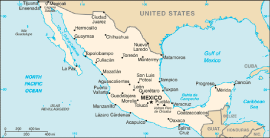
Mexico is a large
source, transit, and destination country for persons trafficked for the
purposes of commercial sexual exploitation and forced labor. Groups considered
most vulnerable to human trafficking in Mexico include women and children,
indigenous persons, and undocumented migrants. A significant number of
Mexican women, girls, and boys are trafficked within the country for
commercial sexual exploitation, lured by false job offers from poor rural
regions to urban, border, and tourist areas. According to the government,
more than 20,000 Mexican children are victims of sex trafficking every year,
especially in tourist and border areas.
- U.S. State Dept Trafficking in Persons
Report, June, 2009 Check a later country report here and possibly a full TIP Report here |
|
|||||||||||
|
CAUTION:
The following links have been culled from
the web to illuminate the situation in HOW TO USE THIS WEB-PAGE Students If you are looking
for material to use in a term-paper, you are advised to scan the postings on
this page and others to see which aspects of Human Trafficking are of particular
interest to you. Would you like to
write about Forced-Labor? Debt
Bondage? Prostitution? Forced Begging? Child Soldiers? Sale of Organs? etc. On the other
hand, you might choose to include precursors of trafficking such as poverty and hunger. There is a lot to
the subject of Trafficking. Scan other
countries as well. Draw comparisons
between activity in adjacent countries and/or regions. Meanwhile, check out some of the Term-Paper resources
that are available on-line. Teachers Check out some of
the Resources
for Teachers attached to this website. HELP for Victims Procuraduria General de la Republica ***
FEATURED ARTICLE *** Details emerge in
human trafficking case in San Antonio [PDF] Guillermo Contreras,
Express-News online, 06/02/2007 www.docstoc.com/docs/80078853/Details-emerge-in-human-trafficking-case-in-San-Antonio [accessed 25 August
2014] How's $600 to buy
what you'd like simply for accompanying men on trips? We can make it happen,
al otro lado — on the other side. That
pitch allegedly made by a trio of women sounded like gold to some
impressionable teens and a young woman not making much in Nuevo Laredo,
Mexico. Three girls agreed to be
smuggled to the United States in mid-May and once they were in or near San
Antonio, they were primped, new clothes were bought for them and they were
given English lessons. Their understanding was that they did not have to have
sex with the men. But rather than the
glitz they were promised, they were sold in an underground world for prostitution,
according to prosecutors and documents filed in federal court Friday. The girls were delivered to a man in San
Antonio referred to in court records as the "boss," who had them
strip, inspected their bodies and told them they were going to be having sex
with men for up to five years to pay off their smuggling debt. The "boss" said he had paid
$3,000 apiece for two of the girls and said he would pay even more to get
them ready for other men, witnesses told investigators, according to their
statements. Anyone who fled would die, and their families would also suffer
the same fate, the statements said. – HTUSAMX Forced to have sex
with 60 men a day and tattooed with the name of their pimps: Human
trafficking victims tell of torture they suffered at hands of three brothers
who 'treated them like property' Ryan Gorman,
MailOnline, The Daily Mail, 8 February 2014 [accessed 8 Feb
2014] PHOTO CAPTION --
Poverty-stricken: Tenancingo is relatively free of the drug gang violence
that has ravaged a large part of Mexico, but sex traffickers routinely kidnap
young women Carmen was ferried
around the tri-state area and forced to have sex with men in their homes and
with seasonal workers in rural areas of Connecticut, New Jersey and New York,
she testified in court, according to the paper. The depraved pimp forced her to have sex
with as many as 60 men in one day.
‘At the end of the day I was bleeding and in great pain caused by these
men,’ she recalled, adding that he would savagely beat her if she wasn’t out
earning money. Carmen hoped her
tormentor would beat her to death. I
was upset because he hadn't killed me and that I had to live another day of
torture,’ she said. Carmen finally
escaped in 2010 but was locked in suicide ward at a city hospital to keep her
from killing herself, she said it’s the only time she had felt safe in
years. – HTUSAMX ***
ARCHIVES *** 'Spa' raids in
resort towns spark outrage over Mexico's human trafficking problem Rafael Romo, Cable News Network CNN, Cancun, 10 August 2020 www.cnn.com/2020/08/10/americas/mexico-human-trafficking-intl/index.html [accessed 11 August
2020] [DECEPTION OF
VICTIMS] AN ALLEGED SCHEME TO
BRING WOMEN INTO MEXICO -- Altogether, Montes de Oca
says his officers found 21 women between the ages of 21 and 25 who were
forced to work at those two places. At the Cancun site, there were two women
from Venezuela, two from Mexico, and one each from Argentina, Colombia and
Germany, according to the state Attorney General's Office. There were an
additional 11 Venezuelan women at the site in Playa del Carmen, two Mexican
women and one Colombian woman. All had been lured
by offers of high-paying jobs as personal assistants or spa therapists,
Montes de Oca told CNN. "Once here, they would
tell them that they had to pay for their transportation, plane tickets,
immigration processing and that the way to pay for that was through
prostitution. If they refused, they were threatened with physical harm or
worse," he said, adding that the traffickers would take victims'
passports and other personal identification documents, so that escaping was
nearly impossible. Mexico City's
Anti-Human Trafficking Hotline to Expand Nationally - 01800 5533 000 Polaris, Mexico
City, 30 September 2015 polarisproject.org/press-releases/mexico-citys-anti-human-trafficking-hotline-to-expand-nationally [accessed 26 January
2020] Of note, Consejo’s local hotline serving Mexico City will be
expanded nationwide. Between the National Helpline Against Trafficking in
Persons (01800 5533 000) operated by Consejo Ciudadano in Mexico and the [U.S.] National Human
Trafficking Resource Center (1-888-373-7888) operated by Polaris in the U.S.,
hotline coverage for victims of human trafficking will span across two-thirds
of the North American continent. Fighting Human
Trafficking Across the U.S.-Mexico Border Polaris polarisproject.org/wp-content/uploads/2016/10/Consejo-NHTH-Statistics-2017.pdf [accessed 26 January
2020] CASE STUDY FROM THE
NATIONAL HUMAN TRAFFICKING HOTLINE - “But I was promised $11 an hour,” he
protested. Manuel had been recruited in Guanajuato, Mexico to work on a
potato farm in North Carolina. The recruiters charged Manuel and 40 other
Mexican males $1,200 each for their H-2A visa, despite these fees being
illegal. When Manuel and his coworkers tried to complain, their supervisors
physically abused them and threatened to have them deported. By the end of
the season, despite his 12-hour workdays, Manuel hadn’t even earned enough
money to cover his recruitment fee. The National Human Trafficking Hotline
connected him with a pro-bono lawyer who helped to obtain Manuel’s back
wages. Manuel is now an advocate for other survivors of human trafficking. Mexico announces end
to funding for human trafficking NGOs Christine Murray,
Reuters, Mexico City [accessed 18 June
2019] Mexico will stop
giving financial aid to anti-human trafficking organizations and instead run
shelters and victim care directly, the president said on Monday, drawing
criticism from activists who said the plan lacked detail. “With this system of intermediation, most of
the money stayed in the hands of intermediaries,” Lopez Obrador
said at a news conference. “Now the government
will do it directly,” he added, saying he wanted to open new government
shelters as soon as possible. 2020 Country
Reports on Human Rights Practices: Mexico U.S. Dept of State Bureau of Democracy, Human Rights, and
Labor, 30 March 2021 www.state.gov/reports/2020-country-reports-on-human-rights-practices/mexico/
[accessed 17 June
2021] PROHIBITION OF
FORCED OR COMPULSORY LABOR Forced labor
persisted in the domestic service, child care, manufacturing, mining, food
processing, construction, tourism, begging, street vending, leather goods
production, and agriculture sectors, especially in the production of chili
peppers and tomatoes. Women and children were subjected to domestic
servitude. Women, children, indigenous persons, persons with disabilities,
LGBTI persons, and migrants (including men, women, and children) were the
most vulnerable to forced labor (see section 7.c.). Day laborers and
their children were the primary victims of forced and child labor in the
agricultural sector. In 2016, the most recent data available, the
government’s federal statistics agency (INEGI) reported 44 percent of persons
working in agriculture were day laborers. Of the day laborers, 33 percent
received no financial compensation for their work. Three percent of
agricultural day laborers had a formal written contract. Indigenous persons
in isolated regions reported incidents of forced labor, in which cartel
members forced them to perform illicit activities or face death. Minors were
recruited or forced by cartels to traffic persons, drugs, or other goods
across the border. PROHIBITION OF CHILD
LABOR AND MINIMUM AGE FOR EMPLOYMENT Underage children
in urban areas throughout the country earned money by begging, washing
windshields, selling small items, or performing in public places. In April
2019 authorities in Sinaloa announced they had identified 312 children who
had worked in the streets of various cities. Authorities found the children
had no relatives in the area and were possibly victims of human trafficking. According to a 2017
INEGI survey, the number of employed children ages five to 17 was 3.2
million, or approximately 11 percent of children in the country. This
represented a decrease from 12.4 percent of children in the 2015 INEGI
survey. Of these children, 7.1 percent were younger than the minimum age of
work or worked under conditions that violated federal labor law, such as
performing hazardous work. Freedom House
Country Report 2020 Edition freedomhouse.org/country/mexico/freedom-world/2020 [accessed 3 May 2020] G4. DO INDIVIDUALS
ENJOY EQUALITY OF OPPORTUNITY AND FREEDOM FROM ECONOMIC EXPLOITATION? Economic
opportunity is limited in Mexico, which maintains a high rate of economic
inequality. Migrant agricultural workers face brutally exploitative
conditions in several northern states. In 2018, the Supreme Court ruled that
Mexico’s millions of domestic workers—the vast majority of whom are
women—must be incorporated into the formal sector and receive social security
and health benefits. Mexico is a major
source, transit, and destination country for trafficking in persons,
including women and children, many of whom are subject to forced labor and
sexual exploitation. Organized criminal gangs are heavily involved in human
trafficking in Mexico and into the United States. This danger was exacerbated
in 2019 when the United States began denying entry to asylum seekers
presenting themselves at the border, forcing as many as 56,000 to wait in
nearby cities like Ciudad Juárez. Three people
charged with human trafficking Erik Barajas ,
KTRK-Houston, June 04, 2009 abclocal.go.com/ktrk/story?section=news/local&id=6848327 [accessed 20
February 2011] The bright lights
of “Rape Trees” Frame
Arizona-Mexico Border: Grim Reminders of Human Trafficking Sue Michaels, ChattahBox News Blog, March 15, 2009 chattahbox.com/us/2009/03/15/%E2%80%9Crape-trees%E2%80%9D-frame-arizona-mexico-border-grim-reminders-of-human-trafficking/ [accessed 20
February 2011] A recent report
from the Cronkite News Service, a student-run news service of These “rape trees”
are becoming more common along the Arizona border counties of Pima and
Cochise, as coyotes and drug cartel members find human trafficking more
lucrative than drug smuggling. Selling Brides:
Native Mexican Custom or Crime? Ioan Grillo,
Time/CNN, www.time.com/time/world/article/0,8599,1876102,00.html [accessed 20
February 2011] content.time.com/time/world/article/0,8599,1876102,00.html [accessed 13 January
2020] The case centers on
an alleged marriage arrangement that went sour involving Marcelino de Jesus
Martinez, his 14-year-old daughter and her suitor, Margarito de Jesus
Galindo, 18. Galindo had agreed to pay Martinez for his daughter's hand in
marriage, according to Greenfield police. According to the cops, the total
cost was $16,000, one hundred cases of beer and several cases of meat. In the neighboring
market town of Juxtlahuaca, Maria Bautista sees the practice as coercive and
barbaric. "It's like a form of slavery. They buy their women and then
treat them like their property," says Bautista, a single mother with her
own business. Bautista has a Triqui father and Mixtec Indian mother, but she
speaks only Spanish and follows few of the old traditions. She cites the
cases of many older men who came back minted from working in the U.S. and who
bought themselves several young wives. Down in the state
capital of Oaxaca, state human rights commissioner Heriberto Garcia also
chastised the custom. "Buying and selling a woman is a clear violation
of her rights," he says in his office decorated with leather-bound law
books. "And a young teenage girl does not have the experience to make
these decisions." Oaxaca state law permits marriage of women at 14 and
men at 16. Mexican officials
have long tolerated arranged marriages, Garcia concedes, adding that he
doesn't know of any cases of prosecutions. But he says he will also propose
to amend a "Treatment of People" law to include an article that makes
bride-selling a criminal act. Such action is opposed by many who see
indigenous traditions as a virtue of Mexico's cultural diversity. Sex Slaves: From 11Alive, www.infowars.com/?p=3206 [accessed 23 April
2012] The female victims
were as young as 14-years old. They expected a better life in America only to
learn when they got here that they were sex slaves. An indictment says
three of the men -- 31-year old Juan Cortez-Meza, 34-year old Amador
Cortez-Meza and 25-year old Francisco Cortez-Meza -- travelled to Mexico to
seduce and befriend the females with promises of a better life in
America. "Once they started
dating them in Mexico they would get them to come to the US promising them
jobs in restaurants or cleaning houses and then when they got here they were
forced into prostitution," said Assistant United States Attorney Susan
Coppedge. The indictment says
"The victims were beaten, threatened, or their families back in Mexico
were threatened in order to force the victims to work as prostitutes against
their will." Human smuggling
ring with Derek Simmonsen,
TCPalm, Scripps Interactive Newspapers Group, St. Lucie County, March 3, 2008 www.tcpalm.com/news/2008/mar/03/30gthuman-smuggling-ring-is-back-in-court/ [accessed 20
February 2011] [accessed 6 February
2018] The girl was 14
years old when she was approached by a couple in her hometown of Veracruz
with an offer to work in their restaurant in America. After paying about $2,000 to cross the
Mexican border, she learned she'd be paying off the debt another way — by
becoming a prostitute. From their home in
Veracruz, three brothers, their uncle and other Cadena-Sosa family members
recruited women from nearby small towns, often promising them $400 a week (10
times the local salary) in jobs picking fruit, house cleaning or working in
restaurants. In a few cases, they even were up front about the prostitution. After crossing into the United States, the
women were told the truth about their work, and those who resisted were raped
or beaten, according to court records and interviews with the victims
conducted by FSU. Most of the money
they earned went to the family or to pay off smuggling debts. The women also
were charged for food, lingerie and forced abortions, making it hard for them
to ever completely clear their debts. RIGHTS-MEXICO:
16,000 Victims of Child Sexual Exploitation Emilio Godoy, Inter
Press Service News Agency www.ipsnews.net/news.asp?idnews=38872 [accessed 20
February 2011] www.ipsnews.net/2007/08/rights-mexico-16000-victims-of-child-sexual-exploitation/ [accessed 22
September 2016] International
organisations fighting child sex tourism say Mexico is one of the leading
hotspots of child sexual exploitation, along with Thailand, Cambodia, India,
and Brazil. Another chilling
statistic is that 95 percent of Mexico City’s 13,000 street children have
already had at least one sexual encounter with an adult. Many girls and boys
are lured to Mexico City from small towns or rural areas by criminal
networks, through false promises of domestic work or other jobs. - htsccp Mask project
combats human trafficking Sally Kalson, www.post-gazette.com/pg/06156/695733-28.stm [accessed 20
February 2011] [accessed 13 January
2020] A number of U.S.
companies built plants there to take advantage of low-cost Mexican labor
after the 1993 passage of the North American Free Trade Agreement. Since
then, more than 400 women and girls have been raped and murdered in and
around the city of 1.4 million people. Countless more have disappeared,
presumably into the underworld of global human trafficking, where they are
forced into prostitution or other forms of modern-day slavery. A new bid to halt
toll of human trafficking Claire Cooper &
Christina Jewett, archive.today/EL2NB [accessed 25 August
2014] Florencia Molina's
sewing teacher in Mexican national pleads
guilty to bringing sex slaves to Houston-area bars Associated Press AP,
Houston, January 17, 2006 At one time this
article had been archived and may possibly still be accessible [here]
[accessed 8
September 2011] Salvador Fernando
Molina Garcia, 37, an illegal immigrant, has pleaded guilty to smuggling
girls and young women from The single count
superseding indictment re-alleges that Gerardo Salazar, 40, is the leader of
a group of men who smuggled minor girls and young women from Mexico into the
United States. Using deception, threats of harm, physical force and
psychological coercion, Salazar compelled their service for prostitution in
Houston area bars. Border Breakdown Paul Streitz, www.magic-city-news.com/Paul_Streitz_67/Border_Breakdown_37813781.shtml [accessed 20
February 2011] mail.friendsofliberty.com/modules.php?name=News&file=article&sid=2395 [accessed 3 May 2020] After the coyotes
get the women across the border, safely on U.S. soil, they gang rape them to
show they have total control over them. They hang their panties in the trees
as signs of the conquest. If the women
are young and pretty, they are kept in houses of prostitution where they have
to have their families buy them out or work their way out. Of course, none
will testify to this because the coyotes know where they are from and can
seek revenge on their families in Press Releases 05, www.usembassy-mexico.gov/eng/releases/ep050819TIP.html [accessed 20
February 2011] Under Secretary Gutierrez noted that “these programs are directed towards providing comprehensive attention for victims on our common border, as well as in southern Mexico; fighting sexual tourism involving minors; creating awareness about the risks of trafficking in persons and related crimes; and deepening the exchange of information and intelligence that will allow us dismantle, apprehend and prosecute criminal organizations, while strictly applying the laws of each country.” UN panel sees grave
women's rights abuse in Mexico Irwin Arieff,
Reuters, United Nations, 26 Jan 2005 At one time this
article had been archived and may possibly still be accessible [here] [accessed 8
September 2011] Some 320 women were
the victims of unsolved murders in News Investigation
Into The Plight Of Young Women Forced Into Horror Of Prostitution Nicole Bode, [accessed 13 June
2013] Before the night is
over, the girls of "Zona Rosa" - a notorious red-light district
just a few blocks from the main tourist drag in this Mexican border town -
will make as much as $250 each by selling sex. It's cold-blooded sexual slavery - forced
prostitution that began when they were kidnapped from their small towns in Task force to
prosecute sex-trade, slavery cases Mark Arner, The San
diego Union-Tribune, March 30, 2005 www.signonsandiego.com/uniontrib/20050330/news_1m30human.html [accessed 20
February 2011] legacy.sandiegouniontribune.com/news/metro/20050330-9999-1m30human.html [accessed 6 February
2018] Many of the girls
and young women had been promised work as maids and were smuggled into San
Diego from Mexico and Central America.
However, authorities said they weren't able to build a strong-enough
case in the rush to rescue minors, and the charges were dropped. Three Defendants
Plead Guilty To Charges Involving Forcing Young Mexican Women Into Sexual
Slavery In Press Release, The www.libertadlatina.org/US_New_York_Carreto_Family_Traffickers_Plead_Guilty_04-05-2005.htm [accessed 1 February
2016] [accessed 18
February 2019] During the plea
allocutions this morning, the defendants Josue Flores Carreto, Geraldo Flores
Carreto, and Daniel Perez Alonso, acknowledged that they recruited young,
uneducated Mexican women from impoverished backgrounds, smuggled them from
Mexico to the United States, and forced them to engage in prostitution. All
three defendants admitted to physically assaulting their victims on multiple occasions
and causing serious bodily injuries to them. They also admitted to using
threats of serious harm and physical restraint against the young Mexican
women to force them to commit acts of prostitution, and beating them for
hiding money, disobeying their orders, and failing to earn more money. The
victims were forced to perform acts of prostitution at a rate of $25 to $35
per "John." Of that amount, the owners and managers of the brothels
took half, and the other half was taken by the defendants and other members
of the Carreto criminal organization. Report: Associated Press AP,
www.freerepublic.com/focus/f-news/1394126/posts [accessed 8
September 2011] When she arrived
she was raped by all three men and sold to a Yakuza organized crime boss, who
branded her across the chest with a 6-inch (15-centimeter) rose tattoo. He
forced her to provide sexual services to up to 40 clients a day, she said. Annual Report Of
Activities By The Anti-Trafficking In Persons Section Of The Organization Of
American States - April 2005 To March 2006 [DOC] Sixth Meeting of
Ministers of Justice or of Ministers or Attorneys General of the scm.oas.org/doc_public/ENGLISH/HIST_06/MJ00334E08.DOC [accessed 25 August
2014] The meeting
“Trafficking of Persons and the Commercial Sexual Exploitation of Minors,”
organized by the executive committee the Inter-American Network of
Parliamentarian Women, was held in the Mexican city of Puebla on March 1,
2006. The OAS Anti-Trafficking in Persons Section was represented by its
Projects Director, Fernando García Robles, with his keynote address on
“Trafficking in Persons: A Transnational Problem.” The conference brought
together parliamentarians of both sexes, national and international nongovernmental
organizations, the international community, and civil society in general. The
OAS’s presence at this event was of great importance, since the draft Decree
Law to Prevent and Punish Trafficking in Persons was then being studied by
the Joint Congressional Committees on Justice, Human Rights, and Legislative
Studies. Rescued From Sex
Slavery Rebecca Leung, CBS
News, Feb. 23, 2005 www.cbsnews.com/stories/2005/02/23/48hours/main675913.shtml [accessed 21
February 2011] Olga got on the
plane with four other Russian girls. In that instant, they became the
personal property of an international slave trader. Olga's plane, however,
was headed to Mexico. Rashkovsky was planning to smuggle the women across the
notoriously unsupervised border between Mexico and the United States. He
brought the women to a hotel in Tijuana. Olga, a consultant
to 48 Hours on this report,
returned to Mexico to retrace her steps. "It’s just old memories,"
she says. "The older I get, the more scarier it is to think about, what
could happen to me." Girls like Olga are
sometimes put to work in Mexican strip clubs before heading north. But Mexico
is more than just a transit country and training ground for Eastern
Europeans. In its own right, Malevolent
Bargains: Slavery Continues in the Form of Forced Prostitution Ed Vitagliano, News
Editor, American Family Association AFA Journal, April 15, 2004 At one time this
article had been archived and may possibly still be accessible [here] [accessed 8
September 2011] AMERICAN TASTE FOR
TRAFFICKED GIRLS
- Virtual sex is not the only decadent delicacy for some Americans; the
simple fact is that thousands of trafficked women and girls are ferried into
the In an article for
The Weekly Standard, Hughes wrote about the extent of the sex trafficking
industry that shuttles girls through Mexico to brothels outside San Diego,
California. "Over a 10-year period, hundreds of girls, 12 to 18 years
old," were brought into the U.S. by Mexican nationals. "The girls were sold to farm workers
-- between 100 and 300 at a time -- in small 'caves' made of reeds in the
fields. Many of the girls had babies, who were used as hostages with death
threats against them, so their mothers would not try to escape," Hughes
said. Mexican Minors
Prostituted To Farmworkers Near La Frontera News,
Tijuana, 13 December 2004 [accessed 21
February 2011] [accessed 6 February
2018] Told that they were
going to work in US factories or restaurants, these women and others like
them from poor Mexican communities were smuggled into the US only to be
forced into prostitution, says Venustiano, a farmworker that has befriended
some of the women. He says that the women do not protest how they are
treated because they fear deportation or retaliation against their
families. Most of the ten women at the
farm in Lead defendant in
prostitution ring pleads guilty www.justice.gov/opa/pr/1999/January/013cr.htm [accessed 2 September
2012] The lead defendant
in a forced prostitution case pleaded guilty today to charges that he and
fifteen others lured women from Globalization University of
California, Berkeley, School of Law, Clinical & Skills Programs,
International Human Rights Law Clinic, Projects & Cases At one time this
article had been archived and may possibly still be accessible [here] [accessed 8
September 2011] U.S.-MEXICO
ANTI-TRAFFICKING WORKING GROUP - In April 2004, the Clinic and the Human
Rights Center convened a conference of international anti-trafficking experts
to strengthen protections for Mexican victims of human trafficking. Clinic
research on forced labor in the United States indicates that hundreds and
possibly thousands of Mexican men, women, and children are trafficked into
this country each year and forced to work in brothels, agriculture, and
sweatshops as modern day slaves. Yet even when victims manage to escape or
are rescued, their ordeal is not over. Family members of survivors who
prosecute their perpetrators have been intimidated or attacked in home
countries. Fear of reprisal against family members in the survivors' home
country once perpetrators are released from prison in the United States is an
on-going concern to survivors and delays their rehabilitation. Similarly,
fear that law enforcement will be unable to protect them or their families
discourages many victims from assisting in prosecution of their traffickers. ACLU Sues Manhattan
Hotel Under 'Victims of Trafficking and Violence Protection Act' Press Release,
American Civil Liberties Union ACLU, www.aclu.org/womens-rights/aclu-sues-manhattan-hotel-under-victims-trafficking-and-violence-protection-act [accessed 21
February 2011] www.aclu.org/news/aclu-sues-manhattan-hotel-under-victims-trafficking-and-violence-protection-act [accessed 6 February
2018] The
plaintiffs seeking legal relief and damages include: Juana Sierra Trejo,
Gabriela Flores Viegas, Ines Bello Castillo, Carmen Calixto
Rodriquez and Lucero Santes Vazquez, all of whom are originally
from Mexico. During their employment at the hotel, the women were
forced to work seven days per week, for up to 15 continuous hours a day,
without breaks. They were denied permission to eat, drink or use the
restroom. They were never paid overtime compensation for their
work. Trafficking Alert -
Vital Voices, March
2004 At one time this
article had been archived and may possibly still be accessible [here]
[accessed 8
September 2011] RECENT NOTABLE
PROSECUTIONS BY THE DEPARTMENT OF JUSTICE INCLUDE - Sentencing of
Florida Man on Human Trafficking Charges: On March 2, 2004, Ramiro Ramos was
sentenced to 15 years in prison for conspiring to hold migrant farm laborers
in involuntary servitude. Ramos was also ordered to forfeit property valued
at more than $3 million, and was ordered deported to Mexico. His brother,
Juan Ramos, was also convicted on charges of involuntary servitude, and will
be sentenced on May 3. The brothers reportedly transported Mexican men and women to Florida and forced them to
work until they paid off "transportation debts," and subjected them
to threats and beatings. Commercial Sexual
Exploitation of Children (CSEC) and Child Trafficking Youth Advocate
Program International -- Edited by Carol Smolenski, Executive Director
ECPAT-USA, & Joanne Selinske, International Social Services (ISS) [accessed 21
February 2011] WHERE CSEC IS OCCURRING TODAY? - Child sexual
exploitation of children occurs on every continent, except Antarctica, and is
most prevalent in countries stricken by poverty, political turmoil, and
corruption. In Cambodia , a nation still recovering from the war, famine, and
brutal dictatorship of the 1970s and ‘80s, sex tourism thrives. The
prostitution of girls as young as 5 years old is prevalent, particularly with
many tourists visiting Cambodia with the specific purpose of having sex with
prepubescent girls.[5] However, the practice is not limited to developing
countries. For example, girls and young women from many countries are
trafficked into the United States, often through Mexico, to become sex
slaves. Abducted, sold or abandoned by family, or lured by hollow promises of
jobs, school, and a better life, girls and women find themselves trapped,
earning no money, and living in highly restrictive settings with no personal
freedoms. State ripe for
racket in human trafficking Daniel González, The
At one time this
article had been archived and may possibly still be accessible [here] [accessed 8 September
2011] In the past six
years, the federal government has prosecuted five slavery rings involving a
total of 1,500 immigrants from Mexico and Guatemala, many of whom were
recruited in Chandler and Marana, to work in slavelike conditions picking tomatoes
and citrus on farms in south Florida, according to Lucas Benitez, co-founder
of the Coalition of Immokalee Workers based in Immokalee, Fla. In some cases, the
workers were held against their will by armed guards and paid $40 to $50 a
week after their wages were garnisheed for housing, food and transportation
from Arizona to Florida, Benitez said. Dying to Leave Thirteen, www.pbs.org/wnet/wideangle/episodes/dying-to-leave/human-trafficking-worldwide/mexico/1456/ [accessed 21
February 2011] VICTIMS - Migrants from
Central America or residents of the Mexican highlands hoping to get work on
farms or construction sites in the Nor do children
escape from Some foreign
household workers enslaved Stephanie Armour, www.usatoday.com/money/general/2001/11/19/cover.htm [accessed 21
February 2011] AMONG RECENT CASES - • In a
middle-class subdivision of Laredo, Texas, known for brick homes and
manicured yards, a 12-year-old Mexican girl sent by her family to clean and
provide childcare in exchange for schooling was found shackled in a backyard,
according to prosecutors. Police were summoned after a neighbor doing roof
work looked down, saw the girl and called 911. The girl had been
chained after finishing her work, starved until she became so hungry she ate
dirt and tortured by having pepper spray blasted into her eyes when she dozed
off, prosecutors say. She was so weak, she had to be carried on a stretcher,
prosecutors say, and her skin had been seared red from days in the sun. Penn News, www.upenn.edu/pennnews/news/us-canadian-and-mexican-representatives-meet-combat-sexual-exploitation-children [accessed 21
February 2011] gaatw.org/working_papers/N%20America/United%20States%20Report.pdf [accessed 3 May
2020] New information
from the study reveals that more than 16,000 children in Mexico are engaged
in prostitution in just seven Mexican cities. Many of these children are
victims of national and intra-regional trafficking from poorer countries
located in Central and south America, including Costa Rica, Honduras and
Guatemala. "In many cases
the intended destination of these children is the U.S.," Estes said,
"but, owing to the more relaxed law enforcement practices toward sexual
predators in Mexico, many traffickers find they can make substantial profit
by exploiting the children through pornography or prostitution in Mexico City
or in Mexican resort communities frequented by Mexicans and foreigners." Agenda Item 9: The
human rights situation in Mexico UN Commission on
Human Rights, Fifty-fifth session, Palais des Nations, At one time this
article had been archived and may possibly still be accessible [here]
[accessed 8
September 2011] The human rights
situation in Concluding
Observations of the Committee on the Rights of the Child (CRC) UN Convention on the
Rights of the Child, , 8 October 1999 www1.umn.edu/humanrts/crc/mexico1999.html [accessed 20
February 2011] [32] While the
Committee is aware of the measures taken by the State party on the situation of
repatriated children (menores fronterizos), it remains particularly concerned
that a great number of these children are victims of trafficking networks,
which use them for sexual or economic exploitation. Concern is also expressed
about the increasing number of cases of trafficking and sale of children from
neighboring countries who are brought into the State party to work in
prostitution. Human Rights
Overview Human Rights Watch [accessed 21
February 2011] ***
EARLIER EDITIONS OF SOME OF THE ABOVE *** Freedom House
Country Report - Political Rights: 3 Civil Liberties: 3 Status: Partly Free 20018 Edition freedomhouse.org/country/mexico/freedom-world/2018 [accessed 3 May 2020] G4. DO INDIVIDUALS
ENJOY EQUALITY OF OPPORTUNITY AND FREEDOM FROM ECONOMIC EXPLOITATION? Mexico is a major source,
transit, and destination country for trafficking in persons, including women
and children, many of whom are subject to forced labor and sexual
exploitation. Organized criminal gangs are heavily involved in human
trafficking in Mexico and into the United States. Government corruption is a
significant concern as many officials are bribed by or aide traffickers. Human Rights
Reports » 2005 Country Reports on Human Rights Practices 2009-2017.state.gov/j/drl/rls/hrrpt/2005/62736.htm [accessed 10
February 2020] TRAFFICKING
IN PERSONS
– CISEN reported that trafficking is usually only one element of organized
criminal gang activities. Transnational and domestic organized criminal
networks and gangs were the primary perpetrators of trafficking in persons.
Many illegal immigrants fell prey to traffickers
along the Guatemalan border, where the growing presence of gangs such as Mara
Salvatruchas and Barrio 18 made the area especially
dangerous for unaccompanied women and children migrating north, whose numbers
continued to increase. Most victims of trafficking
were poor and uneducated. Trafficking victims often related that they were
promised a good job, but once isolated from family and home, were forced into
prostitution or to work in a factory or the agriculture sector. Other young
female migrants recounted being robbed, beaten, and raped by members of
criminal gangs and then forced to work in table dance bars or as prostitutes
under threat of further harm to them or their families. All
material used herein reproduced under the fair use exception of 17 USC § 107
for noncommercial, nonprofit, and educational use. PLEASE RESPECT COPYRIGHTS OF COMPONENT
ARTICLES. Cite this webpage as: Patt,
Prof. Martin, "Human Trafficking & Modern-day Slavery - |
||||||||||||