Human Trafficking & Modern-day Slavery Poverty drives the unsuspecting poor into the
hands of traffickers Published reports & articles from 2000 to 2025 gvnet.com/humantrafficking/Mali.htm
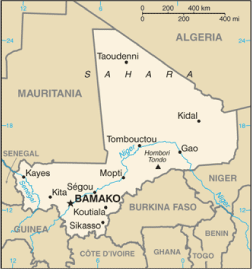
Mali is a source,
transit, and destination country for women and children trafficked for the
purposes of forced labor and, to a lesser extent, commercial sexual
exploitation. In Mali, victims are trafficked from rural areas to urban
centers, agricultural zones, and artisanal mining sites. Victims are also
trafficked between Mali and other West African countries. Some notable
destination countries for Malian child victims are Burkina Faso, Cote
d’Ivoire, Guinea, Senegal, Mauritania, Niger, and Nigeria. Women and girls
are trafficked primarily for domestic servitude and, to a lesser extent,
forced prostitution, while boys are trafficked for forced begging and forced
labor in gold mines and agricultural settings both within Mali and to
neighboring countries. - U.S. State Dept
Trafficking in Persons Report, June, 2009 Check
out a later country report here and possibly a full TIP Report here |
||||||||||||
|
CAUTION:
The following links have been culled from the web to
illuminate the situation in HOW TO USE THIS WEB-PAGE Students If you are looking
for material to use in a term-paper, you are advised to scan the postings on
this page and others to see which aspects of Human Trafficking are of
particular interest to you. Would you
like to write about Forced-Labor? Debt
Bondage? Prostitution? Forced Begging? Child Soldiers? Sale of Organs? etc. On the other
hand, you might choose to include precursors of trafficking such as poverty and hunger. There is a lot to
the subject of Trafficking. Scan other
countries as well. Draw comparisons
between activity in adjacent countries and/or regions. Meanwhile, check out some of the Term-Paper resources
that are available on-line. Teachers Check out some of
the Resources
for Teachers attached to this website. ***
FEATURED ARTICLE *** Chocolate and
Slavery: Child Labor in Samlanchith
Chanthavong, Trade & Environment Database TED Case Studies Number 664,
2002 www1.american.edu/ted/chocolate-slave.htm [accessed 20
February 2011] elib.unikom.ac.id/files/disk1/476/jbptunikompp-gdl-gunardiend-23777-9-chocolat-y.pdf [accessed 12 June
2017] SLAVERY AND THE LINK
TO CHOCOLATE
- Slave traders are trafficking boys ranging from the age of 12 to 16 from
their home countries and are selling them to cocoa farmers in ***
ARCHIVES *** Nestlé &
Cargill v. Doe Series: The Prohibitions on Slavery, Forced Labor, and Human
Trafficking Meet the Sosa Test Oona Hathaway, Chris
Ewell, Nicole Ng, Ellen Nohle
and Alasdair Phillips-Robins, Just Security, 23 November 2020 [Long
URL] [accessed 24
November 2020] Our amicus brief
argues that if any international law norms meet the Sosa threshold, they are
the norms at issue in Nestlé. The respondents in Nestlé – former child slaves
from Mali who were trafficked to
work as slave labor on cocoa plantations in the Ivory Coast – allege that the
two food giants Nestlé USA and Cargill knowingly aided and abetted these
international law violations through technical assistance and financial
contributions from their U.S. offices. The facts in Nestlé are particularly
disturbing because they involve the exploitation of children. Unfortunately,
these plaintiffs are far from alone: An estimated 4 million children are
currently subjected to forced labor around the world. Children are also
particularly vulnerable to human trafficking, making up around 30 percent of
human trafficking victims worldwide. While child labor is more likely to be
involved in production for the domestic economy, many children are employed
in the supply chains of major international corporations. 2020 Country
Reports on Human Rights Practices: Mali U.S. Dept of State Bureau of Democracy, Human Rights, and
Labor, 30 March 2021 www.state.gov/reports/2020-country-reports-on-human-rights-practices/mali/
[accessed 15 June
2021] PROHIBITION OF
FORCED OR COMPULSORY LABOR Most adult forced
labor occurred in the agricultural sector, especially rice, cotton, dry
cereal, and corn cultivation, and in artisanal gold mining, domestic
services, and in other sectors of the informal economy. Forced child labor
occurred in the same sectors. Corrupt religious teachers compelled boys into
begging and other types of forced labor or service (see section 7.c.). The salt mines of Taoudeni in the North subjected men and boys, primarily
of Songhai ethnicity, to a longstanding practice of debt bondage. Employers
subjected many black Tuaregs to forced labor and
hereditary slavery, particularly in the eastern and northern regions of Gao,
Timbuktu, and Kidal (see section 6). PROHIBITION OF CHILD
LABOR AND MINIMUM AGE FOR EMPLOYMENT Child labor,
particularly in its worst forms, was a serious problem. Child labor was
concentrated in the agricultural sector, especially rice and cotton
production, domestic services, gold mining, forced begging organized by
Quranic schools, and other sectors of the informal economy. Approximately 25
percent of children between ages five and 14 were
economically active, and employers subjected more than 40 percent of
economically active children to the worst forms of child labor. Many were
engaged in hazardous activities in agriculture. Armed groups used child
soldiers in the northern and central parts of the country (see section 1.g.).
Child trafficking occurred. Employers used children, especially girls, for
forced domestic labor. Employers forced black Tuareg
children to work as domestic and agricultural laborers. Child labor in
artisanal gold mining was a serious problem. According to the International
Trade Union Confederation, at least 20,000 children worked under extremely
harsh and hazardous conditions in artisanal gold mines. Many children also
worked with mercury, a toxic substance used in separating gold from its ore. An unknown number
of primary school-age boys throughout the country, mostly younger than 10,
attended part-time Quranic schools funded by students and their parents. Some
Quranic teachers (marabouts) often forced their students, known as garibouts or talibes, to beg
for money on the streets or work as laborers in the agricultural sector; any
money earned was usually returned to their teachers. In some cases talibes were also used as domestic workers without
receiving compensation. Freedom House
Country Report 2020 Edition freedomhouse.org/country/mali/freedom-world/2020 [accessed 3 May 2020] G4. DO INDIVIDUALS
ENJOY EQUALITY OF OPPORTUNITY AND FREEDOM FROM ECONOMIC EXPLOITATION? Although
trafficking in persons is a criminal offense, prosecutions are infrequent.
Many judicial officials remain unaware of the antitrafficking
law, and the police lack adequate resources to combat trafficking.
Traditional forms of slavery and debt bondage persist, particularly in the
north, with thousands of people estimated to be living in such conditions. Although the
government has taken steps to eliminate child labor, it is a significant
concern, especially in the agricultural and artisanal gold-mining sectors.
Armed groups also regularly recruited and use child soldiers. 2017 Findings on
the Worst Forms of Child Labor Office of Child
Labor, Forced Labor, and Human Trafficking, Bureau of International Labor
Affairs, US Dept of Labor, 2018 www.dol.gov/sites/default/files/documents/ilab/ChildLaborReport_Book.pdf [accessed 18 April
2019] www.dol.gov/sites/dolgov/files/ILAB/child_labor_reports/tda2017/ChildLaborReportBook.pdf [accessed 3 May
2020] Note:: Also check out this country’s report in the more recent edition DOL
Worst Forms of Child Labor [page 655] Children,
especially of the Bellah community (also known as
black Tuaregs), are subject to hereditary slavery
in northern Mali. (23; 25; 30; 5; 2) Some children are born into slavery, while
others are born free, but remain in a dependent status through which they are
forced to work with their parents for their former masters in exchange for
food, money, and lodging. Child slaves perform agricultural or domestic labor
and are often sexually abused. (31; 2) In addition, children, particularly
those of Songhai ethnicity, work in debt bondage in the northern salt mines
of Taoudenni. (32; 2) Children involved
in artisanal gold mining in western and southern Mali are exposed to toxic
substances and extreme temperatures, transport heavy loads, and work for long
hours. (15; 16; 17; 18; 1; 19; 20; 21) Some boys placed in the care of
Koranic teachers for education are forced by their teachers to beg on the
street or to work in fields, after which they must then surrender the money
they have earned to their teachers. (32; 17; 1; 2) Intermittent
fighting and violence in central and northern Mali continued throughout 2017,
resulting in the killing and displacement of children. (3; 33; 20; 29; 2; 4)
Although the incidence of child soldiers decreased during the reporting
period, children continued to be forcibly recruited and trained by non-state
armed groups, including the Coordination of Azawad Movements (CMA), the
National Movement for the Liberation of Azawad (MNLA), the High Council for
the Unity of Azawad (HCUA), the Arab Movement of Azawad (MAA), and Tuareg Imghad and Allies
Self-Defense Group (GATIA), all signatories of the 2015 Peace Accord. (33; 3;
34; 4) Research found limited evidence of ties between the government and
GATIA, a non-state armed group led by a Malian general, including the
provision of in-kind support to GATIA. (35; 36; 2; 20; 33) The UN verified
that GATIA recruited at least nine children during the reporting period. (3;
37). Protection Project
- Mali
[DOC] The www.protectionproject.org/human_rights_reports/report_documents/mali.doc [accessed 2009] FORMS OF TRAFFICKING - Child
trafficking for forced labor predominates in Mali Signs
Agreement With Senegal To Curb Child Trafficking UN Wire, 2004-07-23
-- Source: www.unwire.org/UNWire/20040723/449_26148.asp www.pambazuka.org/en/category/welfare/23415 [accessed 20
February 2011] UN Integrated
Regional Information Networks IRIN www.irinnews.org/report/47772/guinea-child-trafficking-from-mali-revealed-by-car-crash [accessed 9 March
2015] The death of three
girls in a road accident last month led to investigations which revealed the
existence of a network the trafficks children into Attempts to prevent
human trafficking are making conditions worse for voluntary migrants The Medical News, 5
June 2004 -- Source: http://press.psprings.co.uk/bmj/june/edd1369.pdf www.news-medical.net/news/2004/06/05/2190.aspx [accessed 20
February 2011] A survey of close
to 1000 migrants in Reuters, edition.cnn.com/2003/WORLD/africa/12/16/mali.children.reut/ [accessed 8
September 2011] Malian authorities
have rescued more than 100 children and teenagers from suspected traffickers
believed to be taking them into forced labor in rice fields, officials in the
West African nation said Tuesday.
Police stopped 112 minors aged between 10 and 18 as they traveled in
buses over the weekend in the Segou region, northeast of the capital Joan Baxter, BBC
News, news.bbc.co.uk/2/hi/africa/2063526.stm [accessed 20
February 2011] The city of Africa: Migrants,
Slavery Immigration Laws:
May, 2001 - Number #18 migration.ucdavis.edu/mn/more.php?id=2377_0_5_0 [accessed 7 July
2013] MALI AND SLAVERY - There are an
estimated 15,000 Malian youth ages 15 to 18 who are enslaved in the Ivory
Coast, lured by smugglers who promise the youth and their parents high wages
and training. Instead, most do manual labor in cocoa plantations. A slave is defined
by the ILO as someone "forced to work under physical or mental threat,
and where the owner or employer controls the person completely - where a
person is bought or sold." Humphrey Hawksley in
news.bbc.co.uk/2/hi/africa/1272522.stm [accessed 20
February 2011] At a run-down
police station in Sikasso, a small town in Child Slaves Caught
in Glittering Traps Sikasso -- Source: Corinna Schuler,
National Post (4/17/01)
www.nationalpost.com/home/story.html?f=/stories/20010417/535594.html www.menstuff.org/issues/byissue/childslaves.html#childslaves [accessed 20
February 2011] The next day, the
Sylla brothers found themselves captive in a windowless hut -- caught in the
web of smugglers who coax unknown numbers of young people out of impoverished
Joan Baxter in news.bbc.co.uk/2/hi/africa/948135.stm [accessed 20
February 2011] They number about
15,000 and their plight is enough to "make you weep", says Malian
Minister of Woman and Family Affairs They are child slaves from Mali, between
the ages of six and 16, and they work on plantations in neighbouring Ivory
Coast, where Ms Thiero says they are regularly beaten, starved and locked in
tiny dark huts to keep them from fleeing.
"One small boy brought me to tears when he told of how he drank
his own urine for three days because the plantation owners had locked him up
without food or water," Child Labour
Persists Around The World: More Than 13 Percent Of Children 10-14 Are
Employed International Labour
Organisation (ILO) News, www.ilo.org/global/about-the-ilo/press-and-media-centre/news/WCMS_008058/lang--en/index.htm [accessed 8
September 2011] www.scribd.com/document/367525279/Child-Labour-Persists-Around-the-World-docx [accessed 5 February
2018] "Today's child
worker will be tomorrow's uneducated and untrained adult, forever trapped in
grinding poverty. No effort should be spared to break that vicious
circle", says ILO Director-General Michel Hansenne. Among the countries
with a high percentage of their children from 10-14 years in the work force
are: Mali, 54.5 percent; Burkina
Faso, 51; Niger and Uganda, both 45; Kenya, 41.3; Senegal, 31.4; Bangladesh,
30.1; Nigeria, 25.8; Haiti, 25; Turkey, 24; Côte d'Ivoire, 20.5; Pakistan,
17.7; Brazil, 16.1; India, 14.4; China, 11.6; and Egypt, 11.2. Concluding
Observations Of The Committee On The Rights Of The Child (CRC) UN Convention on the
Rights of the Child, 8 October 1999 www1.umn.edu/humanrts/crc/mali1999.html [accessed 20
February 2011] [23] The Committee
welcomes the recent initiative undertaken by the State party in establishing
the National Commission to Study inter-country Adoption and Combat
Trafficking in Children. The Committee notes that the final report of the
Commission, due in October 1999, will include legislative and other
recommendations to protect the rights of children in situations of adoption
and to prevent and combat the phenomenon of trafficking in children. The
Committee remains concerned, however, at the absence of legislation, policies
and institutions to regulate inter-country adoptions. The lack of monitoring
with respect to both domestic and inter-country adoptions and the widespread
practice of kalifa (informal adoptions) are also matters of concern. [36] While the
Committee notes the efforts of the State party, it remains concerned at the
increasing incidence of sale and trafficking of children, particularly girls,
and the lack of adequate legal and other measures to prevent and combat this
phenomenon. ***
EARLIER EDITIONS OF SOME OF THE ABOVE *** Freedom House
Country Report 2018 Edition freedomhouse.org/country/mali/freedom-world/2018 [accessed 3 May 2020] G4. DO INDIVIDUALS ENJOY
EQUALITY OF OPPORTUNITY AND FREEDOM FROM ECONOMIC EXPLOITATION? Although
trafficking in persons is a criminal offense, prosecutions are infrequent.
Many judicial officials remain unaware of the antitrafficking
law, and the police lacked adequate resources to combat trafficking.
Traditional forms of slavery and debt bondage persist, particularly in the
north, with thousands of people estimated to be living in such conditions. Although the
government has taken steps to eliminate child labor, it is a significant
concern, especially in the agricultural and artisanal gold-mining sectors.
Armed groups also regularly recruited and used child soldiers, and in 2017,
the government reportedly assisted militia groups that included child
soldiers. Human Rights Reports
» 2005 Country Reports on Human Rights Practices 2009-2017.state.gov/j/drl/rls/hrrpt/2005/61580.htm [accessed 10
February 2020] TRAFFICKING
IN PERSONS
– The country was a source, transit, and destination for trafficking. Most of
the trafficking occurred within the country's borders during the year.
Children were trafficked to rice fields in the central regions; boys were
trafficked to mines in the south; and girls were trafficked for involuntary
domestic servitude in The Department of Labor’s 2004 Findings on
the Worst Forms of Child Labor www.dol.gov/ilab/media/reports/iclp/tda2004/mali.htm [accessed 20
February 2011] Note:: Also check out this country’s report in the more recent edition DOL
Worst Forms of Child Labor INCIDENCE
AND NATURE OF CHILD LABOR - Mali is a source of trafficked children, most of whom are sold into forced labor in Côte d'Ivoire to work
on coffee, cotton, and cocoa farms, or in domestic labor. Organized networks of traffickers promise
parents that they will provide paid employment for their children, but then
sell the children to commercial farm owners for a profit. CURRENT
GOVERNMENT POLICIES AND PROGRAMS TO ELIMINATE THE WORST FORMS OF CHILD LABOR - The Government of
Mali is one of nine countries participating in the US DOL-funded ILO-IPEC
project to combat the trafficking of children for exploitive labor in West
and All
material used herein reproduced under the fair use exception of 17 USC § 107
for noncommercial, nonprofit, and educational use. PLEASE RESPECT COPYRIGHTS OF COMPONENT
ARTICLES. Cite this webpage as: Patt,
Prof. Martin, "Human Trafficking & Modern-day Slavery - |
|
|||||||||||