Human Trafficking & Modern-day Slavery Poverty drives the unsuspecting poor into the
hands of traffickers Published reports & articles from 2000 to 2025 gvnet.com/humantrafficking/Malawi.htm
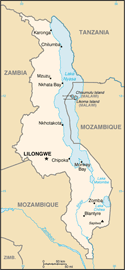
Malawi is a source,
transit, and destination country for men, women, and children trafficked for
the purposes of forced labor and sexual exploitation. The incidence of
internal trafficking is believed higher than that of transnational
trafficking, and practices such as forced labor exist, particularly on
tobacco plantations. Children are trafficked primarily within the country for
forced labor in agriculture, animal herding, domestic servitude, and to
perform forced menial tasks for small businesses. Girls and young women are
trafficked internally for forced labor and prostitution at local bars and
rest houses. - U.S. State Dept Trafficking in
Persons Report, June, 2009 Check out a later country report here and possibly a full TIP Report here |
|
|||||||||||
|
CAUTION: The following
links have been culled from the web to illuminate the situation in
Malawi. Some of these links may lead
to websites that present allegations that are unsubstantiated or even
false. No attempt has been made to
validate their authenticity or to verify their content. HOW TO USE THIS WEB-PAGE Students If you are looking for
material to use in a term-paper, you are advised to scan the postings on this
page and others to see which aspects of Human Trafficking are of particular
interest to you. Would you like to
write about Forced-Labor? Debt
Bondage? Prostitution? Forced Begging? Child Soldiers? Sale of Organs? etc. On the other
hand, you might choose to include precursors of trafficking such as poverty and hunger. There is a lot to
the subject of Trafficking. Scan other
countries as well. Draw comparisons
between activity in adjacent countries and/or regions. Meanwhile, check out some of the Term-Paper resources
that are available on-line. Teachers Check out some of
the Resources
for Teachers attached to this website. ***
FEATURED ARTICLE *** Malawi’s Vulnerable
Shortchanged in Human Trafficking Prevention Efforts Charity Chimungu Phiri, BLANTYRE, Inter Press Service News Agency
IPS, 13 May 2020 [access date
unavailable] www.ipsnews.net/2020/05/malawis-vulnerable-shortchanged-human-trafficking-prevention-efforts/ [accessed 13 May
2020] Some victims make
their own way home -- Modestar* was one of those
young Malawian women who had been stranded overseas. She had left her home in
Zalewa, a town in Malawi’s southern region for
Kurdistan in northern Iraq, some 5,400 miles away, after being promised a
well-paying job looking after the elderly. But the salary she
had been promised was slashed in half, and her phone and passport was
confiscated upon her arrival. She was forced to work long hours caring for an
elderly patient in a private home. “I was not allowed
to go outside of the compound. I worked long hours, at times from 7am to 1am
[the next day], without getting paid,” she told IPS. Eventually she was
rescued by Iraqi police who had been tipped off by another woman who had also
been in domestic service with Modestar. But the
women soon realised they may not be able to return
home, as the employment agent refused to return their passports. Malawi’s rating on
human trafficking ‘mistake’ www.dailytimes.bppmw.com/article.asp?ArticleID=7543 [access date
unavailable] Malawi’s rating as
Tier 1 in this year’s Trafficking in Persons (TIP) report is misleading and does
not reflect the reality on the ground, officials from the Centre for Social
Concern (CFSC) have said. However, officials
from CFSC briefing the press in Lilongwe last week said the Tier 1
classification is a mistake because Malawi has not done much in human
trafficking to warrant first position.
Christopher Boyer of CFSC said in the first place Malawi has no
anti-trafficking legislation in place and neither does it have shelters for
trafficked victims. Boyer also
criticized the report for commending the Malawi government for recruiting 400
child protection officers who work in all the districts and recognizing
victims of trafficking because these officers are not actually doing the
work. Child Prostitution
worsens in Cities Pilirani Semu-Banda,
Nation Online, Jun 04, 05 [accessed 17 April
2012] She said for
Blantyre, the children are picked from their parental homes in Zomba, Thyolo,
Nsanje and Chiradzulu after brothel owners pay some money to parents of the
children. “They give the parents
K1,000 and tell them that the children will be employed in restaurants,” said
Mtisunge. ***
ARCHIVES *** First-person:
Fighting human trafficking in Malawi UN News | Updated:
16 November 2020 www.devdiscourse.com/article/law-order/1308967-first-person-fighting-human-trafficking-in-malawi [accessed 16
November 2020] They were sisters,
and just 14 and 16. I met them and discovered they'd been trafficked from
Malawi to South Africa and forced to work as prostitutes. They were in a
terrible state, both physically and mentally. I managed to
arrange their return to Malawi. Today, one of the sisters is working as an
accountant, the other as a head teacher at a primary school. Shining a light on
a hidden crime -- There are several cases I've been involved in, which I'm
proud of. These include the rescue of Malawian victims of labour
exploitation from Kuwait and Iraq and their safe return home and the rescue
of men from Nepal who had been trafficked to Malawi. And there are the recent
rescues of young victims of forced marriages and prostitution following my
mentoring this summer. 2020 Country
Reports on Human Rights Practices: Malawi U.S. Dept of State Bureau of Democracy, Human Rights, and
Labor, 30 March 2021 www.state.gov/reports/2020-country-reports-on-human-rights-practices/malawi/
[accessed 15 June
2021] PROHIBITION OF
FORCED OR COMPULSORY LABOR The government did
not effectively enforce applicable laws, and forced labor occurred during the
year, especially in agriculture (predominantly the tobacco industry), goat
and cattle herding, and brickmaking. Child forced labor also occurred (see
section 7.c.). Under the tenancy system, estate owners recruit farmers from
distant districts to grow tobacco for them on their estates. Employers loan the
tenant farmers money to buy agricultural inputs during the growing season. If
they are unable to repay the loans, they fall into situations of debt
bondage. PROHIBITION OF CHILD
LABOR AND MINIMUM AGE FOR EMPLOYMENT Child labor,
including the worst forms of child labor, remained a serious and widespread
problem. The 2015 National Child Labor Survey found 38 percent of children
ages five to 17 were involved in child labor. Child labor was most prevalent
in agriculture, especially tea, tobacco and livestock herding, brickmaking
and construction, and domestic service. Forced child labor also occurred,
particularly in agriculture, construction, forced begging and street work,
use in illicit activities, and commercial sexual exploitation (see section 6,
Children). Children often worked 12-hour days, frequently for little or no
pay. Many boys worked as vendors, and young girls in urban areas often worked
outside their families as domestic servants, receiving low or no wages. Freedom House
Country Report 2020 Edition freedomhouse.org/country/malawi/freedom-world/2020 [accessed 8 July
2020] G4. DO INDIVIDUALS
ENJOY EQUALITY OF OPPORTUNITY AND FREEDOM FROM ECONOMIC EXPLOITATION? The enforcement of
labor laws is weak, and employees are often paid extremely low wages, despite
minimum-wage laws. Child labor is a persistent problem, particularly on
tobacco estates. In October 2019, the British law firm Leigh Day announced a
class-action lawsuit against British American Tobacco on behalf of 2,000
Malawian farmers over forced labor and child labor practices. Shortly
thereafter, the United States announced that it would suspend imports of
Malawian tobacco due to evidence of forced labor. 2017 Findings on
the Worst Forms of Child Labor Office of Child
Labor, Forced Labor, and Human Trafficking, Bureau of International Labor
Affairs, US Dept of Labor, 2018 www.dol.gov/sites/default/files/documents/ilab/ChildLaborReport_Book.pdf [accessed 18 April
2019] www.dol.gov/sites/dolgov/files/ILAB/child_labor_reports/tda2017/ChildLaborReportBook.pdf [accessed 3 May
2020] Note:: Also check out this country’s report in the more recent edition DOL
Worst Forms of Child Labor [page 640] Most human
trafficking of children for labor in Malawi is internal. (13; 20) Boys in
particular are trafficked from southern Malawi to work on tobacco farms in
Malawi’s northern and central regions; they are also forced to work as cattle
herders and in the brickmaking industry. (13; 20; 28) Children also are
trafficked from Malawi to other countries, including Mozambique, South
Africa, Tanzania, and Zambia. (23; 28; 29) Children who are trafficked may be
charged for their clothing, food, housing, and transport. They may also be
forced to work in debt bondage because of these charges and be unable to
return home or support themselves. (20; 30) Girls from rural areas
are sometimes provided clothing and lodging from brothel owners. After they
have left home, they are coerced to engage in commercial sexual exploitation
to pay off their debts. (13; 20; 28) Girls who work in rest houses or bars
are often coerced to engage in commercial sexual exploitation in exchange for
room and board. (31; 1). Malawi: Government
Intensifies Campaign Against Child Labour UN Integrated
Regional Information Networks IRIN, Blantyre, 30 November 2007 www.irinnews.org/report/75626/malawi-government-intensifies-campaign-against-child-labour [accessed 9 March
2015] POVERTY - While
recognising the efforts by government and its development partners to combat
human trafficking and child labour, Banda said, "Increasing the number
of child protection officers without dealing with what drives thousands of
our children into exploitative labour will not solve the problem. These children
are compelled to work in estates because of poverty and, to a large extent,
because they either have one or no parent at all." - htpv Human trafficking
syndicate exposed Deborah Nyangulu,
Daily Times, 26 October 2007 – Source: www.dailytimes.bppmw.com/article.asp?ArticleID=7047 groups.yahoo.com/group/MALAWIANA/message/18248?o=1&d=-1 [accessed 19
February 2011] An intricate system
of human trafficking exists in the country involving Malawians and Nigerians who
traffic mainly women and children to as far as Europe. Most of the victims
of trafficking in Malawi, Nikolovska said, are sexually exploited in
Johannesburg and women could be sold for as little as R650 (K13,800) as wives
to South African men and for R1,000 (K21,234) in brothels at Kwazulu Natal
and Gauteng. NGOs Work To
Eradicate Human Trafficking, Help Victims U.S. Department of
State, Washington DC, June 12, 2007 presszoom.com/story_134115.html [accessed 19
February 2011] U.S.-funded
nongovernmental organizations around the world are working to prevent human
trafficking, provide resources to victims and arrest and prosecute child-sex
offenders. From Africa to Europe to Asia, initiatives are raising worldwide
awareness of the illegal practice of human trafficking. PROVIDING
RESOURCES FOR VICTIMS - In Malawi, police officers specially trained to
recognize child victims of exploitation, including trafficking, are raising
community awareness and helping grassroots organizations provide
reintegration assistance for victims. Nearly 400 child protection officers in
the country’s 27 local government districts are serving a critical role by
monitoring communities for signs of trafficking, and they identify about half
of the reported trafficking cases in Malawi. Mozambican gets 6
years for human trafficking www.nationmalawi.com/articles.asp?articleID=19144 www.zoominfo.com/p/Joseph-Sauka/860900748 [accessed 3 February
2015] Sauka in an
interview yesterday said Katundu entered the country on October 1 accompanied
by a boy aged 17 whom he convinced that he would be paid handsomely after
helping him carry some clothes he was going to buy in Zomba. “But his going to Zomba was in search of a
human market. Last month, police
in Zomba arrested three people suspected to have removed private parts of a
boy in the district. Their motive has not been established yet but they are
currently on remand at the Zomba Maximum Prison awaiting trial. Human trafficking
is a reality in Malawi South African
Migration Project SAMP, Queen's University (Canada), Daily Times, 2006-08-25 www.queensu.ca/samp/migrationnews/article.php?Mig_News_ID=3559&Mig_News_Issue=20&Mig_News_Cat=5 [accessed 19
February 2011] In order to combat the
multifaceted problem of human trafficking, interventions must be
multi-disciplinary and multi sectoral. They must among others include; the
legal sector -implementing all international human rights conventions and
treaties, developing regional and bilateral MOU’s with neighbouring countries
on prevention and detection of trafficking, strengthening the national legal
framework through the development of specific anti-trafficking laws and
regulations, and strengthening law enforcement through active prosecution of
trafficking offenders. Also the social
welfare and health sector -improving access to high quality and appropriate
social and protection services for trafficking victims, providing health
services to those infected with diseases etc; community based initiatives -
supporting small income-generating projects in village communities; gender
mainstreaming- raising awareness about gender sensitivity within the court
systems, and among police and other law enforcement officials, as well as
raising awareness on the issues throughout the general public; And the education
sector - increasing awareness about human trafficking by providing education
for all. Improving the existing educational systems and ensure vocational and
technical education structures and mechanisms accessible to out of school
youth. Provide relevant education and training for labour markets,
particularly to youth in areas of high mobility and/or vulnerable groups; the
migration sector - strengthening cross-border initiatives, enhancing the
number and quality of repatriation programmes, improving situation of
trafficked victims in receiving country (avoiding detention and expulsion of
victims), focusing on key factors which leads to the migration to
neighbouring countries; and the labour sector - improving job opportunities
and strengthening national labour laws. All these must be included to combat
the multifaceted problem of human trafficking. New NGO formed to
combat human trafficking South African
Migration Project SAMP, Queen's University (Canada), Daily Times, 2006-07-04 www.queensu.ca/samp/migrationnews/article.php?Mig_News_ID=3393&Mig_News_Issue=19&Mig_News_Cat=5 [accessed 19
February 2011] A new NGO named Centre
for the Protection of Trafficked Persons (Ceptrap) has been formed in the
country to combat human and child trafficking and sexual exploitation. Reports of human
trafficking have been rife in the country with various people using all kinds
of tricks to abduct women. Trafficked people are usually lured with offers of
jobs outside the country. Outrage over
lenient fine for trafficking boys UN Integrated
Regional Information Networks IRIN, Johannesburg, 24 Aug 2005 www.irinnews.org/report/56005/malawi-outrage-over-lenient-fine-for-trafficking-boys [accessed 9 March
2015] A Kwacha 24,000 (US
$200) fine imposed on a man caught trying to smuggle children across the
border into Zambia is causing outrage in Malawi. The Zambian national, named as Masautso
Banda, was arrested last Friday as he attempted to cross the border with 15
children in tow. He was convicted and
sentenced on Saturday for trying to traffic the boys, aged between nine to 15
years, but the fine imposed has been described as a slap on the wrist. An African
cleansing rite that now can kill Sharon LaFraniere,
The New York Times, Mchinji, May 12, 2005 www.vivamalta.net/VMforum/index.php?topic=995.0 [accessed 13
February 2019] But they hunted her
down, she said, and insisted that if she refused to exorcise her dead
husband's spirit, she would be blamed every time a villager died. So she put
her two small children to bed and then forced herself to have sex with
James's cousin. Seduction,
Sale & Slavery: Trafficking In Women & Children For Sexual
Exploitation In Southern Africa [PDF] Jonathan Martens,
Maciej ‘Mac’ Pieczkowski, & Bernadette van Vuuren-Smyth, Pretoria SA,
International Organization for Migration IOM, May 2003 www.unicef.org.mz/cpd/references/40-TraffickingReport3rdEd.pdf [accessed 23 April
2012] [accessed 3 May
2020] EXECUTIVE SUMMARY - The major
findings may be summarized as follows: Mozambican victims
include both girls and young women between the ages of 14 and 24. They are
offered jobs as waitresses or sex workers in Johannesburg, and pay their
traffickers ZAR 500 to smuggle them across the border in minibus taxis either
at Komatipoort or Ponta do Ouro. They stay in transit houses along South
Africa’s border with Mozambique and Swaziland for one night where they are
sexually assaulted as an initiation for the sex work that awaits them. Once
in Johannesburg, some are sold to brothels in the Central Business District
(CBD) for ZAR 1000. Others are sold as slaves on private order for ZAR 550,
or shopped around to mineworkers on the West Rand as ‘wives’ for ZAR 650. An
estimated 1000 Mozambican victims are recruited, transported, and exploited
in this way every year, earning traffickers approximately ZAR 1 million annually. South Africa
regional centre for human trafficking UN Integrated
Regional Information Networks IRIN, Johannesburg, 23 June 2004 www.irinnews.org/report/50363/southern-africa-south-africa-regional-centre-for-human-trafficking [accessed 9 March
2015] Malawian women are
targeted by trafficking groups because they do not require a visa to enter
the United Kingdom. Initial recruitment takes place through Malawian
businesswomen, who are linked to the smuggling syndicates. Young women are
lured by promises of job opportunities in Europe. Upon arrival, as the IOM discovered in the
Netherlands, the women are sold to brothel owners for $10,000, and told they
must work as prostitutes to pay off their debts. "The initiation process
involves a ritual used to threaten the women," Martens said. They are
asked for underwear, hair or nail clippings and threatened with death by
magic if they do not cooperate. The IOM discovered that some brothels even
brand or tattoo the women. Human Trafficking
Stretches Across the Region Moyiga Nduru, Benoni
SA, Inter Press Service News Agency IPS, June 23, 2004 www.ipsnews.net/africa/interna.asp?idnews=24338 [accessed 19
February 2011] www.ipsnews.net/2004/06/rights-southern-africa-human-trafficking-stretches-across-the-region/ [accessed 22
September 2016] According to the
Pretoria-based Institute for Security Studies, as many as 500 organised crime
groups operate in South Africa. These include Nigerian gangs who operate
mainly in Malawi, Zambia and South
Africa. SOUTH AFRICA:
Initiative to fight human trafficking to be launched UN Integrated
Regional Information Networks IRIN, Johannesburg, 18 Jun 2004 www.irinnews.org/report/50302/south-africa-initiative-to-fight-human-trafficking-to-be-launched [accessed 9 March
2015] South Africa is a
country of origin, destination and transit for victims, who are trafficked
primarily for purposes of prostitution and forced labour. Refugees from
neighbouring African countries, children from Lesotho, women and girls from
Mozambique, Malawi, Kenya, Zambia,
Nigeria, Senegal, Taiwan, Russia, Thailand, Latvia and Romania are all
trafficked into South Africa. Social And Cultural
Life Centre For Social
Concern, Kanengo, Lilongwe, Malawi -- Malawi Press Review, June 2004 At one time this
article had been archived and may possibly still be accessible [here]
[accessed 8
September 2011] [scroll down] SOCIAL AND CULTURAL
LIFE - Reports on social
and cultural life also revealed efforts that are being taken by Nankungwis or
Ngalibas, the country's custodians of culture in the fight against the
HIV/AIDS pandemic. It is now common knowledge that some cultural practices
such as chokolo, wife inheritance are not worth keeping and practicing in
light of the HIV/AIDS pandemic. Nankungwis who are responsible for guiding
young people through initiation rites are better placed to disseminate
information on how the disease is spread as well as its consequences. The practice of
marrying girls at a tender age has been blamed for the rise in maternal death
in the country. This practice has a negative effect on the health of young
girls who end up with various health implications for starting child bearing
at a tender age. All the more, the practice has a negative bearing on the
development of the country, as young girls do not get a chance to finish
their education and contribute positively to the development of the country. Reports have also
expressed concern that Malawian women and girls are increasingly becoming
victims of human trafficking to South Africa and other border districts of
Malawi. This is a sad development hence the need for human rights bodies and
government to put into place measures that would end the practice. The Smoking
Business - Tobacco Workers in Malawi [PDF] Liv Torres (ed.),
Fafo-report 339, Fafo Institute for Applied Social Science 2000 ISBN
82-7422-317-9 ISSN 0801-6143 www.fafo.no/pub/rapp/339/339-web.pdf [accessed 19
February 2011] agris.fao.org/agris-search/search.do?recordID=GB2013200008 [accessed 3 May
2020] Malawi is generally
regarded as one of the countries in the region with the highest incidence of
child labour. Child labour in Malawi is also to a large extent explained by poverty,
lack of resources, especially educational, etc as well as poor institutional
and reulatory settings. Poverty and economic necessity exert major pressures
on families to make use as early as possible of the time and labour of
children to assist family survival, often at the expense of schooling. SOUTHERN AFRICA:
Major destination for traffickers in women and children UN Integrated
Regional Information Networks IRIN, Johannesburg, 23 April 2004 [accessed 19
February 2011] "Sexual
exploitation - in particular, prostitution - is the most widely documented
form of exploitation for women and children trafficked within and from
Africa," said the report. In certain instances it has been
"exacerbated also by a demand from foreigners", such as in holiday
resorts in Malawi, where children are reported to be sexually exploited by
European tourists, or sent to Europe as sex slaves. - htcp Committee on the
Rights of the Child - Reports by States 29th session,
Geneva, 14 January to 1 February 2002 olddoc.ishr.ch/hrm/tmb/treaty/crc/reports/crc_23-41/CRC_29.htm [accessed 8 July
2013] [scroll down] MALAWI (INITIAL
REPORT)
- The Committee emphasized the problem of kidnapping and trafficking in
children for slave labour and prostitution. The Malawi Government was
recommended to take measures to protect children before the problem increase
and bi-lateral agreements were stressed as a measure to deal with the
specific area of concern. Concluding
Observations of the Committee on the Rights of the Child (CRC) UN Convention on the
Rights of the Child, 1 February 2002 www1.umn.edu/humanrts/crc/malawi2002.html [accessed 19
February 2011] [63] The Committee
is also concerned at information on alleged instances of trafficking in
children and at the possible use of inter-country adoption for the purpose of
trafficking. ***
EARLIER EDITIONS OF SOME OF THE ABOVE *** Human Rights
Reports » 2005 Country Reports on Human Rights Practices U.S. Dept of State Bureau of Democracy, Human Rights, and
Labor, March 8, 2006 2009-2017.state.gov/j/drl/rls/hrrpt/2005/61579.htm [accessed 10
February 2020] TRAFFICKING
IN PERSONS
– The law does not prohibit trafficking in persons specifically, and
trafficking was a problem. Although the extent of human trafficking was undocumented,
the government made efforts to combat trafficking and used existing laws to
prosecute cases of child trafficking for agricultural labor exploitation. The
penal code contains several provisions relating to prostitution and indecency
that could be used to prosecute traffickers. Since 2001, seven cases
involving trafficking in persons have been prosecuted. On September 24, two
citizens and a foreigner were sentenced to seven years' imprisonment with
hard labor for kidnapping. The three men were arrested in September while
attempting to smuggle five young boys across the border into Zambia to work
on tobacco estates. Other convicted child traffickers were required to pay
fines. The country is a
source and transit point for women and children trafficked for sexual
purposes locally and to brothels abroad, particularly in South Africa.
Victims trafficked to South Africa were typically between 14 and 24 years
old, and were recruited with offers of marriage, study, or employment.
According to the International Organization for Migration, sex tourists,
primarily from Germany, the Netherlands, and the United Kingdom, lured
children into sexual relationships with them while in the country. Poverty
and low educational levels contributed to such exploitation. Traffickers
involved in land border trafficking to South Africa were typically long‑distance
truck drivers and local businesswomen. The Department of Labor’s 2004 Findings on
the Worst Forms of Child Labor U.S. Dept of Labor Bureau of International Labor Affairs, 2005 www.dol.gov/ilab/media/reports/iclp/tda2004/malawi.htm [accessed 19
February 2011] Note:: Also check out this country’s report in the more recent edition DOL
Worst Forms of Child Labor INCIDENCE
AND NATURE OF CHILD LABOR - Children work in crop production on tea estates and
on commercial tobacco farms, where the incidence of working children has
traditionally been high. Bonded labor
has historically been common among tobacco tenants and their families,
including children. There are also
reports that young girls have been traded or sold among tribal chiefs along
the border with Tanzania. Over the
past 2 years, the practice of poor families
exchanging daughters for cattle or money has reportedly re-emerged,
though not in large numbers. Malawi is
a source country for children trafficked regionally and internationally for
menial labor or commercial sexual exploitation. There are also unconfirmed reports of small
numbers of children trafficked internally to resort areas around Lake Malawi
for sex tourism All
material used herein reproduced under the fair use exception of 17 USC § 107
for noncommercial, nonprofit, and educational use. PLEASE RESPECT COPYRIGHTS OF COMPONENT
ARTICLES. Cite this webpage as: Patt,
Prof. Martin, "Human Trafficking & Modern-day Slavery -
Malawi", http://gvnet.com/humantrafficking/Malawi.htm, [accessed
<date>] |
||||||||||||