Human Trafficking & Modern-day Slavery Poverty drives the unsuspecting poor into the
hands of traffickers Published
reports & articles from 2000 to 2025 gvnet.com/humantrafficking/Macedonia.htm
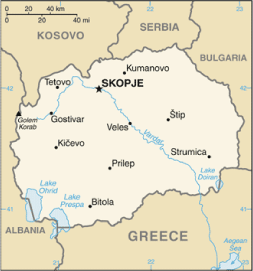
Macedonia is a
source, transit, and destination country for women and children trafficked
for the purpose of commercial sexual exploitation. Macedonian women and
children are trafficked internally within the country. Victims trafficked
into Macedonia are primarily from Albania and Kosovo. Macedonian victims and
victims transiting through Macedonia are trafficked to South Central and
Western Europe. Children, primarily ethnic Roma, are trafficked for the
purpose of forced begging within the country. Victims were trafficked for the
purpose of forced labor in Macedonia’s service sectors. - U.S. State Dept
Trafficking in Persons Report, June, 2009 Check
out a later country report here and possibly a full TIP Report here |
|
|||||||||||
|
CAUTION: The following
links have been culled from the web to illuminate the situation in HOW TO USE THIS WEB-PAGE Students If you are looking
for material to use in a term-paper, you are advised to scan the postings on
this page and others to see which aspects of Human Trafficking are of
particular interest to you. Would you
like to write about Forced-Labor? Debt
Bondage? Prostitution? Forced Begging? Child Soldiers? Sale of Organs? etc. On the other
hand, you might choose to include precursors of trafficking such as poverty and hunger. There is a lot to
the subject of Trafficking. Scan other
countries as well. Draw comparisons
between activity in adjacent countries and/or regions. Meanwhile, check out some of the Term-Paper resources
that are available on-line. Teachers Check out some of
the Resources
for Teachers attached to this website. ***
FEATURED ARTICLE *** Revealed: kept in a
dungeon ready to be sold as slaves David Harrison in
Skopje, The Telegraph, 27 Nov 2005 [accessed 19
February 2011] The women, aged 18
to 24, are from across eastern Europe, lured from Romania, Moldova, Ukraine
and Bulgaria, with promises of good jobs as waitresses, au pairs and
dancers. Instead, they have been
forced into modern-day slavery in western ***
ARCHIVES *** Improving the
standing and the rights of victims of human trafficking in judicial
proceedings in North Macedonia [Cstegory
– Progress Needed ] Council of Europe
News, Skopje, 25 June 2020 [accessed 9 July
2020] The study concludes
that there is a need to bring the domestic legislation in compliance with the
European standards by introducing important procedural safeguards for child
victims of trafficking, providing access to free legal aid, as well as
foreseeing measures for protection from secondary victimisation.
Moreover, the research considers that courts should impose effective,
proportional and dissuasive sanctions on the perpetrators, and that the draft
Law on State Compensation for Victims of Violent Crimes should be adopted
without further delay. 2020 Country
Reports on Human Rights Practices: North Macedonia U.S. Dept of State Bureau of Democracy, Human Rights, and
Labor, 30 March 2021 www.state.gov/reports/2020-country-reports-on-human-rights-practices/north-macedonia/
[accessed 15 June
2021] PROHIBITION OF
FORCED OR COMPULSORY LABOR There were
instances in which women and children were subjected to forced labor, such as
peddling small items in restaurants and bars, and sexual exploitation. Some
Romani children were subject to forced begging, often by relatives (see
section 7.c.). PROHIBITION OF CHILD
LABOR AND MINIMUM AGE FOR EMPLOYMENT During inspections
at some family-run businesses, the State Labor Inspectorate noted minor
children assisting in the work, most commonly in family run handicrafts and
retail businesses, as well as on farms. Child labor
occurred in agriculture, domestic work, and in bars and nightclubs. Some
children in the country engaged in forced begging, cleaning windshields,
scavenging, or selling cigarettes or other small items in open markets, on
the street, or in bars and restaurants at night. Although the necessary laws
were in place, government efforts to eliminate forced begging by children
were largely ineffective. Children involved in these activities were
primarily Roma, Ashkali, and Balkan-Egyptian and
most often worked for their parents or other family members. Freedom House
Country Report 2020 Edition freedomhouse.org/country/north-macedonia/freedom-world/2020 [accessed 8 July
2020] G4. DO INDIVIDUALS
ENJOY EQUALITY OF OPPORTUNITY AND FREEDOM FROM ECONOMIC EXPLOITATION? Laws do not impose rigid barriers to social mobility, though rampant corruption can effectively hamper individuals from rising to higher income levels. Human trafficking remains a problem. The government has taken some steps to better identify trafficking victims, notably at government-run transit centers that house migrants and refugees. However, government support to NGOs that aid trafficking victims has decreased. 2017 Findings on
the Worst Forms of Child Labor Office of Child
Labor, Forced Labor, and Human Trafficking, Bureau of International Labor
Affairs, US Dept of Labor, 2018 www.dol.gov/sites/default/files/documents/ilab/ChildLaborReport_Book.pdf [accessed 18 April
2019] www.dol.gov/sites/dolgov/files/ILAB/child_labor_reports/tda2017/ChildLaborReportBook.pdf [accessed 3 May
2020] Note:: Also check out this country’s report in the more recent edition DOL
Worst Forms of Child Labor [page 621] Most children
involved in child labor in Macedonia engage in street work, including vending
small items, cleaning vehicle windshields, and begging. (3; 4; 6; 7) Some
children engage in begging to help support their families, while others are
forced to beg. The majority of
children involved in street work are of the Roma, Egyptian, and Ashkali ethnicities. (1; 3; 4; 7) Macedonia lacks recent,
comprehensive data on the nature and extent of child labor in the country.
(7) The majority of victims of child trafficking in Macedonia are girls,
between the ages of 14 to 17, who have been trafficked domestically for
commercial sexual exploitation and forced labor in restaurants, bars, and
nightclubs. (1; 11; 14) Girls in eastern and central Macedonia have been
identified as being particularly vulnerable to human trafficking. (16) Roma
girls, especially, are also trafficked for forced marriages in which they are
subject to sexual and labor exploitation. (1; 11; 14; 17; 8; 18) Afghani, Iraqi,
Iranian, Syrian, and other unaccompanied children transiting through the
country, either legally or illegally, are vulnerable to trafficking for labor
and commercial sexual exploitation. (13; 8) During the reporting period, 41
migrant children were identified as potential victims of commercial sexual
exploitation and forced labor. (8). Macedonian
suspected of involvement in human trafficking arrested in Kosovo www.makfax.com.mk/look/novina/article.tpl?IdLanguage=1&IdPublication=2&NrArticle=106451&NrIssue=618&NrSection=20 [access date
unavailable] He is suspected of
having proposed a false marriage offer to a girl from Vucitrn only to lure
her in a motel located in the vicinity of Tetovo and force her into
prostitution. Life in prison for
child sexual abuse makfaxonline
Internet Daily Newspaper, At one time this
article had been archived and may possibly still be accessible [here]
[accessed 8
September 2011] The Criminal Code
will be also supplemented with "Trafficking with minors". A person
who solicitates, transports, buys, sells or accepts an underage person for
sexual exploitation, pornography, forced labor, etc, will be punished with at
least 8-year prison sentence. The buildings and
premises used for committing human trafficking or trafficking with minors,
including hotels, motels, bars, apartments, are also subject to confiscation. Judiciary - weak
link in combating human trafficking www.makfax.com.mk/look/novina/article.tpl?IdLanguage=1&IdPublication=2&NrArticle=56897&NrIssue=284&NrSection=10 [access date
unavailable] Judiciary is one of
the weakest links in the chain in Macedonian institutions as to the fight
against illegal migration and trafficking in human beings. Combat Against
Human Trafficking, Key Issue For Vecer News, February
23, 2007 macedoniadaily.blogspot.com/2007/02/combat-against-human-trafficking-key.html [accessed 21 March
2011] The Macedonian
Interior Ministry prepared 53 charges against 111 perpetrators in the field
of human trafficking, forced prostitution and emigrants trafficking. Balkans Urged To
Curb Trafficking Imogen Foulkes, BBC
News, news.bbc.co.uk/2/hi/europe/4397497.stm [accessed 19
February 2011] Countries
in Macedonia Wins High
Ratings in US Report on Fight Against Human Trafficking Reality At one time this
article had been archived and may possibly still be accessible [here] [accessed 8
September 2011] The US Secretary of
State Colin Powell and the Director of the Office to Monitor and Combat
Trafficking in Persons, John Miller, presented Monday the fourth annual
report on trafficking in human beings.
Macedonia is the only country in the Balkan region, placed in the
first tier of 25 mainly Western European countries which fully comply with
the US standards on the fight against human trafficking. Psychosocial
Support to Groups of Victims of Human Trafficking in Transit Situations Edited by Guglielmo
Schinina -- Psychosocial Notebook, Vol. 4, February 2004, International Organization for Migration
IOM, ISSN 1680-1970 publications.iom.int/books/psychosocial-support-groups-victims-human-trafficking-transit-situations [accessed 30 January
2016] THE A doctor is present
every day at the T.C. and two nurses are there during the night for
emergencies. Pregnancy tests, gynecological examinations, TB tests and
general check-ups are offered to the women on a strictly voluntary basis.
Whenever a woman is in need of specialized care, a qualified professional follows
her case. Regrettably, some women arrive at the T.C. with significant
physical trauma, including broken legs and gunshot wounds and need surgical
attention, rehabilitation and hospitalization. These individual cases are
transferred to local health institutions. Report on Situation
with Children Rights in OneWorld Platform
for www.oneworldsee.org/mk/node/5516 [accessed 19
February 2011] Macedonian NGOs say
that the children in “They can be
victims of almost anything this side of the classical trafficking in
children, which is rare, but also very possible, having in mind the current
situation with the economy in the country. Physical violence remains the
greatest problem, for many parents believe that the children are their
property”, says Gordana Zmijanac from the First Children Embassy “Medjasi”. Eugen Tomiuc, Radio
Free Europe/Radio www.rferl.org/content/article/1055188.html [accessed 19
February 2011] Victims are usually
young girls from poor families who graduate from middle school without few,
if any, prospects for the future. But
older women can also fall prey to traffickers. Twenty-nine-year-old
Mariana is from a village in northern Moldova and spent more than four years
in Macedonia after being sold to
Serbian traffickers. She thought she
was being led into Italy, but instead, this is what she says happened. MARIANA: When we arrived
in Macedonia, we were sent to a
policeman's house. The policeman bought girls and then sold them to
nightclubs. We spent one month and a half at his place. I did not know where I
was and asked him when we were going to Italy. He said, "Italy is
here." Then he sold me to a club. Prostitution
Rampage Through Reality At one time this article
had been archived and may possibly still be accessible [here] [accessed 8
September 2011] The police
discovered the group after one of the abused girls reported that she's been a
victim of human trafficking. According the preliminary reports, the girl R.A.
was forced twice into whoring with Greek citizens. In March this year, the
suspects M.A. and A.N. sold the girl to Sh.K. from Kichevo for 150 Euros. He
and his unwed wife forced the girl to serve them in their bar. The bosses
sold the girl to the Ohrid resident D.B. for 100 Euros June 6, 2003. He also
forced the girl into prostitution in his bar "Persa." The same day, the
accused Sh.K. bought the 14-year old girl A.M. (native of Prilep) from some
man from Bitola, paying 50 Euros. Sh.K. forced the girl to prostitute
herself. Several days afterward, D.B. bought the girl A.N., also to force her
to work as a servant and prostitute. Since she refused the orders of her
owners, she endured repeated raping between June 14 and June 17, 2003. - htcp Row Over Escaped
Trafficker Sase Dimovski -
Balkans: Regional Reporting & Sustainable Training, BCR Issue 440, 6 Sep
2005 iwpr.net/report-news/macedonia-row-over-escaped-trafficker [accessed 19
February 2011] iwpr.net/global-voices/macedonia-row-over-escaped-trafficker [accessed 5 February
2018] A notorious human
trafficker’s escape from jail has highlighted flaws in the Macedonian
judiciary which could hamper the authorities’ efforts to stamp out organised
crime. Dilaver “Leku” Bojku escaped
from the minimum-security Struga prison, where he was serving a six-month
sentence for forcing a woman into prostitution, on June 20. Struga prison
director Dragan Petreski and senior prisons official Ljupco Sapcevski were
both dismissed five days later and are now facing criminal charges over the
incident, as is a Macedonian security guard present when Bojku made his dash
for freedom. But Macedonian prime
minister Branko Crvenkovski has placed the blame for Bojku’s escape firmly on
the republic’s judicial system, which is perceived to be inefficient and in
need of a radical overhaul. Ohrid Police Saves
Nine Victims of Human Trafficking Irina Gelevska,
Reality At one time this
article had been archived and may possibly still be accessible [here] [accessed 8
September 2011] Two days ago, the
local police in Ohrid discovered a young Romanian girl (16), who was forced
into prostitution in the night club "Playboy." The girl, a victim of human trafficking,
informed the police that 8 Ukrainian girls work as sex slaves in the same
night club. 535 Registered
Victims of Human Trafficking in Irina Gelevska,
Reality At one time this
article had been archived and may possibly still be accessible [here] [accessed 8
September 2011] Five hundred thirty
five women have been sold and forced to prostitution in Girl, 15, Sold to
Work as Slave In the Brothels of Dominic Kennedy,
Reality At one time this
article had been archived and may possibly still be accessible [here] [accessed 8
September 2011] A sex slave aged 15
can be bought for as little as £1,300 it emerged, after a Romanian girl who
had been prostituted across Natasha, age 15,
came to the notice of traffickers and soon she was forced to become a
“dancing girl” in a nightclub in the south of Macedonia, where, for six months, her duties included stripping
and having sex with clients. She
escaped this club when she was purchased, without her knowledge, by Jorgi, an
Albanian pimp, for 4,000 German marks (£1,300). He forced her to
telephone saunas and massage parlours, finding the numbers from the back
pages of the magazine What’s On In London. He drove her to and from work,
pocketing the cash that she was paid.
“I was working morning, afternoon and evening. Sometimes I would get
home at 7am and would have to start work again at 11am,” Natasha said. “I hated all the men I was working for. But
if you didn’t do what they were saying they would always get angry and hit
you and swear at you.” After Jorgi hit her she would cover the bruising with
make-up and go to work again. - htcp Irina Gelevska,
Reality At one time this
article had been archived and may possibly still be accessible [here] [accessed 8
September 2011] Between August 2001
and November 2001, Macedonian Police discovered 328 [trafficked] women in the
raids in the night bars in the West and Northwest of the country. 12% of them
are young girls aged 14 to 16. A Skopje shelter, run by IOM with the
assistance from the police, accepted 6 girls under age of 18 during this
year. UNICEF's child
protection officer Carry Nill says that the problem of child sex slavery in
Macedonia worsened during the last two years. Macedonia is known
as a country on the route of trafficking women for prostitution [in Western
Europe], and also as destination country for this kind of organized crime.
Since the last year's security crisis in the country, Macedonia becomes a
lair for children trafficking as well. Trapped in Pravda.Ru,
11.05.2002 english.pravda.ru/news/russia/11-05-2002/42461-0/ [accessed 19
February 2011] MSNBC reports that
on buses and cars and crossing borders on foot Natasha followed a path to sex
slavery trodden by thousands of other hapless women, passing, under the watchful
eyes of a gang of Balkans thugs, through Natasha says that
she was forced to sleep with more than thousand men during her nine months in
Veleshta. Besides the Albanians and Macedonians, there were men from France,
Germany and the United States, she said, referring to soldiers from the NATO
peacekeeping mission in Macedonia and nearby Kosovo. They were as bad as the rest, Natasha said.
They did anything they wanted to us. And besides, if Meti heard me asking
them for help, he would have killed me. MSNBC: Albanian
Nationalists Profit From Sex Slavery and Drugs in Reality At one time this
article had been archived and may possibly still be accessible [here] [accessed 8
September 2011] Tanja said that
their bosses paid a lot of money for them so that girls were supposed to
repay the debt. However, the repayment didn’t end in a month, but prolonged
for a year. Another Ukrainian woman Oxana says that she tried to run away
couple of times, but she was violently prevented from doing so. After one
unsuccessful attempt, her owners beat her up for a week. Her face was made
blue and she had several broken ribs. ***
EARLIER EDITIONS OF SOME OF THE ABOVE *** Human Rights
Reports » 2005 Country Reports on Human Rights Practices 2009-2017.state.gov/j/drl/rls/hrrpt/2005/61662.htm [accessed 10
February 2020] TRAFFICKING
IN PERSONS
– While the country remained primarily a transit and destination point for
trafficking, officials and others acknowledged that it was a point of origin
for a small number of trafficking victims. Women from the country were
trafficked throughout the former There were four
reported cases of trafficking involving girls during the year. There were
reports that female minors were recruited by some massage parlor owners to
perform sexual services for clients. In at least one case, authorities shut
down a massage parlor operating in this way. Trafficked women
were forced to work in prostitution, often under the guise of dancers,
hostesses, or waitresses in local clubs. Police raids and testimony by
victims confirmed that trafficking victims were subjected to threats,
violence, physical and psychological abuse, and seizure of documents to ensure
compliance. The Department of Labor’s 2004 Findings on
the Worst Forms of Child Labor www.dol.gov/ilab/media/reports/iclp/tda2004/macedonia.htm [accessed 19
February 2011] Note:: Also check out this country’s report in the more recent edition DOL
Worst Forms of Child Labor INCIDENCE
AND NATURE OF CHILD LABOR - Children are trafficked to Macedonia from Moldova,
Romania, Bulgaria, and Ukraine. CURRENT
GOVERNMENT POLICIES AND PROGRAMS TO ELIMINATE THE WORST FORMS OF CHILD LABOR - The government’s
National Commission for Prevention and Suppression of Trafficking in Persons
has established a Secretariat, which includes police officials, NGOs, the
OSCE, and the IOM. A Trafficking of Children sub-group has been formed
within the Secretariat. The government
cooperates with IOM to provide a shelter for victims of trafficking. The government has
signed the Agreement on Co-operation to Prevent and Combat Trans-border Crime
in an effort to prevent trafficking and develop an effective transnational
database mechanism. The countries of
the Stability Pact for South Eastern Europe, including All
material used herein reproduced under the fair use exception of 17 USC § 107
for noncommercial, nonprofit, and educational use. PLEASE RESPECT COPYRIGHTS OF COMPONENT
ARTICLES. Cite this webpage as: Patt,
Prof. Martin, "Human Trafficking & Modern-day Slavery - |
||||||||||||