Human Trafficking & Modern-day Slavery Poverty drives the unsuspecting poor into the
hands of traffickers Published reports & articles from 2000 to 2025 gvnet.com/humantrafficking/KyrgyzRepublic.htm
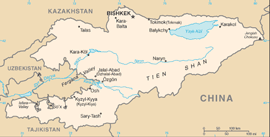
The Kyrgyz Republic
is a source, transit, and to a lesser extent, a destination country for men
and women trafficked from Uzbekistan, Tajikistan, Turkmenistan, and South
Asia for purposes of forced labor and commercial sexual exploitation. Men and
women are trafficked to Kazakhstan and Russia for the purpose of forced labor
in the agricultural, construction, and textile industries. Kyrgyz and foreign
women are trafficked to the U.A.E, Kazakhstan, China, South Korea, Turkey,
Greece, Cyprus, Thailand, Germany, and Syria for commercial sexual
exploitation. The city of Osh is a growing destination for women trafficked
from Uzbekistan for the purpose of commercial sexual exploitation. - U.S.
State Dept Trafficking in Persons Report, June,
2009 Check out a later country report here and possibly a, full TIP Report here |
|||||||||||
|
CAUTION: The following links
have been culled from the web to illuminate the situation in the Kyrgyz
Republic. Some of these links may lead
to websites that present allegations that are unsubstantiated or even
false. No attempt has been made to validate their authenticity or to
verify their content. HOW TO USE THIS WEB-PAGE Students If you are looking
for material to use in a term-paper, you are advised to scan the postings on
this page and others to see which aspects of Human Trafficking are of particular
interest to you. Would you like to
write about Forced-Labor? Debt
Bondage? Prostitution? Forced Begging? Child Soldiers? Sale of Organs? etc. On the other
hand, you might choose to include precursors of trafficking such as poverty and hunger. There is a lot to
the subject of Trafficking. Scan other
countries as well. Draw comparisons
between activity in adjacent countries and/or regions. Meanwhile, check out some of the Term-Paper resources
that are available on-line. Teachers Check out some of
the Resources
for Teachers attached to this website. HELP for Victims International Organization for
Migration ***
FEATURED ARTICLE *** Kyrgyzstan - The
Kidnapped Bride Petr Lom, Frontline
World, March 2004 www.pbs.org/frontlineworld/stories/kyrgyzstan/thestory.html [accessed 17
February 2011] When the bride does
arrive, she is dragged into the groom's house, struggling and crying. Her
name is Norkuz, and it turns out she has been kidnapped from her home about a
mile away. As the women of the
groom's family surround Norkuz and hold down both of her hands, they are at
once forceful and comforting, informing her that they, too, were kidnapped.
The kidnappers insist that they negotiated the abduction with Norkuz's
brother, but her sister, a lawyer from Osh, arrives to protest that her
sister is being forced to marry a stranger. Ideally in Kyrgyz circles, a
bride's family gets a price for their daughter, but Norkuz is 25 --
considered late to marry -- and the women remind her she is lucky she was
kidnapped at all. Preventing Human
Trafficking in Kyrgyzstan Project [PDF] Contributors: Elmira
Shishkaraeva & Galina Gorborukova;
Editor: Amy Heyden, Final
Report, March 5, 2004 Click [here]
to access the article. Its URL is not
displayed because of its length [accessed 10 July
2013] V. CONCLUSIONS - The use of human
beings as collateral in trade deals is a specific type of human trafficking that
exists in the Naryn region of Kyrgyzstan. This type of human trafficking is
related with small enterprises and constitutes informal business guarantees
for trade deals between Kyrgyz and Chinese businesses. Many NGOs and law
enforcement representatives participated in the meetings were inclined to
examine the issue of human collateral as a characteristic of human
trafficking in Kyrgyzstan, although this issue of consent in these deals was
rather controversial. There was a lack of understand of the full definition
of human trafficking and how in these instances, where individuals held as
collateral are denied freedom of movement, have their passports confiscated,
etc., these individuals may be considered victims of human trafficking
regardless of whether or not they consenting to being human collateral. There
does seem to be a decrease in the prevalence of this problem as the tightened
visa regime has made it more difficult to travel to China, but there are
still individuals being held in China who need assistance in being
repatriated to Kyrgyzstan. ***
ARCHIVES *** Trafficked: Three
survivors of human trafficking share their stories Karimova comes full
circle UN Women, 29 July
2019 - originally published on Medium.com/@UN_Women www.unwomen.org/en/news/stories/2019/7/compilation-trafficking-survivors-share-stories [accessed 30 July
2019] But things took a turn
for the worse after arriving in Bishkek. Karimova recalls that, “They held us
in an apartment and took away our passports. They told us that we’d be
photographed again for our new employment documents, to be registered as
waitresses. It felt strange, but we believed them.” Then, Karimova and
the other women were put on a plane to Dubai, handed fake passports instead
of their real ones, and shepherded to an apartment after landing. “We were to
be sex slaves and do whatever the clients wanted. The next day I was sent to
a nightclub and told that I would have to earn at least 10,000 USD by the end
of the month,” says Karimova. 2020 Country
Reports on Human Rights Practices: Kyrgyz Republic U.S. Dept of State Bureau of Democracy, Human Rights, and Labor,
30 March 2021 www.state.gov/reports/2020-country-reports-on-human-rights-practices/
kyrgyzstan/ [accessed 13 June
2021] PROHIBITION OF FORCED
OR COMPULSORY LABOR The law prohibits
all forms of forced or compulsory labor. The law specifically prohibits the
use of force, fraud, or coercion for the purpose of sex or labor exploitation
and prescribes penalties that were sufficient to deter violations. Forced
labor is also prohibited by the labor code and the code on children. The
government did not fully implement legal prohibitions, and victim
identification remained a concern. Forced labor was found in agriculture,
construction, textiles, domestic service, and childcare. PROHIBITION OF CHILD
LABOR AND MINIMUM AGE FOR EMPLOYMENT Child labor
remained a problem. Children continued to be engaged in household-scale work
in cotton and tobacco cultivation; growing rice, potatoes, sugar beets, and wheat;
and raising cattle and sheep. Reports indicated children worked in the
industrial and services sectors as well, in coal mining; brick making; and
construction, including lifting and portering
construction materials and cutting metal sheets for roofs. In the services
sector, children worked in bazaars, including by selling and transporting
goods; washing cars; working in restaurants and cafes; begging and shoe
shining as part of street work; and providing domestic work, including
childcare. Examples of categorical worst forms of child labor in the country
included: commercial sexual exploitation, sometimes as a result of human
trafficking; and illicit activities, including trafficking drugs, as a result
of human trafficking (see section 7.b.). Freedom House
Country Report 2020 Edition freedomhouse.org/country/kyrgyzstan/freedom-world/2020 [accessed 8 July
2020] G4. DO INDIVIDUALS
ENJOY EQUALITY OF OPPORTUNITY AND FREEDOM FROM ECONOMIC EXPLOITATION? The government does
not actively enforce workplace health and safety standards. Child labor is
restricted by law but reportedly occurs, particularly in the agricultural
sector. The trafficking of women and girls into forced prostitution abroad is
a serious problem. Police have been accused of complicity in the trafficking
and exploitation of victims. Kyrgyzstani men are especially vulnerable to
trafficking for forced labor abroad. 2017 Findings on
the Worst Forms of Child Labor Office of Child
Labor, Forced Labor, and Human Trafficking, Bureau of International Labor
Affairs, US Dept of Labor, 2018 www.dol.gov/sites/default/files/documents/ilab/ChildLaborReport_Book.pdf [accessed 18 April
2019] www.dol.gov/sites/dolgov/files/ILAB/child_labor_reports/tda2017/ChildLaborReportBook.pdf [accessed 30 April
2020] Note:: Also check out this country’s report in the more recent edition DOL
Worst Forms of Child Labor [page 590] Hazardous child
labor is most prevalent in the oblasts (provinces) of Naryn
and Osh. (16) There is limited evidence that some children migrate with their
families to work in the cotton fields in Kazakhstan. (24) Some children left
behind, after their parents migrate to work in Kazakhstan, Russia, or other
areas of the country, do not have access to their birth certificates and
guardianship documents that are required for school enrolment. As a result,
these children cannot enroll in school and are vulnerable to the worst forms
of child labor. (6; 13; 25). Kyrgyz Police Halt
Flight To U.A.E. On Trafficking Suspicion February 2006 www.hri.org/news/balkans/rferl/2006/06-02-16.rferl.html#21 [accessed 17
February 2011] One, a resident of Samarkand,
said that she was traveling to work in a restaurant in Dubai. But another
woman, a 17-year-old from Ferghana, said that she was going to the U.A.E. to
work as a prostitute. The woman cited a lack of alternative employment
opportunities in Uzbekistan as the reasons for her decision. Kyrgyzstan
struggles to stop slave trade Aigul Rasulova,
Eurasianet, June 28, 2004 www.eurasianet.org/departments/rights/articles/eav062904.shtml [accessed 17
February 2011] godswordtowomen.org/kyrgyzstan.htm [accessed 4 February
2018] Seventeen-year-old
Olga only wanted a job. Instead, lured to China with the promise of work in a
restaurant, this Kyrgyzstani teenager found herself sold into a prostitution
ring. "If we refused
to work as prostitutes, the owner threatened to punish us," Olga said.
With no money and no passports, Olga and five other girls from Kyrgyzstan
were held in bondage for a month. In the end, alerted by concerned parents, a
joint Interpol operation with officers from Kyrgyzstan, Kazakhstan and China
located the girls and set them free. Facts & Stats Frontline World,
March 2004 www.pbs.org/frontlineworld/stories/kyrgyzstan/facts.html#05 [accessed 17
February 2011] WOMEN AND BRIDE
KIDNAPPING IN KYRGYZSTAN - Though it remains illegal in the Kyrgyz
Republic, the frequency of kidnappings appears to have risen after
independence and continues to be on the rise as an element of the reclamation
of Kyrgyz identity after Soviet rule. There is little evidence that
violations of the law against kidnapping are punished. Bride kidnappings
reportedly range from staged, consensual events that are planned after the
bride and groom have been dating to violent, nonconsensual events planned by
the family of the groom. It's been
estimated that up to a third of all ethnic Kyrgyz women in Kyrgyzstan may
have been wedded in nonconsensual bride kidnappings. Bride Kidnapping:
What Makes Women Stay Abdulaeva Shirin,
Arjomand Victoria, Tursunov Nariman,
30 June 2004 faculty.philau.edu/kleinbachr/why_women_stay.htm [accessed 17
February 2011] www.rferl.org/a/bride-kidnapping-in-kyrgyzstan/25403604.html [accessed 12
February 2019] RESULTS - On the basis of
our interviews, out of the six people interviewed, four of them had been
divorced within the first few years of their abduction. One committed suicide
and only one is still with her husband.
In all of these cases, the women were made to stay with their
abductors due to pressure from their
families and the fear of being ostracized from society if they returned, and
not being able to find a husband. In one case the woman said that when she
was abducted her first thought was that she was going to be killed, so when
she found out that instead she was going to be married she gladly accepted
this ‘better option’ New passport to
help combat human trafficking UN Integrated
Regional Information Networks IRIN www.irinnews.org/report/24471/kyrgyzstan-new-passport-to-help-combat-human-trafficking [accessed 9 March
2015] The old Kyrgyz
passport is not in compliance with international standards, a fact the
authorities feel could contribute to human trafficking and terrorist
activities, and threaten national security. There have been some unconfirmed
reports that human traffickers fly their Uzbek and Tajik victims via the
southern Kyrgyz city of Osh to the United Arab Emirates, Turkey and other
countries using forged Kyrgyz passports, something deemed impossible with the
use of new travel documents, experts say. Widespread Human
Rights Abuses Undermine Kyrgyz Mental Health Care Eurasianet , May 6,
2004 www.eurasianet.org/departments/rights/articles/eav050704.shtml [accessed 17
February 2011] eng.gateway.kg/news/kyrgyzstan/2527 [accessed 12
February 2019] At both Chim-Korgon and the Republican Mental Health Clinic,
forced labor occurs in violation of both the Kyrgyz Constitution and
international law. Neither hospital pays patients for their work. At RMHC,
patients take part in so-called "labor therapy" to improve hospital
grounds. At Chim-Kogron, patients work the hospital’s vegetable fields to
diversify their diet. "If a patient wishes to have a diet that consists
of anything substantially more than bread, pasta, or tea, he or she must work
for this food," the report states. Yet only patients who have
demonstrated good behavior and a stable psychiatric condition have access to
the food. CENTRAL ASIA:
Special report on human trafficking UN Integrated
Regional Information Networks IRIN, Ankara, 21 Oct 2003 www.irinnews.org/report/20782/central-asia-special-report-on-human-trafficking [accessed 9 March
2015] GROWING PROBLEM - "We
conducted some research in the year 2000 in [the Kyrgyz capital] Bishkek,
which concluded that some 4,000 women a year were trafficked from the Kyrgyz
Republic. But this might include some women with a varying degree of consent.
It might include some women who are working in the sex industry, but not as
trafficking victims," Michael Tschanz, the IOM chief of mission in
Almaty, told IRIN. Preventing Human
Trafficking Project in Kyrgyzstan Winrock
International, 08/07/2010 faculty.philau.edu/kleinbachr/organizations.htm [accessed 17
February 2011] pdf.usaid.gov/pdf_docs/Pnadf478.pdf [accessed 4 February
2018] [scroll down] In fall 2003,
Winrock International began a two-year project to prevent human trafficking
in Kyrgyzstan with support from the US Agency for International Development
(USAID). The purpose of the “Preventing Human Trafficking Project” (PHT) is
to increase the ability of individuals and institutions in Kyrgyzstan to
combat human trafficking. Winrock’s
project has the following two objectives: - To contribute to the
prevention of human trafficking by strengthening the capacity of local NGOs
both to conduct public outreach and to provide relevant training on
legitimate alternatives to offers of work abroad; - To contribute
to the protection of victims of human trafficking through development of
appropriate victim assistance services. The UN Link - The
United Nations System in Kyrgyzstan dev.un.org.kg/english/unlink.phtml?174#5 [access
date unavailable] INTERNATIONAL
ORGANIZATION FOR MIGRATION - Poverty and lack of economic
opportunities are the main core of smuggling of and trafficking in human
beings. These factors encourage women and men to seek work abroad, in
situations where perhaps they might not otherwise do so. Methods of
recruitment in the Kyrgyz Republic are similar to other parts of the world.
Newspaper advertisements, tourist firms, friends or acquaintances, and the
Internet are key instruments in the effective organized recruitment of women,
girls and, recently, young men into forced labor, and often into sexual
exploitation. The experience of the International Organization for Migration
shows that women from province are potential victims of trafficking, since
they have more limited access to information. A promise of better life abroad
attracts them to go there. Women are enticed by false promises of highly paid
work, nice housing and good labor conditions in the United Arab Emirates or
South Korea. Cultural factors and lack of relevant legislation pose obstacles
for female victims to pursue traffickers; accountability within some
government structures demand attention to the legal environment for
prosecution of traffickers. Rights
of the Child in Kyrgyzstan [PDF] Ramazan Dyryldaev
and Séverine Jacomy, The Kyrgyz Committee for Human Rights -- A report
prepared for the Committee on the Rights of Child, Geneva, February 2004 www.omct.org/files/2005/09/3074/report_children_kyrgyzstan_eng.pdf [accessed 28 January
2016] C. SEXUAL ABUSE, TRAFFICKING AND SEXUAL
EXPLOITATION
- Several sources report a growing trend of selling or “handing over” of
girls by their own parents. These girls are most vulnerable to near slavery
and sexual abuse in early marriage and/or to prostitution and trafficking.
Both IWPR and IOM/OSCE reports confirm local estimates that Kyrgyzstan
has become a lead country in trafficking of minors for sexual purposes, the
United Arab Emirates and Turkey being the main countries of destination. For instance,
Vecherniy Bishkek reported the case of two girls, Alina, 17 years old, and
Dinara, 15 years old, who managed to escape from a brothel before they were
transported to UAE . Alina reported that in early October 2003, around 4
p.m., she was approached by two unknown young men at a mini-market in
Jalal-Abad. Under some false pretext they took her to a solitary room, and
one of them knocked her unconscious with a heavy object. When she recovered
she found herself lying on a sofa in a strange room, with another girl who
was in tears. They were kept for several days under guard in the same flat,
then taken in a car to Bishkek located 600 km away from Jalal-Abad. Throughout
the trip they were tied up, with Scotch tape put over their mouths. Several
times the car was stopped at police posts, but the traffickers paid ransom
and drove on. In Bishkek the girls were kept in a one-room flat. Potential
buyers were arriving daily to bargain and examine the
"merchandise". In order to break their will the kidnappers would
beat the girls; they took away all their clothes and jewellery. They demanded
that the girls "work" to compensate the costs of carrying them to
Bishkek. During the weeks in slavery the girls "changed hands"
several times: "First we were bought by Mavlyuda, then resold to Ainura.
Finally, when the guards' attention lapsed we escaped from that flat."
But many others were not so lucky. According to various NGOs and public
opinion polls, human traffickers in Kyrgyzstan have sold or involved in
prostitution more than 4,000 women, many of them still underage. Even when pimping
and trafficking networks are uncovered, IWPR official interviewees argue that
law enforcement remains the central problem. “For Kubanych Kudaiberdiev, a
captain in the Kyrgyz police force, building a credible case is the problem.
“It is hard to prove that a girl is a prostitute,” he said. “ To do that, we
need to see the actual monetary transaction take place, or get a statement
from the client. In theory, that may sound quite realistic, but I have never
seen it in all my experience.” Lieutenant-Colonel Musuralieva says the
challenge is not catching the criminals, but getting a prosecution through the
courts successfully when the criminals may have friends in high places. Her
juvenile affairs department regularly teams up with criminal investigation
officers to conduct raids, codenamed “Butterfly”, to catch both prostitutes
and their pimps. “We keep on uncovering these case, but we’re unable to bring
them to their logical conclusion,” she said. “For instance, two cases were
filed against pimps this year, but both were dropped. They got help from
people higher up, and the cases were closed. It’s likely that these pimps
have got backing from some of our high-ranking [police] officers. I’m not
afraid to say so.” But even when cases do go to court, defendants can often
afford good lawyers while the child prostitutes have no one prepared to take
the witness stand for them. If they have parents or relatives, these will
often refuse to testify against the pimps. Concluding
Observations of the Committee on the Rights of the Child (CRC) UN Convention on the
Rights of the Child, 1 October 2004 www1.umn.edu/humanrts/crc/kyrgyzstan2004.html [accessed 17
February 2011] [61]
The Committee is concerned that the recommendations made upon consideration
of the State party’s initial report with regard to the involvement of
children in sexual exploitation have not been fully implemented. The
Committee is also concerned about the health risks posed to children who are
sexually exploited and/or trafficked. Human Rights
Overview Human Rights Watch www.hrw.org/europecentral-asia/kyrgyzstan [accessed 17
February 2011] ***
EARLIER EDITIONS OF SOME OF THE ABOVE *** Human Rights
Reports » 2005 Country Reports on Human Rights Practices U.S. Dept of State Bureau of Democracy, Human Rights, and
Labor, March 8, 2006 2009-2017.state.gov/j/drl/rls/hrrpt/2005/61657.htm [accessed 9 February
2020] TRAFFICKING
IN PERSONS
– Groups targeted by traffickers included young women unable to earn an
adequate living. Poor economic conditions, high unemployment--particularly in
the south--and gender inequality made young women and poor workers vulnerable
to traffickers who offered lucrative jobs or marriage offers to rich men
abroad. The IOM estimated approximately 70 percent of trafficking victims
were from the south. Often women were lured abroad via newspaper
advertisements or even announcements over loudspeakers in local bazaars.
Women responding to job offers for waitresses, au pairs, or dancers, or to
marriage agencies could find themselves abroad without documents or money for
return tickets and forced to work for their traffickers. Traffickers were
often persons who previously operated local prostitution networks. Relatives
or close family friends were also reportedly used to recruit trafficking
victims. Tour agents, restaurants, and nightclubs supplemented their
activities by trafficking young women to foreign prostitution rings.
Traffickers of persons for sexual exploitation included organized crime rings
that often used former trafficking victims as recruiters. In some cases
traffickers provided escorts, usually an older woman, to accompany victims
and facilitate border crossings into countries such as the UAE, where young
women were generally not allowed to enter alone. Labor trafficking was much
less organized and often involved self-employed recruiters who simply loaded
persons onto buses and transported them to the country for work on farms, as
well as labor recruitment firms The Department of
Labor’s 2004 Findings on the Worst Forms of Child Labor U.S. Dept of Labor Bureau of International Labor Affairs, 2005 www.dol.gov/ilab/media/reports/iclp/tda2004/kyrgyz-republic.htm [accessed 29
November 2010] Note:: Also check out this country’s report in the more recent edition DOL
Worst Forms of Child Labor INCIDENCE
AND NATURE OF CHILD LABOR - Children are reported to work as prostitutes in
urban areas throughout the country.
The Kyrgyz Republic is considered to be primarily a country of origin
and transit for the trafficking of children. While the extent of the
problem is unknown, there are reports of girls trafficked for prostitution to
the United Arab Emirates, Turkey, and South Korea. The IOM reported girls as young as 10 years
old are trafficked abroad. fair use exception of 17 USC § 107 for noncommercial, nonprofit, and
educational use. PLEASE RESPECT
COPYRIGHTS OF COMPONENT ARTICLES. Cite this
webpage as: Patt, Prof. Martin, "Human Trafficking & Modern-day
Slavery – Kyrgyz Republic", http://gvnet.com/humantrafficking/KyrgyzRepublic.htm,
[accessed <date>] |