Human Trafficking & Modern-day Slavery Poverty drives the unsuspecting poor into the
hands of traffickers Published reports & articles
from 2000 to 2025 gvnet.com/humantrafficking/EquatorialGuinea.htm
Equatorial Guinea
has been primarily a destination for children trafficked for the purposes of
forced labor and possibly for the purpose of sexual exploitation. Children
are believed to be trafficked from nearby countries, primarily Nigeria,
Benin, Cameroon, and Gabon for domestic servitude, market labor, ambulant
vending, and other forms of forced labor, such as carrying water and washing
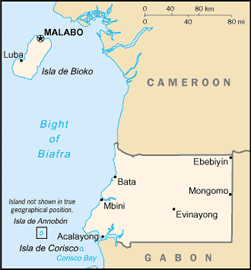
laundry. Most victims are believed to be trafficked to Malabo and Bata, where
a burgeoning oil industry created demand for labor and commercial
exploitation. - U.S. State Dept
Trafficking in Persons Report, June, 2009 Check
out a later country report here or a full TIP Report here |
|
|||||||||||
|
CAUTION: The following
links have been culled from the web to illuminate the situation in HOW TO USE THIS WEB-PAGE Students If you are looking
for material to use in a term-paper, you are advised to scan the postings on
this page and others to see which aspects of Human Trafficking are of
particular interest to you. Would you
like to write about Forced-Labor? Debt
Bondage? Prostitution? Forced Begging? Child Soldiers? Sale of Organs? etc. On the other
hand, you might choose to include precursors of trafficking such as poverty and hunger. There is a lot to
the subject of Trafficking. Scan other
countries as well. Draw comparisons
between activity in adjacent countries and/or regions. Meanwhile, check out some of the Term-Paper resources
that are available on-line. Teachers Check out some of
the Resources
for Teachers attached to this website. ***
FEATURED ARTICLE *** Child Labor
Increasing in Equatorial Guinea afrol News (African News
Agency), 21 November 2000 At one time this
article had been archived and may possibly still be accessible [here] [accessed 13 June
2013] According to a
report released today by the Global March Against Child Labour documenting
child labour all over the world, there is no escape for children suffering
the "worst forms of child labour" in ***
ARCHIVES *** 2020 Country
Reports on Human Rights Practices: Equatorial Guinea U.S. Dept of State Bureau of Democracy, Human Rights, and
Labor, 30 March 2021 www.state.gov/reports/2020-country-reports-on-human-rights-practices/equatorial-guinea/
[accessed 6 June
2021] PROHIBITION OF
FORCED OR COMPULSORY LABOR The law prohibits
forced or compulsory labor. The Ministry of Labor and Social Security
conducted numerous workplace inspections to verify adherence to laws on
forced labor. Despite creating an online tool and telephone numbers to report
cases of forced labor and promoting its efforts online, the government did
not effectively enforce the law or take sufficient action on ending slavery,
and forced labor occurred. Penalties were commensurate with those for other
analogous serious crimes and are included in the law against trafficking in
persons. Employees in the
public and private sector were often paid months late. Some workers,
especially those from overseas, quit their jobs because of nonpayment, having
effectively worked for months without compensation. PROHIBITION OF CHILD
LABOR AND MINIMUM AGE FOR EMPLOYMENT Children were
reportedly transported from nearby countries–primarily Nigeria, Benin,
Cameroon, Togo, and Gabon–and forced to work as domestics, market laborers,
ambulant vendors, launderers, and beggars. Increasingly there were reports of
local children brought from rural areas to work as domestic servants in
Malabo and Bata. The government occasionally provided social services on an
ad hoc basis to children found working in markets. Freedom House
Country Report 2020 Edition freedomhouse.org/country/equatorial-guinea/freedom-world/2020 [accessed 27 April
2020] G4. DO INDIVIDUALS
ENJOY EQUALITY OF OPPORTUNITY AND FREEDOM FROM ECONOMIC EXPLOITATION? Foreign workers in
the oil and construction industries are subject to passport confiscation and
forced labor. Equatoguineans are also vulnerable to forced labor, including
in the sex trade. Corrupt officials are often complicit in human trafficking,
according to the US State Department. A Study on Human
Trafficking for Sexual Exploitation within th Gulf
of Guinea countries James Okolie-Osemene PhD, Department of International Relations
and the Director of Research and Linkage Programme,
Wellspring University, Nigeria [Long URL] [accessed 14
February 2022] The objectives of
this study are to situate and examine the context, nature and networks of
human trafficking for sexual exploitation around the Gulf of Guinea in order
to identify the intersection between the sources, transit and destinations of
the illicit trade, interrogate the human rights implications of human
trafficking for sexual exploitation around the countries of the Gulf of
Guinea on the one hand, and the strengths, weaknesses, opportunities and
threats to the anti-trafficking activities on the other hand. Equatorial Guinea
reporting to the Committee on the Rights of the Child (CRC) – 2005 www.againstsexualexploitation.org/news/?sec=crc-op1&lang=all&nav=&id=2005/06/29/10&iwithSession=fa511d42929534855d2d224e4c1244b4 [access date
unavailable] SEXUAL TRAFFICKING - The Committee
noted that sexual violence and trafficking has been reported in Child Trafficking a
Major Problem in Africa, Report Finds Tara Boyle,
Washington File Staff Writer, U.S. Department of State's Bureau of International
Information Programs, 15 June 2004 iipdigital.usembassy.gov/st/english/article/2004/06/20040616122720ntelyob0.1459162.html#axzz3Cqb9P0ZP [accessed 9
September 2014] www.africaspeaks.com/reasoning/index.php?topic=1935.0;wap2 [accessed 28 January
2018] Three nations in
sub-Saharan Africa -- Equatorial Guinea, Sierra Leone, and Sudan -- received
a "Tier Three" or least favorable ranking in the report for failing
to make reasonable attempts to end the exploitation of minors. In The Department of Labor’s 2004 Findings on
the Worst Forms of Child Labor www.dol.gov/ilab/media/reports/iclp/tda2004/equatorial-guinea.htm [accessed 3 February
2011] Note:: Also check out this country’s report in the more recent edition DOL
Worst Forms of Child Labor INCIDENCE
AND NATURE OF CHILD LABOR - Children are trafficked to Equatorial Guinea from
other countries in West and Central Africa, particularly Cameroon, Nigeria,
and Benin. Girls are trafficked for commercial sexual exploitation and
domestic servitude, while boys are forced to work as farmhands and street
hawkers. Boys trafficked from Concluding
Observations Of The Committee On The Rights Of The Child (CRC) UN Convention on the
Rights of the Child, 3 November 2004 www1.umn.edu/humanrts/crc/guinea2004.html [accessed 3 February
2011] [56] The Committee
welcomes the State party’s ratification of ILO Conventions No. 138 and No.
182 in 2001 and takes note of the adoption in 2004 of the new law against
smuggling of migrants and trafficking in persons. Nevertheless, it remains
concerned at the significant number of children, especially girls, working on
the street and as domestic servants and about the lack of effective
implementation of the labor laws and mechanisms to control child labor. [58] The Committee
is concerned at the growing number of child prostitutes in the streets of the
State party’s capital. It is also concerned that the State party’s report lacks
specific data on sexual exploitation and trafficking of children and
information on legislation on sexual exploitation. The Protection
Project - Equatorial Guinea [DOC] The www.protectionproject.org/human_rights_reports/report_documents/equatorial.doc [Last accessed 2009] FORMS OF TRAFFICKING
-
Eighty-nine percent of African countries are affected by trafficking flows to
and from other countries in ***
EARLIER EDITIONS OF SOME OF THE ABOVE *** 2017 Country
Reports on Human Rights Practices U.S. Dept of State Bureau of Democracy, Human Rights, and
Labor, 20 April 2018 www.state.gov/j/drl/rls/hrrpt/2017/af/276995.htm
accessed 22 March
2019] www.state.gov/reports/2017-country-reports-on-human-rights-practices/equatorial-guinea/ accessed 26 June
2019] PROHIBITION OF
FORCED OR COMPULSORY LABOR Forced labor
occurred. Men and women from Cameroon, Benin, and other neighboring
countries, as well as from the Dominican Republic and Cuba, were recruited
for work, and some were subsequently subjected to forced labor. Often they
were not compensated as agreed upon, and their passports were confiscated. In
one publicized case, a high-level member of the president’s cabinet severely
beat an employee of one of his private businesses when she demanded payment.
He then returned her passport and forced her to leave the country. Another
employer attracted foreign workers by falsely promising to provide them with
employment contracts necessary for obtaining work permits. When workers
resigned to take other, more secure jobs, the employer contacted police to
have the workers deported, which would have occurred if the new employers had
not intervened to prevent deportation. Companies in the
construction sector, among others, held the passports of their foreign
workers, a possible indication of forced labor PROHIBITION OF CHILD
LABOR AND MINIMUM AGE FOR EMPLOYMENT The law was not
effectively enforced, and penalties were not sufficient to deter violations.
Children were transported from nearby countries--primarily Nigeria, Benin,
Cameroon, Togo, and Gabon--and forced to work as domestic workers, market
laborers, ambulant vendors, launderers, and beggars. The government
occasionally provided social services on an ad hoc basis to children found
working in markets. Attention to school attendance generally focused more on
citizen children than on their foreign peers. Human Rights
Reports » 2005 Country Reports on Human Rights Practices 2009-2017.state.gov/j/drl/rls/hrrpt/2005/61567.htm [accessed 8 February
2020] TRAFFICKING
IN PERSONS
–Trafficking victims had no access to health care; they generally worked on
the streets or in agriculture. Traffickers took
advantage of the African tradition of placing children with relatives or
friends in other regions or countries to advance the children's and the
family's academic and economic prospects. Many parents throughout West and All
material used herein reproduced under the fair use exception of 17 USC § 107
for noncommercial, nonprofit, and educational use. PLEASE RESPECT COPYRIGHTS OF COMPONENT
ARTICLES. Cite this
webpage as: Patt, Prof. Martin, "Human Trafficking & Modern-day
Slavery - |
||||||||||||