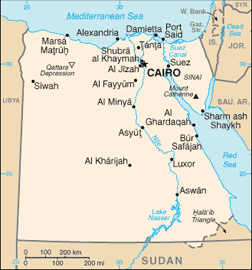
Human Trafficking & Modern-day Slavery Poverty drives the unsuspecting poor into the
hands of traffickers Published reports & articles from 2000 to 2025 gvnet.com/humantrafficking/Egypt.htm
Egypt is a source,
transit, and destination country for women and children trafficked for the
purposes of forced labor and sexual exploitation. Some of Egypt’s estimated
one million street children – both boys and girls – are exploited in
prostitution and forced begging. Local gangs are, at times, involved in this
exploitation. Egyptian children are recruited for domestic and agricultural
labor; some of these children face conditions indicative of involuntary
servitude, such as restrictions on movement, non-payment of wages, threats,
and physical or sexual abuse. - U.S.
State Dept Trafficking in Persons Report, June 2009 Check
out a later country report here or a full TIP Re Report here |
|
|||||||||||
|
CAUTION: The following
links have been culled from the web to illuminate the situation in HOW TO USE THIS WEB-PAGE Students If you are looking
for material to use in a term-paper, you are advised to scan the postings on
this page and others to see which aspects of Human Trafficking are of
particular interest to you. Would you
like to write about Forced-Labor? Debt
Bondage? Prostitution? Forced Begging? Child Soldiers? Sale of Organs? etc. On the other
hand, you might choose to include precursors of trafficking such as poverty and hunger. There is a lot to
the subject of Trafficking. Scan other
countries as well. Draw comparisons
between activity in adjacent countries and/or regions. Meanwhile, check out some of the Term-Paper resources
that are available on-line. Teachers Check out some of
the Resources
for Teachers attached to this website. HELP for Victims National Council for Childhood and Motherhood ***
FEATURED ARTICLE *** Underage And
Unprotected: Child Labor In Egypt's Cotton Fields Human Rights Watch
Reports, www.hrw.org/reports/2001/egypt/Egypt01.htm#P46_655 [accessed 3 February
2011] SUMMARY - Each year over
one million children between the ages of seven and twelve are hired by ‘Summer Brides’:
Under-age daughters sold as ‘sex-slaves’ in Egypt, report claims Al Arabiya News, 15
July 2012 english.alarabiya.net/articles/2012/07/15/226546.html [accessed 16 July 2012] www.ipsnews.net/2013/08/underage-girls-are-egypts-summer-rentals/ [accessed 2 February
2019] Egypt has laws in
place that aim to combat human trafficking which prevent foreigners from
marrying an Egyptian woman if there is more than ten years age difference,
but marriage brokers have found a way around that by forging birth
certificates to make the girls appear older and the men younger. These contracts also eliminate any
potential problems with hotels and land lords who may demand to see proof of
marriage before allowing a couple to stay in a room together, since
pre-marital sex is prohibited in Islam. In some cases the
men take the Egyptian girls back to their home country to work as maids for
their first wives. But even the girls who stay in Egypt do not fare much
better since they often become ostracized by society and find it difficult to
re-marry in the traditional way, particularly if the “summer marriage” resulted
in a child. Many abandon the
child out of shame, either to orphanages or leaving them to join the hundreds
of thousands of street children that already exist in Egypt. Dr. Hoda Badran, who chairs the NGO Alliance for Arab Women,
explained to the Sunday Independent that poverty is the main factor behind
this phenomenon. ***
ARCHIVES *** 2020 Country
Reports on Human Rights Practices: Egypt U.S. Dept of State Bureau of Democracy, Human Rights, and
Labor, 30 March 2021 www.state.gov/reports/2020-country-reports-on-human-rights-practices/egypt/
[accessed 6 June
2021] PROHIBITION OF
FORCED OR COMPULSORY LABOR The constitution
states no work may be compulsory except by virtue of a law. The government
did not effectively enforce the prohibition but conducted awareness raising
activities such as distributing antitrafficking
informational booklets to migrant laborers, and the NCW conducted a media
campaign regarding the treatment of domestic workers, a population vulnerable
to trafficking, and worked with NGOs to provide some assistance to victims of
human trafficking, including forced labor. Penalties for forced labor and
trafficking were less severe than for other analogous crimes, such as
kidnapping. PROHIBITION OF CHILD
LABOR AND MINIMUM AGE FOR EMPLOYMENT Child labor
occurred, although estimates on the number of child laborers varied.
According to the 2012 joint International Labor Organization and Central
Agency for Public Mobilization and Statistics child labor survey, of the 1.8
million children working, 1.6 million were engaged in hazardous or unlawful
forms of labor, primarily in the agricultural sector in rural areas but also
in domestic work and factories in urban areas, often under hazardous
conditions. Children also worked in light industry, the aluminum industry,
construction sites, brick production, and service businesses such as auto
repair. According to government, NGO, and media reports, the number of street
children in Cairo continued to increase in the face of deteriorating economic
conditions. Such children were at greater risk of sexual exploitation or
forced begging. In some cases employers abused or overworked children.
Children also worked in the production of limestone. Freedom House
Country Report 2020 Edition freedomhouse.org/country/egypt/freedom-world/2020 [accessed 27 April
2020] G4. DO INDIVIDUALS
ENJOY EQUALITY OF OPPORTUNITY AND FREEDOM FROM ECONOMIC EXPLOITATION? Egyptian women and
children, migrants from sub-Saharan Africa and Asia, and Syrian refugees are
vulnerable to forced labor and sex trafficking in Egypt. The Egyptian
authorities routinely punish individuals for offenses that stemmed directly
from their circumstances as trafficking victims. Military conscripts are
exploited as cheap labor to work on military- or state-affiliated development
projects. An economic reform
program developed with the International Monetary Fund has caused acute
hardship for many Egyptians since 2016, increasing their susceptibility to
exploitative labor conditions and highlighting inequities in access to
opportunity. However, beginning in February 2019 the government restored two
million people to its food subsidy program, and domestic fuel prices were
lowered in October. 2017 Findings on
the Worst Forms of Child Labor Office of Child
Labor, Forced Labor, and Human Trafficking, Bureau of International Labor
Affairs, US Dept of Labor, 2018 www.dol.gov/sites/default/files/documents/ilab/ChildLaborReport_Book.pdf [accessed 17 April
2019] www.dol.gov/sites/dolgov/files/ILAB/child_labor_reports/tda2017/ChildLaborReportBook.pdf [accessed 27 April
2020] Note:: Also check out this country’s report in the more recent edition DOL
Worst Forms of Child Labor [page 379] Some girls are
subjected to commercial sexual exploitation under the pretext of temporary
marriage to wealthy foreign men, mostly from Persian Gulf countries. (4; 5;
28) Some Egyptian children are trafficked to Italy, and although the number
of arrivals decreased significantly in 2017, Egyptian children continue to be
used for bonded child labor, commercial sexual exploitation, and illicit
activities in Italy. (30; 31; 32; 33; 34; 4; 11; 35). Sisi,
crack down on mass murder, torture in Sinai! Seth J. Frantzman,
Jerusalem Post, 22 June 2014 www.jpost.com/Opinion/Columnists/Sisi-crack-down-on-mass-murder-torture-in-Sinai-360204 [accessed 22 June
2014] The accounts are so
shocking, the more one reads the more one becomes numb. “The kidnappers would
make me lie on my back and then they would get me to ring my family to ask
them to pay the ransom they wanted,” 17-year-old Lamlam from Eritrea told the
BBC in March last year. “As soon as one of my parents answered the phone, the
men would melt flaming plastic over my back and inner thighs and I would
scream and scream in pain.” Another man recalled, “They had about four of
five of us tied up together and they would pour water on the floor and then
electrocute the water so that all of us would get electrocuted at the same
time.” He saw 20 people die. These stories are the tip of the iceberg of a
torture and mass murder industry in the Sinai peninsula that is part of a
network that spans across the Sahara and into Sudan, in which Beduin and
Somali smugglers lure Africans into camps and torture them for ransoms of up
to $30,000. Back in 2011, a
Physicians for Human Rights report found through interviews that 59 percent
of the Africans traversing the Sinai Peninsula had been chained or locked up,
52% had suffered abuse and 44% had witnessed violence and murder. A survivor
told Corriera Dela Serra that “many of the women have been ferociously and
repeatedly raped by Beduin who kept them in captivity in Sinai.” A
33-year-old man named Temesghen told doctors, “they threatened us: ‘if you
don’t pay we’re going to take your organs.’” People were chained up for over
six months; they were kept inside water tankers, in the hot and boiling sun;
the women among them raped everyday. And many of them were murdered. Organ trafficking
on the rise in Egypt, says new report Sarah Sheffer, Bikya
Masr (Egyptian: resellable clutter), www.masress.com/en/bikyamasr/50684 [accessed 13 June
2013] A shocking new
report by the Coalition for Organ Failure Solutions (COFS) Egypt indicates
that organ trafficking is on the rise in the country, as traffickers continue
to target Sudanese refugees and other asylum seekers in the nation. According to the report, entitled
"Sudanese Victims of Organ Trafficking in COFS estimates that
there are thousands of victims of organ trafficking in Child maids now
being exported to US Associated Press AP,
December 28, 2008 www.huffingtonpost.com/2008/12/28/child-maid-trafficking-sp_n_153814.html [accessed 1
September 2014] www.cleveland.com/world/index.ssf/2008/12/child_house_maids_now_being_ex.html [accessed 17
September 2016] Shyima was 10 when
a wealthy Egyptian couple brought her from a poor village in northern Egypt
to work in their California home. She awoke before dawn and often worked past
midnight to iron their clothes, mop the marble floors and dust the family's
crystal. She earned $45 a month working up to 20 hours a day. She had no
breaks during the day and no days off. Once behind the
walls of gated communities like this one, these children never go to school.
Unbeknownst to their neighbors, they live as modern-day slaves, just like
Shyima, whose story is pieced together through court records, police
transcripts and interviews. Shyima cried when
she found out she was going to America in 2000. Her father, a bricklayer, had
fallen ill a few years earlier, so her mother found a maid recruiter, signed
a contract effectively leasing her daughter to the couple for 10 years and
told Shyima to be strong. She arrived at Los
Angeles International Airport on Aug. 3, 2000, according to court documents.
The family brought her back to their spacious five-bedroom, two-story home, decorated
in the style of a Tuscan villa with a fountain of two angels spouting water
through a conch. She was told to sleep in the garage. It had no windows and was neither heated
nor air-conditioned. Soon after she arrived, the garage's only light bulb went
out. The Ibrahims didn't replace it. From then on, Shyima lived in the
dark. She was told to call them
Madame Amal and Hajj Nasser, terms of respect. They called her
"shaghala," or servant. Their five children called her
"stupid." Human trafficking:
the case of Egypt Ahmed Maged, Daily
News www.masress.com/en/dailynews/114081 [accessed 1
September 2014] THE SITUATION IN Picking on cotton Gamal Nkrumah,
Al-Ahram Weekly, Issue No. 905, 10 -
16 July 2008 www.global-sisterhood-network.org/content/view/2166/76/ [accessed 23 January
2016] www.dol.gov/sites/dolgov/files/ILAB/child_labor_reports/tda2009/egypt.pdf [accessed 27 April
2020] Not only do
landless peasants earn a pittance working the land, but they are subjected to
abuse, and no group more so than the children, the
most vulnerable members of society. Foremen in the fields subject the
children to violent beatings. Gangmasters recruit the children, invariably
the offspring of landless peasants and impoverished peasant families. The
parents of the child labourers are desperately poor and are often all too
relieved to part with their children. In the final analysis, farming out
one's children as indentured labourers mean fewer mouths to feed. In The www.jpost.com/MiddleEast/Article.aspx?id=97097 [accessed 3 February
2011] www.jpost.com/Middle-East/In-Egypt-child-workers-a-growing-problem-as-food-prices-rise [accessed 23 January
2018] Each day,
14-year-old Ali Abdel-Nasser works at a brick factory on the outskirts of
Cairo, loading a donkey cart with new bricks to be taken to a nearby furnace
to dry. He has worked at the plant almost every day the last four years,
since age 10 when his father died.
Responsible for a family of seven, the boy is bitter that even the
donkeys at the factory get more time off than he does. Several of the
child workers in the area, interviewed by an Associated Press reporter on a
recent trip, said they had sometimes been beaten with wooden switches by
foremen at the factories, if the foremen thought the children were going too
slowly in their work. No foremen would
agree to be interviewed. But human rights groups and outside experts say
conditions for working children can vary greatly across Egypt — from
factories that provide meals and some basic schooling, to those that work
children long hours, often in scorching heat, and abuse or beat them. Organ trafficking:
a fast-expanding black market IHS Jane's, 05 March
2008 www.traffickingproject.org/2008/03/organ-trafficking-fast-expanding-black.html [accessed 26 June
2013] [accessed 27 April
2020] China, India,
Pakistan, Egypt, Brazil, the
Philippines, Moldova, and Romania are among the world's leading providers of
trafficked organs. If China is known for harvesting and selling organs from
executed prisoners, the other countries have been dealing essentially with
living donors, becoming stakeholders in the fast-growing human trafficking
web. NGOs warn against
plan to increase Russian visas Ruth Eglash, The www.jpost.com/servlet/Satellite?cid=1192380635370&pagename=JPost%2FJPArticle%2FShowFull At one time this
article had been archived and may possibly still be accessible [here] However, Egyptian
Journalists Trained to Report on Child Labor Issues Internews Arabic
Network, April 14, 2004 www.internews.org/news/2004/20040414_egypt.html At one time this
article had been archived and may possibly still be accessible [here] Internews Arabic
Network held a training session in Liberian court
tries Egyptian woman for child trafficking www.angolapress-angop.ao/noticia-e.asp?ID=262519 At one time this
article had been archived and may possibly still be accessible [here]
The Criminal Court
in Little Hands Do
Neat Work Joanne McEwan, Islam
Online, 11/06/2001 www.islamonline.net/english/Society/2001/06/article6.shtml At one time this
article had been archived and may possibly still be accessible [here] It is estimated
that around 1.2 million children swarm the Egyptian cotton fields in early
summer (Schemm, p.8). Most of them are below 12 years of age and work up to
11 hours each day, thus impeaching Egypt's laws that state that a child of 12
(the minimum working age) can only participate in a six hour work day of
seasonal agricultural work. Children not only toil under the hot sun, but are
beaten by the foreman and forced to work in fields that have been sprayed
with pesticides only pesticides only 24 - 48 hours earlier. Yet these
children play an important role in the labor intensive cotton fields…being
ideal in height and plentiful in number. Child Labor Douglas Jehl,
"King Cotton Exacts Tragic Toll From [accessed 27 April
2020] In Egypt, education
is supposed to be compulsory to the age of 15, but thousands of children as
young as age six pick cotton by hand in September for about $1.50 for an
eight-hour day. In September 1997, 31 children were killed when the flatbed
government truck taking them to a government-owned cotton field overturned.
Egyptian law prohibits employment under 12 in agriculture, and under 14 in
nonfarm jobs. However, these age limits are routinely violated, including by
the Agriculture Ministry, which owns 10 percent of the cotton fields in
Egypt. The Egyptian Center for Social
Research estimates that 1.5 million children in Child Labour
Persists Around The World: More Than 13 Percent Of Children 10-14 Are
Employed International Labour
Organisation (ILO) News, www.ilo.org/global/about-the-ilo/press-and-media-centre/news/WCMS_008058/lang--en/index.htm [accessed 4
September 2011] www.scribd.com/document/366840945/Child-Labour-Persists-Around-the-World [accessed 30 January
2019] "Today's child
worker will be tomorrow's uneducated and untrained adult, forever trapped in
grinding poverty. No effort should be spared to break that vicious
circle", says ILO Director-General Michel Hansenne. Among the countries
with a high percentage of their children from 10-14 years in the work force
are: Mali, 54.5 percent; Burkina Faso, 51; Niger and Uganda, both 45; Kenya,
41.3; Senegal, 31.4; Bangladesh, 30.1; Nigeria, 25.8; Haiti, 25; Turkey, 24;
Côte d'Ivoire, 20.5; Pakistan, 17.7; Brazil, 16.1; India, 14.4; China, 11.6;
and Egypt, 11.2. Human Rights Overview
by Human Rights Watch – Defending Human
Rights Worldwide www.hrw.org/middle-eastn-africa/egypt [accessed 3 February
2011] ***
EARLIER EDITIONS OF SOME OF THE ABOVE *** 2017 Country Reports
on Human Rights Practices U.S. Dept of State Bureau of Democracy, Human Rights, and
Labor, 20 April 2018 www.state.gov/j/drl/rls/hrrpt/2017/nea/277239.htm
[accessed 21 March
2019] www.state.gov/reports/2017-country-reports-on-human-rights-practices/egypt/ [accessed 26 June
2019] PROHIBITION OF
FORCED OR COMPULSORY LABOR The constitution
states no work may be compulsory except by virtue of a law. Government did
not effectively enforce the prohibition. Employers subjected male and female
persons (including citizens) from South Asia, Southeast Asia, and Africa to
forced labor in domestic service, construction, cleaning, begging, and other
sectors. The government worked with NGOs to provide some assistance to
victims of human trafficking, including forced labor. PROHIBITION OF CHILD
LABOR AND MINIMUM AGE FOR EMPLOYMENT Child labor
occurred, although estimates on the number of child laborers varied.
According to the EDHS, 1.6 million children worked, primarily in the
agricultural sector in rural areas but also in domestic work and factories in
urban areas, often under hazardous conditions. Children also worked in light
industry, the aluminum industry, construction sites, and service businesses
such as auto repair. According to government, NGO, and media reports, the
number of street children in Cairo continued to increase in the face of
deteriorating economic conditions. Such children were at greater risk of
sexual exploitation or forced begging. In some cases employers abused or
overworked children. Human
Rights Reports » 2005 Country Reports on Human Rights Practices 2009-2017.state.gov/j/drl/rls/hrrpt/2005/61687.htm [accessed 8 February
2020] TRAFFICKING
IN PERSONS
– There were anecdotal and press reports of
trafficking of persons from sub-Saharan Africa and Eastern Europe through the
country to Europe and The Department of Labor’s 2004 Findings on
the Worst Forms of Child Labor www.dol.gov/ilab/media/reports/iclp/tda2004/egypt.htm [accessed 3 February
2011] Note:: Also check out this country’s report in the more recent edition DOL
Worst Forms of Child Labor INCIDENCE
AND NATURE OF CHILD LABOR - Reports indicate a widespread practice of poor rural
families making arrangements to send daughters to cities to work as domestic
servants in the homes of wealthy citizens.
All
material used herein reproduced under the fair use exception of 17 USC § 107
for noncommercial, nonprofit, and educational use. PLEASE RESPECT COPYRIGHTS OF COMPONENT
ARTICLES. Cite this webpage as: Patt,
Prof. Martin, "Human Trafficking & Modern-day Slavery - |
||||||||||||