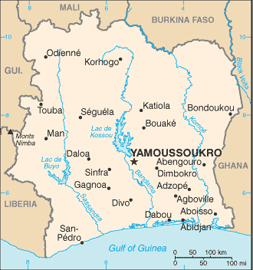
Human Trafficking & Modern-day Slavery Poverty drives the unsuspecting poor into the
hands of traffickers Published reports & articles from 2000 to 2025 gvnet.com/humantrafficking/CoteD'Ivoire.htm
|
|
|||||||||||
|
CAUTION: The following
links have been culled from the web to illuminate the situation in HOW TO USE THIS WEB-PAGE Students If you are looking for
material to use in a term-paper, you are advised to scan the postings on this
page and others to see which aspects of Human Trafficking are of particular
interest to you. Would you like to
write about Forced-Labor? Debt
Bondage? Prostitution? Forced Begging? Child Soldiers? Sale of Organs? etc. On the other
hand, you might choose to include precursors of trafficking such as poverty and hunger. There is a lot to
the subject of Trafficking. Scan other
countries as well. Draw comparisons
between activity in adjacent countries and/or regions. Meanwhile, check out some of the Term-Paper resources
that are available on-line. Teachers Check out some of
the Resources
for Teachers attached to this website. HELP for Victims International Organization for
Migration ***
FEATURED ARTICLE *** NGOs: gladiators of
freedom
[PDF] L. Corradini & Asbel López, The UNESCO Courier, June 2001 unesdoc.unesco.org/images/0012/001227/122747e.pdf#122766 [accessed 30 January
2011] [page 40] At five in the
morning, well before most children get up to go to school, 12-year-old Abula sets out on a six-kilometre
barefoot trek along a road made of mud and stone to work on a coffee
plantation in Bouafle, Côte d’Ivoire. When he gets there,
wet and tired, the foreman tells him where he is to plant that day. “You have
to work fast because they threaten to punish and starve us if we don’t do the
set amount of work,” he says. “If we can’t work because we’re ill, we risk
being physically tortured. One day I saw them torture two friends of mine who
wanted to escape. Both of them ended up dead.” ***
ARCHIVES *** Nestlé &
Cargill v. Doe Series: The Prohibitions on Slavery, Forced Labor, and Human
Trafficking Meet the Sosa Test Oona Hathaway, Chris
Ewell, Nicole Ng, Ellen Nohle
and Alasdair Phillips-Robins, Just Security, 23 November 2020 [Long
URL] [accessed 24
November 2020] Our amicus brief
argues that if any international law norms meet the Sosa threshold, they are
the norms at issue in Nestlé. The respondents in Nestlé – former child slaves
from Mali who were trafficked to work as slave labor on cocoa plantations in
the Ivory Coast – allege that the
two food giants Nestlé USA and Cargill knowingly aided and abetted these
international law violations through technical assistance and financial
contributions from their U.S. offices. The facts in Nestlé are particularly
disturbing because they involve the exploitation of children. Unfortunately,
these plaintiffs are far from alone: An estimated 4 million children are
currently subjected to forced labor around the world. Children are also
particularly vulnerable to human trafficking, making up around 30 percent of
human trafficking victims worldwide. While child labor is more likely to be
involved in production for the domestic economy, many children are employed
in the supply chains of major international corporations. 2020 Country
Reports on Human Rights Practices: Côte d’Ivoire U.S. Dept of State Bureau of Democracy, Human Rights, and
Labor, 30 March 2021 www.state.gov/reports/2020-country-reports-on-human-rights-practices/cote-divoire/
[accessed 31 May
2021] PROHIBITION OF
FORCED OR COMPULSORY LABOR Forced and
compulsory labor continued to occur in small-scale and commercial production
of agricultural products, particularly on cocoa, coffee, pineapple, cashew,
and rubber plantations, and in the informal labor sector, such as in domestic
work, nonindustrial farm labor, artisanal mines, street shops, and
restaurants. PROHIBITION OF CHILD
LABOR AND MINIMUM AGE FOR EMPLOYMENT Children routinely
worked on family farms or as vendors, shoe shiners, errand runners, domestic
helpers, street restaurant vendors, and car watchers and washers. Some girls
as young as nine years old reportedly worked as domestic servants, often
within their extended family networks. Children working on farms faced
hazardous conditions, including risk of injury from machetes, physical strain
from carrying heavy loads, and exposure to harmful chemicals. According to
international organizations, child labor was reported increasingly on cashew
plantations and in illegal gold mines, although no official studies had been
conducted.. Freedom House
Country Report 2020 Edition freedomhouse.org/country/cote-divoire/freedom-world/2020 [accessed 8 July
2020] G4. DO INDIVIDUALS
ENJOY EQUALITY OF OPPORTUNITY AND FREEDOM FROM ECONOMIC EXPLOITATION? Despite efforts by
the government and international industries in recent years to counter the
phenomenon, child labor is a frequent problem, particularly in the cocoa industry.
Human trafficking is prohibited by the new constitution, but government
programs for victims of trafficking—often children—are inadequate. 2017 Findings on
the Worst Forms of Child Labor Office of Child
Labor, Forced Labor, and Human Trafficking, Bureau of International Labor
Affairs, US Dept of Labor, 2018 www.dol.gov/sites/default/files/documents/ilab/ChildLaborReport_Book.pdf [accessed 17 April
2019] www.dol.gov/sites/dolgov/files/ILAB/child_labor_reports/tda2017/ChildLaborReportBook.pdf [accessed 26 April
2020] Note:: Also check out this country’s report in the more recent edition DOL
Worst Forms of Child Labor [page 335] Children from Côte
d’Ivoire are subjected to human trafficking for forced labor in domestic work
within the country and North Africa. Children are also brought from
neighboring West African countries to Côte d’Ivoire for commercial sexual
exploitation and forced labor, including in begging, cocoa production, and
artisanal mining. (1; 10; 21; 16; 4; 15) IOM indicates that some parents send
their boys to Tunisia so they can play soccer, but upon arrival, the boys’
identity documents are confiscated and they are subject to forced labor until
they can repay the cost of their plane ticket. (26). A Study on Human
Trafficking for Sexual Exploitation within th Gulf
of Guinea countries James Okolie-Osemene PhD, Department of International Relations
and the Director of Research and Linkage Programme,
Wellspring University, Nigeria [Long URL] [accessed 14
February 2022] The objectives of
this study are to situate and examine the context, nature and networks of
human trafficking for sexual exploitation around the Gulf of Guinea in order
to identify the intersection between the sources, transit and destinations of
the illicit trade, interrogate the human rights implications of human
trafficking for sexual exploitation around the countries of the Gulf of
Guinea on the one hand, and the strengths, weaknesses, opportunities and
threats to the anti-trafficking activities on the other hand. Chocolate's
bittersweet economy Christian Parenti, Fortune Magazine, February 15 2008 www.nigerianmuse.com/20080217065523zg/nigeria-watch/chocolates-bittersweet-economy-by-christian-parenti-fortune-magazine/ [accessed 30 January
2011] Outside the This type of child
labor isn't supposed to exist in Human Trafficking
'Unacceptable’, Says Anne Thomas,
Christian Today, March 15, 2007 [accessed 30 January
2011] Nearly half the
world's cocoa is harvested in the "Chocolate
manufacturers promised to end the use of trafficked children in harvesting
the cocoa beans that make our chocolate by 2005," explained a
spokesperson from Stop The Traffik, "but this
has not been done. They have started several worthy initiatives but are not
addressing the central issue of trafficked labour. Planning
Intervention Strategies for Child Laborers in Côte d’Ivoire [PDF] Creative Associates
International, Inc., Planning Intervention Strategies for Child Laborers in www.beps.net/publications/ECACLcotedivoirePlanning2002.pdf [accessed 30 January
2011] [page 47 picture
caption] Eleven of the reported 108 children who
were, two years earlier, brought into Côte d’Ivoire to work on their
Marabou’s plantation. The children receive food and housing. Their only form
of education is memorizing the Koran at night. They have not received any
form of wage payment for the two years since arriving in High human
trafficking profits increases practice in Ghana www.modernghana.com/news/124311/1/high-human-trafficking-profits-increases-practice-.html [accessed 30 January
2011] Statistics from the
United Nationa’s Children’s Fund (UNICEF) indicated
that human trafficking was rated the World’s third most profitable illicit
business venture apart from drugs and prostitution. Subsequently, the
number of children trafficked from Afram Plains in
the Eastern, Yeji in the Brong
Ahafo, and Atitekpo in
the Volta Regions countries such as The Gambia and Statistics from the
United Nationa’s Children’s Fund (UNICEF) indicated
that human trafficking was rated the World’s third most profitable illicit
business venture apart from drugs and prostitution. Subsequently, the number of children
trafficked from Afram Plains in the Eastern, Yeji in the Brong Ahafo, and Atitekpo in the
Volta Regions countries such as The Gambia and How can something
so sweet taste so wrong? Athena Sydney athena.gemstonedeva.com/articles.php [accessed 29 August
2014] [scroll down to Hidden Genocide] Forty-three percent
of the cocoa used in chocolate comes from Ivory Coast, which makes this
African country the biggest producer of cocoa worldwide. Most of the laborers
on cocoa plantations are between twelve and sixteen years old, some of them
are even younger, nine years old. These young children are treated like
slaves – they don’t receive any payment for their labor, and are beaten with
sticks when they don’t work, or try to escape. They are locked up at night,
don’t get sufficient nutrition and work eighty to one hundred hours per week.
The children are separated from their families, since they are ‘purchased’
from their families in adjacent countries like UNICEF: Human
Trafficking Affects Every Country in PolitInfo, At one time this
article had been archived and may possibly still be accessible [here]
[accessed 4
September 2011] The study describes
trafficking as a dynamic phenomenon that can change from day to day depending
on the changing circumstances of a country. Mr. Rossi says that for example,
before the civil uprising in Drissa's Story and the
Origins of Slavery in 2003 dillpill.deviantart.com/journal/1110784/ [accessed 30 January
2011] www.antislavery.org/wp-content/uploads/2017/01/1_cocoa_report_2004.pdf [accessed 26 April
2020] [page 51] - DRISSA'S
STORY
- Once in Korhogo, in the Ivory Coast, Drissa was offered what sounded like a good job on a
cocoa plantation, but when he reached the isolated farm, he was enslaved.
More than 300 miles from home, far from any settlement, not even knowing
where he was, Drissa was trapped. When he tried to
run away he was savagely beaten. At night, along with 17 other young men, Drissa was locked into a small room, with only a tin can
as a toilet. On the plantation
the work is hard. In oppressive heat, with biting flies around their heads
and snakes in the undergrowth, the slaves worked from dawn till dusk tending
and collecting the cocoa pods. Often given only braised banana to eat for
months at a time, they developed vitamin deficiencies. Weak from hunger they
staggered under great sacks of cocoa pods. If they slowed in their work, they
were beaten. 'Chocolate Slaves'
Carry Many Scars Neil Tweedie, The
Daily Telegraph, April 17, 2001 www.vachss.com/help_text/archive/chocolate_slaves.html [accessed 30 January
2011] Drissa is a child but
does not care for chocolate so much. He still carries the marks of his time
harvesting the cocoa beans from vast plantations of cacao trees in the Labor Group Demands
US Ban On Imported Elizabeth Price, Dow
Jones Newswires, May 31, 2002 www.thecalamityhowler.com/agbiz/166.htm [accessed 20
April 2012] [accessed 26 April
2020] [scroll down] A labor-rights
group is threatening legal action to require the "Child slaves
are used on cocoa plantations all over ( Slaves to
chocolate: thousands of boys toil on Current Events, a
Weekly Reader publication, www.mcclatchydc.com/news/nation-world/national/article24592888.html [accessed 11 March
2018] vision.ucsd.edu/~kbranson/stopchocolateslavery/atasteofslavery.html [accessed 26 April
2020] Aly Diabate, from the country of Mali, was 12 years old when
a slave trader promised him $150 and a bicycle for working on a cacao farm in
Ivory Coast, where 43 percent of the world's cacao is grown. Instead, Aly was
sold for about $35 to a cacao farmer, who regularly beat the boy with a
bicycle chain and branches from a cacao tree. "The beatings were part of
my life," Aly told a reporter for Knight Ridder Newspapers in 2001,
after he was freed by local authorities and returned to his Child Slaves Caught
in Glittering Traps Corinna Schuler,
National Post, 4/17/01 www.menstuff.org/issues/byissue/childslaves.html [accessed 30 January
2011] Moumouni, 14 at the time,
and his 16-year-old brother had left the village with dreams of paid
employment and possessions their impoverished parents could not provide: a
bike and a pair of American jeans.
"Then, come on," Solo beckoned. "I'll take you to
someone who will give you a job. You won't even have to pay for
transportation." The next day,
the Sylla brothers found themselves captive in a
windowless hut -- caught in the web of smugglers who coax unknown numbers of
young people out of impoverished Traffickers target
boys in cocoa trade - Enslavement
nearly hidden as children taken to work on Sudarsan Raghavan,
Knight Ridder Newspapers, At one time this
article had been archived and may possibly still be accessible [here]
[accessed 4
September 2011] Businessmen called
"locateurs" wait in the little bus
station in this large border town, where crammed mini-buses leave for The dusty alley
behind the bus station is brimming with vendors selling everything from food
to cigarettes. There are cobblers and shanty kiosks selling bootleg tapes of
West African pop music. Chickens and goats abound, and dust mingles with the
scent of raw meat. There also is a
dark warehouse with blackened walls and a thick wooden door covered with tin
sheeting that locks from the outside. Malian officials say slave traders
sometimes keep their young victims here overnight so they can't escape. At one time this
article had been archived and may possibly still be accessible [here]
[accessed 4
September 2011] According to the
ILO, the best defense against the sale of children is to have local NGOs
educate villagers about what really happens to their children, and to step up
enforcement of laws that make recruiting and enslaving children a crime. Scandal of From the Files of
The Daily Mail, 2001 listas.cev.org.br/cevleis/2001-11/msg00142.html [accessed 30 January
2011] SCANDAL OF Child Labour Persists Around The World: More Than 13 Percent Of
Children 10-14 Are Employed International Labour Organisation (ILO) News,
Geneva, 10 June 1996 www.ilo.org/global/about-the-ilo/press-and-media-centre/news/WCMS_008058/lang--en/index.htm [accessed 9
September 2011] www.scribd.com/document/366840945/Child-Labour-Persists-Around-the-World [accessed 30 January
2019] "Today's child
worker will be tomorrow's uneducated and untrained adult, forever trapped in
grinding poverty. No effort should be spared to break that vicious
circle", says ILO Director-General Michel Hansenne. Among the countries
with a high percentage of their children from 10-14 years in the work force
are: Mali, 54.5 percent; Burkina Faso, 51; Niger and Uganda, both 45; Kenya,
41.3; Senegal, 31.4; Bangladesh, 30.1; Nigeria, 25.8; Haiti, 25; Turkey, 24; Côte d'Ivoire, 20.5; Pakistan, 17.7;
Brazil, 16.1; India, 14.4; China, 11.6; and Egypt, 11.2. Concluding
Observations of the Committee on the Rights of the Child (CRC) UN Convention on the
Rights of the Child, 8 June 2001 www1.umn.edu/humanrts/crc/cotedivoire2001.html [accessed 30 January
2011] [55] While noting
the efforts undertaken by the State party within its Plan of Action to fight
child trafficking, the Committee remains deeply concerned at the large number
of child victims of trafficking for the purpose of exploitation in the State
party's agricultural, mining and domestic service sectors and other forms of
exploitation. The Protection
Project - Côte The www.protectionproject.org/human_rights_reports/report_documents/cote.doc [Last accessed 2009] FORMS OF TRAFFICKING
-
Children have been trafficked to Human Rights
Overview by Human
Rights Watch – Defending Human Rights Worldwide www.hrw.org/africa/cote-divoire [accessed 30 January
2011] ***
EARLIER EDITIONS OF SOME OF THE ABOVE *** 2017 Country
Reports on Human Rights Practices U.S. Dept of State Bureau of Democracy, Human Rights, and
Labor, 20 April 2018 www.state.gov/j/drl/rls/hrrpt/2017/af/276991.htm
[accessed 20 March
2019] www.state.gov/reports/2017-country-reports-on-human-rights-practices/cote-divoire/ [accessed 25 June
2019] PROHIBITION OF
FORCED OR COMPULSORY LABOR Forced and
compulsory labor continued to occur in small-scale and commercial production
of agricultural products, particularly on cocoa, coffee, pineapple, cashew,
and rubber plantations, and in the informal labor sector, such as domestic
work, nonindustrial farm labor, artisanal mines, street shops, and
restaurants. Forced labor on cocoa, coffee, and pineapple plantations was
limited to children. PROHIBITION OF CHILD
LABOR AND MINIMUM AGE FOR EMPLOYMENT Children routinely
worked on family farms or as vendors, shoe shiners, errand runners, domestic
helpers, street restaurant vendors, and car watchers and washers. Some girls
as young as nine years old reportedly worked as domestic servants, often
within their extended family networks. While the overall prevalence of child
labor decreased, children in rural areas continued to work on farms under
hazardous conditions, including risk of injury from machetes, physical strain
from carrying heavy loads, and exposure to harmful chemicals. According to
international organizations, child labor was noticed increasingly on cashew
plantations and in illegal gold mines, although no studies had been
conducted. In 2016 UNICEF and the government undertook the Multiple Indicator
Cluster (MICS) survey with a section on child labor. According to UNICEF, the
child labor prevalence of 31.3 percent reported in the MICS 2016 referred to
an expanded age group of children between five and 17 years old and included
economic activities, household chores, and hazardous working conditions,
which represented 21.5 percent. Human Rights
Reports » 2005 Country Reports on Human Rights Practices 2009-2017.state.gov/j/drl/rls/hrrpt/2005/61565.htm [accessed 7 February
2020] TRAFFICKING
IN PERSONS
– The country was a source and destination country for trafficking in women
and children from The country's
cities and farms provided ample opportunities for traffickers, especially of
children and women. The informal labor sectors were not regulated under
existing labor laws, so domestics, most non-industrial farm laborers, and
those who worked in the country's wide network of street shops and
restaurants remained outside government protection. Internal trafficking of
girls ages 9 to 15 to work as household domestics in The Department of Labor’s 2004 Findings on
the Worst Forms of Child Labor www.dol.gov/ilab/media/reports/iclp/tda2004/cote-d'ivoire.htm [accessed 30 January
2011] Note:: Also check out this country’s report in the more recent edition DOL
Worst Forms of Child Labor INCIDENCE
AND NATURE OF CHILD LABOR - National armed forces and rebel groups are reported
to recruit or use children in situations of armed conflict, sometimes on a
forced basis. Rebel forces are also
reported to actively recruit child soldiers from refugee camps and other
areas in the western part of the country.
All
material used herein reproduced under the fair use exception of 17 USC § 107
for noncommercial, nonprofit, and educational use. PLEASE RESPECT COPYRIGHTS OF COMPONENT
ARTICLES. Cite this
webpage as: Patt, Prof. Martin, "Human Trafficking & Modern-day
Slavery - Côte |
||||||||||||