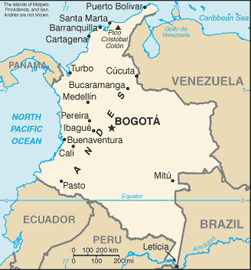
Human Trafficking & Modern-day Slavery Poverty drives the unsuspecting poor into the
hands of traffickers Published reports
& articles from 2000 to 2025 gvnet.com/humantrafficking/Colombia.htm
Colombia is a major
source country for women and girls trafficked to Latin America, the
Caribbean, Western Europe, Asia, and North America, including the United
States, for purposes of commercial sexual exploitation and involuntary
servitude. Within Colombia, some men are trafficked for forced labor, but
trafficking of women and children from rural to urban areas for commercial
sexual exploitation remains a larger problem.
- U.S. State Dept Trafficking in Persons
Report, June, 2009 Check out a
later country report here or a full TIP Report here CAUTION: The following links
have been culled from the web to illuminate the situation in Colombia. Some of these links may lead to websites
that present allegations that are unsubstantiated or even false. No
attempt has been made to validate their authenticity or to verify their content. HOW TO USE THIS WEB-PAGE Students If you are looking
for material to use in a term-paper, you are advised to scan the postings on
this page and others to see which aspects of Human Trafficking are of
particular interest to you. Would you
like to write about Forced-Labor? Debt
Bondage? Prostitution? Forced Begging? Child Soldiers? Sale of Organs? etc. On the other
hand, you might choose to include precursors of trafficking such as poverty and
hunger. There is a lot to the subject of Trafficking. Scan other countries as well. Draw comparisons between activity in
adjacent countries and/or regions.
Meanwhile, check out some of the Term-Paper
resources that are available on-line. Teachers Check out some of
the Resources for Teachers attached to this
website. HELP for Victims International Organization for
Migration ***
FEATURED ARTICLE *** Colombian Hailed as
Hero in Fight Against Trafficking in Persons Brian iipdigital.usembassy.gov/st/english/article/2004/06/20040616130952mbrepak0.8762171.html#axzz3BnNYBYXY
[accessed 29 August
2014] Francisco Sierra, Sierra said the
women are told they will find a better life by working in other countries
such as Holland, Japan, and Spain, but they most often find themselves
trapped into working in brothels to pay off their so-called
"transportation" fees; such fees may total as much as $50,000 to
$80,000. Sierra said that the women are expected to pay their captors roughly
$2,000 every ten days or they will be severely punished. 24 August 2006 --
Source: www.plenglish.com/article.asp?ID=%7BF048200B-8872-4382-9DA5-E794A6D11AE8%7D&language=EN Colombia harbors new ways of human trafficking involving young children, body parts, labor exploitation and recruitment for the domestic armed conflict. Adriana Ruiz, coordinator of the UN anti-Trafficking Project, added that human trafficking now joins traditional trafficking of women for sex slavery in Europe and Asia. Although she lacked precise numbers, Ms. Ruiz denounced theft of babies and a worrying traffic of organs like ovaries and ovules, as well as labor exploitation via domestic service. U.N. Official Says
Indigenous Face Extinction [Regarding Conditions in Stacey Hunt, 2004 www.libertadlatina.org/Lat_Colombia_Indigenous_Face_Extiction_03-22-2004.htm [accessed 30 January
2011] [accessed 26 April
2020] Colombian
indigenous communities are in danger of extinction as paramilitaries and
guerrillas target them for massacre, torture, displacement, rape and forced
recruitment, a U.N. official said March 16. One group, the Kankuamos of northern Colombia's Sierra Nevada Mountains,
has lost more than 200 members to killings since 1986, said Stavenhagen, a Mexican. Ten Kankuamos
have been murdered since an October demand by the Inter-American Commission
for Human Rights that the Colombian government adopt measures to prevent the
group's genocide, he added. While indigenous
peoples constitute only 2 percent of Colombia's 44 million inhabitants, their
traditional territories cover 30 percent of the country.
Paramilitaries, guerrilla groups and government forces fight to control rural
land and people for a variety of reasons, including drug cultivation, forced
conscription and land grabs. ***
ARCHIVES *** 2020 Country
Reports on Human Rights Practices: Colombia U.S. Dept of State Bureau of Democracy, Human Rights, and
Labor, 30 March 2021 www.state.gov/reports/2020-country-reports-on-human-rights-practices/colombia/
[accessed 30 May
2021] PROHIBITION OF
FORCED OR COMPULSORY LABOR There were reports
ELN guerrillas and organized-crime gangs used forced labor, including forced
child labor, in coca cultivation and illegal mining in areas outside government
control as well as forced criminality, such as extortion, in urban areas. The
ICBF indicated that between November 16, 1999, and July 31, 2019, the number
of children and adolescents who had demobilized from illegal armed groups was
6,860, of whom 11 percent were indigenous and 8 percent Afro-Colombian. Forced labor in
other sectors, including organized panhandling, mining, agriculture
(especially near the coffee belt), cattle herding, crop harvesting, forced
recruitment by illegal armed actors, and domestic service, remained a serious
problem. Afro-Colombians, indigenous persons, Venezuelan migrants, and
inhabitants of marginalized urban areas were at the highest risk of forced
labor, domestic servitude, forced begging, and forced recruitment. Authorities
did not make efforts to investigate cases or increase inspections of forced
labor, and officials did not have a protocol to connect labor inspectors with
police or to provide guidance for front-line personnel on indicators of
forced labor. This resulted in impunity for forced labor and unidentified
victims without protection in critical sectors, such as floriculture, coffee
production, and extractive industries. PROHIBITION OF CHILD
LABOR AND MINIMUM AGE FOR EMPLOYMENT Child labor
remained a problem in the informal and illicit sectors. The National
Administrative Department of Statistics (DANE) collected and published
information on the economic activities of children between the ages of five
and 17 through a module in its Comprehensive Household Economic Survey during
the fourth quarter of each calendar year. According to DANE’s most recent
survey, conducted in 2019, 5.4 percent of children were working, with 42
percent of those engaged in agriculture, livestock raising,
fishing, and hunting, and 30 percent in commerce, hotels, and restaurant
work. To a lesser extent, children were engaged in the manufacturing and
transport sectors. Children also routinely performed domestic work, where
they cared for children, prepared meals, tended gardens, and carried out
shopping duties. DANE reported that 46 percent of children who were engaged
in an employment relationship did not receive remuneration. Significant rates
of child labor occurred in the production of clay bricks, coal, coffee,
emeralds, gold, grapes, coca, pome and stone fruits, pornography, and
sugarcane. Forced child labor was prevalent in the production of coca.
Children were also engaged in street vending, domestic work, begging, and
garbage scavenging. There were reports that children engaged in child labor
in agriculture, including coffee production and small family production
centers in the unrefined brown sugar market. Commercial sexual exploitation
of children occurred (see section 6, Children). Freedom House
Country Report 2020 Edition freedomhouse.org/country/colombia/freedom-world/2020 [accessed 8 July
2020] G4. DO INDIVIDUALS
ENJOY EQUALITY OF OPPORTUNITY AND FREEDOM FROM ECONOMIC EXPLOITATION? Child labor, the
recruitment of children by illegal armed groups, and related sexual abuse are serious problems in Colombia; recruitment has
declined but not ended since the peace accord. A 2011 free trade agreement
with the United States and a subsequent Labor Action Plan called for enhanced
investigation of abusive labor practices and rights violations, but progress
remains deficient in several areas. In coca-growing zones, armed groups exert
coercive pressure on farmers to engage in coca cultivation and shun
crop-substitution programs. 2017 Findings on
the Worst Forms of Child Labor Office of Child
Labor, Forced Labor, and Human Trafficking, Bureau of International Labor
Affairs, US Dept of Labor, 2018 www.dol.gov/sites/default/files/documents/ilab/ChildLaborReport_Book.pdf [accessed 17 April
2019] www.dol.gov/sites/dolgov/files/ILAB/child_labor_reports/tda2017/ChildLaborReportBook.pdf [accessed 24 April
2020] Note:: Also check out this country’s report in the more recent edition DOL Worst Forms of Child Labor [page 287] Commercial sexual
exploitation of children occurs more often in private homes rented online
than in commercial establishments. (9) In Bucaramanga, child victims of
commercial sexual exploitation are allegedly recruited in schools by other
students. (34) In mining areas, trafficking of children for forced labor and
commercial sexual exploitation is widespread. (35) In Cartagena, children are
forced by illegal armed groups and criminal organizations to commit
homicides. (36) The government
reports that the recruitment and use of children by illegal armed groups has
declined by 60 percent since the government and the FARC signed a peace
accord in 2016. However, the National Liberation Army, Popular Liberation
Army, and non-ideological criminal organizations such as the Gulf Clan
continued to recruit children in 2017. (9). RIGHTS-COLOMBIA:
Trafficking Victims’ Ordeal Never Over Helda Martínez,
Inter Press Service News Agency IPS, Bogotá, Jun 10 , 2009 www.ipsnews.net/news.asp?idnews=47163 [accessed 30 January
2011] www.ipsnews.net/2009/06/rights-colombia-trafficking-victimsrsquo-ordeal-never-over/ [accessed 8
September 2016] According to the available
data, some 70,000 people fall victim to human trafficking every year in
Colombia, which ranks third in the number of victims in Latin America, behind
the Dominican Republic and Brazil. MARÍA AND HER
NEVER-ENDING FEAR
- But people do fall for the bogus offers because they are in dire need of an
opportunity for a better life. That was what happened to María,
a 40-year old woman originally from the central province of Tolima, who was
living on the outskirts of Bogotá when she was captured by members of a
trafficking mafia. She admitted to
IPS that she’s still scared her captors will find her or come after her kids.
Her fear will not leave her, even though she knows she’s protected by Fundación Esperanza and that her case is being
prosecuted. "I wanted to go back to being me, but I can’t anymore,"
she said. She’s also filled with
rage. In November 2008 she and her family carefully examined the work
contract before she decided to accept a job as a domestic in the home of a
wealthy Colombian family in the United States. It provided at least a
short-term solution to the unemployment and lack of income that were causing
her such anxiety. In the 39 days she
worked as a modern-day slave, María’s weight
plunged from 58 to 41 kilos, and she was forced to spend hours on her knees
cleaning, constantly watched and threatened, until she was collapsing from
exhaustion. Worst of all, she was
prevented from contacting her family, María told
IPS, speaking very softly, as if trying to exorcise the horrible experience.
A Salvadoran woman working as a domestic in a neighbouring
house noticed María’s rapid weight loss and the
frightened look on her face, and decided to approach her when her captors
were not watching. The woman from El
Salvador told María that what her
"employers" were doing was illegal, explained how to unblock the
telephone, and gave her an emergency number to phone the police for
help. But the police merely forced
her captors to give back her passport and admonished them for how they were
treating her. That night, María’s kidnappers scared her with all sorts of threats
against her and her family back in Colombia. They warned her that if she
didn’t sign a paper exonerating them from all responsibility, they would
report her to the police and accuse her of several offences, and she would be
thrown in jail for years. Human trafficking's
dirty profits and huge costs Inter-American
Development Bank, Nov 2, 2006 www.iadb.org/news/detail.cfm?language=English&ARTID=3357&id=3357 [accessed 30 January
2011] [accessed 30 January
2019] CASES IN LATIN
AMERICA AND THE CARIBBEAN - In Colombia, more than 14,000 children are kidnapped
each year and forced to become soldiers for the paramilitary or other militia
forces, according to the United Nations High Commissioner for Human Rights
Report, 2003. Report: Associated Press AP,
www.pixies-place.com/forums/showthread.php?t=24929 [accessed 18 July
2013] When she arrived she was raped by all three men and sold to a Yakuza organized crime boss, who branded her across the chest with a 6-inch (15-centimeter) rose tattoo. He forced her to provide sexual services to up to 40 clients a day, she said. Colombia, Japan to
tackle trafficking The Asahi Shimbun
& The International Herald Tribune IHT/ASAHI, January 19,2005 www.asahi.com/english/nation/TKY200501190138.html [accessed 30 January
2011] The Japanese and
Colombian governments have agreed on a series of steps aimed at preventing
human trafficking and providing support to sex-trade victims. The officials
explained to their Colombian counterparts about Japan's new policy of
treating women duped into exploitation as victims to protect. The women will
be allowed to stay in shelters for an extended period of time rather than be
subject to immediate deportation. In turn, the
Colombian government has promised to step up control on passport forgeries,
according to the officials. Colombia
will also make efforts to publicize that victims of human trafficking in
Japan, if they seek help from police, will be placed under protection. Colombia will also take measures to improve
mental care provided to victims when they return to Colombia, according to
the officials. Yoshimi Nagamine, 2003 Yomiuri Shimbun, 2003-11-29 www.libertadlatina.org/Lat_Colombia_Japan_Pressured_to_End_Trafficking_11292003.htm [accessed 30 January
2011] "I was told
there was a job at a beauty salon. But when I arrived in Japan, I was taken
to a strip joint and confined in a second-floor room," said the woman in
a vivid description of her treatment.
"Then they demanded I return 5 million yen in travel expenses and
I was forced to work as a prostitute.
"A Japanese broker took pictures of me naked and said he would
kill my family if I ran away. He kept punching me until I was left covered in
bruises," the woman went on to say.
This woman ran into the Colombian Embassy in May last year, seeking
protection after running away from her captors. According to the embassy, more than 70 such
women have sought refuge at the embassy. Fanny Polanía Molina, libertadlatina.org, www.libertadlatina.org/paper30ColombiaJapan.pdf [accessed 30 January
2011] chuckgoolsby2.readyhosting.com/paper30ColombiaJapan.pdf [accessed 30 January
2019] "A dangerous
network of trafficking in women is captured. A dangerous network dedicated to
trafficking in women, at the service of the Japanese Mafia, was
disarticulated this weekend by units belonging to the DAS – the
Administrative Security Department. The DAS had known of the existence of the
actions by the Japanese Mafia for two years now, which, through Colombian
contacts, sought beautiful young women to engage them in prostitution." Trafficking in
Colombian women to the Asian continent has become “a true threat for thousands
of Colombian women who end up as slaves in Japan and other countries."
Trafficking in Colombian women to Japan began in the 80s, when the Japa nese Mafia began to make
incursions in Colombian territory and decided to set up their center of
operations in certain regions of the country. Sex slavery racket
a growing concern in Latin America Timothy Pratt, The
Christian Science Monitor, January 11, 2001 www.libertadlatina.org/LA_Colombia_CS%20Monitor%20Article_01112001.htm [accessed 30 January
2011] www.csmonitor.com/2001/0111/p7s1.html [accessed 30 January
2019] Viviana was one of
what the Interpol estimates are 35,000 women trafficked out of Colombia every
year, with estimated profits of $500 million, making it second only to the
Dominican Republic in the West.
"It began when a neighbor told me I was pretty, and could work in
a casino in Spain and make good money," recalls Viviana. "She said
I could earn $1,000 a week. It seemed like the only way I could ever buy a
house for my son. So I said yes." The offer seemed
like a good deal, until she got to Asturias, Spain, where a man began
explaining about "towels, sheets, condoms, and percentages." He
also said she owed them $4,000. She then realized - "this was not a
casino, it was a bordello." She spent that night crying, convinced she
had "fallen into the jaws of a beast." Colombia This Week
-- November 22, 2004 Colombia This Week
is a news summary produced and distributed by ABColombia
Group. Sources include daily Colombian, US, European and Latin American
newspapers, and reports from non-governmental organisations
and the UN System www.usofficeoncolombia.org/InfoBrief/112204.htm [accessed 29 August
2014] colhrnet.igc.org/newitems/nov04/abccolwk.n22.htm [accessed 30 January
2019] [scroll down to Thurs 18] 14,000 CHILDREN IN
COLOMBIAN ARMED GROUPS; COLOMBIA'S ROLE IN PLAN PUEBLA-PANAMA - UK-based NGOs
Save the Children and Amnesty International report that more than 14,000
child soldiers are fighting in the Colombian conflict, denouncing that the
illegal armed groups (FARC, ELN and AUC) are systemically recruiting children
under 15 years old from indigenous and rural communities, putting their lives
at extreme risk and sending them to the front line of battle. Colombia:
"Scarred bodies, hidden crimes": Sexual Violence against women in
the armed conflict Amnesty International,
Index Number: AMR 23/040/2004, Date Published: 11 October 2004 www2.amnesty.se/svaw.nsf/%28intdok%29/9A0848A7ED7323C9C1256F32004E2E78 [accessed 21 January
2016] www.amnesty.org/en/documents/amr23/040/2004/en/ [accessed 30 January
2019] "Paramilitary
and guerrilla groups seek to intrude into even the most intimate aspects of
women’s lives in areas under their control by setting curfews and dress
codes, and by humiliating, flogging, raping and even killing those who dare
to transgress," said Ms Lee. Colombia:
Full-flexed war after government breaks off peace talks Human Rights
Education Associates HREA, 25 Feb 2002 At one time this article
had been archived and may possibly still be accessible [here] [accessed 4
September 2011] Those who will be hardest
hit by the government's offensive are the most marginalized Colombians ?
poor, indigenous and Afro-Colombian women and their families. Already, more
than 25% of Colombians have been displaced by fighting between the FARC and
the Colombian government (the latter aided by paramilitaries that are
responsible for 75% of the country's human rights violations, including 3,500
killings each year). All warring parties stand accused of grave human rights
abuses, including assassinations, torture and kidnapping of civilians. Crimes
against women include forced servitude, sexual slavery, forced prostitution,
forced sterilization and forced pregnancy. IOM press briefing
notes 10 Aug 2004: Sudan, Colombia Spokesperson: Jean
Philippe Chauzy, International Organization for
Migration IOM, 10 August 2004 [accessed 30 January
2011] IOM presented the
"Vulnerability, Risk and Opportunity Map" (Mapa
de Vulnerabilidad, Riesgo
y Oportunidad), a methodology aimed at helping
local governments and civil society to work together to tackle and prevent
forced conscription. Plight of Jeremy McDermott ,
BBC News, 19 September, 2003 news.bbc.co.uk/2/hi/americas/3121600.stm [accessed 30 January
2011] Some 112 former
child combatants were interviewed for the publication, which describes how
children are recruited into the ranks of the Marxist guerrillas and
right-wing paramilitaries from as young as eight years old and gradually
hardened to violence. Around 25% of
guerrilla ranks are female and the study highlighted the problem of sexual
abuse many young girls are subjected to by their guerrilla superiors. Females as young as 12 are forced to use
contraception and, if they get pregnant, must undergo abortions. You’ll Learn Not To
Cry - Child Combatants in Colombia This
report provides the first comprehensive account of child combatants in Human Rights Watch,
September 18, 2003 www.hrw.org/sites/default/files/reports/colombia0903.pdf [accessed 21 January
2016] RECRUITMENT METHODS - The great majority of child recruits to the irregular forces decide to join voluntarily. Yet forcible recruitment occurs in some parts of Colombia. Human Rights Watch interviewed thirteen former combatants, all of whom had belonged to either the FARC-EP or the UC-ELN, who described having been forced to join the ranks of the group unwillingly; they made up slightly more than 10 percent of the children we interviewed. Another two children said that they had been pressured to join a guerrilla group. And even the voluntary decision to join irregular forces is more a reflection of the dismal lack of opportunities open to children from the poorest sector of rural society than a real exercise of free will. 'Street of the
Damned' Loses its Daughters; Colombian Kidnappers Target Poor Children Anthony www.libertadlatina.org/Latin_America_Cases_Colombia_p1.htm [accessed 30 January
2011] [accessed 13 August
2020] Like a nightmarish
fairy tale in which young girls are spirited away by monsters, five were
abducted from this three-block stretch of 125th Street in Bogota's Miguelito neighborhood from November 1995 to July 1997.
Not one has been found. War Without
Quarter: Human Rights Watch,
October 1998 www.hrw.org/legacy/reports98/colombia/ [accessed 29 August
2014] II COLOMBIA AND
INTERNATIONAL HUMANITARIAN LAW - The drama of Guintar
is repeated throughout Colombia, where war is not fought primarily between
armed and uniformed combatants on battlefields, but against the civilian
population and in their homes, farms, and towns. Many of the victims of
Colombia’s war wear no uniform, hold no gun, and profess no allegiance to any
armed group. Indeed, battles between armed opponents are the exception.
Instead, combatants deliberately and implacably target and kill the civilians
they believe support their enemies, whether or not the civilians are even
aware that they are in peril. Concluding Observations
of the Committee on the Rights of the Child (CRC) UN Convention on the
Rights of the Child, 6 October 2000 www1.umn.edu/humanrts/crc/colombia2000.html [accessed 30 January
2011] [69] While the
Committee takes note of the State party's efforts to combat the trafficking
and sale of children, it remains concerned about the lack of adequate
preventive measures in this area. The Protection
Project - The www.protectionproject.org/human_rights_reports/report_documents/colombia.doc [Last accessed 2009] FORMS OF TRAFFICKING - As of November
2003, more than 70 Colombian women claiming to be victims of trafficking had
sought refuge at the Colombian embassy in Some 567,000 minors
from 6 to 18 years of age work in Colombia, 323,000 of them in the domestic
service industry. Of these children, 87 percent are girls. Young women from
rural areas leave for provincial capitals with offers of good jobs as
domestic workers. Often, actual working conditions are much worse than those
promised to them. They are subjected to sexual, physical, and psychological
abuse and receive only a portion of the wages promised them. Human Rights
Overview by Human
Rights Watch – Defending Human Rights Worldwide [accessed 30 January
2011] ***
EARLIER EDITIONS OF SOME OF THE ABOVE *** 2017 Country
Reports on Human Rights Practices U.S. Dept of State Bureau of Democracy, Human Rights, and
Labor, 20 April 2018 www.state.gov/j/drl/rls/hrrpt/2017/wha/277319.htm
[accessed 19 March
2019] www.state.gov/reports/2017-country-reports-on-human-rights-practices/colombia/ [accessed 25 June
2019] PROHIBITION OF
FORCED OR COMPULSORY LABOR There were reports
ELN guerrillas and organized criminal gangs used forced labor, including
forced child labor, in coca cultivation and illegal mining in areas outside
government control as well as forced labor for criminal activity, such as
extortion, in urban areas. The ICBF noted it was difficult to produce exact
statistics on the number of children who participated in illegal armed groups
due to the groups’ clandestine nature. In February 2016 the FARC announced it
would stop recruiting children under the age of 18. The FARC reached an
agreement with the government in May 2016 on how to release minors already in
the ranks and facilitate their reintegration. As of June 14, the FARC
released 88 children, according to UNICEF. As part of a temporary bilateral
ceasefire between the government and the ELN scheduled from October 1 to
January 12, 2018, the ELN committed to stop the recruitment of minors. Forced labor in
other sectors, including organized begging, mining, agriculture, forced
recruitment by illegal armed actors, and domestic service, also remained a serious
problem. Afro-Colombians, indigenous Colombians, and inhabitants of
marginalized urban areas were at the highest risk of forced labor, domestic
servitude, forced begging, and forced recruitment. PROHIBITION OF CHILD
LABOR AND MINIMUM AGE FOR EMPLOYMENT Child labor
remained a problem in the informal and illicit sectors. In April the National
Administrative Department of Statistics (DANE) published the results of a
2015 survey of child labor that measured child labor during October-December
2014. DANE data noted that, of the 11.1 million children between ages five
and 17, an estimated one million worked outside the home (approximately 68
percent boys and 32 percent girls). The national rate of children who worked
outside the home was 7.8 percent, with 4.2 percent of children ages five to
14 working and 19.8 percent of children ages 15 to 17 working. For the period
of the study, 29.8 percent of the children who worked did not attend school.
According to the study, 36.3 percent of child laborers in urban areas engaged
in commerce, hotel, and restaurant work, while 36.6 percent of child laborers
in rural areas engaged in agriculture, fishing, cattle farming, hunting, and
forestry work; 47.2 percent of working children ages five to 17 did not
receive payment. Significant rates
of child labor occurred in the production of clay bricks, coal, emeralds,
gold, coca, and pornography. Children also worked as street vendors and
domestic servants and were engaged in begging and garbage scavenging. There
were also reports that children were involved in agriculture, including
coffee production and small family production centers in the unrefined brown
sugar market, as well as selling inexpensive Venezuelan gasoline. Commercial
sexual exploitation of children occurred. Human Rights
Reports » 2005 Country Reports on Human Rights Practices 2009-2017.state.gov/j/drl/rls/hrrpt/2005/61721.htm [accessed 7 February
2020] CHILDREN
– Although
the law prohibits service in the public security forces before age 18, both
paramilitaries and guerrillas forcibly recruited and used children as
soldiers. The IOM estimated that since 1999 it assisted 2,426 children in the
country who had been members of illegal armed groups. The Ministry of Defense
estimated that 20 percent of FARC members were minors and that most guerrilla
fighters had joined the FARC ranks as children. TRAFFICKING
IN PERSONS
– Many traffickers disclosed the sexual nature of the work they offered but
concealed information about working conditions, clientele, freedom of
movement, and compensation. Others disguised their intent by portraying
themselves as modeling agents, offering marriage brokerage services, or
operating lottery or bingo scams with free trips as prizes. Recruiters
reportedly loitered outside high schools, shopping malls, and parks to lure
adolescents into accepting nonexistent jobs abroad. Most traffickers were
well-organized and linked to narcotics or other criminal organizations. The
armed conflict created situations of vulnerability for a large number of
internal trafficking victims. The Department of Labor’s 2004 Findings on
the Worst Forms of Child Labor www.dol.gov/ilab/media/reports/iclp/tda2004/colombia.htm [accessed 30 January
2011] Note:: Also check out this country’s report in the more recent edition DOL Worst Forms of Child Labor INCIDENCE
AND NATURE OF CHILD LABOR - Colombia is a source and transit country for girls
trafficked for sexual exploitation. There
are also reports of internal trafficking of boys for forced labor. Children are recruited, sometimes forcibly,
by guerrilla and paramilitary groups in All
material used herein reproduced under the fair use exception of 17 USC § 107
for noncommercial, nonprofit, and educational use. PLEASE RESPECT COPYRIGHTS OF COMPONENT
ARTICLES. Cite this webpage as: Patt,
Prof. Martin, "Human Trafficking & Modern-day Slavery - |