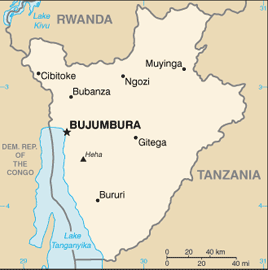
Human Trafficking & Modern-day Slavery Poverty drives the unsuspecting poor into the
hands of traffickers Published reports & articles from 2000 to 2025 gvnet.com/humantrafficking/Burundi.htm
Burundi is a source
country for children trafficked for the purposes of child soldiering,
domestic servitude, and commercial sexual exploitation. Human trafficking of
Burundian adults and children with albinism to Tanzania for the forcible
removal of body parts may occur; so-called Tanzanian traditional healers seek
various body parts of persons with albinism for traditional medical
concoctions commonly purchased to heal illness, foster economic advancement,
or hurt enemies. - U.S. State Dept Trafficking in Persons Report, June, 2009 Check out a later country report here
or the full TIP Report here |
|
|||||||||||
|
CAUTION: The following
links have been culled from the web to illuminate the situation in HOW TO USE THIS WEB-PAGE Students If you are looking for
material to use in a term-paper, you are advised to scan the postings on this
page and others to see which aspects of Human Trafficking are of particular
interest to you. Would you like to
write about Forced-Labor? Debt
Bondage? Prostitution? Forced Begging? Child Soldiers? Sale of Organs? etc. On the other
hand, you might choose to include possible precursors of trafficking such as poverty. There is a lot to the subject
of Trafficking. Scan other countries as
well. Draw comparisons between
activity in adjacent countries and/or regions. Meanwhile, check out some of the Term-Paper resources
that are available on-line. Teachers Check out some of
the Resources
for Teachers attached to this website. ***
FEATURED ARTICLE *** Burundian's ordeal
in Lebanon BBC News, 27 June
2007 news.bbc.co.uk/2/hi/africa/6241214.stm [accessed 25 January
2011] First of all they
refused to pay me the amount we had agreed before I left. When we arrived home, my boss told me I
would be paid $50 a month whilst before I left we agreed I would be paid
$100. After three months, I asked for
my payments so that I could send money to my brothers and sisters. My boss gave me only $150. I complained I
should be given $300. She said I was being paid $50 a month. We went through
lots of ordeals. The husband or son of
the lady I worked for would often rape me. And there was no way you could
complain: I felt they would not hesitate to kill me. You just kept quiet. We were often beaten
and tortured. They chose food for us, they would decide the clothes that we
would put on, but being beaten was the most common practice. There was little difference between
prostitution and working as a maid because even when you chose house work,
you would often be raped there. ***
ARCHIVES *** 2023 Findings on
the Worst Forms of Child Labor U.S. Dept of Labor, Bureau of International Labor Affairs,
Child Labor and Forced Labor Reports www.dol.gov/agencies/ilab/resources/reports/child-labor/Burundi
[accessed 22
December 2024] Minimal Advancement – Efforts Made but Continued Policy
that Delayed Advancement -- In 2023, Burundi made minimal advancement
in efforts to eliminate the worst forms of child labor. The government
approved and began implementing its National Action Plan to Combat
Trafficking in Persons for 2023–2027, taking actions including repatriating
victims of child labor exploitation from Tanzania. In October 2023, it
established the Permanent National Multisector Committee on Child Labor and
its Worst Forms, which completed a draft action plan on child labor by the
end of the year. The government also significantly increased its contribution
to the National School Feeding Program, from $2 million in previous years to
$6 million in 2023, encouraging school attendance and thereby helping address
one of the root causes of child labor. However, despite new initiatives to
address child labor, Burundi is assessed as having made only minimal
advancement because it maintained a Ministry of Education policy that calls
for the expulsion of students for becoming pregnant and for causing a
pregnancy. While boys expelled under this policy can return to the same
school at the start of the next school year, girls expelled face much more
punitive restrictions. Unless they miscarry or have a still birth, they may
only return to school once their child is at least 12 months old, but not
more 24 months old. In either case, they must enroll in a different school,
which can be especially challenging in rural areas with few school options.
The additional restrictions on girls' re-enrollment result in very few girls
who deliver a child returning to school, thereby increasing their
vulnerability to child labor. In addition, Burundi's laws do not guarantee
free basic education or establish a compulsory education age. The government
also failed to provide comprehensive criminal law enforcement data related to
the worst forms of child labor and lacked resources to conduct labor inspections
and criminal investigations. Lastly, Burundi has insufficient social programs
to address child labor. 2020 Country
Reports on Human Rights Practices: Burundi U.S. Dept of State Bureau of Democracy, Human Rights, and
Labor, 30 March 2021 www.state.gov/reports/2020-country-reports-on-human-rights-practices/burundi/
[accessed 13 May
2021] PROHIBITION OF
FORCED OR COMPULSORY LABOR Children and young
adults were coerced into forced labor on plantations or small farms in the
south, small-scale menial labor in gold mines, carrying river stones for
construction in Bujumbura, work aboard fishing vessels, or engaging in
informal commerce in the streets of larger cities (see section 7.c.). Forced
labor also occurred in domestic service and charcoal production. Citizens
were required to participate in community work each Saturday morning from
8:30 a.m. to 10:30 a.m. Although enforcement of this requirement was rare,
there were sporadic reports that communal administrators fined residents who
failed to participate, and members of the Imbonerakure
or police sometimes harassed or intimidated individuals who did not
participate. PROHIBITION OF CHILD
LABOR AND MINIMUM AGE FOR EMPLOYMENT In rural areas
children younger than 16 were often responsible for contributing to their
families’ and their own subsistence and were regularly employed in heavy
manual labor during the day, including during the school year, especially in
agriculture. Children working in agriculture could be forced to carry heavy
loads and use machines and tools that could be dangerous. They also herded
cattle and goats, which exposed them to harsh weather conditions and forced
them to work with large or dangerous animals. Many children worked in the
informal sector, such as in family businesses, selling in the streets, and
working in small local brickworks. There were instances of children being
employed as beggars, including forced begging by children with disabilities.
The September COI report also cited forced recruitment into the Imbonerakure or, in the case of younger children, into
the CNDD-FDD “Little Eagles.” In
urban areas, child domestic workers were prevalent, accounting for more than
40 percent of the 13- to 15-year-old children in the country, according to a
government survey from 2013-14. Reports indicated that an increased number of
children from the Twa ethnic group were being
transported from rural areas to Bujumbura with promises of work and
subsequently were exploited. Child domestic workers were often isolated from
the public. Some were only housed and fed instead of being paid for their
work. Some employers, who did not pay the salaries of children they employed
as domestic servants, accused them of stealing, and children were sometimes
imprisoned on false charges. Child domestic workers could be forced to work
long hours, some employers exploited them sexually, and girls were
disproportionately impacted. Freedom House
Country Report 2020 Edition freedomhouse.org/country/burundi/freedom-world/2020 [accessed 24 April
2020] G3. DO INDIVIDUALS ENJOY
PERSONAL SOCIAL FREEDOMS, INCLUDING CHOICE OF MARRIAGE PARTNER AND SIZE OF
FAMILY, PROTECTION FROM DOMESTIC VIOLENCE, AND CONTROL OVER APPEARANCE? Sexual and domestic
violence are serious problems but are rarely reported to law enforcement
agencies. Rights monitors continue to report sexual violence carried out by
security forces and Imbonerakure, who act with
impunity. Women are often targeted for rape if they or their spouses refuse
to join the CNDD–FDD, and men sometimes experience sexual abuse while in
government custody. G4. DO INDIVIDUALS
ENJOY EQUALITY OF OPPORTUNITY AND FREEDOM FROM ECONOMIC EXPLOITATION? Individuals not
allied with the ruling party may lose their employment. Community service
requirements have taken on political overtones, such as building offices for
the CNDD–FDD, amounting to what the 2019 UN report called forced labor. Women have limited
opportunities for advancement in the workplace. Much of the population is
impoverished. In 2017, “vagrancy” and begging by able-bodied persons became
formal offenses under the penal code. The ongoing political and humanitarian
crisis has contributed to an economic decline, less access to basic services,
and deteriorating living conditions. The government has
conducted some trainings for government officials on
handling cases of human trafficking. However, the government has largely
failed to prevent domestic human trafficking, to protect victims, and to
prosecute perpetrators. 2017 Findings on
the Worst Forms of Child Labor Office of Child Labor,
Forced Labor, and Human Trafficking, Bureau of International Labor Affairs,
US Dept of Labor, 2018 www.dol.gov/sites/default/files/documents/ilab/ChildLaborReport_Book.pdf [accessed 15 April
2019] www.dol.gov/sites/dolgov/files/ILAB/child_labor_reports/tda2017/ChildLaborReportBook.pdf [accessed 24 April
2020] Note:: Also check out this country’s report in the more recent edition DOL
Worst Forms of Child Labor [page 228] Children in Burundi
engage in the worst forms of child labor, including in commercial sexual
exploitation. Children also perform dangerous tasks in agriculture. (1; 2; 3;
4; 5; 6; 7; 8) Burundian children are
trafficked within the country, often from rural areas, for domestic work and
commercial sexual exploitation. (2; 3; 4; 17) Women who offer room and board
to children sometimes force the children into commercial sexual exploitation
to pay expenses; these brothels are found in the more impoverished parts of
Bujumbura, near Lake Tanganyika, along trucking corridors, and in other
cities such as Gitega, Ngozi,
and Rumonge. (2; 3; 19) Burundian girls are also
trafficked internationally for commercial sexual exploitation in Kenya, the
Middle East, Rwanda, and Uganda. (20; 21; 22; 12; 19) Evidence also suggests
that children are trafficked to Tanzania for work in agriculture and forced
labor. (17; 23; 12) Burundi is one of
the poorest countries in the world, with over 90 percent of its citizens
engaged in subsistence agriculture. (24) In Burundi, research indicates that
children perform dangerous tasks in agriculture in the production of tea,
coffee, sugarcane, cotton, palm oil, peat, potatoes, and rice. (1; 5; 7; 8;
11; 12) In 2017, there were no reports of new recruitment of child soldiers
in Burundi. (12; 25). Diverse Human
Trafficking Trends in East African Region Highlights Urgent Need for Greater
Protection International
Organization for Migration IOM, 12-10-2010 [accessed 18 January
2016] In Adult victims were
identified in the domestic sector, as well as the mining, agricultural and
hospitality industries. Migration body to
monitor human trafficking impact [access information
unavailable] "Many girls
are taken from Iringa and brought to major cities to work as housegirls but they end up being subjected to
prostitution and other works which they did not expect, this is internal
trafficking," she said. Many young boys,
she said, are taken to work in the mining companies, something which not only
denies their rights but also are psychosocially affected. The Protection
Project - Burundi The www.protectionproject.org/human_rights_reports/report_documents/burundi.doc [Last accessed 2009] www.protectionproject.org/country-reports/ [accessed 13
February 2019] A Human Rights
Report on Trafficking in Persons, Especially Women and Children FORMS OF TRAFFICKING - Women and girls
are trafficked to European cities and to South Africa for prostitution. The
number of children trafficked from Child Soldier Use
2003 - A Briefing for the 4th UN Security Council Open Debate on Children and
Armed Conflict Coalition to Stop
the Use of Child Soldiers, January 2004 www.hrw.org/reports/2004/childsoldiers0104/4.htm [accessed 25 January
2011] GOVERNMENT FORCES - The government
of NON-STATE ARMED
GROUPS
- Child recruitment by armed opposition groups escalated during the year
because of increased instability brought about by the change in government. The main
Hutu-dominated armed political group, the CNDD-FDD (Nkurunziza
faction), which has rear bases in eastern DRC, reportedly continued to
recruit and abduct children, including from schools and from refugee camps in
neighbouring Travel advice by
country - Country Profiles: Burundi Foreign &
Commonwealth Office, 15 July 2008 www.fco.gov.uk/en/travel-and-living-abroad/travel-advice-by-country/country-profile/sub-saharan-africa/burundi/?profile=all [accessed 25 January
2011] [scroll down] HUMAN RIGHTS - The human rights
situation in History of Gascoigne, Bamber. “History of www.historyworld.net/wrldhis/PlainTextHistories.asp?historyid=ad25 [accessed 25 January
2011] The immediate
effect of the attempted coup is the flight abroad of Mwambutsa,
leaving his 18-year-old younger son in A republic is
proclaimed, and it is one in which the Tutsi are now unmistakably in power.
The subsequent decades reveal that it is a power which they wield with
ruthless brutality. The worst blot on Concluding
Observations of the Committee on the Rights of the Child (CRC) UN Convention on the
Rights of the Child, 6 October 2000 www1.umn.edu/humanrts/crc/burundi2000.html [accessed 25 January
2011] [71] The Committee
is concerned about the participation of children in the State party's armed
forces, either as soldiers, or as helpers in camps or in the obtaining of
information. The Committee is also concerned about reports of widespread
recruitment of children by opposition armed forces. The Committee is further
concerned at reports of sexual exploitation of children by members of the
armed forces. The Committee is deeply concerned about violations of the
provisions of international humanitarian law relating to the treatment of
civilians in armed conflict. Human Rights
Overview by Human
Rights Watch – Defending Human Rights Worldwide [accessed 25 January
2011] ***
EARLIER EDITIONS OF SOME OF THE ABOVE *** 2017 Country
Reports on Human Rights Practices U.S. Dept of State Bureau of Democracy, Human Rights, and
Labor, 20 April 2018 www.state.gov/j/drl/rls/hrrpt/2017/af/276975.htm
[accessed 18 March
2019] www.state.gov/reports/2017-country-reports-on-human-rights-practices/burundi/ [accessed 25 June
2019] PROHIBITION OF
FORCED OR COMPULSORY LABOR The law prohibits
most forms of forced or compulsory labor, including by children. The
government did not effectively enforce applicable laws. Resources for
inspections and remediation were inadequate, and the penal code did not
specify penalties. Workplace inspectors had authority to impose fines at
their own discretion. Children and young
adults were coerced into forced labor on plantations or small farms in the
south, small-scale menial labor in mines, carrying river stones for
construction in Bujumbura, or engaging in informal commerce in the streets of
larger cities. PROHIBITION OF CHILD
LABOR AND MINIMUM AGE FOR EMPLOYMENT In urban areas
child domestic servants were often isolated from the public. Some were only
housed and fed instead of being paid for their work. Some employers who did
not pay the salaries of children they employed as domestic servants accused
them of stealing, and children were sometimes imprisoned on false charges.
Child domestic workers could be forced to work long hours, some employers
exploited them sexually, and girls were disproportionately impacted. Human Rights
Reports » 2005 Country Reports on Human Rights Practices 2009-2017.state.gov/j/drl/rls/hrrpt/2005/61557.htm [accessed 7 February
2020] TRAFFICKING
IN PERSONS
– The Ministry for National Solidarity, Human Rights, and Gender was
responsible for combating trafficking. During the year The government
supported public awareness campaigns and programs to prevent trafficking and
continued to demobilize and provide assistance to former child soldiers from
the FDN, GP, and six former rebel groups. The Department of Labor’s 2004 Findings on
the Worst Forms of Child Labor www.dol.gov/ilab/media/reports/iclp/tda2004/burundi.htm [accessed 25 January
2011] Note:: Also check out this country’s report in the more recent edition DOL
Worst Forms of Child Labor INCIDENCE
AND NATURE OF CHILD LABOR - Rebel forces continue to force or abduct children to
serve as child soldiers or perform related activities. Child soldiers from All
material used herein reproduced under the fair use exception of 17 USC § 107
for noncommercial, nonprofit, and educational use. PLEASE RESPECT COPYRIGHTS OF COMPONENT
ARTICLES. Cite this webpage as: Patt,
Prof. Martin, "Human Trafficking & Modern-day Slavery - |
||||||||||||