Human Trafficking & Modern-day Slavery Poverty drives the unsuspecting poor into the
hands of traffickers Published
reports & articles from 2000 to 2025 gvnet.com/humantrafficking/Burma.htm
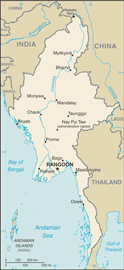
Burma is a source
country for women, children, and men trafficked for the purpose of forced
labor and commercial sexual exploitation. Burmese women and children are
trafficked to Thailand, the People's Republic of China (PRC), Bangladesh,
India, Pakistan, Malaysia, and South Korea for commercial sexual
exploitation, domestic servitude, and forced labor. Some Burmese migrating
abroad for better economic opportunities wind up in situations of forced or
bonded labor or forced prostitution. - U.S. State Dept
Trafficking in Persons Report, June, 2009 Check out a later country report here
or the full TIP Report here |
|
|||||||||||
|
CAUTION:
The following links have been culled from the web to
illuminate the situation in HOW TO USE THIS WEB-PAGE Students If you are looking
for material to use in a term-paper, you are advised to scan the postings on
this page and others to see which aspects of Human Trafficking are of
particular interest to you. Would you
like to write about Forced-Labor? Debt
Bondage? Prostitution? Forced Begging? Child Soldiers? Sale of Organs? etc. On the other
hand, you might choose to include possible precursors of trafficking such as poverty. There is a lot to the subject
of Trafficking. Scan other countries
as well. Draw comparisons between
activity in adjacent countries and/or regions. Meanwhile, check out some of the Term-Paper resources
that are available on-line. Teachers Check out some of
the Resources
for Teachers attached to this website. ***
FEATURED ARTICLE *** Remarks at
Swearing-in Ceremony Mark P. Lagon, Director, Office to Monitor and Combat Trafficking
in Persons, Washington DC, July 9, 2007 2001-2009.state.gov/g/tip/rls/rm/07/88003.htm [accessed 13 June
2013] Last week in The isolated 10-acre factory was surrounded by steel walls, 15 feet tall with barbed wire fencing, located in the middle of a coconut plantation far from roads. Workers weren't allowed to leave and were forbidden phone contact with any one outside. They lived in run-down wooden huts, with hardly enough to eat. Aye Aye is a brave, daring soul. She tried to escape with three other women. But factory guards caught them and dragged them back to the camp. They were punished as an example to others, tied to poles in the middle of the courtyard, and refused food or water. Aye Aye told me how her now beautiful hair was shaved off as another form of punishment, to stigmatize her. And how she was beaten for trying to flee. Beaten. Tortured. Starved. Humiliated. Is this not slavery?? Thai families
partners in child sex trade - Border area's products are drugs and daughters Andrew Perrin, San
Francisco Chronicle, Mae Sai, www.sfgate.com/news/article/Thai-families-partners-in-child-sex-trade-2877185.php [accessed 16 August
2012] When Burmese
migrant Ngun Chai sold his 13-year-old daughter into prostitution for $114,
his wife, La, had one regret -- they didn't get a good price for her. "I
should have asked for 10,000 baht ($228)," La Chai said. "He robbed
us." She was angry that the agent who bought her eldest child, Saikun,
in 1999 took her to Bangkok, some 460 miles away, rather than a nearby city
as promised. It did not concern La Chai that Saikun would be forced to have
sex with as many as eight men a day. With prices varying
from $114 to $913 -- the latter figure equal to almost six years' wages for
most families -- parental bonds in impoverished households are easily broken.
In fact, child prostitution is so established that many brothel agents live
in the village, and are often friends or relatives of the family from whom
they buy the children -
htcp ***
ARCHIVES *** 2023 Findings on
the Worst Forms of Child Labor U.S. Dept of Labor, Bureau of International Labor Affairs,
Child Labor and Forced Labor Reports www.dol.gov/agencies/ilab/resources/reports/child-labor/Burma
[accessed 22
December 2024] No Advancement – Efforts Made But Complicit in Forced
Child Labor
-- In 2023, Burma is receiving an assessment of no advancement. Despite
initiatives to address child labor, Burma is assessed as having made no
advancement because it demonstrated complicity in the use of forced child
labor. Burma's military continued to force civilians, including children, to
work in non-combat roles as porters, cleaners, cooks, and agricultural
laborers in conflict areas. Otherwise, Burma re-formed its National Committee
on the Elimination of Child Labor, which aims to promote awareness of child
labor, build capacity to address child labor, designate child labor-related
responsibilities to agencies, and design and implement action plans to
eliminate child labor. However, Burma's policies and practices continued to
limit children's access to education, as schools do not provide classes in
many ethnic languages, including Rohingya. Further,
Rohingya children were denied national identity
cards required to register for school, and
state-imposed movement restrictions prevent Rohingya
children from attending school. Burma also has not published a list of
hazardous work activities prohibited for children, as required by the Child
Rights Law. In addition, it is unknown whether labor or criminal law
enforcement agencies took actions to address child labor during the reporting
period. Trafficking of
Myanmar College Student Sparks Probe Into Fishing Industry Abuses Radio Free Asia RFA,
27 November 2019 www.rfa.org/english/news/myanmar/trafficking-of-myanmar-college-student-11272019145733.html [accessed 1 December
2019] Myanmar’s top human
rights body said Wednesday it will investigate the domestic fishing
industry’s use of workers sold to operators by human traffickers following a
case involving a university student who went missing for weeks after being
abducted by alleged traffickers. Myat Thura Tun, a history major at
Dagon University in Yangon, was trafficked by
brokers on Oct. 2 and sold for 700,000 kyats (U.S. $456) to the operators of
a fishing raft in Kha Pyat
village, Pyapon township, in Myanmar’s Ayeyarwady region, according to local media reports. He had worked on
the raft for about 45 days when his family tracked him down and secured his
release last week after paying 800,000 kyats (U.S. $521). Myat Thura Tun indicated that he had
been tortured by a supervisor on the raft, local media said. The boy was
physically and mentally traumatized, with the upper part of his left ear cut
off and injuries on the rest of his body. In recent weeks,
more reports of abuse and forced labor have emerged, concerning workers made
to labor long hours on traditional bamboo kyar-phaung
(tiger rafts) during peak fishing season and who are often given fatal
punishments by foremen. Trafficked: Three
survivors of human trafficking share their stories I no longer feel
alone UN Women, 29 July 2019
- originally published on Medium.com/@UN_Women www.unwomen.org/en/news/stories/2019/7/compilation-trafficking-survivors-share-stories [accessed 30 July
2019] Khawng Nu, now 24 years
old, is from Kachin, a conflict affected and
impoverished state in northern Myanmar. There are few job opportunities, so
when a woman from her village offered her work in a Chinese factory, Khawng Nu accepted the offer. However, upon arriving in
China, Khawng Nu quickly learned that she had been
deceived. The situation wasn’t at all what she was told it would be. Khawng Nu had been
trafficked to birth babies, a type of trafficking that accounts for 20 per
cent of the trafficking of women in Myanmar. Khawng
Nu recalls seeing more than 40 women on the floor of the building where she
was kept, some as young as 16. “They give pills to
women and inject them with sperm for them to carry babies for Chinese men,”
explains Khawng Nu. They were beaten and bullied at
any sign of resistance. 2020 Country
Reports on Human Rights Practices: Burma U.S. Dept of State Bureau of Democracy, Human Rights, and
Labor, 30 March 2021 www.state.gov/reports/2020-country-reports-on-human-rights-practices/burma/
[accessed 13 May
2021] PROHIBITION OF
FORCED OR COMPULSORY LABOR The military’s use
of forced labor declined, although the 2020 Secretary-General’s Report on
Children and Armed Conflict noted an increase in use of children by the
military with indicators of forced labor in conflict-affected areas in
Rakhine State. The military continued to compel forced labor by civilians as
porters, cleaners, and cooks in conflict areas. Although the military and the
government received complaints through the complaints mechanism about the
military’s use of forced labor, no military perpetrators were tried in
civilian court, and it was not possible to confirm military assertions that
perpetrators were subjected to military justice. Prisoners
in the country’s 50 labor camps engaged in forced labor. PROHIBITION OF CHILD
LABOR AND MINIMUM AGE FOR EMPLOYMENT In cities children worked mostly as street vendors, refuse collectors, restaurant and teashop attendants, and domestic workers. Children often worked in the informal economy, in some instances exposing them to drugs and petty crime, risk of arrest, commercial sexual exploitation, HIV/AIDS, and other sexually transmitted infections (also see section 6). Children were also vulnerable to forced labor in teashops, agriculture and forestry, gem production, begging, and other fields. In rural areas children routinely worked in family agricultural activities, occasionally in situations of forced labor. Child labor was also reported in the extraction of gems and jade, as well as rubber and bricks. Freedom House
Country Report 2020 Edition freedomhouse.org/country/myanmar/freedom-world/2020 [accessed 24 April
2020] G3. DO INDIVIDUALS
ENJOY PERSONAL SOCIAL FREEDOMS, INCLUDING CHOICE OF MARRIAGE PARTNER AND SIZE
OF FAMILY, PROTECTION FROM DOMESTIC VIOLENCE, AND CONTROL OVER APPEARANCE? Men and women
formally enjoy equal rights on personal status issues, though there are
restrictions on marriages of Buddhist women to non-Buddhist men. Laws that
might protect women from domestic abuse, workplace sexual harassment, and
rape are weak and poorly enforced, and such violence is an acute and
persistent problem. The army has a record of using rape as a weapon of war
against ethnic minority women, and security personnel typically enjoy
impunity for sexual violence. G4. DO INDIVIDUALS
ENJOY EQUALITY OF OPPORTUNITY AND FREEDOM FROM ECONOMIC EXPLOITATION? Human trafficking,
forced labor, child labor, and the recruitment of child soldiers all remain
serious problems in Myanmar, and the government’s efforts to address them are
inadequate. Child soldiers are enlisted by the military and ethnic rebel
groups, which also recruit civilians for forced labor. Various commercial and
other interests continue to use forced labor despite a formal ban on the
practice since 2000. Trafficking victims include women and girls subjected to
forced sex work and domestic servitude, as well as the expanding practice in
several ethnic states of being sold as brides to men in China. People displaced
by conflict are especially vulnerable to exploitation. 2017 Findings on
the Worst Forms of Child Labor Office of Child
Labor, Forced Labor, and Human Trafficking, Bureau of International Labor
Affairs, US Dept of Labor, 2018 www.dol.gov/sites/default/files/documents/ilab/ChildLaborReport_Book.pdf [accessed 15 April
2019] www.dol.gov/sites/dolgov/files/ILAB/child_labor_reports/tda2017/ChildLaborReportBook.pdf [accessed 24 April
2020] Note:: Also check out this country’s report in the more recent edition DOL
Worst Forms of Child Labor [page 218] Children in Burma
engage in the worst forms of child labor, including in commercial sexual
exploitation and armed conflict. (1; 2) In 2017, Burmese
armed forces—the Tatmadaw—forcibly recruited
children and used children as combatants in armed conflict. Since 2012, there
have been 856 verified reports of child recruitment, including 49 cases in
the first half of 2017. (2) Military and civilian brokers are reported to use
force and coercion to formally recruit children into the armed forces.
Children are deployed as combatants to the front lines of armed conflict, and
they also serve as guards and messengers. (2) In addition, in conflict areas
Burma’s armed forces use children for forced labor to porter goods, cook for
battalions, and clean barracks. During the reporting period, there were at
least 13 documented cases of children working in these types of support
roles, one of which involved over 200 children. (1) Further, the military’s
“self-reliance” policy requires local military units to procure their own
food and labor supplies, which has led to the use of forced labor, including
forced child labor, to produce goods and provide support for the armed
forces. (1) Children are also recruited and used in armed conflict by
non-state armed groups, including the Karen National Liberation Army, the
Kachin Independence Army, the Karenni Army, the
Shan State Army–South, the United Wa State Army,
and the Ta’ang National Liberation Army in Kachin, Kayin and Shan States. (2; 1) Children from the Rohingya ethnic minority in Burma’s Rakhine State were
also vulnerable to the worst forms of child labor. Since August 2017, an
estimated 690,000 Rohingya people fled from Burma
to Bangladesh due to the continued violence and acts of ethnic cleansing,
perpetrated by the Burmese military in Rakhine State. Nearly 400,000 of those
displaced are children, many of whom are subjected to hazardous work, forced
labor, and commercial sexual exploitation in Bangladesh. (29; 30; 31) There
are reports that Rohingya children are exploited in
bonded labor in the fish drying industry, while other Rohingya
boys work on farms, in construction, or on fishing boats. (32; 33; 31; 30)
Girls are often sent to work in domestic service for Bangladeshi families,
where some are physically and sexually abused, and others do not receive
payment. Also, some young girls are forced into commercial sexual
exploitation, in some cases after they were promised job in domestic service.
(34; 33; 32; 35; 31; 36; 30) Rohingya children
internally displaced in Rakhine State as a result of the violence are also
vulnerable to the worst forms of child labor, including in the extractive
industries in Burma’s Kachin State. (37) Rohingya Women Flee
Violence Only to Be Sold Into Marriage Chris Buckley and
Ellen Barry, International N.Y. Times, Gelugor,
Malaysia, 2 Aug 2015 [accessed 3 August
2015] The young woman had
been penned in a camp in the sweltering jungle of southern Thailand for two
months when she was offered a deal. She fled Myanmar
this year hoping to reach safety in Malaysia, after anti-Muslim rioters
burned her village. But her family could not afford the $1,260 the smugglers
demanded to complete the journey. She joined the
hundreds of young Rohingya women from Myanmar sold
into marriage to Rohingya men already in Malaysia
as the price of escaping violence and poverty in their homeland. While some Rohingya women agree to such marriages to escape
imprisonment or worse at the hands of smugglers, others are tricked or
coerced. Some are only teenagers. Thai fishing
industry turns to trafficking: 'We witnessed girls being raped again and
again' Chris Kelly, Annie
Kelly, Claudine Spera, Irene Baqué,
Mustafa Khalili & Lucy Lamble, theguardian.com,
20 July 2015 [accessed 20 Ju;y 2015] One year on from
the Guardian's expose of slave labour in the supply
chain of Thai prawns sold in supermarkets across the world, a new
investigation has linked Thailand's fishing industry with the vast
transnational trafficking syndicates profiting from the misery of some of the
most persecuted people on earth. Hundreds of Rohingya migrants were sold from jungle camps on to Thai fishing boats
producing seafood sold across the globe. As Thailand's fishing sector faces
crisis, fishermen are also moving closer to the traffickers, converting their
boats to carry people and facilitating huge off-shore trafficking camps. Suffer the children Danielle Bernstein,
Asia Times Online, www.atimes.com/atimes/Southeast_Asia/LK06Ae02.html [accessed 25 January
2011] Recent interviews with underage deserters from the Burmese brides for
sale Way Yan, Mizzima
News, Ruili, 28 October 2008 www.bnionline.net/index.php/feature/mizzima/5247-burmese-brides-for-sale-.html [accessed 20 August
2014] www.bnionline.net/en/mizzima-news/item/5247-burmese-brides-for-sale-.html [accessed 24 April
2020] Wah Wah was one of the women that Ma Phyu and her gang had
sold into slavery. Wah Wah was sold to a Chinese man living in Sandong, near Beijing,
at the price tag of Chinese RMB 20,000 (approximately US$ 2,900). A few weeks
later, Wah Wah managed to flee from the clutches of her buyer and made her
way back to Ruili earlier this month. The hapless young lady had nowhere else
to go but to return back to her perpetrators, and Ma Phyu was happy when her
commodity arrived back in her hands for resale. However, when she tried to
sell her to another Chinese man, Wah Wah vehemently refused. But the
traffickers, having already struck a deal and received some advance money,
tried to force Wah Wah to accept her newest companion. As dusk fell over
Ruili on that fateful day, Wah Wah was taken by taxi along the road to
Namkhan, Burma, a few miles away. Accompanying her in the vehicle were
several members of the human trafficker's family. Eventually, they stopped
the taxi next to a paddy field beside the highway in the vicinity of Man
Heiro, still in Burmese territory and about 20 miles from Ruili. "Before
leaving Ruili, they were drunk with beer. She was taken to a paddy field near
the highway. Then Kyaw Swa started raping her. After that, Bo Bo stabbed her
repeatedly. She died from five stab wounds. Then her corpse was left in the
nearby drainage," recalls a source from the Chinese police investigation
team of the incident. KWAT: Women
enslaved due to economic hardships Phanida, Mizzima
News, Chiang Mai, 05 August 2008 reliefweb.int/report/myanmar/myanmar-kwat-women-enslaved-due-economic-hardships [accessed 20 August
2014] Economic hardship
and poverty have caused several young women in US Senate
'Trafficking of Burmese Migrants' Report Holds Member of Parliament
Klang Charles Santiago, charlessantiago.org/2009/04/24/us-senate-trafficking-of-burmese-migrants-report-holds-malaysia-and-asean-responsible-and-demands-immediate-action/ [accessed 20 August
2014] The report suggests
that Malaysian authorities are in cohorts with human traffickers in Human Traffickers
Get Free Rein with Burmese Migrants in Original reporting
in Burmese by Kyaw Min Htun. Written for the Web in English by Luisetta
Mudie, Radio Free www.david-kilgour.com/2008/Feb_09_2008_11.htm [accessed 25 January
2011] Burmese migrant
workers in Several secret
jails or deportation camps exist around the country to hold foreign nationals
found without papers. From there, officials take them to the Thai border,
where trafficking gangs have close ties to Malaysian officials and have been
tipped off to their arrival. Economic Crisis
Fueling Child Labor, Trafficking Saw Yan Naing, The www2.irrawaddy.com/article.php?art_id=9627 [accessed 24 April
2020] The economic crisis
and instability in Burma is driving waves of Burmese children into hard
labor, begging and the sex trade, claims exiled Burmese rights groups. Meanwhile, the
results of child trafficking has had a huge impact on the education of many
Burmese migrant children, forcing the children into hard labor in factories,
sweat shops and even into the sex trade, according to Burmese migrant
education groups. Many victims under the age of 18 have become street beggars
and sex workers instead of studying at school, said Paw Ray, the chairperson
of the BMWEC, which operates nearly 50 schools for children of Burmese
migrant workers in Mae Sot. Ben Blanchard,
Reuters, www.reuters.com/article/idUSPEK11308820071212 [accessed 25 January
2011] There has been a
rise in trafficking cases involving Governing Justly
and Combating Human Trafficking: The Linkages Mark P. Lagon,
Director, Office to Monitor and Combat Trafficking in Persons, U.S. Dept of
State, Remarks at the Freedom House-SAIS "Human Trafficking and
Freedom" Event, Washington DC, December 3, 2007 2001-2009.state.gov/g/tip/rls/rm/07/96171.htm [accessed 21 July
2013] The Burmese people represent
a case study of repression at home and then vulnerability abroad. Facing a
cruel regime, bleak economic conditions and the prospect of forced labor at
home, millions of Burmese have had to flee. Among these most vulnerable are
girls and women from Burma's ethnic minorities. Rape is widespread in Burma.
Shan, Karen, Chin, Mon and other ethnic minority women and girls live in
daily fear of sexual violence by their military oppressors. After
successfully escaping slavery in Burma, another cruel fate awaits too many
Burmese. They are preyed upon by traffickers and exploitative employers. They
are pushed into the sex trade or into highly predatory economic sectors in
neighboring countries. Fleeing literal enslavement at home, they face extreme
exploitation in neighboring countries-these women, migrants and refugees are
regularly dehumanized. Agence France-Presse
AFP, www.abc.net.au/news/2007-11-25/burma-rebel-group-denies-child-soldier-claims/967816 [accessed 25 January
2011] In a statement
released Friday, UN Secretary General Ban Ki-moon said that both the military
government and rebel groups continued to violate children's rights by
recruiting underage soldiers. Citing a recent UN report, he said that the
government was picking up street children or those without national identity
cards and offering them the choice of arrest or joining the army. Myanmar's military
government officially denies using child soldiers and has passed a law to
outlaw the practice. But human rights groups say child soldiers in Myanmar remain
alarmingly common, with boys as young as 12 recruited to fight the ethnic
rebel armies in the country's border regions. - htsc The Burmese Junta's
Hidden Victims Mark P. Lagon,
Director, Office to Monitor and Combat Trafficking in Persons, 2001-2009.state.gov/g/tip/rls/94556.htm [accessed 21 July
2013] Facing bleak economic
conditions and the prospect of forced labor at home, millions of Burmese have
had to flee their homes and villages, usually without legal documents, making
them even more vulnerable to human trafficking and the predations of corrupt
officials. Human trafficking
helps spread HIV/AIDS in Asia: UN Ranga Sirilal,
Reuters, www.reuters.com/article/idUSL22325220070822 [accessed 25 January
2011] "Trafficking
... contributes to the spread of HIV by significantly increasing the
vulnerability of trafficked persons to infection," said Caitlin
Wiesen-Antin, HIV/AIDS regional coordinator, Major human
trafficking routes run between Nepal and India and between Thailand and
neighbors like Laos, Cambodia and Myanmar.
Many of the victims are young teenage girls who end up in prostitution.
"The link between human trafficking and HIV/AIDS has only been
identified fairly recently," Wiesen-Antin told the International
Congress on AIDS in Asia and the Pacific. Myanmar sentences
33 human traffickers to life imprisonment Xinhua News Agency,
February 19, 2007 english.people.com.cn/200702/19/eng20070219_351227.html [accessed 25 January
2011] According to the
report, the human traffickers deceived 49 young Myanmar court
sentences woman to 12 years for human trafficking The Associated Press
AP, www.iht.com/articles/ap/2006/10/28/asia/AS_GEN_Myanmar_Human_Trafficking.php At one time this
article had been archived and may possibly still be accessible [here]
A Senior Officials
Meeting for the Coordinated Mekong Ministerial Initiative against Trafficking
(COMMIT) opens [PDF] "The New Light
of Myanmar", Yangon, 27 Oct 2004 -- page 16 www.ibiblio.org/obl/docs/NLM2004-10-28.pdf [accessed 18
February 2013] [scroll down]
INTERNATIONAL RELATION - SENIOR OFFICIALS MEETING FOR THE COORDINATED MEKONG
MINISTERIAL INITIATIVE AGAINST TRAFFICKING (COMMIT) OPENS - In Myanmar, we have, as of last year,
formed a Specialist Anti-trafficking Police Unit and Anti-trafficking Task
Forces around the border and other hot spot areas. At the same time, we are
of course aware, of the absolute need to provide psycho-social support to the
victims of trafficking, undertake and improve repatriation and reintegration
systems, and provide rehabilitation services for the victims of trafficking
and vulnerable groups. Xinhua News Agency,
August 05, 2006 english.people.com.cn/200608/05/eng20060805_290239.html [accessed 25 January
2011] During the period,
subordinate committees at different levels in 14 states and divisions were
able to expose and arrest 1,484 persons -- 815 males and 669 females, and
also rescued in time 3, 694 persons -- 1,904 males and 1,790 females, the
paper disclosed. Three Women
Arrested in Muse for Human Trafficking Narinjara
Independent Arakanese News Agency, 7/23/2006 bnionline.net/index.php/news/narinjara/279-three-women-arrested-in-muse-for-human-trafficking.html [accessed 20 August
2014] According to
confirmed sources, some human trafficking syndicates have been dispatching
young women from Xinhua News Agency,
June 20, 2006 english.people.com.cn/200606/20/eng20060620_275589.html [accessed 25 January
2011] Noting that Myanmar
passed an anti-trafficking in persons law in September 2005 that covers
sexual exploitation, forced labor, slavery, servitude and debt bondage, the
release said during the year, the government prosecuted 426 traffickers in
203 cases under the new law and identified 844 victims. Xinhua News Agency, news.xinhuanet.com/english/2006-05/07/content_4517342.htm [accessed 25 January
2011] en.ce.cn/World/Asia-Pacific/200605/07/t20060507_6891299.shtml [accessed 21 January
2018] Since the signing
of the historic COMMIT Memorandum of Understanding in Yangon, Myanmar in
October 2004, by Ministers of the six countries, the Governments have been
active in laying the foundation for a network of cooperation to stop
traffickers and prosecute them, protect victims of trafficking and assist
them return safely home, and launch efforts to prevent others from sharing
the same fate. Rice Names
'Outposts of Tyranny' The Associated Press
AP, Jan. 19, 2005 news.bbc.co.uk/2/hi/americas/4186241.stm [accessed 21 July
2013] Condoleezza Rice
named Diminished ILO
Visit Spells Trouble Larry Jagan, www.freerepublic.com/focus/f-news/1354851/posts [accessed 25 January
2011] When the high-level
delegation cut short its visit and left Rangoon a week ago, it left the
regime with a four-point plan of action: the issuance of clear instructions
to the army, and publicity for a campaign, to stop the use of forced labor; a
renewed commitment to the previously agreed plan of action on forced labor,
after the regime has dragged its feet over the past year; the granting of
freedom of movement to the ILO liaison officer in Rangoon, which has been
curtailed significantly for some time; and the extension of an amnesty to the
third of three people convicted of high treason essentially for having
contact with the ILO. 18. Allegations On
Exercising Forced Labor in OKKAR, Union of www.myanmar-information.net/political/english.pdf [accessed 25 January
2011] newsgroups.derkeiler.com/Archive/Soc/soc.rights.human/2005-09/msg00027.html [accessed 29 May
2017] [scroll
down to … 18. Allegations On Exercising Forced Labor in This allegation has
been widely and conveniently used against the Government of Myanmar by
certain quarters to disseminate disinformation in the attempt to portray her
as a cruel and wicked regime. U.N.: Jonathan Fowler,
Associated Press AP, www.burmanet.org/news/2005/03/25/associated-press-un-myanmar-must-stop-forced-labor-jonathan-fowler/ [accessed 25 January
2011] www.business-humanrights.org/en/un-myanmar-burma-must-stop-forced-labor [accessed 24 April
2020] "For years
we've had a contradictory message," she said following a meeting of the
ILO's governing body. "There is always a promise to do something, a few
little steps, then a terrible backlash." Sex Trafficking
Growing In S.E.Asia Fayen Wong, Reuters,
www.chinapost.com.tw/print/61645.htm At one time this
article had been archived and may possibly also be accessible [here] [accessed 20 August
2014] Girls from the
villages of 4 Kyodo News
International, www.thefreelibrary.com/4+Myanmar+officials+get+jail+over+forced+labor.-a0128174630 [accessed 25 January
2011] Four local
officials in Travel Guides and
the Nov 6, 2004 www.gadling.com/2004/11/06/travel-guides-and-the-burma-debate/ [accessed 25 January
2011] The Burmese
democracy movement, led by Nobel Peace Prize winner Aung San Suu Kyi, has
asked that tourists not visit Big Business Keeps
Eye on Historic Human Rights Case Anna Sussman,
Pacific News Service, Nov 19, 2004 news.newamericamedia.org/news/view_article.html?article_id=910d6bde26c3823430b0f878520c3dc1 [accessed 4
September 2011] [accessed 29 May
2017] One of the
plaintiffs, Jane Doe, has testified that her husband was shot when attempting
to flee forced labor on the pipeline, and that her baby was killed when
thrown into a fire in retaliation for his attempted escape. All 12 plaintiffs
remain anonymous for fear of repercussions against them and their family
members. Harsh Policy
Towards Burmese Refugees Sam Zia-Zarifi,
Deputy Director of Human Rights Watch/Asia, Special to The Nation ( www.hrw.org/english/docs/2004/01/27/thaila7075.htm [accessed 25 January
2011] www.hrw.org/news/2004/01/27/thailand-harsh-policy-towards-burmese-refugees [accessed 24 April
2020] The Thai government
made this decision, despite the fact that the horrendous conditions in Burma
have not ceased. Burmese continue to flee abuses such as forced labor,
persecution of dissidents, conscription of child soldiers, rape of ethnic
minority women and children by government troops, and forced relocation. Conscripts -
Soldiers of misfortune Alex Perry, Reported
by Robert Horn/Karen state, www.badasf.org/slavery/timeasia-childsavery.htm#five [accessed 29 August
2011] For years, sein
win's job in the burmese army was to guard citizens who had been forced into
hard labor, building the nation's roads, railways, helipads and barracks.
"We threatened them with guns to make them work," says Sein Win,
now 20, who recently deserted from the military. "No soldier would dare
be kind to the villagers because the officers would beat us if we showed them
any mercy." Now Program on Posted by Randy Paul
in weblog Human Rights and weblog International Law, January 12, 2004 beautifulhorizons.typepad.com/weblog/2004/01/now_program_on_.html [accessed 20 August
2014] Last week on NOW
with Bill Moyers, there was a segment that dealt with this issue and the
specific case in Burma in which several Burmese citizens are suing the oil
company, Unocal over allegations of complicity with slave labor that the
Burmese military (which provided security for a oil pipeline that Unocal was
building). Oral intervention
delivered by Anti-Slavery International on 6 April 2004 Anti-Slavery
International, Oral intervention, UN Commission on Human Rights 60th session,
6 April 2004 old.antislavery.org/archive/submission/submission2004-CHRchild.htm At one time this
article had been archived and may possibly also be accessible [here]
[accessed 20 August
2014] ITEM 13 RIGHTS OF
THE CHILD
- Restrictions of freedom of movement, as Rohingya children and their parents
are virtually confined to their village tracts. The need to obtain travel passes
limits their access to health, education and employment, thus severely
affecting the livelihood of the family. In the field of
health and education, they are particularly neglected. Sixty per cent of the
Muslim children of Northern Rakhine State are said to suffer from
malnutrition and the level of illiteracy is extremely high. Restriction of
access to food through a series of constraints, including arbitrary taxation
and extortion, is the main strategy of the regime to encourage departure, and
a major root cause of the ongoing exodus to Bangladesh. Increasingly,
measures are being imposed to control birth and to limit expansion of the
Rohingya population. Unlike other people of Burma, the Rohingyas must apply
for permission to get married, which is only granted in exchange for high
bribes and can take up to several years to obtain. To register their
children's birth, parents are charged fees that significantly increased in
2003. Moreover, building a new house or repairing or extending an existing dwelling
also require authorisation, resulting in overcrowded and precarious living
conditions, affecting women and children. Many Rohingya
children are subject to forced labour. Cultural practices in the Rohingya
community prevent women from participating in activities outside of their
homes. As male adults are busy earning the daily wage to feed the family, the
burden of carrying out forced labour duties often falls on children. Solar Health
Clinics in Burma Geoffrey Schöning,
SEI Newsletter Issue 17 - May 2004 www.earthplatform.com/burmese/military At one time the full
article had been archived and may possibly still be accessible [here]
[accessed 4
September 2011] [scroll down to Solar Health Clinics in Burma] BACKGROUND - The Eastern area
of Burma (often referred to as Myanmar), along the
border with Thailand is a zone that has been under siege for the past several
decades. The Burmese military have been constantly oppressing the indigenous
peoples of this area, burning villages and crops, forcing men and women into
slavery, raping, and killing. In the past, it was
possible to escape to refugee camps within the Thai border, and currently
there is a string of refugee camps along the border with US House of Reps.
Extends groups.yahoo.com/group/freeburma9999/message/670 [accessed 19 April
2012] uscampaignforburma.org/images/PressRelease/2004/June_14th_2004-_modified.pdf [accessed 29 May
2017] [scroll down] The regime's brutality is well-documented. According to credible nongovernmental organizations, it has imprisoned over 1,500 political prisoners, conscripted up to 70,000 child soldiers, carries out a modern form of slavery, and uses rape as a weapon of war. Case Study: Corvée
(Forced) Labour Adam Jones,
Gendercide Watch www.gendercide.org/case_corvee.html [accessed 25 January
2011] FOCUS (4): "Trading Women" Filmmaker Shatters Myths about Human Trafficking Vicki iipdigital.usembassy.gov/st/english/article/2003/09/20030911115501namrevlisv0.2781031.html#axzz3AwlMjpJ9 At one time this
article had been archived and may possibly also be accessible [here]
[accessed 4
September 2011] IDENTIFYING THE
PROBLEM IN ASIA
- "One thing our research showed, for a highland girl in "If you look
at where the key problem of trafficking is (in this area of Southeast Asia),
it is in Burma. The majority of girls who are trafficked come from Burma. For
the Shan women, the way they express their choices are to stay home and get
raped by the Burmese army for free, or come down to Thailand and do sex work
for money. This is not a choice anyone should ever have to make," he
said. www.burmatoday.net/kaowao/2003/10/031012_thailand_kaowao.htm [accessed 25 January
2011] Local migrant
advocacy groups say the Chiang Mai raid, like other actions taken against
human trafficking, had netted Burmese women voluntarily engaged in
prostitution. Now, they say, those women may be worse off than before. These groups accuse
the US-funded anti-trafficking task force that led the raid of steamrolling
women's rights and treating all sex workers as victims. "The women
didn't feel like they were rescued because they lost their money.... They
felt like they were trapped," says Hseng Noung, of the Shan Women's Action
Network (SWAN), who interviewed ethnic Shan women detained in the raid.
"Being forced to work physically is one thing, but these women were
forced to work by their situation." Oil-gas giant faces
landmark trial over slavery in Kathy George, www.seattlepi.com/local/150576_human01.html [accessed 25 January
2011] The soldiers' true
role was to force villagers in the pipeline region to work without pay -- a
modern form of slavery, the 9th Circuit opinion said. And Unocal knew, both
before and after investing in the project, that the military was enslaving
the people, the opinion said. Unocal's own
consultant, former military attache John Haseman, reported to Unocal in
December 1995 that the soldiers were committing "egregious human rights
violations" along the pipeline route. "The most common are forced
relocation without compensation of families from land near/along the pipeline
route, forced labor to work on infrastructure projects supporting the
pipeline ... and imprisonment and/or execution by the army of those opposing
such actions," Haseman told Unocal in a report quoted in court records. New Coalition urges
UK Government to stop investment in Burma Anti-Slavery
International, 18 March 2002 www.thefreelibrary.com/Tutu+tells+Britain%3A+It%27s+time+to+act+over+Burma.-a083908269 At one time the full
article had been archived and may possibly still be accessible [here]
[accessed 4
September 2011] Archbishop Desmond
Tutu, said: "Burma's military has put millions of civilians into forced
labour, imprisoned hundreds of political prisoners, has created more child
soldiers than any other country in the world, and has forcibly 'relocated'
half a million ethnic people". Millions Suffer in
Sex Slavery United Press
International UPI, Chicago, April 24, 2001 humanrightscivics1.wikifoundry.com/page/Sex+Slaves [accessed 20 August
2014] Statistical
estimates indicate 300,000 women have been sold into the sex trade in Western
Europe in the last 10 years, and since 1990, 80,000 women and children from
Myanmar (formerly Burma), Cambodia, Laos and China have been sold into
Thailand's sex industry. Silver Cos. needn't
look far to find some slave-museum artifacts Rick Mercier, The
Free Lance-Star, December 1, 2001 www.fredericksburg.com/News/FLS/2001/122001/12012001/461253/index_html [accessed 25 January
2011] [accessed 24 April
2020] Last year, the ILO
condemned the Burmese military's "widespread and systematic" use of
forced labor as "a modern form slavery,"
and called on governments, labor unions, and employers to take steps to
ensure they were not helping to sustain the Burmese junta's practice of
enslaving its citizens. There are a couple
of ways that Burmese imports enrich Burma's slavemasters and contribute to
their ability to continue enslaving people, according to the Free Burma
Coalition. First, Burma's military dictatorship charges a 5 percent tax on
all exports from Burma, and much of that revenue goes straight to the
military. Second, the junta retains partial ownership of most factories in
Burma, with profits going largely to the military. Moreover, the coalition
says, Burmese imports never even would have made it to places like Central
Park had it not been for roads and other infrastructure back in ILO team completes
mission to assess forced labor in Myanmar Agence France-Presse
AFP, www.burmalibrary.org/reg.burma/archives/200010/msg00110.html [accessed 25 January
2011] An International
Labor Organisation (ILO) team has completed a six-day mission to "They are not
completely happy with what they have seen so far, and want to see more
progress being made (on ending forced labor)," the source said.
"However, there are signs of goodwill on the part of the Burmese, who
were cooperative. The team managed to see everyone they wanted to see." 2000 Update on
Forced Labor and Forced Relocations United States
Department of Labor, Bureau of International Labor Affairs, 2000 www.dol.gov/ILAB/media/reports/ofr/burma2000/forced.htm [accessed 25 January
2011] Since the
Department of Labor's 1998 report, there has been little change in the
situation with regard to the use of forced labor in Maggie O'Kane, The
Guardian, 27 July 2000 www.guardian.co.uk/uk/2000/jul/27/burma [accessed 25 January
2011] The Burmese have
been accused of using "security" issues in the pipeline area of
Tanasserim to drive ethnic Karen people from the land. There are now 120,000
Karen living in refugee camps and human rights groups say at least 30,000
Karen have been killed. The army's tactics include rape and summary
executions. The report says the
army was extorting money from local people and using children and forced
unpaid labour - described by the special UN rapporteur to Burma as a modern
form of slavery - to build military barracks. "The harsh conditions of
those carrying out the labour, including young children and the testimony of
local people, belies the government claim that such work is voluntary,"
said the report. Welcome to Free Center for Southeast
Asian Studies, ny.xmu.edu.cn/Article/ShowArticle.asp?ArticleID=1812 [accessed 25 January
2011] [scroll down] The country of The Boston Tea
Party Revisited:Massachusetts Boycotts Burma Robert Stumberg and
William Waren, "State Legislatures Magazine", National Conference
of State Legislatures NCSL, May 1999 www.amazon.com/The-Boston-party-revisited-Massachusetts/dp/B00098S5EG At one time this
article had been archived and may possibly still be accessible [here]
[accessed 4
September 2011] Political
repression. When the military government of Burma lost more than 80 percent
of the seats in parliament to the National League for Democracy in 1990, it
repudiated the election and began closing NLD offices and jailing the party's
legislators. The government has waged war against rural ethnic minorities,
who supported the NLD commitment to create a federal system with regional
self-government. Forced labor. Burma
is building its commercial infrastructure with labor forced at the point of a
gun. In the previous decade, more than 5.5 million people have been forced to
work on construction of airport runways, railroads, highways and agricultural
irrigation systems. Seven percent of Burma's economy is based on this slavery.
Rape and brutality.
The most common form of forced labor is military portering. Even old people,
women and teenagers are required to carry military supplies on their backs.
Porters are forced to walk ahead of troops to detonate mines and act as human
shields in combat against Burma's own ethnic minorities. Soldiers often beat
porters with rifle butts and have forced teenagers to execute other porters
who could no longer work. Women porters are separated at night from the men
and are frequently raped by the soldiers. Displacement of
populations in Western Burma (Myanmar) Anti-Slavery
International, UN Economic & Social Council Commission on Human Rights
55th Session Item 14(c) Specific
Groups and Issues - Mass Exoduses and Displaced Persons, old.antislavery.org/archive/submission/submission1999-01dis.htm At one time this
article had been archived and may possibly also be accessible [here]
[accessed 20 August
2014] In Burma, the
widespread repression of ethnic minorities and the countrywide practice of
forced labour as documented in the ILO Commission of Inquiry report dated 2
July 1998, have led to an unprecedented displacement of populations. So-called
"development programmes" consist mostly of infrastructure projects
carried out with unpaid forced labour and extortion from the local
population. New roads are built to facilitate military penetration and to
control border trade for the economic interest of the military. These
projects have thus provided little improvement to the inhabitants of these
regions, but rather persecution and impoverishment. In Sagaing
Division, Naga villagers are used as forced labour to upgrade roads for
military purposes, and are forced to become porters and recruits for the
troops. In the In Sagaing
Division, a series of dam projects for irrigation has led to land
confiscation, destruction of sacred sites and forests, as well as extensive
forced labour. The Kalay-Pakkoku
railway was built with the forced labour of thousands of villagers and
prisoners. In In These military
practices have meant that many people are no longer able to grow enough food
or otherwise earn enough income to support their families. They have been
impoverished to such an extent that they have no other option than leaving
their homes in search of a means of survival. Unwanted and
Unprotected:Burmese Refugees in Human Rights www.hrw.org/legacy/reports/reports98/thai/ [accessed 20 August
2014] SUMMARY AND
RECOMMENDATIONS
- At almost no time since Burmese asylum seekers started arriving on Thai
soil in 1984 has the need for protection of this group been greater.1
Human rights violations inside Modern Form of
Slavery: Trafficking of Burmese Women and Girls into Brothels in Human Rights Watch, www.hrw.org/legacy/reports/1993/thailand/ [accessed 4
September 2011] IV. TRAFFICKING IN WOMEN AND GIRLS A. RECRUITMENT THE MONEY - For all but two
of the twenty-six Burmese women and girls trafficked through Mae Sai, the cash
transaction that sealed the recruit's fate took place in the town of Once the money
changed hands, the Mae Sai agent often arranged through the local police to
send the woman or girl, usually with two or three other new recruits,
sometimes with as many as ten, in a truck or van directly to a brothel or to
another agent at a way station en route to Bangkok -- usually Chiangrai. Of
those we interviewed, twenty ended up in Concluding
Observations of the Committee on the Rights of the Child (CRC) UN Convention on the
Rights of the Child, 24-01-1997 sim.law.uu.nl/SIM/CaseLaw/uncom.nsf/0/0f90115e70a4b29ec125663c00343b92?OpenDocument [accessed 25 January
2011] [24] Furthermore,
the Committee expresses its regret that insufficient measures are being taken
to address the problems of child abuse, including sexual abuse,
and the sale and trafficking of children, child prostitution and child
pornography. It is especially concerned by the fact that a significant number
of girls, and sometimes boys, are victims of transnational trafficking for
the purpose of sexual exploitation in brothels across the border. The Protection
Project - The www.protectionproject.org/human_rights_reports/report_documents/myanmar.doc [Last accessed 2009] FORMS OF TRAFFICKING - Women and
children are trafficked from Reportedly, Myanmar
women and girls are commonly sold to Chinese men as mail-order brides and for
the purpose of forced marriage. More than 100 Myanmar women are reported to
be living in the Chinese province of Anhwei alone,
where they are exploited by their Chinese husbands sexually and forced to
work on farms and as housemaids. Human
Rights Overview by Human
Rights Watch - Defending Human Rights Worldwide [accessed 25 January
2011] ***
EARLIER EDITIONS OF SOME OF THE ABOVE *** Freedom House
Country Report - Political Rights: 5 Civil Liberties: 5 Status: Partly Free 2018 Edition freedomhouse.org/country/myanmar/freedom-world/2018 [accessed 24 April
2020] G4. DO INDIVIDUALS
ENJOY EQUALITY OF OPPORTUNITY AND FREEDOM FROM ECONOMIC EXPLOITATION? While the
government has made increased efforts to identify and prosecute human
trafficking, it remains a serious problem. Child labor is widespread. Various
commercial and other interests continue to use forced labor despite a formal
ban on the practice since 2000. Trafficking victims include women and girls
subjected to forced sex work and domestic servitude. 2017 Country
Reports on Human Rights Practices U.S. Dept of State Bureau of Democracy, Human Rights, and
Labor, 20 April 2018 www.state.gov/j/drl/rls/hrrpt/2017/eap/277069.htm [accessed 18 March
2019] www.state.gov/reports/2017-country-reports-on-human-rights-practices/burma/ [accessed 25 June
2019] PROHIBITION OF
FORCED OR COMPULSORY LABOR Reports of forced
labor occurred across the country, including in conflict and cease-fire
areas, and the prevalence was higher in states with significant armed
conflict. Forced labor reports included forced portering
and activities related to the military’s “self-reliance” policy. Under the
self-reliance policy, military battalions are responsible for procuring their
own food and labor supplies from local villagers--a major contributing factor
to forced labor and other abuses. The ILO received reports
of forced labor in the private sector, including excessive overtime with or
without compensation by workers at risk of losing their jobs and also by
bonded labor. Domestic workers also remained at risk of domestic servitude. PROHIBITION OF CHILD
LABOR AND MINIMUM AGE FOR EMPLOYMENT Child labor
remained prevalent and highly visible. Children were at high risk, with
poverty leading some parents to remove them from schools before completion of
compulsory education. In cities children worked mostly as street vendors or
refuse collectors, as restaurant and teashop attendants, and as domestic
workers. Children often
worked in the informal economy, in some instances exposing them to drugs and
petty crime, risk of arrest, commercial sexual exploitation, and HIV/AIDS and
other sexually transmitted diseases (also see section 6). Children were
vulnerable to forced labor in teashops, agriculture, and begging. In rural
areas children routinely worked in family agricultural activities,
occasionally in situations of forced labor. Human Rights
Reports » 2005 Country Reports on Human Rights Practices 2009-2017.state.gov/j/drl/rls/hrrpt/2005/61603.htm [accessed 7 February
2020 TRAFFICKING
IN PERSONS
- The government made limited progress on trafficking in persons during the
year. The government's pervasive security controls, restrictions on the free flow
of information, and lack of transparency prevented a comprehensive assessment
of trafficking in persons activities in the country. While experts agreed
that human trafficking from the country was substantial, no organization,
including the government, was able or willing to estimate the number of
victims. The government did not allow an independent assessment of its
reported efforts to combat the problem. Trafficking of
women and girls to Human traffickers
appeared to be primarily free‑lance, small‑scale operators using
village contacts that fed victims to more established trafficking
"brokers". All
material used herein reproduced under the fair use exception of 17 USC § 107
for noncommercial, nonprofit, and educational use. PLEASE RESPECT COPYRIGHTS
OF COMPONENT ARTICLES. Cite this webpage as: Patt, Prof. Martin, "Human
Trafficking & Modern-day Slavery - |
||||||||||||