Human Trafficking & Modern-day Slavery Poverty drives the unsuspecting poor into the
hands of traffickers Published reports & articles from 2000 to 2025 gvnet.com/humantrafficking/BurkinaFaso.htm
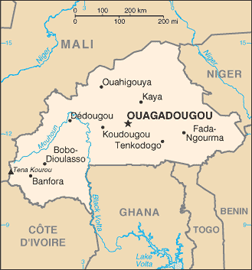
Burkina Faso is a source, transit, and destination country
for children and women trafficked for the purposes of forced labor and commercial
sexual exploitation. Most victims are children, trafficked within the country
from rural areas to urban centers such as Ouagadougou and Bobo-Dioulasso, for domestic servitude, sexual exploitation,
and forced labor in gold mines and stone quarries, and the agriculture
sector. Burkinabè children are also trafficked for
the same purposes to other West African countries, most notably to Côte
d’Ivoire, where many are subjected to forced agricultural labor, including on
cocoa farms. - U.S. State Dept Trafficking in Persons Report, June, 2009 Check out a later country report here
or the full TIP Report here |
|
|||||||||||
|
CAUTION: The following
links have been culled from the web to illuminate the situation in HOW TO USE THIS WEB-PAGE Students If you are looking
for material to use in a term-paper, you are advised to scan the postings on
this page and others to see which aspects of Human Trafficking are of
particular interest to you. Would you
like to write about Forced-Labor? Debt
Bondage? Prostitution? Forced Begging? Child Soldiers? Sale of Organs? etc. On the other
hand, you might choose to include possible precursors of trafficking such as poverty. There is a lot to the subject
of Trafficking. Scan other countries
as well. Draw comparisons between activity
in adjacent countries and/or regions.
Meanwhile, check out some of the Term-Paper resources
that are available on-line. Teachers Check out some of
the Resources
for Teachers attached to this website. ***
FEATURED ARTICLES *** Nigerian ladies
rescued from prostitution syndicate’s den in Burkina Faso Chris Anucha and
Matthew Dike, Daily Sun, February 2, 2006 [access information
unavailable] Tony was said to
have promised to take Rita and Lovina to Germany, to meet their elder sister
who resides in that country, but the journey ended up in Burkina Faso where
he told them they were brought to the country for prostitution. Children saved from
'slavery' Agence France-Presse
AFP, www.news24.com/Africa/News/Children-saved-from-slavery-20040507 [accessed 24 January
2011] Police in The traffickers had
managed to win the confidence of the children's parents by convincing them
that the youngsters were to be taken to The official daily
Sidwaya reported that the real fate of such victims, snatched in several
provinces in ***
ARCHIVES *** 2023 Findings on
the Worst Forms of Child Labor U.S. Dept of Labor, Bureau of International Labor Affairs,
Child Labor and Forced Labor Reports www.state.gov/reports/2023-country-reports-on-human-rights-practices/burkina-faso/
[accessed 22
December 2024] Moderate Advancement - In 2023, Burkina
Faso made moderate advancement in efforts to eliminate the worst forms of
child labor. The government enacted a list of light work authorized for
children that meets international standards. The government also deployed a
mobile app called Kogl-Kamba in a few
locations to facilitate reporting and share information with social services
providers on child labor issues. Lastly, the government carried out radio
campaigns nationally in five local languages to inform the population,
especially rural communities, on what is considered hazardous work for
children. However, despite these efforts, the government lacked financial
resources for the enforcement of child labor laws and did not release
information on its labor law enforcement efforts. Finally, the government did
not provide information on activities undertaken to implement the National
Child Protection Strategy during the reporting period. 2020 Country
Reports on Human Rights Practices: Burkina Faso U.S. Dept of State Bureau of Democracy, Human Rights, and
Labor, 30 March 2021 www.state.gov/reports/2020-country-reports-on-human-rights-practices/burkina-faso/
[accessed 13 May
2021] PROHIBITION OF
FORCED OR COMPULSORY LABOR Forced child labor occurred in the agricultural (particularly cotton), domestic labor, and animal husbandry sectors, as well as at gold panning sites and stone quarries. Educators forced some children sent to Quranic schools by their parents to engage in begging (see section 6, Children). Women from other West African countries were fraudulently recruited for employment and subsequently subjected to forced prostitution, forced labor in restaurants, or domestic servitude in private homes. PROHIBITION OF CHILD
LABOR AND MINIMUM AGE FOR EMPLOYMENT Child labor took place in the agricultural sector or in family-owned small businesses in villages and cities. There were no reports of children younger than age 15 employed by either government-owned or large private companies. Children also worked in the mining, trade, construction, and domestic labor sectors. Some children, particularly those working as cattle herders and street hawkers, did not attend school. Many children younger than 15 worked long hours. A study by the International Labor Organization reported that children working in artisanal mining sometimes worked six or seven days a week and up to 14 hours per day. Street beggars often worked 12 to 18 hours daily. Such children suffered from occupational illnesses, and employers sometimes physically or sexually abused them. Child domestic servants worked up to 18 hours per day. Employers often exploited and abused them. Criminals transported Burkinabe children to Cote d’Ivoire, Mali, and Niger for forced labor or sex trafficking. Freedom House
Country Report 2020 Edition freedomhouse.org/country/burkina-faso/freedom-world/2020 [accessed 8 July
2020] G4. DO INDIVIDUALS
ENJOY EQUALITY OF OPPORTUNITY AND FREEDOM FROM ECONOMIC EXPLOITATION? Burkina Faso is a source,
transit, and destination country for human trafficking. Child labor is
present in the agricultural and mining sectors. Women from neighboring
countries are recruited by traffickers and transported to Burkina Faso, where
they are forced into prostitution. According to the US
Department of State’s 2019 Trafficking in Persons Report, Burkina Faso has
worked to combat human trafficking through expanded efforts to convict
perpetrators and protect victims of trafficking. However, the country fell
short in key areas, including comprehensive data reporting and the
identification and referral of adult victims. 2017 Findings on
the Worst Forms of Child Labor Office of Child
Labor, Forced Labor, and Human Trafficking, Bureau of International Labor
Affairs, US Dept of Labor, 2018 www.dol.gov/sites/default/files/documents/ilab/ChildLaborReport_Book.pdf [accessed 15 April
2019] www.dol.gov/sites/dolgov/files/ILAB/child_labor_reports/tda2017/ChildLaborReportBook.pdf [accessed 24 April
2020] Note:: Also check out this country’s report in the more recent edition DOL
Worst Forms of Child Labor [page 208] Children in Burkina
Faso engage in the worst forms of child labor, including in commercial sexual
exploitation and artisanal gold mining. Children also perform dangerous tasks
in cotton harvesting. (1; 2; 3; 4; 5; 6) Table 1 provides key indicators on
children’s work and education in Burkina Faso. Burkina Faso is a
destination, transit point, and source for child trafficking to and from other
West African countries. (36; 40; 41; 42; 43) The practice of confiage, which involves sending a child to live with a
relative or friend to attend school in a larger town or city, may place
children at risk of internal human trafficking. (28) Child labor in artisanal
gold mining is particularly acute and often exposes children to dangerous
chemicals used in the gold extraction process, such as cyanide and mercury.
(4; 5; 44; 45; 46; 47). Child slavery in
Burkina Faso, including boy domestic slaves; protection from the authorities
and NGOs; possibility of emancipation, particularly when a young boy given to
a family as a payment of a debt reaches the age of majority (2004-2006) Immigration and
Refugee Board of www.unhcr.org/refworld/country,,IRBC,,BFA,456d621e2,45f146f3b,0.html [accessed 24 January
2011] www.refworld.org/docid/45f146f3b.html [accessed 5
September 2016] Many sources
indicated that child forced labour is still a problem in Burkina Faso
(Country Reports 2004 28 Feb. 2005, intro. and Sec. 5; AFP 5 Jan. 2006).
Country Reports 2004 reported that "security forces ... intercepted 644
trafficked children in 2003," and that "trafficked children were
subject to violence, sexual abuse, forced prostitution, and deprivation of
food, shelter, schooling, and medical care" (28 Feb. 2005, Sec. 5). The
same source also indicated that "organized child trafficking networks existed
throughout the country," and that "one study identified eight
networks in NGOs Work To
Eradicate Human Trafficking, Help Victims iipdigital.usembassy.gov/st/english/article/2007/06/20070605161941bcreklaw0.5122492.html#axzz3CMfHlohT [accessed 5
September 2014] japan2.usembassy.gov/e/p/2007/tp-20070613-07.html [accessed 29 May
2017] U.S.-funded
nongovernmental organizations around the world are working to prevent human
trafficking, provide resources to victims and arrest and prosecute child-sex
offenders. From Africa to Europe to PREVENTING HUMAN
TRAFFICKING
- The anti-trafficking network in The Protection
Project - Burkina Faso The www.protectionproject.org/human_rights_reports/report_documents/burkina.doc [Last accessed 2009] www.protectionproject.org/country-reports/ [accessed 13
February 2019] A Human Rights
Report on Trafficking in Persons, Especially Women and Children FORMS OF TRAFFICKING - Burkina Faso has
been labeled “a theatre of child labor.”
Children from other African countries are trafficked to Burkina Faso:
Government Tackles Rising Number of Abandoned Children UN Integrated
Regional Information Networks IRIN, 6 April 2004 www.irinnews.org/report/49418/burkina-faso-government-tackles-rising-number-of-abandoned-children [accessed 8 March
2015] According to government
statistics, there were 2.1 million orphans and abandoned children in Children, separated
from their families by unscrupulous individuals who promise the impoverished
parents that the child will have better life with another family, end up with
no one to protect them. Many are little more than unpaid domestic slaves. - htsc Child trafficking
projects in West Africa - Burkino Faso Stop Child
Trafficking, 01.06.2005 At one time this
article had been archived and may possibly still be accessible [here]
[accessed 4
September 2011] Their luggage is
next to nothing. Because when the young boys and girls from the south of Labour standards violated
in Benin, Burkina Faso, Mali AFROL News, 30 June
2004 www.afrol.com/articles/13491<<CAUTION:
Virus Alert [accessed 23 January
2011] Although migration.ucdavis.edu/mn/more.php?id=2421_0_5_0 [accessed 21 July
2013] CHILD TRAFFICKING - In a
high-profile campaign by the government of the Since January, 350
alleged child slaves have been returned. The Ivorian government agrees that
child slavery is a problem but denies it is widespread on the cocoa
plantations. It claims that the children, traffickers and their sponsors are
all foreigners and that Ivorian farmers are not to blame. The country has
tightened its borders controls, especially with Child Labour
Persists Around The World: More Than 13 Percent Of Children 10-14 Are
Employed International Labour
Organisation (ILO) News, www.ilo.org/global/about-the-ilo/press-and-media-centre/news/WCMS_008058/lang--en/index.htm [accessed 9
September 2011] www.scribd.com/document/366840945/Child-Labour-Persists-Around-the-World [accessed 30 January
2019] "Today's child
worker will be tomorrow's uneducated and untrained adult, forever trapped in
grinding poverty. No effort should be spared to break that vicious
circle", says ILO Director-General Michel Hansenne. Among the countries
with a high percentage of their children from 10-14 years in the work force
are: Mali, 54.5 percent; Burkina Faso,
51; Niger and Uganda, both 45; Kenya, 41.3; Senegal, 31.4; Bangladesh,
30.1; Nigeria, 25.8; Haiti, 25; Turkey, 24; Côte d'Ivoire, 20.5; Pakistan,
17.7; Brazil, 16.1; India, 14.4; China, 11.6; and Egypt, 11.2. Concluding
Observations of the Committee on the Rights of the Child (CRC) - 2002 UN Convention on the
Rights of the Child, 4 October 2002 www1.umn.edu/humanrts/crc/burkinofaso2002.html [accessed 24 January
2011] [54] While
welcoming the efforts undertaken by the State party to combat child
trafficking through a national program and, in particular, the adoption of a
travel document with five other countries of the region, the Committee is
deeply concerned at the number of trafficked children who are exploited in
the State party and in neighboring countries. ***
EARLIER EDITIONS OF SOME OF THE ABOVE *** 2017 Country
Reports on Human Rights Practices U.S. Dept of State Bureau of Democracy, Human Rights, and
Labor, 20 April 2018 www.state.gov/j/drl/rls/hrrpt/2017/af/276973.htm
[accessed 18 March
2019] www.state.gov/reports/2017-country-reports-on-human-rights-practices/burkina-faso/ [accessed 25 June
2019] PROHIBITION OF
FORCED OR COMPULSORY LABOR The law prohibits
all forms of forced or compulsory labor. The law considers forced or
compulsory any labor or service provided by an individual under the threat of
any type of sanction and not freely offered. The government did not
effectively enforce applicable laws. Forced child labor occurred in the
agricultural (particularly cotton), informal trade, domestic labor,
restaurant, and animal husbandry sectors, as well as at gold panning sites
and stone quarries. Educators forced some children sent to Quranic schools by
their parents to engage in begging (see section 6, Children). The government
did not have a significant, effective program in place to address or
eliminate forced labor. Women from other West African countries were
fraudulently recruited for employment in the country and subsequently
subjected to forced prostitution, forced labor in restaurants, or domestic
servitude in private homes. PROHIBITION OF CHILD
LABOR AND MINIMUM AGE FOR EMPLOYMENT Children also
worked in the mining, trade, construction, and domestic labor sectors.
According to a 2012 UNICEF study, 20,000 children worked as servants, gold
washers, or diggers in the gold mining sector. Some children, particularly
those working as cattle herders and street hawkers, did not attend school.
Many children under age 15 worked long hours. A study by the International
Labor Organization reported that children working in artisanal mining
sometimes worked six or seven days a week and up to 14 hours per day. Street
beggars often worked 12 to 18 hours daily. Such children suffered from
occupational illnesses, and employers sometimes physically or sexually abused
them. Child domestic servants earned from 3,000 to 6,000 CFA francs ($5.50 to
$11) per month and worked up to 18 hours per day. Employers often exploited
and abused them. Criminals transported Burkinabe children to Cote d’Ivoire,
Mali, and Niger for forced labor or sex trafficking. Human Rights
Reports » 2005 Country Reports on Human Rights Practices 2009-2017.state.gov/j/drl/rls/hrrpt/2005/61556.htm [accessed 7 February
2020] TRAFFICKING
IN PERSONS
– The country was an occasional source for women who traveled to Trafficked children
were subject to violence, sexual abuse, forced prostitution, and deprivation
of food, shelter, schooling, and medical care. Organized child trafficking
networks existed throughout the country, and during the year security forces
dismantled four such networks. Child trafficking networks cooperated with
regional smuggling rings. According to the
2004-05 report by the Protection of Infants and Adolescents office, security
forces intercepted 921 trafficked children, more than half of whom were
girls; 158 were destined for international trafficking. The Department of Labor’s 2004 Findings on
the Worst Forms of Child Labor www.dol.gov/ilab/media/reports/iclp/tda2004/burkina-faso.htm [accessed 24 January
2011] Note:: Also check out this country’s report in the more recent edition DOL Worst Forms of Child Labor INCIDENCE
AND NATURE OF CHILD LABOR - Studies indicate that a significant proportion of
trafficking activity is internal. Children
are trafficked into All
material used herein reproduced under the fair use exception of 17 USC § 107
for noncommercial, nonprofit, and educational use. PLEASE RESPECT COPYRIGHTS OF COMPONENT
ARTICLES. Cite this webpage as: Patt,
Prof. Martin, "Human Trafficking & Modern-day Slavery – |
||||||||||||