Human Trafficking & Modern-day Slavery Poverty drives the unsuspecting poor into the
hands of traffickers Published reports & articles from 2000 to 2025 gvnet.com/humantrafficking/Bosnia-Herzegovina.htm
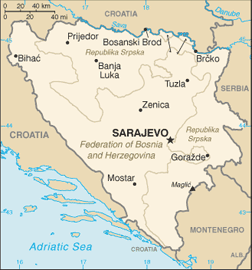
Bosnia and Herzegovina is primarily a source for women and
girls trafficked within the country for commercial sexual exploitation,
though it is also a destination and transit country for women and girls
trafficked to Western Europe for the same purpose. Some victims from Serbia,
Ukraine, Moldova, Romania, Iraq, and Russia are trafficked into Bosnia and
Herzegovina via Serbia or Montenegro for commercial sexual exploitation.
Internal trafficking continued to increase in 2008, as the majority of
identified victims were Bosnian, and more than half of them were children.
There were reports that some girls, particularly Roma, were trafficked for
the purpose of forced marriage. Reports of Roma children trafficked for
forced labor continued. - U.S.
State Dept Trafficking in Persons Report, June, 2009 Check out a later country report here
or the full TIP Report here |
|
|||||||||||
|
CAUTION: The following
links have been culled from the web to illuminate the situation in HOW TO USE THIS WEB-PAGE Students If you are looking
for material to use in a term-paper, you are advised to scan the postings on
this page and others to see which aspects of Human Trafficking are of
particular interest to you. Would you
like to write about Forced-Labor? Debt
Bondage? Prostitution? Forced Begging? Child Soldiers? Sale of Organs? etc. On the other
hand, you might choose to include possible precursors of trafficking such as poverty. There is a lot to the subject
of Trafficking. Scan other countries
as well. Draw comparisons between
activity in adjacent countries and/or regions. Meanwhile, check out some of the Term-Paper resources
that are available on-line. Teachers Check out some of
the Resources
for Teachers attached to this website. HELP for Victims Crime
Catchers Hotline ***
FEATURED ARTICLE *** Trafficking of
Women and Girls to A
Submission for the United Nations Committee on the Rights of the Child from
the Human Rights Watch Children’s Rights Division, 2002 www.crin.org/docs/resources/treaties/crc.39/Bosnia_HRW_ngo_report.doc [accessed 23 January
2011] www.hrw.org/reports/2002/bosnia/ [accessed 28 May
2017] I was sold in
Bosnia. The owner told me that he paid 2000 KM [convertible
marks-€1,025/U.S.$925] for each of seven girls. My movement was restricted
completely. I could not go anywhere. In Dubrave
village, Tuzla municipality, at the Harl[e]y
Davidson nightclub, one [local policeman] was very often in the club. I
recognized him in the photo showed to me by the local police for Crime
Department Tuzla. I was beaten very often if I refused "to work."
Very often we were hungry. Every time we were threatened to be sold to
Serbia.... Kevin [an American] paid 3,000 Deutschmarks [€1,538/U.S.$1,388]
for me. ***
ARCHIVES *** 2023 Findings on
the Worst Forms of Child Labor U.S. Dept of Labor, Bureau of International Labor Affairs,
Child Labor and Forced Labor Reports www.dol.gov/agencies/ilab/resources/reports/child-labor/bosnia-and-herzegovina
[accessed 22 December
2024] Minimal Advancement - In 2023, Bosnia and
Herzegovina made minimal advancement in efforts to eliminate the worst forms
of child labor. Law enforcement officers participated in workshops to further
their knowledge of labor exploitation issues. The State Coordinator's Office
also provided four non-governmental organizations with financial support
(totaling approximately $73,000) to operate assistance programs and shelters
for victims of human trafficking. However, social programs dedicated to
assisting children involved in forced begging do not have adequate resources,
and representatives from both entities' Ministries of Labor are not included
in the National Anti-Trafficking Strike Force, which limits coordination
efforts. Furthermore, most child labor is in the informal sector, and laws on
the minimum age for work do not meet international standards because they do
not apply to children who are self-employed or those working outside of
formal employment relationships. Finally, the government does not have an
official mechanism to refer children found in child labor to social services
providers. 2020 Country
Reports on Human Rights Practices: Bosmoa-Herzegovina U.S. Dept of State Bureau of Democracy, Human Rights, and
Labor, 30 March 2021 www.state.gov/reports/2020-country-reports-on-human-rights-practices/bosnia-and-herzegovina/
[accessed 13 May
2021] PROHIBITION OF
FORCED OR COMPULSORY LABOR The prosecution of 13 BiH nationals for collusion in forced labor involving 672 victims of forced labor in Azerbaijan in 2015 continued in BiH courts. The government failed to prosecute organized crime syndicates that forced Romani children to beg on the streets, alleging that it was Romani custom to beg. There were reports that individuals and organized crime syndicates trafficked men, women, and children for begging and forced labor (see section 7.c.). PROHIBITION OF CHILD
LABOR AND MINIMUM AGE FOR EMPLOYMENT During the year the government did not receive reports of child labor at places of employment. Neither entity had inspectors dedicated to child labor inspections; authorities investigated violations of child labor laws as part of a general labor inspection. The labor inspectorates of both entities reported that they found no violations of child labor laws, although they did not conduct reviews of children working on family farms. The government did not collect data on child labor because there were no reported cases. The general perception among officials and civil society was that the exploitation of child labor was rare. Freedom House
Country Report 2020 Edition freedomhouse.org/country/bosnia-and-herzegovina/freedom-world/2020 [accessed 8 July
2020] G4. DO INDIVIDUALS
ENJOY EQUALITY OF OPPORTUNITY AND FREEDOM FROM ECONOMIC EXPLOITATION? Legal protections against
exploitative working conditions are poorly enforced, and workers in some
industries face hazardous conditions. Patronage and clientelism
continue to adversely affect hiring practices and contribute to de facto
restrictions on economic opportunity. According to the US
State Department’s 2019 Trafficking in Persons Report, both Bosnian and
foreign adults and children are subject to trafficking for the purposes of
sexual exploitation and forced labor in BiH, with
Romany children particularly vulnerable to forced begging and forced
marriages that amount to domestic servitude. The report found that the
government was making efforts toward prosecuting perpetrators, protecting
victims, and preventing trafficking, though its efforts in the second area
decreased somewhat during the coverage period. 2017 Findings on
the Worst Forms of Child Labor Office of Child
Labor, Forced Labor, and Human Trafficking, Bureau of International Labor
Affairs, US Dept of Labor, 2018 www.dol.gov/sites/default/files/documents/ilab/ChildLaborReport_Book.pdf [accessed 15 April
2019] www.dol.gov/sites/dolgov/files/ILAB/child_labor_reports/tda2017/ChildLaborReportBook.pdf [accessed 23 April
2020] Note:: Also check out this country’s report in the more recent edition DOL
Worst Forms of Child Labor [page 182] Children from the largest
minority group in BiH, the Roma, remain vulnerable
to the worst forms of child labor. (3; 5; 6; 1; 2; 11; 12; 21; 14) The Roma
custom of paid and arranged marriages between families has resulted in the
exploitation of some Roma girls as domestic workers. (2; 11; 22; 14; 23)
Birth registration is required to attend school in BiH
and some Roma children lack identity documents, which may affect their access
to education. (1; 20; 24; 25; 26; 27; 22) Children out of school are
vulnerable to the worst forms of child labor. Sources also indicate that some
Roma children face discrimination by some teachers and peers, travel long
distances to schools, and are unable to afford school supplies, as well as
clothing and food. (16; 21; 28; 29; 10) In addition, research found that
discrimination against some Roma children by school administrators has led to
disproportionately high enrollment rates of Roma children in schools for
children with intellectual disabilities. (30). Wartime Sexual Violence
in Bosnia: The Human Trafficking Connection Ivana Radovic, Belgrade, Balkan Investigative Reporting Network
BIRN, 31 December 2020 balkaninsight.com/2020/12/31/wartime-sexual-violence-in-bosnia-the-human-trafficking-connection/ [accessed 31
December 2020] The indictment said
that three women, two of whom were 13 and 15 years old, were also kept
effectively enslaved by the paramilitaries; forced to cook, clean houses,
wash soldiers’ uniforms and do whatever they were told under the threat of
murder. At the same time, they were severely beaten, raped and sexually
humiliated. Three other girls who had been captured earlier in the war were
kept under similar conditions. Three of the six victims married their
captors. Elements of sexual
slavery were included in the Court of Bosnia and Herzegovina’s judgments
convicting Croatian Defence Council member Josip Tolic of the inhumane treatment and murders of Serb
civilians in detention facilities in Odzaci and Bosanski Brod in northern
Bosnia. Police arrest 15 in
Bosnia-France human trafficking ring Agence France-Presse AFP, Sarajevo, 23 June 2015 news.yahoo.com/police-arrest-15-bosnia-france-human-trafficking-ring-151556309.html [accessed 23 June
2015] Bosnian and French
police arrested Tuesday 15 members of a human trafficking ring that forced
women and children to beg and steal in cities across France, Bosnian
authorities said. Seven suspects were
arrested in Bosnia and eight in France, the police said. The women and
children involved were subject to blackmail, threats and physical and
psychological abuse, police said in a statement. "Once there, they were forced to
steal in the street and give up the money. In some cases, children were also
victims," police said.
Investigators estimate that the traffickers made more than two million
euros on the operation ($2.2 million), and laundered the proceeds through
property and luxury car purchases in Bosnia. Survivor
Testimonies Jeff Edwards,
"The Sex Factory", The Mirror ,19 May 2002 jammedtruestories.blogspot.com/2008/09/eleni-trafficked-in-bosnia.html [accessed 23 January
2011] TESTIMONY OF ELENI - Eleni, 25,
didn't know the friend who wrote inviting her to work as a waitress was now a
prostitute. Once at the Bosnian restaurant her new owner told her she had
been bought for 900 DEM and had to repay him by having sex with his
customers. When she refused she was beaten until she couldn't walk for days
but was still forced to have sex. She said: "My
owner told me 'You are lying down anyway so you can still work for me.'"
After two months she was sold on to a man who held a pistol to her head when she
threatened to go to police. Eleni was moved to a remote house after corrupt
police tipped off her owner that Interpol was looking for her. He raped her
several times then passed her to a third owner as she had become "too
dangerous." She said: "I was a slave. I was no more than a piece of
meat." AMNESTY
INTERNATIONAL From an old article -- URL not available Article was
published sometime prior to 2015 Violence against
women - In June the UN Committee on the Elimination of Discrimination against
Women expressed concern that BiH remained a country
of origin, transit and destination in the trafficking in women, and that victims of sexual violence during the 1992-1995 war
suffered additional disadvantages as both female heads of households and
IDPs. NGOs Work To
Eradicate Human Trafficking, Help Victims iipdigital.usembassy.gov/st/english/article/2007/06/20070605161941bcreklaw0.5122492.html#axzz3BzVdE4u4 [accessed 31 August
2014] U.S.-funded
nongovernmental organizations around the world are working to prevent human
trafficking, provide resources to victims and arrest and prosecute child-sex
offenders. From Africa to Europe to Asia, initiatives are raising worldwide
awareness of the illegal practice of human trafficking. PROVIDING
RESOURCES FOR VICTIMS - In Bosnia and Herzegovina, the NGO Vasa Prava provides free legal assistance to victims of human
trafficking. Founded in 1996, the organization runs 16 permanent
offices and 50 mobile units, staffed by 80 employees. It has assisted
more than 400,000 Bosnians. Attorneys from Vasa Prava
are available to domestic victims from the time they arrive at a shelter, and
they arrange residency permits and asylum applications for foreign victims. Victims assisted by Vasa Prava are more likely to testify against their
traffickers in criminal proceedings, and their testimony has led to the
conviction of several notorious traffickers and organized crime rings. 71 victims of human
trafficking reported in Bosnia and Herzegovina for 2006 www.focus-fen.net/index.php?id=n114371 [Last access date
unavailable] For 2006 71 victims
of human trafficking were registered in Bosnia and Herzegovina, 31 of whom
were locals, 22 from Serbia and Montenegro, six from Moldova, four from
Ukraine, three from Croatia, two from Bulgaria and one from each of
Switzerland, Russia and Romania, Radio-Television of the Republika
Srpska (RTRS) reported. Increasing Number
Of Bosnian Women Fall Victim To Trafficking Hina News Line, 19 March
2007 At one time this
article had been archived and may possibly still be accessible [here]
[accessed 4
September 2011] The number of
victims of human trafficking on territory of Bosnia-Herzegovina has been
falling over recent years, but the share of female citizens of
Bosnia-Herzegovina falling victim to this crime is on the rise, Bosnian state
co-ordinator of efforts aimed at countering human
trafficking said earlier this week. Sentences for those
found guilty of human trafficking in Bosnia vary in length from prison terms
of one year to 15 years. According to Radovanovic, judges more frequently resort to milder
sentences. So far only once the sentence of 14 years has been delivered for
this crime. Balkans Urged To
Curb Trafficking Imogen Foulkes, BBC
News, news.bbc.co.uk/2/hi/europe/4397497.stm [accessed 23 January
2011] Countries in Child Sex
Trafficking Study By CU-Boulder Sociologist Reveals Misperceptions www.colorado.edu/news/releases/2005/02/28/child-sex-trafficking-study-cu-boulder-sociologist-reveals-misperceptions [accessed 28 August
2012] [accessed 21 January
2018] Unprecedented
research into child sex trafficking in the post-war nation of
Bosnia-Herzegovina suggests that public perceptions of the problem and some
kinds of intervention efforts around the globe may be misguided, according to
a University of Colorado at Boulder sociologist. "People often
think that all child sex traffickers kidnap their victims, but in many cases
the children end up funneled into the system by their own families because of
extreme poverty," according to assistant Professor AnnJanette
Rosga. "Sometimes the children leave home
voluntarily because of abuse or other harmful conditions." - htsccp Sex slavery is a
worldwide disgrace Katie Kelberlau, At one time this article
had been archived and may possibly still be accessible [here]
[accessed 4
September 2011] Trafficking in Human Beings in Transition and Post-Conflict Countries [PDF] Alja Klopcic,
Human Security Perspectives, Volume 1 (2004) Issue 1 At one time this
article had been archived and may possibly still be accessible [here]
[accessed 4
September 2011] A. PUSH FACTORS - As demonstrated above,
the majority of women and children are very of-ten helped to cross the
borders by people whom they trust and are subsequently traded to traffickers.
As the female trafficking agents are easily trusted, the potential victims
should be warned about the trap they can fall into, especially if they live
with potential traffickers in the same local communities. Amnesty
International Report 2004 - Amnesty
International, 26 May 2004 Click [here]
to access the article. Its URL is not
displayed because of its length [accessed 31 August 2014] TRAFFICKING
IN WOMEN AND GIRLS
- Some positive developments were noted in the prosecution of those
responsible for serious human rights abuses against women and girls in the
context of trafficking and forced prostitution. In March the owner of a local
nightclub was found guilty of enslavement and sentenced. The case marked the
first conviction in the Federation for enslavement; those tried in
trafficking cases had previously always been charged with the lesser offence
of procurement. In May, five Bosnian Serb men were handed over to the custody
of the State Court, which started an investigation into their alleged
involvement in the trafficking of women and girls who had been forced to
engage in prostitution in a chain of nightclubs in Prijedor. Bosnia and
Herzegovina : Traffickers Walk Free Human Rights Watch,
November 25, 2002 www.hrw.org/en/news/2002/11/25/bosnia-and-herzegovina-traffickers-walk-free [accessed 23 January
2011] According to Human
Rights Watch, traffickers who have forced thousands of women and girls into
prostitution in Hopes Betrayed:
Trafficking of Women and Girls to Post-Conflict Bosnia and Herzegovina for
Forced Prostitution Human Rights Watch
Reports, Volume 14 No. 9 (D), November 2002 www.hrw.org/legacy/reports/2002/bosnia/ [accessed 23 January
2011] [accessed 23 January
2011] EXECUTIVE SUMMARY - According to
experts of nongovernmental organizations (NGOs) and the United Nations
Mission in Bosnia and Herzegovina (UNMIBH), trafficking first began to appear
in 1995. As of October 2002, UNMIBH suspected 227 of the nightclubs and bars
that dot Bosnian cities and towns of involvement in trafficking in human
beings. Experts from the U.N. mission's Special Trafficking Operations
Program (STOP) stated in a 2001 press conference that approximately 25
percent of the women and girls working in nightclubs and bars were
trafficked.2
NGO experts working to stop trafficking in Bosnia and Herzegovina, cautioning
that the statistics remain woefully unreliable, estimated that as many as
2,000 women and girls from the former Soviet Union and Eastern Europe have
found themselves trapped in Bosnian brothels. Trafficking in
Women and Girls in Human Rights Watch,
June 14, 2004 www.hrw.org/english/docs/2004/06/14/bosher8815.htm [accessed 23 January
2011] books.google.com/books/about/Trafficking_in_Women_and_Girls_in_Bosnia.html?id=I1ugAQAACAAJ [accessed 28 May
2017] Human Rights Watch
submitted a number of requests to the Bosnia: The United
Nations, human trafficking and prostitution Tony Robson, World Socialist
Web Site, 21 August 2002 www.wsws.org/articles/2002/aug2002/bosn-a21.shtml [accessed 23 January
2011] There is mounting evidence
that the United Nations has carried out a cover-up of the role played by its
personnel in human trafficking and prostitution in Bosnia—a trade that has
grown astronomically since the establishment of the Western protectorate
seven years ago. Teenagers 'used for
sex by UN in Stewart Payne,
Telegraph, 25/04/2002 At one time this
article had been archived and may possibly still be accessible [here]
[accessed 4
September 2011] A human rights
investigator who claims she was sacked for exposing the sexual abuse of
Bosnian women by her United Nations colleagues, told a tribunal yesterday that
girls as young as 15 were offered for sex.
Kathryn Bolkovac, 41, said women were forced
to dance naked in Bosnian bars frequented by UN police officers. Bosnia: Landmark
Verdicts for Rape, Torture, and Sexual Enslavement Human Rights Watch,
Feb 22, 2001 www.hrw.org/en/news/2001/02/22/bosnia-landmark-verdicts-rape-torture-and-sexual-enslavement [accessed 23 January
2011] These cases marked
the first time in history that an international tribunal brought charges
solely for crimes of sexual violence against women. The decision also marked
the first time that the ICTY found rape and enslavement as crimes against
humanity. The eight-month long trial included testimony of sixty-three
witnesses, including sixteen victims of rape held for months in sexual
slavery and subjected to multiple gang rapes by the defendants and others.
The Tribunal found that the defendants had enslaved six of the women. Most
importantly, although two of the women were sold as chattel by Radomir Kovac for 500 Deutsch
Marks each, the Tribunal found that enslavement of the women did not
necessarily require the buying or selling of a human being. BRAMA, November 16,
2000 www.brama.com/news/press/001116trafficking.html [accessed 23 January
2011] According to the Concluding
Observations of the Committee on the Rights of the Child, BiH UN Convention on the
Rights of the Child, 3 June 2005 www1.umn.edu/humanrts/crc/bosnia2005.html [accessed 23 January
2011] [69] While the
Committee welcomes some positive developments in the prosecution of those
responsible for serious crimes against women and girls in the context of
trafficking and forced prostitution, as well as the adoption by the Council
of Ministers of a National Plan of Action to combat trafficking in 2001, it
is concerned that a growing number of children under 18, especially
adolescents girls, are still being trafficked for the purpose of sexual
exploitation. The Committee is further concerned that the Optional Protocol
to the Convention on the sale of children, child prostitution and child
pornography has not been adequately addressed within the criminal justice
systems. The Protection
Project – Bosnia and Herzegovina [PDF] The Paul H. Nitze School of Advanced International Studies (SAIS),
The Johns Hopkins University www.protectionproject.org/wp-content/uploads/2010/09/Bosnia_and_Herzegovina.pdf [accessed 24
February 2016] A Human Rights
Report on Trafficking in Persons, Especially Women and Children Human Rights
Overview Human Rights Watch www.hrw.org/europecentral-asia/bosnia-and-herzegovina [accessed 23 January
2011] ***
EARLIER EDITIONS OF SOME OF THE ABOVE *** 2017 Country
Reports on Human Rights Practices U.S. Dept of State Bureau of Democracy, Human Rights, and
Labor, 20 April 2018 www.state.gov/j/drl/rls/hrrpt/2017/eur/277147.htm
[accessed 17 March
2019] www.state.gov/reports/2017-country-reports-on-human-rights-practices/bosnia-and-herzegovina/
[accessed 24 June
2019] PROHIBITION OF
FORCED OR COMPULSORY LABOR Adequate
legislation exists at the state level and in the RS and the Brcko District for forced or compulsory labor. Federation
laws, however, do not criminalize all forced labor activities. The government
did not enforce these laws effectively, but there was little verified
evidence that forced labor occurred in the country. Penalties for violations
range from three to 10 years in prison and were generally sufficient to deter
violations, but resources, inspections, and remediation were inadequate. The prosecution of
13 BiH nationals for collusion in forced labor
involving 672 victims of forced labor in Azerbaijan in 2015 continued in BiH court. There were reports that individuals and
organized crime syndicates trafficked men, women, and children for begging
and forced labor PROHIBITION OF CHILD
LABOR AND MINIMUM AGE FOR EMPLOYMENT Boys and girls were
subjected to forced begging and involuntary domestic servitude in forced
marriages. Sometimes forced begging was linked to other forms of human
trafficking. In the case of Romani children, family members or organized
criminal groups were responsible for both subjecting girls and boys to forced
begging and domestic servitude in forced marriages. Several of the worst
forms of child labor occurring in the country included the use of children
for illicit activities, commercial sexual exploitation of children, and the
use of children for the production of pornography. Human Rights
Reports » 2005 Country Reports on Human Rights Practices [accessed 7 February
2020] TRAFFICKING
IN PERSONS
– The country was a destination, transit point, and, to a lesser extent,
country of origin for women, girls, and, in a few cases, teenage boys
trafficked for sexual exploitation. During the year, Romani children were
trafficked into and within the country for forced labor. The country was also
a transit point for Chinese nationals being trafficked for forced labor;
illegal Chinese immigrants generally remained in the country for short
periods before continuing to destinations in Over 90 percent of
trafficked women in the country came from Victims reported
working in conditions akin to slavery, with little or no financial support.
In some cases, traffickers paid victims some wages so that they could send
money home to their families. Traffickers coerced victims to remain in these
situations through intimidation, verbal threats, seizure of passports,
withholding of food and medical care, and physical and sexual assault. To
keep victims in the country legally, traffickers also made victims apply for
asylum since, as asylum seekers, they were entitled to remain in the country
until their claims could be adjudicated. The Department of Labor’s 2004 Findings on
the Worst Forms of Child Labor www.dol.gov/ilab/media/reports/iclp/tda2004/bosnia-herzegovina.htm [accessed 23 January
2011] Note:: Also check out this country’s report in the more recent edition DOL Worst Forms of Child Labor INCIDENCE
AND NATURE OF CHILD LABOR - The prostitution and trafficking of girls to, from,
and within the country continues to be a problem. Reports indicate that there are growing
numbers of minors, primarily girls ages 14 to 18
years, who are trafficked from less economically developed Eastern Bosnia to
more economically developed Western Bosnia and externally to Eastern and All
material used herein reproduced under the fair use exception of 17 USC § 107
for noncommercial, nonprofit, and educational use. PLEASE RESPECT COPYRIGHTS OF COMPONENT
ARTICLES. Cite this webpage as: Patt,
Prof. Martin, "Human Trafficking & Modern-day Slavery –
Bosnia-Herzegovina", http://gvnet.com/humantrafficking/ Bosnia-Herzegovina.htm,
[accessed <date>] |
||||||||||||