Human Trafficking & Modern-day Slavery Poverty drives the unsuspecting poor into the
hands of traffickers Published reports & articles from 2000 to 2025 gvnet.com/humantrafficking/Bolivia.htm
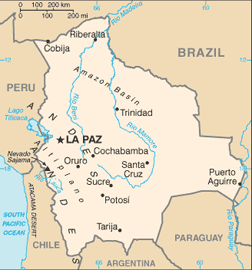
Bolivia is
principally a source country for men, women, and children trafficked for the
purposes of commercial sexual exploitation and forced labor. A large number
of Bolivians are trafficked to Argentina, Brazil, Chile, Peru, Spain, and the
United States for forced labor in sweatshops, factories, and agriculture. In
a case discovered in May 2008, more than 200 Bolivian workers were trafficked
to Russia for forced labor in the construction industry. Within the country,
young Bolivian women and girls are trafficked from rural to urban areas for
commercial sexual exploitation. Members of indigenous communities are
particularly at risk of forced labor within the country, especially on ranches,
sugar cane, and Brazilian nut plantations. Bolivian children are trafficked
internally for forced labor in mining, agriculture, and as domestic servants.. - U.S. State
Dept Trafficking in Persons Report, June, 2009 Check out a later country report here
or the full TIP Report here |
|
|||||||||||
|
CAUTION: The following
links have been culled from the web to illuminate the situation in
Bolivia. Some of these links may lead
to websites that present allegations that are unsubstantiated or even false. No attempt has been made to verify their
authenticity or to validate their content. HOW TO USE THIS WEB-PAGE Students If you are looking
for material to use in a term-paper, you are advised to scan the postings on
this page and others to see which aspects of Human Trafficking are of
particular interest to you. Would you
like to write about Forced-Labor? Debt
Bondage? Prostitution? Forced Begging? Child Soldiers? Sale of Organs? etc. On the other
hand, you might choose to include possible precursors of trafficking such as poverty. There is a lot to the subject
of Trafficking. Scan other countries
as well. Draw comparisons between
activity in adjacent countries and/or regions. Meanwhile, check out some of the Term-Paper resources
that are available on-line. Teachers Check out some of
the Resources
for Teachers attached to this website. HELP for Victims International
Office for Migration ***
FEATURED ARTICLE *** Bolivia, U.S.
cracking down on human trafficking Donna Boe, Idaho State Legislator, Journal Politics, Idaho
State Journal, General, September 23, 2006 At one time this article
had been archived and may possibly still be accessible [here]
[accessed 4
September 2011] Bolivia, like the
United States, has a human trafficking problem and is searching for solutions. So says Casimira Rodriquez Romero, the newly appointed Bolivian
Minister of Justice, in an interview with me in August. According to
Rodriquez, two major forms of human trafficking exist in Bolivia. Because
people are desperate for jobs, they flock to Argentina, Brazil, Spain and
North America where some find jobs, and others end up as indentured servants
or worse. There is also a tragic problem of disappearance of children, and
the government is establishing ways to locate these children and to find out
what happened to them. Trafficked in
China, originally from Bolivia Oliver Poole. “Young
Mother’s Dream of Fast Fortune Ended in Nightmare” South China Morning Post
(11 March 1997) jammedtruestories.blogspot.com/2008/09/trafficked-in-china-originally-from.html [accessed 23 January
2011] TESTIMONY OF
PATRICIA
- From her home in an impoverished village in rural Bolivia, the
prospect of quick riches as an escort girl proved impossible to resist for
23-year-old Patricia Suarez. A neighbor working for a Hong Kong gang
suggested the trip, promising the young mother an escape from part-time work
as a domestic servant that paid only US $50 (HK $387) a week. Desperate
for money, the former university student left her two-month old baby with her
mother and six brothers and sisters—unaware that she was heading for a nightmare
trapped in a sleazy underworld. ***
ARCHIVES *** 2023 Findings on
the Worst Forms of Child Labor U.S. Dept of Labor, Bureau of International Labor Affairs,
Child Labor and Forced Labor Reports www.dol.gov/agencies/ilab/resources/reports/child-labor/bolivia
[accessed 22
December 2024] Moderate Advancement - In 2023, Bolivia
made moderate advancement in efforts to eliminate the worst forms of child
labor. As part of the Regional Platform Against Human Trafficking and
Smuggling, Bolivia and Argentina signed an agreement that included 35
coordinated actions to combat human trafficking, migrant smuggling, and
related crimes. In addition, the government, in collaboration with a civil
society organization, Munasim Kullakita
Foundation, and the police, released Alerta
Juliana, a mobile application to help locate missing children, including some
who could be vulnerable to human trafficking crimes, and refer them to
authorities and protection services. In September, Ministerial Resolution No.
1444/23 which allows labor inspectors to conduct unannounced inspections at any
time, was passed into law. However, despite these
efforts, Bolivia's laws do not meet international standards on the
prohibition against child trafficking because they require the use of
threats, force, or coercion be proven for a crime of child trafficking to
have occurred. Bolivian law also does not set a minimum age for participation
in apprenticeships, and the government did not publicly release information
on its labor and criminal law enforcement efforts in 2023. Bolivia Struggles
to Help Its Human Trafficking Victims Max Radwin, InSight Crime, 26
February 2020 www.insightcrime.org/news/brief/bolivia-struggles-human-trafficking-victims/ [accessed 27 Feb
2020] Last year, authorities registered 299 cases of human trafficking, a
drop from the 465 in 2018, according to the report. A disproportionate
number of victims are poor, indigenous and live in rural areas. Most of them
were lured into sex trafficking or forced labor in the mining, agricultural
and livestock sectors, the report said. Sex trafficking—especially of women
and young girls—is common on a domestic scale but can sometimes extend to an
international network with Chile, Brazil and countries overseas. 2020 Country
Reports on Human Rights Practices: Bolivia U.S. Dept of State Bureau of Democracy, Human Rights, and
Labor, 30 March 2021 www.state.gov/reports/2020-country-reports-on-human-rights-practices/bolivia/
[accessed 13 May
2021] PROHIBITION OF
FORCED OR COMPULSORY LABOR Men, women, and children were victims of sex trafficking and forced labor in domestic service, mining, ranching, and agriculture. Indigenous populations were especially vulnerable to forced labor in the agriculture sector and to deceptive employment opportunities that may amount to forced labor in neighboring countries. PROHIBITION OF CHILD
LABOR AND MINIMUM AGE FOR EMPLOYMENT The ministry
collaborated with the IDB to implement a program that identifies and employs
unemployed parents who have children in the workforce. A ministry official
stated that while there were varying reasons why children as young as 10
chose to work, one main reason was because their parents could not find
steady employment. This program sought to secure jobs for underemployed
parents on the condition their children stop working. The ministry also
provided the parents’ salaries for the first three months to avoid burdening
the businesses that provided employment. Among
the worst forms of child labor were instances of children working in brick
production, hospital cleaning, domestic labor, transportation, and vending at
night. In the agricultural sector, forced child labor was present in the
production of Brazil nuts/chestnuts and sugarcane. Children were also
subjected to hazardous work activities in the mining industry, as well as sex
trafficking and other forms of commercial sexual exploitation. Freedom House
Country Report 2020 Edition freedomhouse.org/country/bolivia/freedom-world/2020 [accessed 23 April
2020] G4. DO INDIVIDUALS ENJOY
EQUALITY OF OPPORTUNITY AND FREEDOM FROM ECONOMIC EXPLOITATION? Bolivia is a source
country for the trafficking of men, women, and children for forced labor and
prostitution, and the country faced increased international criticism over
permissive legislation regarding child labor in 2018: in December of that
year, Morales signed a measure to change the minimum working age to 14 years
old. 2017 Findings on
the Worst Forms of Child Labor Office of Child
Labor, Forced Labor, and Human Trafficking, Bureau of International Labor
Affairs, US Dept of Labor, 2018 www.dol.gov/sites/default/files/documents/ilab/ChildLaborReport_Book.pdf [accessed 17 April
2019] www.dol.gov/sites/dolgov/files/ILAB/child_labor_reports/tda2017/ChildLaborReportBook.pdf [accessed 23 April
2020] Note:: Also check out this country’s report in the more recent edition DOL
Worst Forms of Child Labor [page 171] Children produce
and harvest sugarcane and Brazil nuts in the departments of Beni, Pando, Santa Cruz, and Tarija. (1; 5; 7; 13)
Indigenous children are particularly vulnerable to the worst forms of child
labor. (27; 28; 29) Some indigenous Guaraní families live in debt bondage and
work on ranches, including in raising cattle, in the Chaco region of Bolivia.
(30; 5; 13) In Tarija, the sugarcane and Brazil nut harvest seasons attract
over 3,000 internal migrants, increasing the vulnerability of these
workers—many of them children—to forced labor and human trafficking. In 2017,
25 members of the Guarani community, including eight children, were rescued
from forced labor in Tarija. (8) The cultural
practice known as padrinazgo, which involves rural
families sending their children to urban areas to live with individuals to better
access education, social services, and food, often leads to forced labor,
including in domestic service and third party businesses. Girls, age 14 on
average, were found to be engaged in commercial sexual exploitation in El
Alto. (8) Bolivian children are also smuggled to other countries, where they
are vulnerable to commercial sexual exploitation. The government does not
have a system in place to track data on forced child labor, commercial sexual
exploitation of children, or engagement of children in illicit activities.
(8). Japan Sex Industry
Ensnares Latin Women Associated Press AP,
Lima, Peru, 4-29-05 www.freerepublic.com/focus/f-news/1394126/posts [accessed 23 January
2011] At least 1,700
women from Latin America and the Caribbean are lured each year into sexual
slavery in Japan's huge illicit sex industry, according to a new report. A team of researchers hired by the
Organization of American States found that most of the women come from
Colombia, Bolivia, Brazil, Mexico
and Peru. U.S. Says Belize,
Cuba, Venezuela Not Fighting Human Trafficking U.S. Department of
State Bureau of International Information Programs, 5 June 2006 iipdigital.usembassy.gov/st/english/article/2006/06/200606051529441xeneerg0.8676874.html#axzz3CMfHlohT [accessed 5
September 2014] HUMAN TRAFFICKING
“TIER 2 WATCH LIST”
- Even though Bolivia moved up from its Tier 3 listing in the 2005 report,
the country was placed on the Tier 2 watch list for its failure to show
evidence of increasing efforts to combat trafficking in the areas of
trafficking prosecutions and victim protection. Human trafficking's
dirty profits and huge costs Inter-American
Development Bank, Nov 2, 2006 www.iadb.org/news/detail.cfm?language=English&ARTID=3357&id=3357 [accessed 23 January
2011] [accessed 21 January
2018] CASES IN LATIN
AMERICA AND THE CARIBBEAN - In Bolivia, the intermediaries who traffic in
illegal adoptions charge up to $30,000 per child. The Bolivian National
Police have found only 18 percent of the children and youth who disappeared
in 2005 and 2006 (IOM/OAS, 2004). Annual Report Of
Activities By The Anti-Trafficking In Persons Section Of The Organization Of
American States - April 2005 To March 2006 [DOC] Organization of
American States, Inter-American Commission of Women, 27 March 2006 scm.oas.org/doc_public/ENGLISH/HIST_06/MJ00334E08.DOC [accessed 5
September 2014] BOLIVIA - The Prevention
of Trafficking of Women and Children Project was carried out in Bolivia,
during October, in conjunction with the International Organization for
Migration. This project involved a prevention campaign carried by the mass
media, including television and radio, for which public service announcements
were produced in the Spanish, Quechua, Aymara, and Guarani languages. Between October 17
and 21, a series of seminars, focusing on different topics, were held in the
cities of Trinidad, La Paz, and Cochabamba. La Paz hosted a seminar on
“Training for Journalists from the Bolivian Media in Trafficking in Persons:
Reporting and Spreading the News while Upholding Victims’ Rights,” at which
communicators, journalists, and owners of media outlets (written press,
radio, and television) involved with the topic or who had produced important
work relating to it, were given training relating to trafficking in human
lives. In Cochabamba the seminar focused on preventing the trafficking of
children and adolescents from the most representative sectors of Bolivian
society, and involved youth and children’s organizations and leaders at the
local, departmental, and national levels. Finally, the seminar “Training for
Government and Civil Society Authorities in Combating trafficking in Persons,
Particularly Women” was held in the city of Trinidad. This seminar assisted
departmental authorities from Beni, Pando, and
Santa Cruz, along with representative sectors of civil society and women
leaders. Due to Efforts
against Trafficking in Persons Bolivia Removed from Tier 2 Watch List U.S. Secretary of
State Hillary Clinton, June 16, 2009 bolivia.usembassy.gov/traffpb.html [accessed 5
September 2014] Over the past year,
despite limited resources, Bolivia increased law enforcement and prosecution.
In a landmark case in Cochabamba, the regional Attorney’s Office secured the
convictions of two traffickers for enslaving an 11-year-old child. Moreover,
special anti-trafficking police and prosecutors opened 36 trafficking
prosecutions across the country in 2006. Also, Bolivia made
efforts to prevent this crime by means of awareness seminars held throughout
the country and increased protection services for the victims. The Grounds for
Bolivia’s New Military Bases Alex Sánchez,
Research Fellow, Council on Hemispheric Affairs COHA, 18 Oct 2006 www.coha.org/the-grounds-for-bolivia%E2%80%99s-new-military-bases/ [accessed 23 January
2011] BOLIVIA’S PLANS FROM A DOMESTIC PERSPECTIVE - An
argument in favor of the bases is that Bolivia does have a major problem with
drug trafficking and contra-band activities, making constructed military
bases in the rainforest a national security necessity. A BBC September 13
report noted that in the extreme northeastern part of Bolivia, in Pando, at
Fort Manoa, only one sergeant and nine privates are
guarding the border with Brazil. The Bolivian police is
also dispersed and scarce, with only an average of three policemen at each of
the country’s 110 border points. These facts have facilitated criminal
activity such as human trafficking,
particularly between Bolivia and Paraguay. At the presentation of Bolivia’s
National Security Council’s report to the Chamber of Deputies on June 22,
Defense Minister Walker San Miguel asserted that “We have a sparse population
along the borders, and consequently we are a country tremendously vulnerable
to peaceful invasion by citizens of other bordering countries.” Concluding
Observations of the Committee on the Rights of the Child (CRC) UN Convention on the
Rights of the Child, 28 January 2005 www1.umn.edu/humanrts/crc/bolivia2005.html [accessed 23 January
2011] [63]. The Committee
is concerned about the extent of sexual exploitation and trafficking of
children for this or other purposes, in particular economic exploitation, in
the State party and about the lack of effective programs to address this
problem. The Protection
Project - Bolivia [DOC] The Paul H. Nitze School of Advanced International Studies (SAIS),
The Johns Hopkins University www.protectionproject.org/human_rights_reports/report_documents/bolivia.doc [accessed 2009] FORMS OF TRAFFICKING - Women and
children are trafficked from Bolivia for the purposes of forced prostitution
and forced labor. Trafficking is believed to exist for the purpose of organ
sales and illegal adoption as well. Women and children are
trafficked to Argentina, Brazil, and Chile to work as domestic servants. Some
women are trafficked from Bolivia to Argentina, where they are forced to work
in textile factories, or to northern Chile, where they are made to work in
agriculture. Women are trafficked from
Bolivia to Brazil to work in textile factories, in homes, in the agricultural
sector, and in factories. Bolivian
women have been trafficked to Spain with promises of work, but instead they
have been forced into prostitution.
Bolivian children are reportedly trafficked to Spain for illegal
adoption. In July 2000,
Bolivian nationals trafficked 24 Bolivian girls to
Argentina for the purpose of prostitution. The recruiter (the mother of the
brothel owner) recruited children from outdoor markets in the rural areas of
Bolivia. She told them and their parents that the girls could work as criaditas, or little maids, in Argentina. The parents
authorized the children to leave under the pretense that they were going on
vacation, so that they could get tourist visas. Tickets and visas were
purchased through a travel agency. The recruiter; the brothel owner’s
husband, who had transported the children; the owner of the travel agency;
and the brothel owner were charged with forcing minors into prostitution. Human Rights
Overview Human Rights Watch [accessed 23 January
2011] ***
EARLIER EDITIONS OF SOME OF THE ABOVE *** Freedom House
Country Report 2018 Edition freedomhouse.org/country/bolivia/freedom-world/2018 [accessed 23 April
2020] G4. DO INDIVIDUALS
ENJOY EQUALITY OF OPPORTUNITY AND FREEDOM FROM ECONOMIC EXPLOITATION? Child labor and
forced labor are ongoing problems. A law approved in 2014 allows children
aged 12 to 14 to enter work contracts as long as they do not work for longer
than six hours a day. Children as young as 10 are permitted to work in
independent jobs such as shoe shining as long as they are under parental
supervision. Bolivia is a source
country for the trafficking of men, women, and children for forced labor and
prostitution. The government has been slow to address the problem, though in
recent years it has allocated greater resources toward investigations and
public awareness campaigns. The Department of Labor’s 2004 Findings on
the Worst Forms of Child Labor U.S. Dept of Labor Bureau of International Labor Affairs, 2005 www.dol.gov/ilab/media/reports/iclp/tda2004/bolivia.htm [accessed 23 January
2011] Note:: Also check out this country’s report in the more recent edition DOL
Worst Forms of Child Labor INCIDENCE
AND NATURE OF CHILD LABOR - Some children are known to work as indentured
domestic laborers and prostitutes.
Children are reportedly trafficked internally to urban or border areas
for commercial sexual exploitation. It
is also reported that children and adolescents are trafficked internally
within Bolivia and to Argentina, Chile, Brazil, and Spain for the purpose of
forced labor and commercial sexual exploitation. Women and adolescents
from the indigenous areas of the high plains are at the greatest risk of
being trafficked. 2017 Country
Reports on Human Rights Practices U.S. Dept of State Bureau of Democracy, Human Rights, and
Labor, 20 April 2018 www.state.gov/j/drl/rls/hrrpt/2017/wha/277311.htm [accessed 17 March
2019] www.state.gov/reports/2017-country-reports-on-human-rights-practices/bolivia/
[accessed 24 June
2019] PROHIBITION OF
FORCED OR COMPULSORY LABOR There was a lack of
enforcement of the law banning forced labor. Ministry of Labor officials
noted that inadequate resources prevented more-thorough enforcement and
restricted the ability of authorities to provide services to victims of
forced labor. The ministry held various workshops to educate vulnerable
workers of their rights, levied penalties against offending employers, and
referred cases of suspected forced labor and human smuggling to the Ministry
of Justice for prosecution. Penalties against employers found violating
forced labor laws were insufficient to deter violations, in part because they
were generally not enforced. Men, women, and
children were victims of forced labor in domestic service, mining, ranching,
and agriculture as well as sex trafficking. PROHIBITION OF CHILD
LABOR AND MINIMUM AGE FOR EMPLOYMENT Among the worst
forms of child labor, children worked in the sugarcane harvest, the Brazil
nut harvest, brick production, hospital cleaning, domestic labor,
transportation, agriculture, and vending at night. Children were also
subjected to commercial sexual exploitation. A 2013 study estimated 3,000 to
4,000 children and adolescents worked in the Brazil nut harvest in Beni Department; indigenous groups confirmed a majority
of these children were indigenous. Researchers also found that some children
worked in Brazil nut processing factories, including at night. There were reports
that children were victims of forced labor in mining, agriculture, and as
domestic servants. The media reported that minors under age 14 worked in
brick manufacturing in El Alto and Oruro, and their parents sometimes
contracted them to customers who needed help transporting the bricks. Human Rights
Reports » 2005 Country Reports on Human Rights Practices U.S. Dept of State Bureau of Democracy, Human Rights, and
Labor, March 8, 2006 2009-2017.state.gov/j/drl/rls/hrrpt/2005/61717.htm [accessed 7 February
2020] TRAFFICKING
IN PERSONS
– Faced with extreme poverty, many citizens were economic migrants, and some
were victimized by traffickers as they moved from rural areas to cities and
then abroad. Women and children, particularly from indigenous ethnic groups
in the Altiplano region, were at greater risk of
being trafficked. Children were trafficked within the country to work in
prostitution, mines, domestic servitude, and agriculture, particularly
harvesting sugar cane and Brazil nuts. Weak controls along its extensive five
borders made the country an easy transit point for illegal migrants, some of
whom may have been trafficked. Commercial sexual exploitation of children
also remained a problem. While there were
reports that some adolescents were sold into forced labor, it appeared that
most victims initially were willing economic migrants who were duped or later
coerced into accepting jobs that turned out to be forced labor. All
material used herein reproduced under the fair use exception of 17 USC § 107
for noncommercial, nonprofit, and educational use. PLEASE RESPECT COPYRIGHTS OF COMPONENT
ARTICLES. Cite this webpage as: Patt,
Prof. Martin, "Human Trafficking & Modern-day Slavery -
Bolivia", http://gvnet.com/humantrafficking/Bolivia.htm, [accessed
<date>] |
||||||||||||