Human Trafficking & Modern-day Slavery Poverty drives the unsuspecting poor into the
hands of traffickers Published reports & articles from 2000 to 2025 gvnet.com/humantrafficking/Belarus.htm
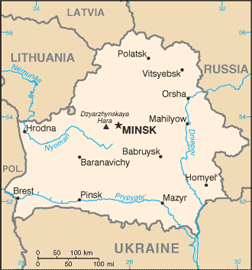
Belarus is a source and transit country for women, men,
and children trafficked from Belarus and neighboring countries to Russia,
Germany, Poland, the Czech Republic, Lithuania, Latvia, Austria, the
Netherlands, Israel, the United Arab Emirates (UAE), Turkey, Egypt, Ukraine,
and the Republic of Togo for the purposes of commercial sexual exploitation
and forced labor. Authorities registered 591 trafficking victims of whom 458
were trafficked for sexual exploitation (including 96 minors) and 133 for
forced labor; 366 were female (including 42 minors) and 225 were male
(including 61 minors). - U.S.
State Dept Trafficking in Persons Report, June, 2009 Check out a later country report here
or the full TIP Report here |
|
|||||||||||
|
CAUTION: The following links
have been culled from the web to illuminate the situation in HOW TO USE THIS WEB-PAGE Students If you are looking
for material to use in a term-paper, you are advised to scan the postings on
this page and others to see which aspects of Human Trafficking are of
particular interest to you. Would you
like to write about Forced-Labor? Debt
Bondage? Prostitution? Forced Begging? Child Soldiers? Sale of Organs? etc. On the other
hand, you might choose to include possible precursors of trafficking such as poverty. There is a lot to the subject
of Trafficking. Scan other countries
as well. Draw comparisons between
activity in adjacent countries and/or regions. Meanwhile, check out some of the Term-Paper resources
that are available on-line. Teachers Check out some of
the Resources
for Teachers attached to this website. HELP for Victims Ministry
of Interior ***
FEATURED ARTICLE *** Efforts To
Eradicate Human Trafficking In Belarus Sean Kenney, Borgen Project borgenproject.org/eradicate-human-trafficking-in-belarus/ [accessed 20 January
2021] THE SITUATION -- Belarus
recorded 128 confirmed trafficking victims and nine potential victims in the
Trafficking in Persons report for 2020. Meanwhile, data that NGOs compiled in
2019 has indicated that 91 identified victims comprised of 58 men and 33
women. While victims exist within Belarus, they also exist outside of
Belarus’ borders as the traffickers export men for forced labor to Russia and
women for sex work to western Europe. Of the 91 victims, 52 experienced exploitation
in Russia. At the moment,
human trafficking predominantly affects men in Belarus by way of labor
exploitation. In particular, it is common for Belarusian men to find
themselves enslaved in Dagestani brick factories. Forced labor also takes
place in Belarus through state-sponsored programs called “subbotniks.”
These governmental programs force factory workers, civil workers and students
to work on farms and clean streets, and anyone who resists experiences
threats and intimidation. ***
ARCHIVES *** 2020 Country Reports
on Human Rights Practices: Belarus U.S. Dept of State Bureau of Democracy, Human Rights, and
Labor, 30 March 2021 www.state.gov/reports/2020-country-reports-on-human-rights-practices/belarus/
[accessed 11 May
2021] PROHIBITION OF
FORCED OR COMPULSORY LABOR Regulations against
forced labor were seldom enforced, and resources and inspections dedicated to
preventing forced and compulsory labor were minimal. Belarus largely
served as a source country for labor trafficking. Aside from border
restrictions enacted during COVID-19, Belarusians were able to freely travel
to and work in Russia, reportedly the largest destination country. Compared
to NGOs, the government rarely identified victims of labor trafficking, and
prosecution of those responsible for forced labor remained minimal. NGOs in
2019 identified 59 labor trafficking victims, compared with the government’s
three. Authorities reportedly did not recognize claims by Belarusians who
returned from Russia and complained they had endured forced labor there.
Government efforts to prevent and eliminate labor trafficking did not improve
during the year. PROHIBITION OF CHILD
LABOR AND MINIMUM AGE FOR EMPLOYMENT The law prohibits
the worst forms of child labor. The minimum age for employment is 16.
Children as young as 14 may conclude a labor contract with the written
consent of one parent or a legal guardian. The Prosecutor General’s Office is
responsible for enforcement of the law. Persons younger than 18 are allowed
to work in nonhazardous jobs but are not allowed to work
overtime, on weekends, or on government holidays. Work may not be harmful to
children’s health or hinder their education. The government
generally enforced these laws and penalties for violations were commensurate
with those of other serious crimes. Freedom House
Country Report 2020 Edition freedomhouse.org/country/belarus/freedom-world/2020 [accessed 8 July
2020] G4. DO INDIVIDUALS
ENJOY EQUALITY OF OPPORTUNITY AND FREEDOM FROM ECONOMIC EXPLOITATION? Mandatory unpaid national
work days, postgraduate employment allocation, compulsory labor for inmates
in state rehabilitation facilities, and restrictions on leaving employment
have led labor activists to conclude that all Belarusians experience forced
labor at some stage of their life. The lack of economic opportunities led
many women to become victims of the international sex trade. Preventing,
Fighting and Addressing the Social Consequences of Trafficking in Human
Beings in the Republic of Belarus European Union, the
United Nations Development Programme (UNDP) and the United Nations Children’s
Fund (UNICEF), 2009 www.trafik.by/en/about_the_project/general_information/ [accessed 22 January
2011] jobs.undp.org/cj_view_job.cfm?cur_job_id=15246 [accessed 23 April
2020] The joint project
of the European Union, the United Nations Development Programme (UNDP) and
the United Nations International Children’s Fund (UNICEF) “Preventing,
Fighting and Addressing the Social Consequences of Trafficking in Human
Beings in the Republic of Belarus seeks to enhance the national capacities of
Belarus in fighting trafficking in human beings with preventive measures and
better protection and rehabilitation of victims of trafficking. In particular, the
project aims to:
Government of
Belarus shows political will and determination to counter human trafficking The National Legal
Internet Portal of the kalinkovichi.gomel-region.by/en/news/republic/?id=2597 [accessed 2
September 2014] [accessed 23 April
2020] The government of
Belarus has showed political will and determination to counter human
trafficking and has achieved great results in this area, Director General of
the International Organization for Migration (IOM) Brunson McKinley said
during a ceremony to inaugurate the international centre for training and
retraining specialists in combating human trafficking and illegal migration
today in Minsk. “The idea to open
the centre attests to the desire of the Belarusian government to share its
rich experience and best practices in the fight against trade in people and illegal
migration with specialists from all countries,” Mr. Brunson McKinley said. 500 human
trafficking crimes exposed in Belarus this year [2006] ITAR-TASS News
Agency of Russia, Minsk, 26/10/2006 -- Source:
http://www.tass.ru/eng/level2.html?NewsID=10926716&PageNum=0 www.humantrafficking.org/updates/453 [accessed 13 June
2013] www.data.minsk.by/belarusnews/102006/250.html [accessed 28 May
2017] Some 500 crimes of human
trafficking were exposed in According to
Belarussian representatives, the problem of recruiting citizens for sexual or
labor exploitation abroad remains quite acute. According to an analysis of
criminal cases, Byelorussians are taken to 30 countries of the world for
sexual or labor exploitation The problem of
labor exploitation of Belarussians at construction sites in Russia has also became topical recently. They are promised high pay, but,
upon arriving at the point of destination, Russian employers take away their
passports and force them to work 12 to 14 hours a day, using physical
violence on those who resist. IOM appraises
Belarus’ efforts aimed to fight against human trafficking The National Legal
Internet Portal of the www.humantrafficking.org/updates/452 [accessed 2
September 2014] The International Organization
for Migration /IOM/ appraises Belarus’ efforts aimed to counteract human
trafficking, head of the counter-trafficking department of the IOM
headquarters in Geneva Richard Danziger told a press conference in Minsk on
October 25. He has noted that
the work of the government of Belarus in the field of fight against human
trafficking meets the world standards and is very efficient. According to
Richard Danziger, Belarus has forged “a comprehensive regulatory framework”,
which takes into account the IOM recommendations and international
experience. Slavery and Belarus Anna Volk, Tech
Central Station TCS Daily,, 08/23/2005 – Source:
www.techcentralstation.com/082305D.html www.ideasinactiontv.com/tcs_daily/2005/08/slavery-and-belarus.html [accessed 13 June
2013] www.data.minsk.by/belarusnews/082005/100.html [accessed 23 April
2020] Early in 2004,
during a trip from his presidential palace to his residence, the Belarusian president,
Alexander Lukashenko, decided there were too many faces of foreign women and
girls on billboards. As a "preventive" step against human
trafficking, he signed a decree that requires companies to use only
Belarusian faces in their advertising. This is supposed to help more young
Belarusian women get more modeling jobs in the country, instead of going
abroad, where they may suffer an increased risk of being
"trafficked". Committee
On Elimination Of Racial Discrimination Considers Report Of United Nations Press
Release www.unog.ch/80256EDD006B9C2E/%28httpNewsByYear_en%29/92288CE8917BE978C1257BCE0045640F?OpenDocument [accessed 2
September 2014] In
connection with human trafficking, an Expert asked what was being done to improve
the situation of women and girls who were forced into prostitution. The
delegation said measures had been taken to ensure that such activities were
punished, as well as child prostitution. Efforts were also taken to ensure
that the victims were re-integrated into society. A number of seminars had
been conducted in both Human Rights in Belarus Foreign Affairs, At one time this
article had been archived and may possibly still be accessible [here] [accessed 4
September 2011] BACKGROUND - Lukashenko continues
to repress those who are critical of the President and his administration.
Several prominent figures critical of the President have disappeared
including former Interior Minister Yury Zakharanka, opposition leader Viktar
Hanchar, businessman Anatol Krasousky, and Dmitry Zavadsky, a caeranman with
Russia's ORT television. Professor Yury Bandazhevsky, a fierce critic of the
Belarusian authorities' reaction to the Chernobyl nuclear disaster, remains
imprisoned and is in poor health. However, journalists Viktor Ivashkevich,
Pavel Mazheyka, and Mikola Markevich, who had previously been arrested and
sentenced to hard labour for slander, were freed in 2003. Belarus was
classified as the only "not free" country in Europe in a recent
survey by New York based NGO Freedom House. Efforts of the
Government of www.belarusembassy.org/humanitarian/trafficking2.htm [access date
unavailable] Currently there are
five projects against human trafficking being implemented in Out of 555 crimes
registered during 11 months of 2004 17 are qualified as human trade, 72 –
recruiting people for sexual exploitation, 307 – keeping brothels and pimping
(including 91 for trafficking people abroad), 27 – dissemination of
pornographic materials, 128 – inducing youngsters into asocial behavior
(including 78 involving prostitution), and 4 – kidnapping with trafficking
abroad. In all, 184 crimes related to trafficking people abroad were
uncovered. About 400 women were identified as victims of trafficking. Action to End Modern-day Slavery - 2004 TIP Release Press Statement Embassy of the
United States of America, Minsk, Belarus, 2004 TIP Release Press Statement,
June 14, 2004 At one time this
article had been archived and may possibly still be accessible [here] [accessed 4
September 2011] "Criminals and
criminal networks are targeting some of the most vulnerable people in Some 10,000 Belarusians victims of human trafficking annually www.charter97.org/eng/news/2004/03/02/some [accessed 22 January
2011] At one time this
article had been archived and may possibly also be accessible [here] Some 10,000
Belarusians become victims of human trafficking annually, according to Raman
Pawlyuchenka of the International Organization for Migration (IOM). The total
number of Belarusian victims may have reached 50,000, Mr Pawlyuchenka said at
a three-day workshop last week. A typical
Belarusian victim is a woman from a low-income problem family resident in a
small provincial town, IOM experts say. They suggest that instruction in
measures against sex slavery should be incorporated in Belarusian school
curricula. Bosnia: The United
Nations, human trafficking and prostitution Tony Robson, World
Socialist Web Site, 21 August 2002 www.wsws.org/articles/2002/aug2002/bosn-a21.shtml [accessed 22 January
2011] According to the International
Organisation for Migration (IOM) between 6,000 and 10,000 foreign women have
been coerced into prostitution in Many are lured by
promises of finding work in the West as waitresses or nannies. Once isolated
from their families, the sex traffickers take their passports and sell the
women to pimps for between $500 and $1,500. At some venues, like the
nightclubs in Brcko, near the Bosnia-Serbia border, women are auctioned like
cattle to brothel owners. Concluding
Observations Of The Committee On The Rights Of The Child (CRC) UN Convention on the
Rights of the Child, 7 June 2002 www1.umn.edu/humanrts/crc/belarus2002.html [accessed 22 January
2011] [51] The Committee
is concerned about the information that The Protection
Project - The www.protectionproject.org/human_rights_reports/report_documents/belarus.doc [accessed 2009] FORMS OF TRAFFICKING - Women and girls
are trafficked from According to data
from the Ministry of Labor and Social Welfare, the average unemployed
Belarusian is a woman under the age of 30 with a general secondary
education. Belarusian women are lured
by newspaper advertisements that promise legitimate work abroad; however, the
women often end up in prostitution and are kept against their will by threats
of violence. Several investigations
abroad have uncovered trafficking rings involving Belarusian women or girls.
In April 2004, police in Luxembourg raided a nightclub, smashing a ring that
had trafficked approximately 150 women, most of them from Belarus, Russia,
and Ukraine, to Luxembourg for forced prostitution. In May 2004, the gendarmerie of Upper
Austria reported that 150 young Belarusian women had been forced into
prostitution in that province after being lured there with false promises of
jobs in restaurants, bars, and nightclubs. There are no direct
or indirect statistics on trafficking in children from Belarus. Experts from
nongovernmental organizations (NGOs) know of individual cases and facts,
however, and they have confirmed that trafficking in children from Belarus
does exist. Those most at risk for child trafficking are children between the
ages of 11 to 18 who are from single-parent or dysfunctional families in
villages and small towns. Girls are more likely to be victims than boys.
Traffickers recruit children from youth clubs, at pubs, and in student
hostels with false promises of good earnings, though sometimes the victims
know they are being recruited for the sex industry. A widespread method is
for the trafficker to pretend that he has fallen in love with a girl in order
to gain her trust and then to sell her. Girls are used to provide sexual
services and for the production of pornography. Boys have been trafficked to
Russia for pornographic video production. Human Rights
Overview Human Rights Watch www.hrw.org/europecentral-asia/belarus [accessed 22 January
2011] ***
EARLIER EDITIONS OF SOME OF THE ABOVE *** 2017 Country
Reports on Human Rights Practices U.S. Dept of State Bureau of Democracy, Human Rights, and
Labor, 20 April 2018 www.state.gov/j/drl/rls/hrrpt/2017/eur/277143.htm
[accessed 17 March
2019] www.state.gov/reports/2017-country-reports-on-human-rights-practices/belarus/ [accessed 24 June
2019] PROHIBITION OF
FORCED OR COMPULSORY LABOR Regulations against
forced labor were seldom enforced, and resources and inspections dedicated to
preventing forced and compulsory labor were minimal and inadequate to deter violations.
Penalties for violations included forfeiture of assets and sentences of five
to 15 years’ imprisonment. The government rarely identified victims of
trafficking, and prosecution of those responsible for forced labor remained
minimal. Government efforts to prevent and eliminate forced labor in the
country did not improve. Human Rights
Reports » 2005 Country Reports on Human Rights Practices 2009-2017.state.gov/j/drl/rls/hrrpt/2005/61638.htm [accessed 7 February
2020] CHILDREN - Trafficking of
children was a problem. TRAFFICKING
IN PERSONS
– NGO sources estimated that 10 thousand citizens became victims of
trafficking annually, primarily for sexual exploitation in other countries.
The country was both a country of origin and transit for women and girls
trafficked to the EU (particularly Traffickers used
force, fraud, and coercion to traffic persons, mostly from economically
depressed areas, for sexual exploitation or for physical or menial labor.
Traffickers used offers of foreign employment or marriage and travel agencies
to recruit victims. More than half of the women trafficked were promised jobs
as dancers or entertainers without any mention of prostitution or sex work.
Traffickers often withheld victims' documents and used physical and emotional
abuse to control them. Employment agencies
particularly travel and modeling agencies and persons with connections
overseas were primarily responsible for trafficking. Some traffickers
reportedly had links to organized crime and drug trafficking. All
material used herein reproduced under the fair use exception of 17 USC § 107
for noncommercial, nonprofit, and educational use. PLEASE RESPECT COPYRIGHTS OF COMPONENT
ARTICLES. Cite this webpage as: Patt,
Prof. Martin, "Human Trafficking & Modern-day Slavery - |
||||||||||||