Human Trafficking & Modern-day Slavery Poverty drives the unsuspecting poor into the
hands of traffickers Published reports & articles
from 2000 to 2025 gvnet.com/humantrafficking/Bahrain.htm
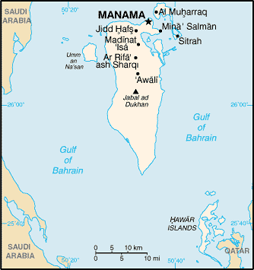
Bahrain is a
destination country for men and women trafficked for the purposes of forced
labor and commercial sexual exploitation. Men and women from India, Pakistan,
Nepal, Sri Lanka, Bangladesh, Indonesia, Thailand, the Philippines, Ethiopia,
and Eritrea migrate voluntarily to Bahrain to work as formal sector laborers
or domestic workers. Some, however, face conditions of involuntary servitude
after arriving in Bahrain, such as unlawful withholding of passports,
restrictions on movement, non-payment of wages, threats, and physical or
sexual abuse. - U.S. State Dept Trafficking in
Persons Report, June, 2009 Check out a later country
report here
or the full TIP Report here |
|
|||||||||||
|
CAUTION:
The following links have been culled from the web to
illuminate the situation in HOW TO USE THIS WEB-PAGE Students If you are looking
for material to use in a term-paper, you are advised to scan the postings on
this page and others to see which aspects of Human Trafficking are of
particular interest to you. Would you like to write about Forced-Labor? Debt
Bondage? Prostitution? Forced Begging? Child Soldiers? Sale of Organs? etc. On the other hand, you might choose to include
possible precursors of trafficking such as poverty.
There is a lot to the subject of Trafficking. Scan other countries as well.
Draw comparisons between activity in adjacent countries and/or regions.
Meanwhile, check out some of the Term-Paper resources
that are available on-line Teachers Check out some of
the Resources
for Teachers attached to this website. ***
FEATURED ARTICLES *** Confronting the Taboo
of Human Trafficking John Defterios, Khaleej Times
Online, 13 March 2009 www.cnn.com/CNNI/Programs/mme/blog/2009/03/horrific-traffic.html [accessed 18 August
2015] www.khaleejtimes.com/editorials-columns/confronting-the-taboo-of-human-trafficking [accessed 18 August
2015] Forty-year-old Suryavathi Rao fled the home of her employer that morning
shoeless with only a nightgown and bible to her name. The years of domestic labour have taken their toll. She could easily pass for
60 if not a few years older. After working 16 hours a day, seven days a week
for a year and a half, Suryavathi could not take it
anymore. She said through a
translator that her meagre salary of $108 a month had not been paid for six
months. She complained about not being fed meals and surviving on the
generosity of her neighbour another domestic worker
who pulled together leftovers to get by. Suryavathi
could not get through three sentences without breaking into tears. As a
result of her fleeing for protection, she has become a runaway worker with no
rights. Her employer holds her passport. The best she can hope for is to get
the passport back and hope that the shelter can give her enough money to buy
a ticket and fly home to Southern India. It is not that simple of course,
since back home Suryavathi fears she won't be
welcomed back due to her "failure" to send back money and keep a
job. This is the life of
a forced labourer and the complex world of human
trafficking. Technically, Suryavathi was not
trafficked. She had a sponsor agency that she paid $1100 to back in India and
is still charging here 5 per cent a month interest on the balance. But she
certainly did not expect slave like conditions when she arrived. Habib Toumi, Bureau Chief, Gulf News, February 13, 2007 [accessed 20 January
2011] LACK OF LEGISLATION - Around 270,000
foreigners out of total population of 710,000 live in Bahrain, whose economy
depends heavily on them. But the lack of comprehensive legislation on foreign
workers, mainly from Asia, who come to Bahrain to work as domestic servants
and in the construction industry often means that they have to put up with
physical abuse, sexual harassment, non-payment or delay in payment of salary
and long hours of work. "We want to use the workshop to increase
awareness, knowledge and understanding of the issue of exploitative labour and labour trafficking. ***
ARCHIVES *** 2023 Findings on
the Worst Forms of Child Labor U.S. Dept of Labor, Bureau of International Labor Affairs,
Child Labor and Forced Labor Reports www.dol.gov/agencies/ilab/resources/reports/child-labor/bahrain
[accessed 22
December 2024] Moderate Advancement - Note: Due to changes
in the trade preferential status of Bahrain in 2018, ILAB conducted no
further reports on the worst forms of child labor in Bahrain covering years
after 2017. In 2017, Bahrain
made a moderate advancement in efforts to eliminate child labor. The Labor Market
Regulatory Authority developed a handbook on the National Referral System for
Victims of Trafficking in Persons and opened a shelter for victims. It also
conducted training on human trafficking issues for all police officers.
Although research is limited, there is evidence that children in Bahrain
engage in child labor in domestic work and selling items on the street. The
government has not conducted research to determine the nature and extent of
child labor in the country. The law does not sufficiently prohibit commercial
sexual exploitation of children. 2020 Country
Reports on Human Rights Practices: Bahrain U.S. Dept of State Bureau of Democracy, Human Rights, and
Labor, 30 March 2021 www.state.gov/reports/2020-country-reports-on-human-rights-practices/bahrain/
[accessed 11 May
2021] PROHIBITION OF
FORCED OR COMPULSORY LABOR There were reports
of forced labor in the construction and service sectors. The labor law covers
foreign workers, except domestic workers, but enforcement was lax, and cases of
debt bondage were common. There were also reports of forced labor practices
among domestic workers and others working in the informal sector; labor laws
did not protect most of these workers. Domestic workers from third countries
have the right to see the terms included in their employment contract before
leaving their home countries, or upon arrival. The law requires domestic
contacts to be tripartite and to have the signature of the employer,
recruitment office, and employee. According to
reports by third-country labor officials and human rights organizations,
employers withheld passports, a practice prohibited by law, restricted
movement, substituted contracts, or did not pay wages; some employers also
threatened workers and subjected them to physical, psychological, and sexual
abuse. The Ministry of Labor and Social Development (Ministry of Labor)
reported 1,976 labor complaints from domestic workers and construction
workers, mostly of unpaid wages or denied vacation time. In August the
ministry reported that 16 workers were victims of forced labor during the
annual summer work ban. Authorities referred 27 companies to the courts for
alleged violations of the ban. PROHIBITION OF CHILD
LABOR AND MINIMUM AGE FOR EMPLOYMENT The law requires
that before the ministry makes a final decision on allowing a minor to work,
the prospective employer must present documentation from the minor's guardian
giving the minor permission to work; proof the minor underwent a physical
fitness examination to determine suitability; and assurance from the employer
the minor would not work in an environment the ministry deemed hazardous. The
government generally enforced the law with established mechanisms; however,
gaps exist within the operations of the Ministry of Labor that may hinder
adequate enforcement of their child labor laws. Freedom House
Country Report 2020 Edition freedomhouse.org/country/bahrain/freedom-world/2020 [accessed 19 March
2020] G4. DO INDIVIDUALS
ENJOY EQUALITY OF OPPORTUNITY AND FREEDOM FROM ECONOMIC EXPLOITATION? Migrant workers are
vulnerable to exploitation. Some employers subject them to forced labor and
withhold their salaries and passports, although this is illegal. The government
has taken steps to combat human trafficking in recent years, and has begun on
occasion to investigate and prosecute perpetrators. 2017 Findings on
the Worst Forms of Child Labor Office of Child
Labor, Forced Labor, and Human Trafficking, Bureau of International Labor
Affairs, US Dept of Labor, 2018 www.dol.gov/sites/default/files/documents/ilab/ChildLaborReport_Book.pdf [accessed 15 April
2019] www.dol.gov/sites/dolgov/files/ILAB/child_labor_reports/tda2017/ChildLaborReportBook.pdf [accessed 22 April
2020] Note:: Also check out this country's report in the more recent edition DOL
Worst Forms of Child Labor [page 133] The government has
established laws and regulations related to child labor (Table 4). However,
gaps exist in Bahrain's legal framework to adequately protect children from
the worst forms of child labor, including the prohibition of commercial
sexual exploitation of children. The minimum age protection
in the Labor Law does not apply to children in certain sectors, such as
domestic work. (7) The law does not
sufficiently prohibit commercial sexual exploitation because offering and
using children for prostitution and offering, procuring, and using children
for production of pornography and pornographic performances are not
criminally prohibited. (10; 11). Thai Sex Worker In
Bahrain Seeks To Extricate Friends Caught In Catch 22 Situation Pattaya Daily News,
02/05/2007 www.bahrainrights.org/en/node/1210 [accessed 20 January
2011] [accessed 20 January
2011] Uoom told the reporter
"I want to warn other women. If you were convinced by someone who promised
you a well-paid job in Bahrain, don't trust them. They will tell you of a
dream-like city, but what you'll face is like a hell." Cyber
sex sites spur vice probe Rebecca Torr, Gulf Daily News, August 15th, 2007 byshr.org/?p=56#more-56 [accessed 20 January
2011] A Human trafficking
victims failing to turn up Geoffrey bew, Gulf Daily News, August 08, 2007 www.gulf-daily-news.com/NewsDetails.aspx?storyid=189949 [accessed 20 January
2011] Migrant workers'
rights activists say they are helpless when it comes to assisting victims of
human trafficking in "Human
trafficking victims are of concern to us, but what can we do?" she told
the GDN. "We have no idea where these people are being held or whether
they have come here on their own free will. "We hope that these people
can somehow take advantage of the amnesty, but how we get to the victims is
the main thing." Her comments come after Thai Embassy officials said the
fear of arrest was preventing many of its people from taking part in the
amnesty. No
Human-Trafficking Problem in www.bna.bh/portal/en/news/413701?date=2011-04-15 [accessed 1
September 2011] Social development
minister Dr Fatima Al Balooshi
has rejected the idea of classifying Invisible victims
of trafficking Habib Toumi, Bureau Chief, Gulf News, November 3, 2006 gulfnews.com/news/gulf/bahrain/invisible-victims-of-trafficking-1.264267 [accessed 20 January
2011] gulfnews.com/world/gulf/bahrain/invisible-victims-of-trafficking-1.264267 [accessed 20 January
2011] "A significant
number of human beings, including women, are trafficked into Bahrain.
Unfortunately, their plight seems to remain unknown to significant parts of
Bahraini society, perhaps because the victims tend to be foreign nationals or
are considered to be of low social status," Sigma Huda, UN Special
Rapporteur on Human Trafficking, has said. The Bangladesh-born
lawyer said: "Bahrain's victims of trafficking are often invisible
victims because they suffer in places that remain hidden to the public eye,
such as private homes, hotel rooms or labour
camps." Reuters, Manama, Nov
1, 2006 www.bahrainrights.org/en/node/669 [accessed 20 January
2011] Huda said female domestic
workers, roughly 50,000 of Huda described
complaints of 14 to 16-hour working days, imprisonment in the home, the
confiscation of passports, deprivation from contacting home countries,
withholding pay, or being forced to steal food or eat scraps through lack of
meals. "Physical
abuse is also a problem. Some victims told me of incidents of severe and
traumatic abuse including mental and verbal abuse," she said, adding
that widely held racist and sexist attitudes contributed to the prevalence of
trafficking. Human trafficking
claimed Bahraini.TV, August
7, 2006 bahraini.tv/2006/08/07/human-trafficking-claimed/ [Last accessed 20
January 2011 - access is now restricted] A probe into
alleged human trafficking may be launched in relation to last week's Gudaibiya labour camp blaze, in
which 16 workers were killed. Indian Ambassador Balkrishna
Shetty has asked the Bahrain Foreign Ministry to investigate what he alleges
were violations of international laws against human trafficking. Islamic Clerics
Authorize Sex With Infants Excerpts from an
interview with Bahraini women's rights activist Ghada
Jamshir, Al-Arabiya TV, December 21, 2005 MEMRI.org,
FrontPageMagazine.com, January 4, 2006 archive.frontpagemag.com/readArticle.aspx?ARTID=6050 [accessed 20 January
2011] "The point is
not to have opposition from abroad. The point is for them to live and be
protected in a safe country. If a woman cannot get any protection in her
country, cannot get any protection from the courts, cannot get any protection
in the marital home - where will she go? Where will she go?" "All her life,
the woman is a prisoner in her own home. In the past, she would not go out to
work, or to study abroad. Very few women would go to university outside
Bahrain. She is at home in order to cook, sweep, and raise the children. How
will she get an education? There are women whose families are extremist. They
even force them to marry against their will. 2nd ID Seeks to
Curb Lap Dancing at Clubs Seth Robson, Stars
and Stripes, Pacific Edition, Camp Red Cloud, www.military.com/NewContent/0,13190,SS_012604_Lap,00.html [accessed 20 January
2011] www.stripes.com/news/2nd-id-seeks-to-curb-lap-dancing-at-clubs-1.15739 [accessed 4
September 2016] The crime often
involves women duped into moving to a foreign country, then forced to become
sex workers there. Greer said he learned about human trafficking after
meeting his Philippine wife when she was working in a South Korean nightclub.
"When I was
dating my wife, I found out her sister in Bahrain hadn't been paid in 10
months. She was working 16 hours a day, six days a week. Through many e-mails
and telephone calls we took this guy to court and he had to pay her and
return her to the Philippines," he said. Arms Trade Victoria Garcia,
Analyst, Center for Defense Information, March 31, 2004 At one time this
article had been archived and may possibly still be accessible [here] [accessed 4
September 2011] BACKGROUND - Although the
government has worked to advance human rights and improve citizens' ability
to change their government through more democratic means, the U.S. Department
of State notes several problems in the human rights area. While the
Constitution calls for an independent judiciary, courts are often subject to
government pressure and security forces are rarely tried for abusing their
power. The government limits the freedom of speech and of the press;
freedoms of assembly and association; and freedom of movement. Violence
and discrimination against women is common, as is discrimination based on
religion and ethnicity. Forced labor and human trafficking are also
problems. Ansar Burney Trust
Rescues Two More 'Child Camel Jockeys' in UAE At one time this
article had been archived and may possibly still be accessible [here] [accessed 4
September 2011] ANSAR BURNEY TRUST
RESCUES TWO MORE 'CHILD CAMEL JOCKEYS' IN UAE - The Ansar
Burney Welfare Trust International is the only human rights organisation working since last several years practically
against slave labour in Middle East and Arab
Countries to rescue the innocent children working as child camel jockeys in
very worst circumstances. It has rescued total 318 children in this current
year, 147 children on slave in UAE and 171 children from Qatar, Bahrain, Saudi Arabia, Muscat, Kuwait
and other parts of the Arab and Middle East countries and sent them back to
Bangladesh, Pakistan, Srilanka and other respective
countries for their rehabilitation. Agence France-Presse AFP, 16 June 2004 At one time this article
had been archived and may possibly still be accessible [here] [accessed 4
September 2011] The State
Department in its report observed that An estimated
10-20,000 women and girls are trafficked annually to India, Pakistan,
Bahrain, Kuwait and the United Arab Emirates (UAE). Human Rights
Overview by Human
Rights Watch - Defending Human Rights Worldwide www.hrw.org/middle-eastn-africa/bahrain [accessed 20 January
2011] ***
EARLIER EDITIONS OF SOME OF THE ABOVE *** Freedom House
Country Report 2018 Edition freedomhouse.org/country/bahrain/freedom-world/2018 [accessed 23 April
2020] G4. DO INDIVIDUALS
ENJOY EQUALITY OF OPPORTUNITY AND FREEDOM FROM ECONOMIC EXPLOITATION? Some employers
subject migrant workers to forced labor, and there are reports that abusers
withhold workers' documentation in order to prevent them from leaving or
reporting abuse to the authorities. The government has taken steps to combat
human trafficking in recent years, but efforts to investigate and prosecute
perpetrators remain weak. Bahrain rolled out a new "flexible" work
permit in July 2017 that would allow some expatriate workers to be their own
sponsors. However, the permit is prohibitively expensive for household
workers and laborers who have been historically exploited. 2017 Country
Reports on Human Rights Practices U.S. Dept of State Bureau of Democracy, Human Rights, and
Labor, 20 April 2018 www.state.gov/j/drl/rls/hrrpt/2017/nea/277237.htm
[accessed 16 March
2019] www.state.gov/reports/2017-country-reports-on-human-rights-practices/bahrain/ [accessed 24 June
2019] PROHIBITION OF
FORCED OR COMPULSORY LABOR The law prohibits
all forms of forced or compulsory labor except in national emergencies, but
the government did not always enforce the law effectively. There were reports
of forced labor in the construction and service sectors. The labor law covers
foreign workers, except domestic workers, but enforcement was lax, and cases
of debt bondage were common. There were also reports of forced labor
practices that occurred among domestic workers and others working in the
informal sector; labor laws did not protect most of these workers. Since 2012
domestic workers have the right to see their terms of employment. In many cases employers
withheld passports, restricted movement, substituted contracts, or did not
pay wages; some employers also threatened workers and subjected them to
physical and sexual abuse. The Ministry of Labor reported complaints from
domestic workers, mostly of unpaid wages. Human
Rights Reports » 2005 Country Reports on Human Rights Practices 2009-2017.state.gov/j/drl/rls/hrrpt/2005/61686.htm [accessed 6 February
2020] SECTION 6 WORKER
RIGHTS -
[c] Unskilled foreign workers can become indentured servants and often lacked
the knowledge to exercise their legal right to change employment. In numerous
instances, employers withheld salaries from their foreign workers for months
and even for years, and refused to grant them the necessary permission to
leave the country. The government and the courts generally worked to rectify
abuses if they were brought to their attention, but they otherwise focused
little attention on the problem. The fear of deportation or employer
retaliation prevented many foreign workers from making complaints to the
authorities. Labor laws do not
apply to domestic servants. There were numerous credible reports that
domestic servants, especially women, were forced to work 12‑ or 16‑hour
days, given little time off, were malnourished, and were subjected to verbal
and physical abuse, including sexual molestation and rape. Between 30 to 40
percent of the attempted suicide cases handled by the government's
psychiatric hospitals were foreign maids. It was estimated
that there were 50,000 foreign housemaids working in the country who are
predominantly of Sri Lankan, Indonesian, Indian, Bangladeshi and Filipino
origins. During the year, there were several incidents of seriously abused
housemaids reported in the press. Housemaids who have
no embassy representation in the country (Indonesian and Sri Lankan) are
often subject to the worst types of physical and sexual abuse. With no
diplomatic mission to protect them and no established victim assistance
shelter, runaway housemaids have often been returned by untrained police to
abusing employers. All
material used herein reproduced under the fair use exception of 17 USC § 107
for noncommercial, nonprofit, and educational use. PLEASE RESPECT COPYRIGHTS
OF COMPONENT ARTICLES. Cite this webpage as: Patt, Prof. Martin, "Human
Trafficking & Modern-day Slavery - |
||||||||||||