Human Trafficking & Modern-day Slavery Poverty drives the unsuspecting poor into the
hands of traffickers Published reports & articles from 2000 to 2025 gvnet.com/humantrafficking/Algeria.htm
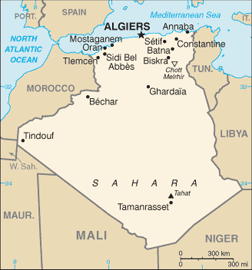
Algeria is a transit
country for men and women trafficked from sub-Saharan Africa to Europe for
the purposes of commercial sexual exploitation and forced labor. These men
and women enter Algeria, voluntarily but illegally, often with the assistance
of smugglers. Some of them become victims of trafficking; men are forced into
unskilled labor and women into prostitution to pay smuggling debts. Criminal
networks of sub-Saharan nationals in southern Algeria facilitate transit by
arranging transportation, forged documents, and promises of employment. Among
an estimated population of 5,000 to 9,000 illegal migrants, some 4,000 to
6,000 are believed to be victims of trafficking, of whom approximately 1,000
are women. - U.S. State Dept Trafficking in
Persons Report, June, 2009 Check out a later country
report here
or the full TIP Report here |
|||||||||||
|
CAUTION: The following links
have been culled from the web to illuminate the situation in HOW TO USE THIS WEB-PAGE Students If you are looking
for material to use in a term-paper, you are advised to scan the postings on
this page and others to see which aspects of Human Trafficking are of
particular interest to you. Would you
like to write about Forced-Labor? Debt
Bondage? Prostitution? Forced Begging? Child Soldiers? Sale of Organs? etc. On the other
hand, you might choose to include possible precursors of trafficking such as poverty. There is a lot to the subject
of Trafficking. Scan other countries
as well. Draw comparisons between
activity in adjacent countries and/or regions. Meanwhile, check out some of the Term-Paper resources
that are available on-line. Teachers Check out some of
the Resources
for Teachers attached to this website. ***
FEATURED ARTICLE *** Coalition Against
Trafficking in Women www.catwinternational.org/factbook/Algeria.php [accessed 18 January
2011] ORGANIZED AND
INSTITUTIONALIZED SEXUAL EXPLOITATION AND VIOLENCE - Algerian women
are raped, forced into prostitution and temporary marriages, beaten and
beheading for failure to wear head coverings by Islamic militants in ***
ARCHIVES *** 2023 Findings on
the Worst Forms of Child Labor U.S. Dept of Labor, Bureau of International Labor Affairs, Child
Labor and Forced Labor Reports www.dol.gov/agencies/ilab/resources/reports/child-labor/algeria
[accessed 19 December
2024] Moderate Advancement - In 2023, Algeria
made moderate advancement in efforts to eliminate the worst forms of child
labor. The National Authority for the Protection and Promotion of Children
launched a mobile phone application to enhance reporting on children in
abusive situations, including child labor. The government added eight new
schools in rural areas to improve education access. Additionally, in May
2023, a new law was enacted that provides increased penalties for using
children to obtain narcotics and psychotropics and
criminalizes the exploitation of children in the promotion of narcotics or psychotropics. Despite this endeavor, the law still does
not criminalize the production and trafficking of drugs. Gaps remain as the
involvement of children in either the production or trafficking of drugs is
not criminalized. In addition, the government has not determined by national
law or regulation the types of work that are hazardous for children.
Moreover, while the labor inspectorate is authorized to conduct inspections
in all workplaces, inspectors do not investigate some workplaces, such as
informal construction sites, in the absence of a complaint, resulting in instances
of child labor going undetected. 2020 Country
Reports on Human Rights Practices: Algeria U.S. Dept of State Bureau of Democracy, Human Rights, and
Labor, 30 March 2021 www.state.gov/reports/2020-country-reports-on-human-rights-practices/algeria/
[accessed 10 May
2021] PROHIBITION OF
FORCED OR COMPULSORY LABOR The law prohibits all forms of forced or compulsory labor. NGOs reported that irregular migrants sometimes worked in forced labor and that their lack of work permits made them more vulnerable to exploitation. For example, female migrants were subjected to debt bondage as they worked to repay smuggling debts through domestic servitude, forced begging, and forced prostitution. Designated penalties under this statute were not commensurate with penalties for kidnapping. Construction workers and domestic workers were reportedly vulnerable. The government did not effectively enforce the law. PROHIBITION OF CHILD
LABOR AND MINIMUM AGE FOR EMPLOYMENT Although specific data was unavailable, children reportedly worked mostly in the informal sales market, often in family businesses. There were isolated reports that children were subjected to commercial sexual exploitation. Freedom House
Country Report 2020 Edition freedomhouse.org/country/algeria/freedom-world/2020 [accessed 19 March
2020] G3. DO INDIVIDUALS
ENJOY PERSONAL SOCIAL FREEDOMS, INCLUDING CHOICE OF MARRIAGE PARTNER AND SIZE
OF FAMILY, PROTECTION FROM DOMESTIC VIOLENCE, AND CONTROL OVER APPEARANCE? Women do not enjoy equal
rights in marriage and divorce. Domestic violence is common, and the laws
against it are weak; for example, cases can be dropped if the victim forgives
the alleged abuser. Women’s rights groups report that between 100 and 200
women are killed in domestic abuse incidents each year. No law addresses
spousal rape. G4. DO INDIVIDUALS
ENJOY EQUALITY OF OPPORTUNITY AND FREEDOM FROM ECONOMIC EXPLOITATION? A 2009 law
criminalized all forms of trafficking in persons, and Algeria reported its
first conviction under the law in 2015. In recent years, the government has
made an effort to enforce the ban through prosecutions and has provided
protection for victims, though not systematically. Undocumented sub-Saharan
African migrants are particularly susceptible to racial discrimination, labor
exploitation, including through the practice of debt bondage, and sexual
exploitation. African Migrants
Report Torture, Slavery in Algeria Reuters, Dakar, 30
May 2018 www.voanews.com/a/african-migrants-torture-slavery-algeria/4416142.html [accessed 30 May
2018] Dozens of Africans
say they were sold for labor and trapped in slavery in Algeria in what aid agencies
fear may be a widening trend of abusing migrants headed for a new life in
Europe. Reuters heard
detailed accounts of forced labor and slavery from an international charity
and a local association in Agadez, Niger's main
migrant transit hub, and interviewed two of the victims by telephone. "The first time they sold me for
100,000 CFA francs ($170)," said Ousmane Bah,
a 21-year-old from Guinea who said he was sold twice in Algeria by unknown
captors and worked in construction.
"They took our passports. They hit us. We didn't eat. We didn't
drink," he told Reuters. "I was a slave for six months." Report on the Worst
Forms of Child Labour Compiled by the Global March
Against Child Labour [PDF] The Global March
Against Child Labour Resource Centre, 20 September
2004 beta.globalmarch.org/resourcecentre/world/algeria.pdf [accessed 28 August
2012] CHILD TRAFFICKING - There are
unconfirmed reports that young Algerian girls are trafficked to Commercial sexual
exploitation of children: The situation in the Middle East/ Based on the
situation analysis written by Dr Najat M’jid for the Arab-African
Forum against Commercial Sexual Exploitation, www.unicef.org/events/yokohama/backgound8.html [accessed 18 January
2011] FORM AND PREVALENCE
OF CSEC IN THE REGION
- Although statistics on CSEC inevitably understate the extent of the
problem, which is largely hidden and therefore impossible to measure, there
are some reliable figures on cases of CSEC that have been reported to law
enforcement entities. In 1999: v The Department of
Labor’s 2004 Findings on the Worst Forms of Child Labor www.dol.gov/ilab/media/reports/iclp/tda2004/algeria.htm [accessed 18 January
2011] Note:: Also check out this country’s report in the more recent edition DOL
Worst Forms of Child Labor INCIDENCE
AND NATURE OF CHILD LABOR - Although there were reports in the past that young
girls were kidnapped by terrorist groups and forced to work, there were no
reported terrorist abductions in 2004. CHILD
LABOR LAWS AND ENFORCEMENT - The Penal Code prohibits compulsory labor, including forced
or bonded labor by children. Article
342 of Ordinance 75-47 of June 1975 and Law No. 82-04 of February 13, 1982
prohibits the corruption and debauchery of minors younger than age 19, while
Article 343 and 344 prohibit the use and recruitment of minors in
prostitution. The Penal Code prohibits
the removal, arbitrary detention and kidnapping of a person, although is no
law specifically prohibiting trafficking in persons. Concluding
Observations of the Committee on the Rights of the Child (CRC) UN Convention on the
Rights of the Child, 30 September 2005 www1.umn.edu/humanrts/crc/algeria2005.html [accessed 10 January
2016] [78] The Committee expresses
its deep concern at the information that child prostitution is increasing and
that not only girls, but also boys who work as vendors, couriers or domestic
servants, are particularly vulnerable to sexual exploitation. The Committee
also notes with concern reports of trafficking in children and that Human Rights
Overview Human Rights Watch www.hrw.org/middle-eastn-africa/algeria [accessed 3
September 2011] ***
EARLIER EDITIONS OF SOME OF THE ABOVE *** Freedom
House Country Report - Political Rights: 6 Civil Liberties: 5 Status: Not Free 2018 freedomhouse.org/country/algeria/freedom-world/2018 [accessed 22 April
2020] G4. DO INDIVIDUALS ENJOY
EQUALITY OF OPPORTUNITY AND FREEDOM FROM ECONOMIC EXPLOITATION? A 2009 law
criminalized all forms of trafficking in persons, and Algeria reported its
first ever conviction under the law in 2015. In recent years, the government
has made an effort to enforce the ban through prosecutions and has provided
protections for the victims, though not systematically. Undocumented
sub-Saharan migrants are particularly susceptible to exploitation by
traffickers. 2017 Country
Reports on Human Rights Practices U.S. Dept of State Bureau of Democracy, Human Rights, and
Labor, 20 April 2018 www.state.gov/j/drl/rls/hrrpt/2017/nea/277235.htm
[accessed 12 March
2019] www.state.gov/reports/2017-country-reports-on-human-rights-practices/algeria/
[accessed 24 June
2019] PROHIBITION OF
FORCED OR COMPULSORY LABOR The law prohibits
all forms of forced or compulsory labor. NGOs reported that irregular migrants
sometimes worked in forced labor and that their lack of work permits made
them more vulnerable to exploitation. For example, female migrants were
subjected to debt bondage as they worked to repay smuggling debts through
domestic servitude, forced begging, and forced prostitution. Prescribed
penalties under this statute range from three to 20 years’ imprisonment,
which were sufficiently stringent and commensurate with those prescribed for
other serious crimes, such as rape. Construction workers and domestic workers
were reportedly vulnerable. The government increased efforts to investigate
and prosecute trafficking offenders and to identify and provide protection
services to trafficking victims, including those subject to forced labor. Human
Rights Reports » 2005 Country Reports on Human Rights Practices 2009-2017.state.gov/j/drl/rls/hrrpt/2005/61685.htm [accessed 4 February
2020] TRAFFICKING
IN PERSONS
–According to media reports and a local NGO, forced prostitution and domestic
servitude of illegal immigrants from West Africa occurred as immigrants
transited through the country seeking economic opportunity in All
material used herein reproduced under the fair use exception of 17 USC § 107
for noncommercial, nonprofit, and educational use. PLEASE RESPECT COPYRIGHTS OF COMPONENT
ARTICLES. Cite this webpage as: Patt,
Prof. Martin, "Human Trafficking & Modern-day Slavery - |