Human Trafficking & Modern-day Slavery Poverty drives the unsuspecting poor into the
hands of traffickers Published reports & articles from 2000 to 2025 gvnet.com/humantrafficking/Albania.htm
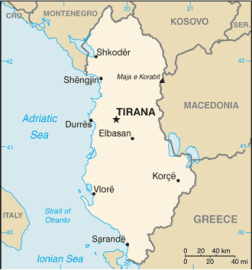
Albania is a source country for men, women, and children trafficked for
the purposes of sexual exploitation and forced labor, including forced
begging. Albanian victims are trafficked primarily to Greece, and also to
Italy, Macedonia, Kosovo, Spain, France, the U.K. and other Western European
countries, as well as within Albania. Available data indicate that more than
half the victims of trafficking are under the age of 18. - U.S. State Dept
Trafficking in Persons Report, June, 2009
Check out
a later country report here
or the full TIP Report here |
|||||||||||
|
CAUTION: The following
links have been culled from the web to illuminate the situation in
Albania. Some of these links may lead to
websites that present allegations that are unsubstantiated or even
false. No attempt has been made to
verify their authenticity or to validate their content. HOW TO USE THIS WEB-PAGE Students If you are looking for
material to use in a term-paper, you are advised to scan the postings on this
page and others to see which aspects of Human Trafficking are of particular
interest to you. Would you like to
write about Forced-Labor? Debt
Bondage? Prostitution? Forced Begging? Child Soldiers? Sale of Organs? etc. On the other
hand, you might choose to include possible precursors of trafficking such as poverty. There is a lot to the
subject of Trafficking. Scan other
countries as well. Draw comparisons
between activity in adjacent countries and/or regions. Meanwhile, check out some of the Term-Paper resources
that are available on-line Teachers Check out some of
the Resources
for Teachers attached to this website. HELP for Victims Ministry
of Interior (in cooperation with International Organization for
Migration and UN Office on Drugs and Crime) ***
FEATURED ARTICLE *** Help the Children Information and
Research Centre for Children's Rights in Albania, Newsletter 224, June 5,2004 At one time this article
had been archived and may possibly still be accessible [here] [accessed 3
September 2011] www.slobodan-milosevic.org/news/aot050208.htm [accessed 22 April
2020] [scroll down] THE EUROPEAN
PARLIAMENT DISCUSSES THE ORGAN TRANSPLANTS IN ALBANIA - According to
these articles, a clinic in Fieri city, practices the removal of the children
organs to further transport them in Italy and France, with involvement by
Italian and French groups and individuals», writes Karamanu
in her letter. «According to the media, these doctors mobilise
Albanian networks, which pay the children’s parents whose organs are removed.
Apart form this, figures
report 39 missing children with no trace in Albania and their parents making
no effort to find them. For Albanians, It's
Come to This: A Son for a TV Nicholas Wood, The
New York Times, Durres, Albania, November 13, 2003 www.essex.ac.uk/armedcon/story_id/000159.html [accessed 18 January
2011] www.nytimes.com/2003/11/13/world/for-albanians-it-s-come-to-this-a-son-for-a-tv.html [accessed 10 May
2021] Fatmira Bonjaku's husband is in jail, accused by the police of
selling their 3-year-old son to an Italian man in return for the television
set that six other children watch in the family's dimly lighted room. The
police also say her husband had plans to sell their newest born, whom she is
breast feeding. Over the past 12
years, since the collapse of Stalinism here, a substantial trade in children
has established itself in Albania, Europe's most impoverished and long most
isolated country. ***
ARCHIVES *** 2023 Findings on
the Worst Forms of Child Labor U.S. Dept of Labor, Bureau of International Labor Affairs,
Child Labor and Forced Labor Reports www.dol.gov/agencies/ilab/resources/reports/child-labor/albania
[accessed 17
December 2024] Moderate Advancement - In 2023, Albania
made moderate advancement in efforts to eliminate the worst forms of child
labor. The government published its first Victims' Protection Strategy
2024–2030 to strengthen protection mechanisms and social services for
survivors of worst forms of child labor, thereby fulfilling one of its
obligations as a European Union candidate country. The State Agency for the
Protections and Rights of Children also continued to provide child protection
workers, government social services providers, and other stakeholders with
regular trainings and case management plans for the most vulnerable
populations of children. Additionally, the Ministry of Economy, Culture, and
Innovation collaborated with the United Nations Development Program and the
United Nations Children's Fund to adapt the National Youth Guarantee Scheme
in three major municipalities to provide vocational training and additional
education for economically vulnerable children and youth. The National Youth
Agency also provided support for new youth centers, which provide educational
resources and digital skills training for at-risk youth. However, Albania's
legal framework does not explicitly prohibit using, procuring, or offering
children for illicit activities. In addition, children from Roma and Balkan
Egyptian minority communities, children with disabilities, and refugees and
displaced migrant children face significant barriers to education access in
the country. 2020 Country
Reports on Human Rights Practices: Albania U.S. Dept of State Bureau of Democracy, Human Rights, and
Labor, 30 March 2021 www.state.gov/reports/2020-country-reports-on-human-rights-practices/albania/
[accessed 10 May
2021] PROHIBITION OF
FORCED OR COMPULSORY LABOR Some law
enforcement organizations and the victim advocates at the prosecutors’
offices received training in a victim-centered approach to victims of human
trafficking. The government continued to identify victims of forced labor and
prosecuted and convicted a small number of traffickers. The Labor
Inspectorate reported no cases of forced labor in the formal sector during
the year. See section 7.c. for cases involving children in forced labor in
the informal sector. PROHIBITION OF CHILD
LABOR AND MINIMUM AGE FOR EMPLOYMENT Labor inspectors
investigated the formal labor sector, whereas most child labor occurred in
the informal sector. Children engaged in gathering recyclable metals and
plastic, small-scale agricultural harvesting, selling small goods in the
informal sector, serving drinks and food in bars and restaurants, the
clothing industry, and mining. There were reports that children worked as
shop vendors, vehicle washers, textile factory workers, or shoeshine boys.
There were isolated reports of children subjected to forced labor in cannabis
fields in 2019. The number of children engaged in street-related activities
(such as begging or selling items) increased during the summer, particularly
around tourist areas. Children were
subjected to forced begging and criminal activity. Some of the children
begging on the street were second- or third-generation beggars. Research
suggested that begging started as early as the age of four or five. While the
law prohibits the exploitation of children for begging, police generally did
not enforce it, although they made greater efforts to do so during the year. Freedom House
Country Report 2020 Edition freedomhouse.org/country/albania/freedom-world/2020 [accessed 23 July
2020] G4. DO INDIVIDUALS
ENJOY EQUALITY OF OPPORTUNITY AND FREEDOM FROM ECONOMIC EXPLOITATION? Albania has relatively
robust labor laws, but lacks the capacity to enforce workplace safety and
other protections. Conditions in the manufacturing, construction, and mining
sectors are often substandard and put workers at risk. While Albania
continues to struggle with human trafficking, authorities are becoming more
proactive in addressing the issue, with the US State Department’s 2019
Trafficking in Persons Report noting additional funding for victim
coordinators and the adoption of a 2018–20 action plan. However, the
department also warned that funding for shelters managed by NGOs was delayed
during the reporting period. 2017 Findings on
the Worst Forms of Child Labor Office of Child
Labor, Forced Labor, and Human Trafficking, Bureau of International Labor Affairs,
US Dept of Labor, 2018 www.dol.gov/sites/default/files/documents/ilab/ChildLaborReport_Book.pdf [accessed 15 April
2019] www.dol.gov/sites/dolgov/files/ILAB/child_labor_reports/tda2018/ChildLaborReportBook.pdf [accessed 22 April
2020] Note:: Also check out this country’s report in the more recent
edition DOL
Worst Forms of Child Labor [page 114] Children are
trafficked internally in Albania and abroad to neighboring and EU countries
for commercial sexual exploitation and forced labor, including forced
begging. (23; 27; 28; 9) Internal child trafficking and forced begging have
increased in recent years, particularly during the tourist season. (23; 26;
27; 28) Street children, especially those from Egyptian and Roma communities,
are incredibly vulnerable to becoming victims of human trafficking. (2; 3;
29; 30) In addition,
children in Albania informally collect chromium around the mines where debris
from mine tunnels is found, and sometimes carry heavy rocks for miles. (16; 7;
17; 8; 19; 20) The work is not coerced, and parents are aware that their
children collect chromium. (8). "Vulnerability'
To Human Trafficking: A Study Of Viet Nam, Albania, Nigeria And The UK Patricia Hynes,
Report of Shared Learning Event held in Tirana, Albania: 24-26 October 2017 [Long URL] [accessed 13
February 2022] This report
describes the first stages of an ethically-led, two-year research study into
understanding the causes, dynamics and ‘vulnerabilities’ to and resilience
against human trafficking in three source countries– Albania, Viet Nam and
Nigeria – plus the support needs of people from these countries who have
experienced trafficking when identified as potential ‘victims’ of trafficking
in the UK. The Story of E.R. True Stories,
Anti-Trafficking Educational Curriculum, Association of Albanian Girls and
Women - AAGW www.twitlonger.com/show/f8udar
[accessed 23 July
2013] "My name is
E.R. and I am from Elbasan. When I was 15, my parents married me, against my
will, to a man aged 35, whom I did not love. So started my miseries. Not too long afterwards, I abandoned him
and returned to my family. But my parents did not accept me back because I
had dishonored them by leaving my husband. I had no support and nowhere to
go. I got acquainted with a boy who was 20 who said he loved me and promised
to marry me. He convinced me to go to Italy for 'a better life.' I thought my sufferings now were at an
end, but I did not know the real hell that was expecting me. I was compelled
to work on the street. I did so for nearly three years. My exploiter savagely
battered me frequently, mainly when I did not bring home the required sum or
when he faced drug trafficking problems. Trafficking In
Human Beings: Paradigms Of A Successful Reintegration Into Society (Albanian
Case) Ervin Muco, Ph.D., Universiteti i Tiranes, European Scientific
Journal February 2013 edition vol.9, No.4 ISSN: 1857 – 7881 (Print) e-ISSN
1857-7431 [Long URL] [accessed 16
February 2022] The phenomenon of
human trafficking in Albania has its origins after 1990 with the change of
political system in Albania. Driven by the desire for a better lifestyle
Albanian citizens began to immigrate to different countries of the world and
a part of them will fall prey to organized crime networks. Among the factors
that led to the birth and growth of human trafficking in Albania were: high
levels of corruption in the justice system, lack of information, reduction of
the system of values, the strong links between criminal groups and politics,
low education level, weakening of the role of state in preserving order and
management of borders, geographical position between East and West, economic
hardship, lack of legislation. Replenish rock band
see “evils of human trafficking” in Albania Inspire Magazine www.inspiremagazine.org.uk/news.aspx?action=view&id=931 [accessed 18 January
2011] During the five-day
trip, Ross Gill, Harun Kotch and Darren Lewis from the band Replenish met
women and children who had been victims of trafficking, including Nazire*, a young woman who had been abducted at
knifepoint and trafficked to Greece, where she was forced into prostitution. Nazire’s family was later able to secure her release but
because she reported her kidnappers to the police, she and her family live in
constant fear of reprisals. Training Roma to
combat human trafficking Council of Europe
Press Division, October 31, 2006 wcd.coe.int/wcd/ViewDoc.jsp?id=1056663 [accessed 1
September 2011 Through a
contribution of the Norwegian and Finnish governments, the Council of Europe
is organising training courses to prevent human
trafficking of Roma from Albania, Moldova and Slovakia. Albanian PM:
government has aided human trafficking Serbianna News, Tirana, June
26, 2006 www.serbianna.com/news/2006/01925.shtml [accessed 18 April
2012] Widespread
corruption in Albania's judicial system and government has exacerbated the
country's human trafficking problem, Prime Minister Sali
Berisha acknowledged on Monday, and criticized law
enforcement authorities for not tackling the problem adequately. Authorities arrest
80 mobsters operating between Italy and Albania AP Worldstream, Rome, 12-13-2005 www.highbeam.com/doc/1P1-116351378.html [partially accessed
18 January 2011 - access restricted] Carabinieri in the Calabrian
town of Catanzaro said the 'ndrangheta allowed the
forced prostitution of girls from Eastern Europe in exchange for arms and
drugs imported from Albania. Dozens of
the girls had been sold by their families, seized, or lured with promises of
work or marriage, and had mostly crossed to Italy from Albania on clandestine
boat trips, a police statement said UN Special
Rapporteur ends visit to Albania Child Rights
Information Network CRIN, Press release published by the SR, Jean-Miguel
Petit, following his visit to Albania, 31 October - 7 November 2005 www.crin.org/en/library/news-archive/special-rapporteur-sale-children-child-prostitution-and-child-pornography [accessed 10 January
2016] In the area of
child trafficking, Albania has several achievements to report: the
legislative and policy frameworks are in place; there is more awareness in
society; the police is better trained to deal and investigate this crime; border
control improved; the establishment of the court of serious crimes and the
prosecutors' office for serious crimes increased the prosecution capacity;
NGOs gained a valuable expertise in delivering rehabilitation programs for
victims of trafficking and in providing social services to communities. All
this did not exist 5 years ago. They are important achievements. UN expert fighting
sex trafficking calls for child protection system in Albania UN News Centre,
November 8, 2005 www.un.org/apps/news/story.asp?NewsID=16480&Cr=albania&Cr1 [accessed 18 January
2011] The new Government
of Albania has improved the legal framework necessary to reduce the flow of
trafficked children, but it must develop a national child protection system
aimed at combating the poverty that drives exploitation, a United Nations
human rights expert said after completing his visit to the
Balkan country. Balkans Urged To
Curb Trafficking Imogen Foulkes, BBC
News, Geneva, March 31, 2005 news.bbc.co.uk/2/hi/europe/4397497.stm [accessed 18 January
2011] Countries in
South-East Europe are failing to take effective measures against people
trafficking, the United Nations Children's Fund (UNICEF) says. A UNICEF report says that while countries
in the region have strict anti-trafficking laws they do not tackle the root
causes of the problem. Children of the
Stoplights Discarded Lies,
Winds of Change.NET, January 14, 2005 www.windsofchange.net/archives/006160.html [accessed 18 January
2011] The Greek
government estimates that there are some 3,000 unaccompanied Albanian
children in the country, with more coming during the summer months. In oral
evidence about the trafficking of Albanian children to Greece, given to the
Commission on Human Rights, Terre des Hommes representative Eylay Kadjar-Hamouda said, “A
child earns a minimum of €30-€50 per day and gives all the money to his boss.
A very small percentage is sent back to his family in Albania but in a very
irregular way. Albanian State
Should Collaborate With NGOS Rrezearta Ago, OneWorld Southeast Europe, February 10, 2005 At one time this
article had been archived and may possibly still be accessible [here] Helga Konrad, OSCE
Trafficking Representative, has declared that Albania is still far from
fulfilling the standards and requirements of the European Union related to
human trafficking, which remains at a high level. That means that not only a plan compiled by
the Government is needed, but also concrete steps towards its implementation. Human Rights in
Republic of Albania Amnesty
International Report 2007 www.amnesty.org/en/region/albania/report-2007 [accessed 18 January
2011] TRAFFICKING - Despite
increased, and to some extent successful, measures to counter trafficking,
Albania continued to be a source country for the trafficking of women, often
minors, for sexual exploitation. Children, many of them Roma, continued to be
trafficked to be exploited as beggars, for cheap labour,
crime or for adoption. According to official statistics, in the first six
months of the year, 119 criminal proceedings were registered with the Serious
Crimes Prosecutor's Office relating to charges of trafficking women for
prostitution, and five to charges of trafficking children. – htcp Human Rights Watch
World Report 2003 - Events of 2002 www.hrw.org/legacy/wr2k3/europe1.html [accessed
18 January 2011] ALBANIA
- HUMAN RIGHTS DEVELOPMENTS - Progress notwithstanding, there remain
many obstacles to the implementation of the government’s anti-trafficking
strategy. Particularly problematic is the government’s reluctance to
recognize that Albania is a major country of origin. Prosecution of
traffickers is the weakest link in the system: only a small fraction of those
arrested by the police were successfully prosecuted and tried. Even when
traffickers are found guilty, they received prison sentences that were
generally much lower than the new statutory minimum of seven years. Police
corruption and the absence of a witness protection system also hinder
investigations. Child Trafficking
in EU countries [PDF] www.stopchildtrafficking.org/site/uploads/media/english/EU.pdf [access date
unavailable] In Italy the organisation Save the Children counted 7823 unaccompanied
children between June 2000 and November 2001, almost 4000 of them from
Albania, followed by children from Morocco and Romania. In July 2002 the
Albanian government reported 6075 unaccompanied children in the neighbouring states (3971 in Italy and 1730 in Greece).
According to the police at least 2800 of these children were being exploited
as drug couriers, thieves or prostitutes. Trafficked children
in Greece mainly come from Albania, but also from Bulgaria and the former
Yugoslavia. For some time now they have also been coming from Iraq. - htsc Italy Human Rights
Report NetCent Communications NCBuy Home : Reference Center : Country : Italy : Human
Rights -- Data Source: US Department of State Bureau of Consular Affairs www.ncbuy.com/reference/country/humanrights.html?code=it&sec=6f [accessed 18 January
2011] [6f] TRAFFICKING IN
PERSONS
- Police and prosecutorial investigations, focusing on traffickers who
smuggled young women from Albania,
Bulgaria, Romania, Ukraine, Moldova, and China and forced them into
prostitution, resulted in the arrests of almost 200 citizens and foreign
nationals. ..... By September, police had arrested 18 people on charges of
exploitation and alien smuggling for trafficking at least 67 children from Albania to Italy for sale to
childless couples. Child trafficking
in eastern Europe: A trade in human misery Richard Tyler, World
Socialist Web Site, October 25, 2003 www.wsws.org/articles/2003/oct2003/traf-o25.shtml [accessed 18 January
2011] International
federation Terre des Hommes estimates that 6,000 children between the ages of
12 and 16 are trafficked from eastern Europe each year, with more than 650
being forced to work as sex slaves in Italy. The price of a girl trafficked
to Italy can be between $2,500 and $4,000, with up to $10,000 being paid if
she is a virgin. According to the French human rights organisation,
Albania is the county most involved in the sex trade, with women and children
being lured to go to the West with false promises of marriage, jobs or education.
When they get there, there is no husband, no job and no education. Alone in a
foreign land without any means of support, violence and coercion ensure they
are soon earning money for their new “owners.” Sex and slavery John Gibb, The
Observer, February 23, 2003 www.guardian.co.uk/theobserver/2003/feb/23/features.magazine67 [accessed 18 January
2011] Police estimate
that 10,000 illegal immigrants are working as prostitutes in Britain today.
Many are from Eastern Europe, brought here by ruthless Balkan pimps who sell
them into a life of enforced vice for as little as £150. Dying to Leave Thirteen, New York
Public Media, September 25th, 2003 www.pbs.org/wnet/wideangle/episodes/dying-to-leave/human-trafficking-worldwide/albania/1447/ [accessed 18 January
2011] www.pbs.org/wnet/wideangle/uncategorized/human-trafficking-worldwide-albania/1447/ [accessed 18
February 2018] VICTIMS - Albania not only
supplies women and girls for the international sex trade, but also acts as a
major hub through which women from countries further East are taken to Western
European markets. Albanian women and girls are either lured by false promises
of marriage or offers of legitimate employment or kidnapped to work as
prostitutes. Ranging in age from 14 to 35, girls trafficked from Albania are
among the youngest victims worldwide, with as many as 80 percent of them
younger than 18, according to a 2000 Save the Children report. They are
brought to work primarily in Italy as street prostitutes, the most dangerous
and unpredictable form of prostitution. Some Albanian girls are trafficked to
other countries such as Belgium, Greece, the Netherlands, and the United
Kingdom. In Italy, according to a 2001 Save the Children report, Albanian
pimps reportedly expect their teen-aged prostitutes to earn between $200-$550 a night. Most of the women never receive
a cut of the money they make. Foreign women and
girls, the majority of whom are from Moldova and Romania, are also trafficked
through Albania for sexual exploitation. Brought in via Romania, Serbia,
Montenegro, or Macedonia, they are bought and sold in Albania before being
sent to the port cities of Durres or Vlora for
passage to Italy. Albanian children,
both boys and girls, are trafficked to Greece and Italy to beg, wash car
windows, and deal in drugs. Most of those trafficked come from Albania’s
ethnic Roma minority, a traditionally disadvantaged group. Often in exchange
for a monthly stipend, very poor families give their children to traffickers,
who take them across the border to Greece by foot or by boat to Italy to work
as forced laborers. The children’s parents only receive a small fraction of
what they earn, which may average almost $1,000 per month, according to the
2001 Save the Children report “Child Trafficking in Albania.” A smuggler’s
paradise
- There’s
money to be made on the roads of southeastern Europe. David Binder,
msnbc.com, May, 2002 www.msnbc.msn.com/id/3071968/ [accessed 18 January
2011] www.nbcnews.com/id/3071968/ns/us_news-only/t/smugglers-paradise/ [accessed 22 April
2020] [scroll down] On a broad plain
south of Tuzi lies a sprawling, ramshackle refugee
camp next to the huge city dump. Traffickers in sex slaves hold girls
kidnapped from as far away as Romania here before they are shipped across the
Adriatic to Italy, according to the Albanian Interior Ministry. Concluding Observations of the Committee on the Rights of the Child (CRC) UN Convention on the
Rights of the Child, 28 January 2005 sim.law.uu.nl/SIM/CaseLaw/uncom.nsf/0/10c1b349cbae3e05c1256fa4004ac5b2?OpenDocument [accessed 18 January
2011] [70] The Committee
notes the concerns expressed by the State party at the extent of the problem
of sexual exploitation of children in Albania. It also welcomes the measures
taken by the State party to combat trafficking in children, such as the
establishment of an anti-trafficking centre in Vlora. However, the Committee notes with concern that the
sale of children is not criminalized in domestic legislation, that children
reportedly continue to be trafficked, in particular to Italy and Greece, and
considers that additional efforts must be vigorously pursued to combat this
persistent phenomenon. Human Rights
Overview by Human
Rights Watch – Defending Human Rights Worldwide www.hrw.org/europecentral-asia/albania [accessed 18 January
2011] ***
EARLIER EDITIONS OF SOME OF THE ABOVE *** 2017 Country
Reports on Human Rights Practices U.S. Dept of State Bureau of Democracy, Human Rights, and
Labor, 20 April 2018 www.state.gov/j/drl/rls/hrrpt/2017/eur/277133.htm [accessed 12 March
2019] www.state.gov/reports/2017-country-reports-on-human-rights-practices/albania/ [accessed 24 June
2019] PROHIBITION OF
FORCED OR COMPULSORY LABOR The law prohibits
all forms of forced or compulsory labor, but the government did not always
effectively enforce the law. Lack of coordination among ministries and the
sporadic nature of implementation of standard operating procedures hampered
enforcement. Penalties of eight to 15 years in prison were sufficiently
stringent to deter violations, but they were seldom enforced. Law enforcement
organizations trained their officers to adopt a victim-centered approach to
human trafficking. The government continued to identify trafficking victims
but prosecuted and convicted a small number of traffickers. The Office of the
National Antitrafficking Coordinator increased
government efforts to prevent trafficking through awareness activities. PROHIBITION OF CHILD
LABOR AND MINIMUM AGE FOR EMPLOYMENT The law
criminalizes exploitation of children for labor or forced services, but the
government did not enforce the law effectively. The SILSS monitored for cases
of child labor and other labor malpractices, but insufficient human resources
limited its activities. There were reports that child laborers worked as
street or shop vendors, beggars, farmers, shepherds, drug runners, vehicle
washers, textile factory workers, miners, or shoeshine boys. Some of the
children begging on the street were second- or third-generation beggars.
Research suggested that begging started as early as the age of four or five.
While the law prohibits the exploitation of children for begging, police
generally did not enforce it, although they made greater efforts to do so
during the year. Human
Rights Reports » 2006 Country Reports on Human Rights Practices U.S. Dept of State Bureau of Democracy, Human Rights, and
Labor, March 6, 2007 2009-2017.state.gov/j/drl/rls/hrrpt/2006/78797.htm [accessed 17 March
2020] WOMEN
- Many
communities, particularly those from the northeastern part of the country,
still followed the traditional code--the kanun--under
which, according to some interpretations, women are considered to be, and
were treated as, chattel. Some interpretations of the kanun
dictate that a woman's duty is to serve her husband and to be subordinate to
him in all matters. Human
Rights Reports » 2005 Country Reports on Human Rights Practices 2009-2017.state.gov/j/drl/rls/hrrpt/2005/61633.htm [accessed 4 February
2020] TRAFFICKING
IN PERSONS
– Internal trafficking increased during the year. TdH
identified and assisted 126 trafficked children, approximately 53 of whom
were internally trafficked. Children were generally trafficked for forced
begging or sexual exploitation. Roma and Egyptian communities were
particularly vulnerable due to poverty and illiteracy. In a few cases
children were bought from families or kidnapped, reportedly for begging or
working abroad. According to TdH, children, mostly
from Romani and Egyptian communities, were increasingly trafficked for
begging by their parents without the involvement of a third party. The main forms of
recruitment involved marriage under false pretenses or false promises of
marriage to lure victims abroad for sexual exploitation. Due to the poor
economic situation, men and women from organized criminal groups also lured
many women and girls from all over the country by promising them jobs in
Italy and Greece. Traffickers typically confiscated victims' documents,
physically and sexually abused them, and sometimes forced them to work as
prostitutes before they left the country. Both citizens and foreign women
trafficked by domestic organized crime networks were abused, tortured, and
raped. Traffickers also threatened many of the victims' family members. To a
lesser extent, family members of neighbors sold victims—particularly Romani
children—to traffickers or traffickers kidnapped children, including from
orphanages The Department of
Labor’s 2004 Findings on the Worst Forms of Child Labor U.S. Dept of Labor Bureau of International Labor Affairs, 2005 www.dol.gov/ilab/media/reports/iclp/tda2004/albania.htm [accessed 18 January
2011] Note:: Also check out this country’s report in the more recent
edition DOL
Worst Forms of Child Labor INCIDENCE
AND NATURE OF CHILD LABOR - The trafficking of Albanian children as young as 6
years old to Western Europe for prostitution and other forms of exploitive
labor remains a problem. The Ministry
of Public Order estimated that within an 8-year period (1992-2000), some
4,000 children were trafficked from Albania, mostly for domestic work, begging
and agriculture. A 2003 study of
trafficking victims who received services at the “Hearth” Psycho-Social
Center revealed that 21 percent were minors between the ages of 14 and 18
years. Boys and girls are trafficked
to Italy and Greece to participate in organized begging rings and forced
labor, including work in agriculture and construction. In January 2003, Terre des hommes reported
that the majority of children trafficked to Greece were sent with their
family's knowledge to work for remuneration. In addition, the report
found that 95 percent of children trafficked belong to the Roma ethnic
minority or the “Egyptian” community.
There have been reports that children are tricked or abducted from
families or orphanages and then sold to prostitution or pedophilia
rings. Children who are returned to
the Albanian border from Greece are oftentimes at high risk of being
re-trafficked. According to the 2003
Terre des hommes report, trafficking of Albanian children specifically to
Greece appears to be on a decline.
Internal trafficking, on the other hand, is reported to be rising,
with increasing numbers of children in the capital of Tirana falling victim
to prostitution and other forms of exploitation. All
material used herein reproduced under the fair use exception of 17 USC § 107
for noncommercial, nonprofit, and educational use. PLEASE RESPECT COPYRIGHTS OF COMPONENT
ARTICLES. Cite this webpage as: Patt,
Prof. Martin, "Human Trafficking & Modern-day Slavery -
Albania", http://gvnet.com/humantrafficking/Albania.htm, [accessed
<date>] |